
On this page
Start here
Quick answer
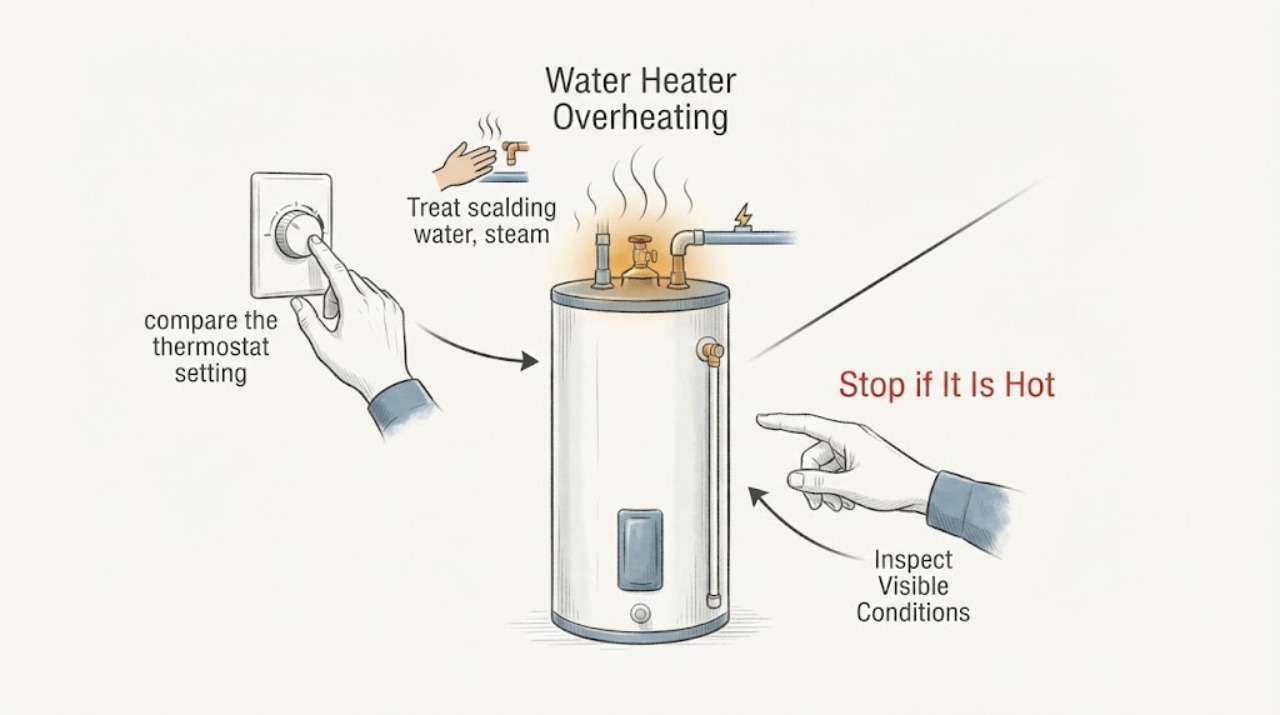
Treat dangerously hot water or a large temperature-and-pressure relief discharge as an emergency stop condition. Compare the thermostat with the manufacturer’s safe setting only from a safe position; normal settings with continued overheating, repeated high-limit trips, or relief discharge require qualified service.
Work through in order
Diagnostic checks
Use only checks that match the exact appliance or system and its official guide.
-
Check 1
Treat scalding water, steam, or a large T&P discharge as an immediate stop condition; keep people away and do not touch the tank or relief pipe.
Expected result: Water is dangerously hot, the T&P pipe releases a large amount, or there is smoke, leaking, or a burning electrical smell.
Next step: Turn off energy at the appropriate safe disconnect if accessible without contact with hot/wet parts and call qualified water-heater service.
Why this matters
Why: Excessive temperature can cause severe burns and may indicate thermostat/element failure; the relief system must remain unobstructed.
-
Check 2
If water is simply hotter than expected and there is no active discharge, compare the thermostat setting with the manufacturer’s normal setting and check point-of-use mixing protection.
Expected result: The thermostat is set too high, settings are normal, or a mixing valve is absent/failed.
Next step: Do not adjust beyond the manual’s safe range; use a qualified plumber for mixing-valve or control work.
Why this matters
Why: A high setting can explain hot water; normal settings with excessive temperature shift suspicion to thermostat, element, or control fault.
-
Check 3
Observe whether the high-limit/ECO or relief device has tripped or discharged, without removing covers or testing live wiring.
Expected result: The safety device trips again, the relief valve discharges, or no safety event is visible but water remains too hot.
Next step: Do not reset repeatedly or cap the T&P pipe; arrange qualified service.
Why this matters
Why: Repeated safety trips or relief discharge support an uncontrolled heating condition that needs professional diagnosis.
Use your observations
Decision map
Find the observation that best matches what you see, then follow the next safe action.
-
PATH 01Next step
What you see
The thermostat is set high and water temperature returns to normal after a safe adjustment.
Do this next
Monitor temperatures and follow the exact manual for final settings.
Why this path and its safety boundary
Why it matters: The setting was likely the cause, though scald protection remains necessary.
-
PATH 02Next step
What you see
Water remains dangerously hot at a normal setting, or the T&P valve discharges heavily.
Do this next
Keep the relief path clear and obtain urgent qualified service.
Why this path and its safety boundary
Why it matters: A thermostat, heating element, or control fault may be overheating the tank.
Helpful context
Understand the symptom
This guide focuses on water heater overheating and uses each observation to select the next safe check.
When checks do not resolve it
Need a professional?
Arrange qualified service when external checks do not restore operation or when there is damaged wiring, smoke, burning smell, sparking, gas odor, overheating, or repeated breaker trips.
Common questions
FAQ
What can cause a water heater to overheat?
A. O. Smith identifies a nonfunctioning thermostat or shorted heating element as possible causes of extremely hot water.
Can I cap the relief discharge pipe?
No. The manufacturer warns never to cap or plug the T&P relief valve or discharge pipe.
Is 120°F a useful reference?
Rheem and water-heater guidance use lower settings to reduce scald risk; follow the exact model instructions and local code.
Read the exact guide
Official sources
- Before You Call For Service…Rheem · water heater water too hot
- 100288224 Smith Retail.inddA. O. Smith · water heater overheating and T&P discharge
Community feedback
Share a repair observation
Share a plain-text repair observation. Accepted observations are published automatically; this page may take a moment to update.