
On this page
Start here
Quick answer
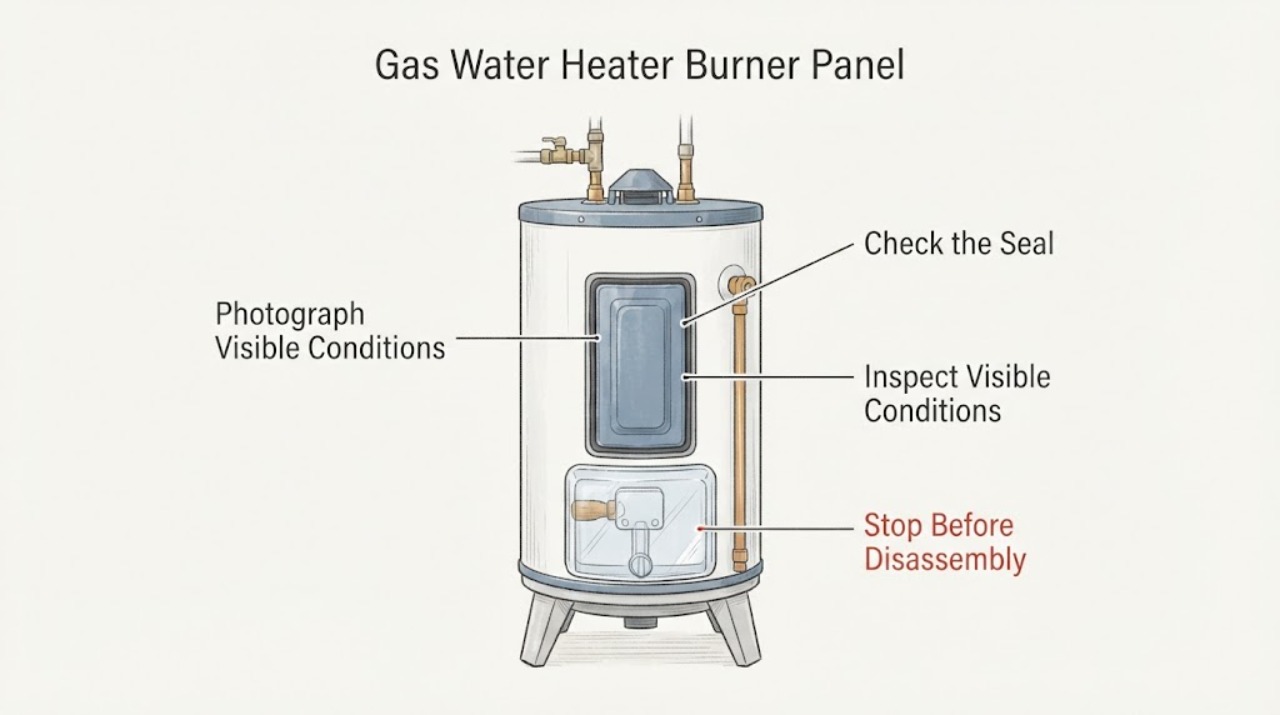
Do not pry, drill, or use force to open a stuck gas-water-heater burner panel. The CPSC says not to use force or tools on a gas heating appliance unless the appliance instructions call for them, and says operation of a gas-appliance safety valve is not a do-it-yourself job. Because no brand or model is supplied, there is no safe universal latch or screw sequence: keep the panel closed, identify the exact model from the exterior label, and use that manual or a qualified gas-water-heater technician. You may make only safe exterior observations, such as visible panel damage, a water leak, or blocked external intake/flue areas. If you smell or hear gas, see smoke, or a CO alarm sounds, leave immediately and contact the gas utility or emergency services from outside.
Work through in order
Diagnostic checks
Use only checks that match the exact appliance or system and its official guide.
-
Check 1
Read the exterior rating label and record the full water-heater brand, model, serial information, fuel type, and the exact location of the panel. Photograph the closed panel and any visible warning label without removing a cover.
Expected result: The model and fuel type are clear, or the label is missing/illegible and the panel design cannot be identified.
Next step: Use only the exact manual for the confirmed model. If identity or access design remains unclear, stop and arrange qualified gas-water-heater service rather than trying a generic latch or screw sequence.
Why this matters
Why: A readable identity allows the exact owner manual and its access boundary to be matched; an unidentified panel has no verified release method.
-
Check 2
With the heater left off, no gas odor, and no need to reach inside, inspect the closed panel and surrounding exterior for a bent edge, displaced visible gasket, loose fastener head, scorch mark, corrosion, or water at the base/fittings.
Expected result: The panel is visibly damaged or distorted, a gasket is displaced, there is scorching/corrosion, or water is present; alternatively the exterior looks intact.
Next step: For any damage, scorching, corrosion, or leak, leave the heater off and call a qualified technician. If the exterior is intact but the panel still resists, do not escalate force; use model-matched service guidance.
Why this matters
Why: Visible damage, heat marks, or leakage can make opening or operation unsafe, while an intact exterior does not prove that a hidden latch or internal component is sound.
-
Check 3
From outside the appliance, look for blocked or covered air-intake openings and visible flue or vent termination obstruction; do not move the heater, remove a vent, or reach through the panel.
Expected result: An intake or vent termination is visibly obstructed/covered, or the external air and vent path appears clear.
Next step: Do not cover or alter the openings. If obstruction, soot, damage, or uncertainty is present, stop using the heater and have a qualified technician inspect it; do not perform a draft, gas, or burner test yourself.
Why this matters
Why: A blocked combustion-air or vent path is a safety concern, but a clear exterior path does not authorize opening the burner enclosure or prove correct combustion.
-
Check 4
Check for an immediate hazard before any further troubleshooting: gas odor or hissing, smoke/scorching, a CO alarm, or symptoms such as headache, dizziness, nausea, confusion, or loss of coordination.
Expected result: Any gas-leak sign, smoke, CO alarm, or possible CO symptom is present, or none is present.
Next step: If any sign is present, leave immediately, avoid switches/flames/phones inside, and contact gas authorities or emergency services from outside. If no sign is present, keep the panel closed and schedule model-matched qualified service.
Why this matters
Why: These signs are an emergency and are not a stuck-panel diagnosis; no warning sign only means that an emergency response is not currently indicated, not that panel removal is safe.
Use your observations
Decision map
Find the observation that best matches what you see, then follow the next safe action.
-
PATH 01Next step
What you see
The exact manual clearly identifies the cover as a user-accessible panel and gives a release procedure, with no gas smell, smoke, leak, scorching, or CO warning.
Do this next
Follow the matched manual exactly and stop if the panel does not release as described. Do not substitute a procedure from another brand or heater family.
Why this path and its safety boundary
Why it matters: Only that model-specific document establishes that the cover may be opened and what preparation is required; the generic symptom does not.
-
PATH 02Next step
What you see
The manual is unavailable, the model is missing, or the cover remains stuck after the documented release steps.
Do this next
Leave the heater off, preserve the model label and exterior photos, and arrange qualified gas-water-heater service. Do not pry, drill, remove gas tubing, or reach inside.
Why this path and its safety boundary
Why it matters: The access boundary is unresolved or the panel may be seized/damaged; force could affect a gasket, combustion enclosure, wiring, or gas-control safety.
-
PATH 03Next step
What you see
The exterior check finds a blocked intake/vent, water leak, scorch mark, corrosion, damaged panel, or displaced visible seal.
Do this next
Do not operate or open the burner enclosure. Have a qualified technician inspect the heater and correct the condition using the exact model documentation.
Why this path and its safety boundary
Why it matters: The heater has an external condition that can affect combustion, venting, enclosure safety, or water damage; it is not evidence for a specific replaceable part.
-
PATH 04Next step
What you see
Gas is smelled or heard escaping, smoke is present, a CO alarm sounds, or someone has possible CO symptoms.
Do this next
Leave immediately, avoid operating switches or phones inside, get outside, and contact the gas utility or emergency services from outside. Do not re-enter to open the panel or relight the heater.
Why this path and its safety boundary
Why it matters: This is an emergency rather than a panel-repair branch.
Helpful context
Understand the symptom
Treat the stuck cover as a stop condition
The panel may be held by a latch, screws, a gasket, or a design that is intended for trained service. Those possibilities cannot be distinguished safely from the symptom alone. CPSC guidance for gas water heaters says to read the proper operating procedure, never use force or tools unless the instructions call for them, and have gas-appliance operation checked by a qualified contractor. Do not pry around a burner cover or continue after the panel resists.
Use the model label to find the right boundary
Record the complete model and serial information from the exterior rating label and photograph the closed panel, without removing any cover. A gas tank, tankless unit, and different manufacturer families can use different access panels and ignition arrangements. With no model in this topic, a generic screwdriver sequence, pilot-light sequence, gasket claim, or panel-removal instruction would be an unsupported transfer. The exact manual must say whether the panel is intended for a homeowner or for service.
Limit observations to the outside
With the heater left off and no gas odor, inspect only what is visible without opening the enclosure: a bent or loose panel edge, a displaced visible gasket, water at the base or fittings, and external intake or flue termination clearance. Rheem notes that gas burner access and air-intake areas should remain uncovered and that vent terminations must remain clear; it also places burner, flame-sensor, igniter, gas-line, and electrical work with qualified professionals. These observations identify a reason to stop and call, not a confirmed failed part.
Escalate gas and carbon-monoxide warning signs
If gas is smelled or heard escaping, do not try to open the panel, relight the pilot, operate a switch, or use a phone inside. Leave immediately and contact the gas utility or emergency service from outside. If a CO alarm sounds, or anyone has headache, fatigue, shortness of breath, nausea, dizziness, confusion, or loss of coordination, leave for fresh air and call emergency services. CPSC describes CO as odorless and colorless and recommends trained inspection of heating systems, chimneys, and vents.
When checks do not resolve it
Need a professional?
Call a qualified gas-water-heater technician before opening the enclosure when the model/manual is unknown, the panel will not release using the exact documented procedure, the panel or gasket is damaged, there is a leak/scorching/corrosion, the intake or vent path is obstructed, or any inspection would require removing gas, electrical, burner, or combustion components. For gas odor, hissing, smoke, a CO alarm, or possible CO symptoms, leave immediately and contact the gas utility or emergency services from outside.
Common questions
FAQ
Can I pry the burner panel off with a screwdriver?
Not as a generic repair. CPSC says never use force or tools on a gas heating appliance unless the appliance instructions call for them. Without the exact model and a documented procedure, stop and arrange qualified service.
Does a stuck cover prove the gasket is seized?
No. It could involve a latch, fastener, gasket, distortion, corrosion, or a service-only enclosure. The symptom does not identify the cause, so do not infer a gasket or order a part without model-matched evidence.
What should I do if I smell gas while trying to inspect it?
Leave immediately. Do not relight the pilot, operate switches, or use a phone inside; contact the gas utility or emergency services from outside.
Read the exact guide
Official sources
- Winter Storms Aren’t Over; CPSC Warns of Deadly Carbon Monoxide Risks and Fires During Power OutagesU.S. Consumer Product Safety Commission · Current CPSC emergency guidance: leave immediately for a gas smell or sound of leaking gas and contact local gas authorities from outside; used only for emergency boundaries.
- How to Keep Your Tank and Tankless Water Heaters Running at Peak PerformanceRheem Manufacturing Company · Rheem manufacturer maintenance guidance used only as a bounded manufacturer example for uncovered burner/air-intake areas, external vent checks, and professional burner/gas/electrical work; it is not a universal panel-release procedure for an unidentified heater.
- CPSC Issues Winter Safety WarningU.S. Consumer Product Safety Commission · Government safety guidance for gas-fueled water heaters; supports no-force/no-tool, no-relight-with-gas-odor, and qualified-service boundaries, not a model-specific panel-release procedure.
- Protect Your Family from Carbon Monoxide PoisoningU.S. Consumer Product Safety Commission · Government CO guidance relevant to gas-water-heater venting and alarms; it does not authorize opening a burner panel.
Community feedback
Share a repair observation
Share a plain-text repair observation. Accepted observations are published automatically; this page may take a moment to update.