
On this page
Start here
Quick answer
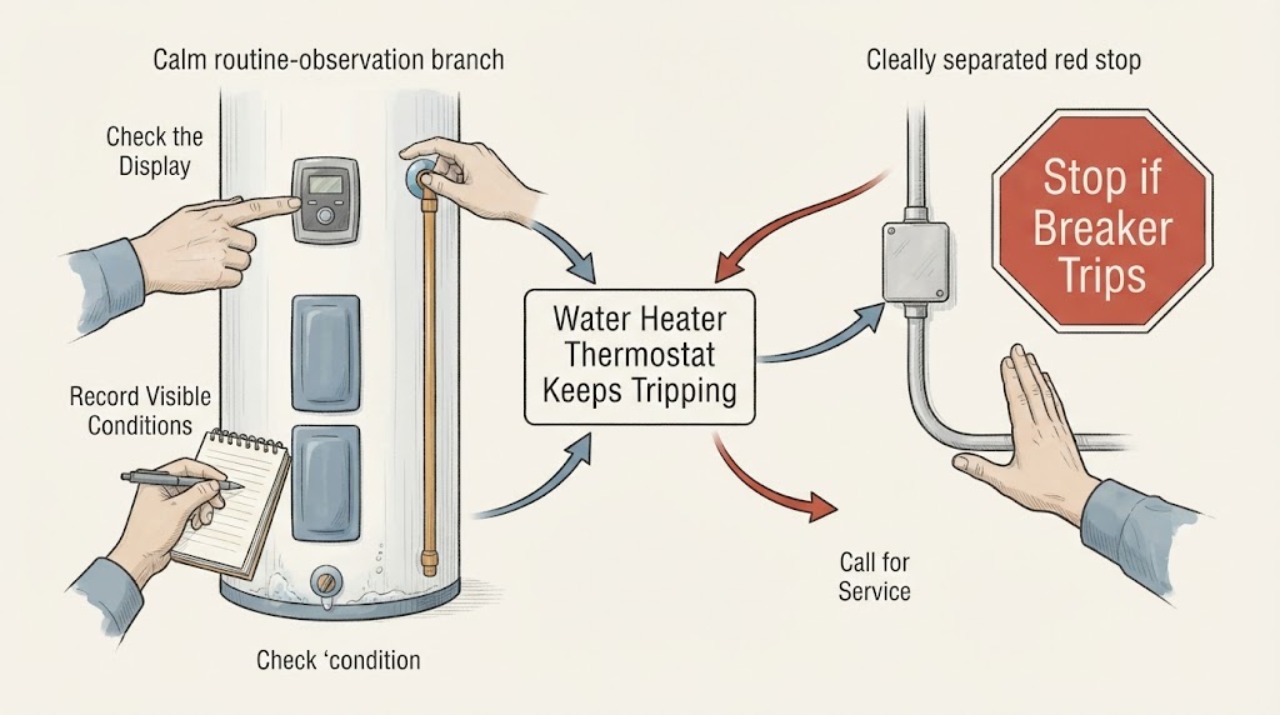
A water-heater thermostat or high-limit trip is a protective symptom, not proof that the thermostat itself has failed. A. O. Smith notes that thermostat problems can trip a high-limit safety switch and that repeated trips need professional attention, while water-heater designs vary between gas, electric, storage, instantaneous and heat-pump equipment. Do not keep resetting the control, remove an access cover, or make a live electrical or gas adjustment. From outside the appliance, identify the exact type and model, record whether water is unusually hot, leaking or discharging from the relief area, and leave the heater off for qualified service if the trip repeats or any hazard is present.
Work through in order
Diagnostic checks
Use only checks that match the exact appliance or system and its official guide.
-
Check 1
Stop using the heater after a thermostat or high-limit trip. If it is safe to reach the normal appliance control and there is no water, smoke or electrical hazard, leave the heat source off; do not reset it again, remove an access cover, touch wiring or adjust a gas control.
Expected result: There is unusually hot water or steam, a leak, hot-water discharge at the relief area, a burning or electrical smell, smoke, visible damage, or no visible hazard.
Next step: For any hazard, keep people away, do not touch the hot or wet area, and arrange urgent qualified plumbing/electrical service or emergency help as appropriate. With no visible hazard, continue only with the identification and observation checks below while the heater remains off.
Why this matters
Why: Very hot water or relief discharge can indicate an overtemperature or pressure event, and heat, smoke, water or electrical damage raises the safety risk. A quiet exterior does not prove that the thermostat, high-limit device or heating system is safe.
-
Check 2
Without removing a cover or moving the heater, read the full rating label and record the brand, model, serial, fuel or power type, tank versus tankless design, and any displayed indicator or message. Use the exact owner manual or manufacturer support path for that identity.
Expected result: The label identifies an electric, gas, instantaneous, storage or heat-pump design and the control indication can be matched to its manual; the label or design remains uncertain.
Next step: If the identity is known, give the exact model and the observed trip to qualified service and follow only the matching manual. If it is not known, stop at external observation and do not borrow instructions from another water-heater family.
Why this matters
Why: The DOE lists multiple water-heater types, and A. O. Smith uses different guidance for gas and electric equipment. An uncertain identity prevents a safe button sequence or model-specific thermostat conclusion; it does not show that one component has failed.
-
Check 3
Record the circumstances without opening or energizing the heater: whether the trip has happened once or repeatedly, whether water became unusually hot or stayed cold, whether a breaker or fuse also operated, whether a gas model shows an abnormal pilot or indicator from its normal viewing point, and whether the relief area or floor is wet.
Expected result: The trip repeats, hot-water temperature is abnormal, an electrical protective device also trips, a gas pilot/indicator is abnormal, or the exterior remains dry with normal-looking temperature.
Next step: Leave the heater off and pass the pattern to qualified service. Do not reset a breaker or heater repeatedly, relight or adjust a gas appliance without the exact manual, or perform live voltage/resistance tests.
Why this matters
Why: A repeated trip or abnormal temperature is consistent with an unresolved control, heating or safety event, but the observations cannot distinguish a thermostat from another cause. A gas or electric symptom must be interpreted within the exact model instructions; a dry exterior does not clear the internal system.
-
Check 4
Prepare a service handoff with the full model and serial, fuel or power type, the number and timing of trips, the water-temperature observation, any breaker/fuse event, and photos of only visible leaks, discharge or damage. Keep the heater isolated until the provider gives model-specific instructions.
Expected result: The thermostat/high-limit trip returns, the model cannot be identified, the unit has any leak/relief discharge or abnormal temperature, or the heater is otherwise normal after one isolated observation.
Next step: Arrange a licensed plumber, electrician or manufacturer-qualified service provider appropriate to the heater type. Do not open the cabinet, bypass a safety device, replace a part by appearance, or resume operation merely because the symptom stopped temporarily.
Why this matters
Why: A service record can narrow the correct manual and inspection path, but no external observation here confirms a thermostat, element, gas valve, board or other part. A repeated safety trip is specifically a reason to seek professional help.
Use your observations
Decision map
Find the observation that best matches what you see, then follow the next safe action.
-
PATH 01Next step
What you see
Water is scalding, steam or very hot discharge is present, the relief area is releasing water, or the tank/floor is leaking.
Do this next
Keep the heater out of use, do not touch the discharge or remove covers, keep people away from hot water, and obtain urgent qualified service. Do not try to prove the relief-valve or thermostat diagnosis yourself.
Why this path and its safety boundary
Why it matters: This pattern is consistent with an unresolved temperature/pressure or water-containment hazard; A. O. Smith warns that relief discharge can be very hot and that thermostat malfunction can contribute to abnormal temperature.
-
PATH 02Next step
What you see
A gas-model pilot or indicator is abnormal, or an electric-model breaker/fuse trips along with the heater safety trip.
Do this next
Leave the heater and its protective device off, do not relight, bypass, reset repeatedly or measure live circuits, and contact qualified service that handles the identified heater type.
Why this path and its safety boundary
Why it matters: The external pattern points to a fuel-specific or electrical safety path, but it does not identify a failed gas valve, thermostat, element or breaker.
-
PATH 03Next step
What you see
The thermostat/high-limit trip happens again, even though the heater looks dry and the water temperature is not currently extreme.
Do this next
Keep the heater isolated and arrange professional diagnosis using the exact model and trip history. Do not treat a temporary return to normal as permission for repeated resets or cover removal.
Why this path and its safety boundary
Why it matters: A repeated protective trip remains unresolved; the absence of an external leak does not rule out a control, heating or safety problem.
-
PATH 04Next step
What you see
There was one trip, no visible hazard remains, the model and type are known, and the matching manual gives a documented interpretation that does not require opening the cabinet.
Do this next
Record the event and use only the exact manual or qualified service path; stop immediately if the trip returns, temperature changes, a leak appears or any electrical/gas warning develops.
Why this path and its safety boundary
Why it matters: The event may be a model-specific protective state or an isolated condition, but this generic page cannot confirm that the heater is repaired or that the thermostat is sound.
Helpful context
Understand the symptom
A thermostat trip is a warning, not a part diagnosis
A. O. Smith describes a thermostat problem as one possible reason a high-limit safety switch trips, and says repeated trips call for professional help. That symptom can also sit alongside a heating, supply, control or installation issue. Because the task gives no brand, model, fuel type or tank design, use the trip to decide how to observe and isolate the appliance, not to name a failed thermostat or heating element.
Use only external observations on an unidentified heater
The Department of Energy groups consumer water heaters into gas, electric, storage, instantaneous and heat-pump types. A. O. Smith likewise separates gas and electric troubleshooting. Read the rating label and controls without opening the cabinet, and note the exact display or indicator pattern, fuel type, unusual water temperature and any visible leak or relief-valve discharge. Do not copy a reset sequence, thermostat setting or access-panel procedure from a different model.
Overheating or discharge makes this a service boundary
A. O. Smith explains that a malfunctioning thermostat can allow higher-than-normal temperature and that the temperature-and-pressure relief valve may release very hot water. Its maintenance guidance says the unit should be powered and supplied safely off before maintenance and allowed to cool. Do not touch a relief outlet, remove panels, drain hot water, repeat a reset, or test wiring; keep people away from hot discharge and arrange qualified service.
Common questions
FAQ
Does a tripping water-heater thermostat prove the thermostat is bad?
No. A. O. Smith lists a thermostat problem as one possible reason a high-limit safety switch trips, but the symptom can also accompany other heating, control, fuel or installation conditions. Repeated trips need professional diagnosis rather than a guessed part.
Should I keep pressing the reset after the water heater trips?
No. Treat a repeat trip as an unresolved protective event. Leave the heater off, do not remove an access cover or test live wiring, and arrange service with the exact model and trip history.
What should I check when I do not know whether the heater is gas or electric?
Read the external rating label and record the full model, fuel or power type, tank or tankless design, display/indicator pattern, water-temperature behavior and any visible leak or relief discharge. Do not use another model's reset or adjustment sequence.
When is a water-heater thermostat trip urgent?
Treat scalding water, steam, very hot relief discharge, leaking water, smoke, burning/electrical signs or a repeated trip as a stop-and-service condition. Keep away from hot or wet areas and use qualified plumbing/electrical or emergency help as the situation requires.
Read the exact guide
Official sources
- Water Heater Repair: Things to ConsiderA. O. Smith · Opened A. O. Smith repair guidance. It directs users to the manual and professional help, distinguishes gas/electric/tankless repair contexts, and says breaker trips can involve thermostat/heating-element issues. It does not establish a specific failed part on this unidentified heater.
- Water Heater MaintenanceA. O. Smith · Opened A. O. Smith maintenance guidance. It says to turn off power and water for maintenance, use protective equipment, let the unit cool, and distinguish gas and electric shutoff. The article uses this only for the stop/cooldown boundary and gives no access-panel or reset procedure.
- Leaking Temperature and Pressure Relief ValveA. O. Smith · Opened A. O. Smith technical bulletin. It explains that the relief valve limits temperature/pressure and that a malfunctioning thermostat can produce higher temperature and very hot or large-volume discharge. It supports external hazard recognition, not user valve testing or internal repair.
- Is Your Hot Water Not Getting Hot? Common Causes & What To Do About ThemA. O. Smith · Opened A. O. Smith consumer guidance. It supports the general safety and interpretation boundary for a water-heater thermostat/high-limit trip, while its model-specific reset instructions are not transferred to this unidentified heater.
- Consumer Water HeatersU.S. Department of Energy · Opened the U.S. Department of Energy consumer overview. It establishes that consumer water heaters span multiple designs, which is why an unidentified heater cannot safely inherit a single thermostat or reset procedure.
Community feedback
Share a repair observation
Share a plain-text repair observation. Accepted observations are published automatically; this page may take a moment to update.