
On this page
Start here
Quick answer
First identify whether the Whirlpool cooktop is gas, radiant electric, or induction; the same symptom has different safe checks. For any type, note whether the whole surface or only one zone is affected, confirm the intended control and lock state, and check for a displayed code. An electric element can cycle on and off or glow unevenly by design, while an induction zone needs suitable cookware and can stop when the surface or electronics overheat. A gas burner needs a correctly seated, clean cap and a confirmed gas supply, but any gas odor, delayed ignition, abnormal flame, smoke, arcing, broken glass, or repeated breaker trip is an immediate stop condition. Use only the exact Whirlpool owner manual for the model, and arrange qualified service for internal wiring, gas fittings, heating elements, induction electronics, or a fault that returns after one safe reset.
Before you begin
Safety first
- This article covers model identification and ordinary-access observations only. It does not authorize live electrical work, gas-line or regulator work, internal panel access, safety-device bypass, powered mechanism access, or repeated test cycles after a fault.
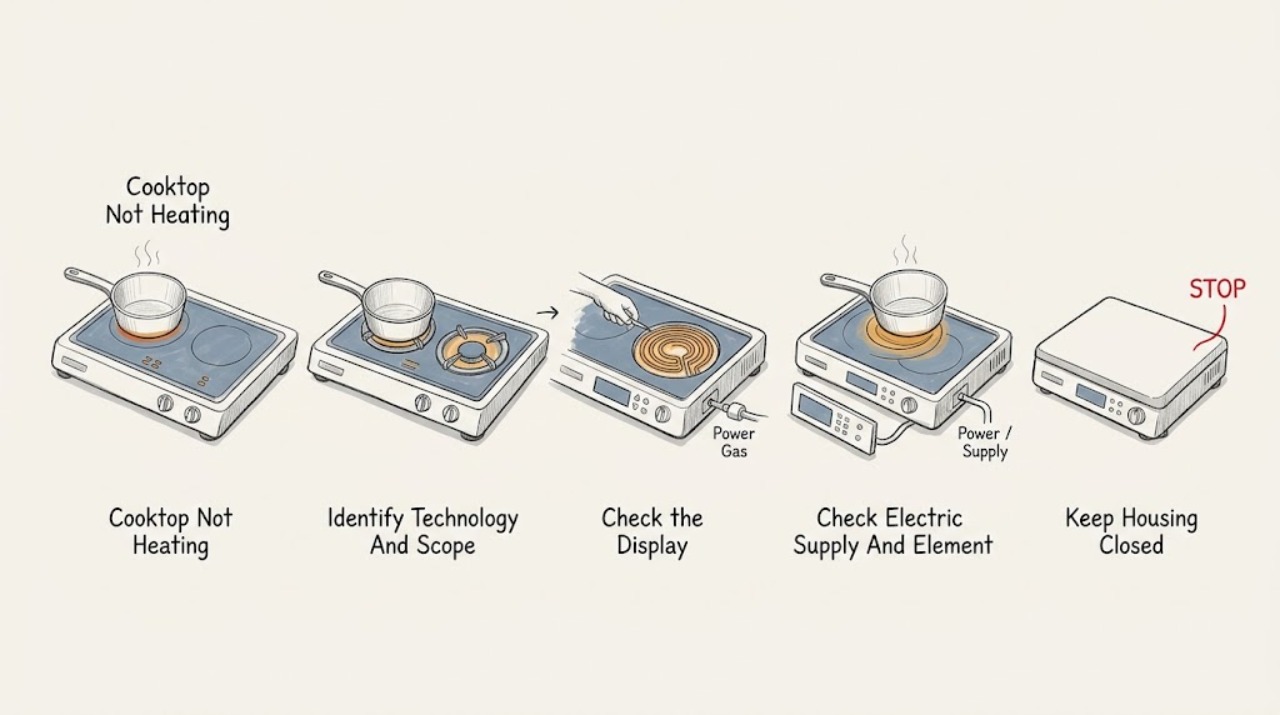
Work through in order
Diagnostic checks
Use only checks that match the exact appliance or system and its official guide.
-
Check 1
From the model label and matching Whirlpool manual, identify the cooktop as gas, radiant or coil electric, or induction, then try to determine whether all zones or only one zone fails without removing trim or panels.
Expected result: Record the model, technology, affected zone, display state, selected setting, whether other zones heat, and whether the surface is hot even when an element is not visibly glowing.
Next step: Continue with only the branch for the identified technology and use the manual's model-specific control sequence; if the technology or model cannot be confirmed, stop and ask Whirlpool or a qualified technician to identify it.
Stop if: Do not lift the cooktop, remove a panel, touch wiring, or use another model's error-code or reset procedure.
Why this matters
Why: A whole-surface failure points toward power, controls, lock state, or gas supply. A single-zone failure points toward that burner, element, cookware-recognition path, or local control. Cycling or a dark radiant area can be normal and is not by itself proof of failure.
-
Check 2
With the surface clear and cool enough to handle controls safely, confirm the intended zone, power level, burner knob or touch input, and any documented Control Lock or similar lock state in the exact manual.
Expected result: Record whether the display acknowledges the input, whether a lock indicator is present, whether the wrong zone or warming setting was selected, and whether the control responds normally without repeated presses.
Next step: Clear the documented lock or correct the setting once according to the manual, then observe one normal heating attempt; request service if the control remains unresponsive or unpredictable.
Stop if: Do not bypass the lock, hold a touch control continuously, place objects on a touch panel, or operate when the panel is cracked, wet, hot beyond normal, smoking, or sparking.
Why this matters
Why: A lock or incorrect setting can make a healthy cooktop appear not to heat. A control that does not respond, activates unexpectedly, or shows an unexplained code indicates a control or power problem rather than a cookware or flame adjustment.
-
Check 3
For an electric cooktop, check the external power status and breaker or fuse only from a dry, safe position, and for a coil model confirm that a removable coil is fully seated as the Whirlpool guidance describes.
Expected result: Record whether the display is dark, a breaker or fuse has opened, the coil is visibly seated, one element is affected, or all elements are affected; do not remove covers or perform live electrical measurements.
Next step: If there is no hazard, follow the matching manual's single power-recovery procedure; if power does not return, a breaker opens again, or the local element remains cold, arrange an electrician or qualified appliance technician.
Stop if: Do not repeatedly reset a breaker, use an adapter or extension cord, open the junction or control area, or touch exposed conductors.
Why this matters
Why: A loss of external power can affect the whole cooktop, while a displaced coil or one nonworking zone points to a local element or control path. A breaker that opens again is not a reset invitation and may indicate a fault.
-
Check 4
For a radiant or coil electric zone, observe the cookware and heating area from a safe distance at the selected setting without touching the glass or element to decide whether it is cycling normally.
Expected result: Record whether the zone heats and cycles, whether only part of a dual or triple element responds to cookware size, whether a warming or simmer setting is selected, and whether the zone fails to return after the surface has cooled.
Next step: Allow the cooktop to cool and use the correct cookware and setting once as the manual permits; if the zone still does not heat or the surface is damaged, stop using it and arrange qualified service.
Stop if: Do not touch a supposedly dark zone, pour liquid onto hot glass, continue with cracked glass, or remove the element or limiter.
Why this matters
Why: Whirlpool says radiant elements can cycle on and off to limit temperature and may not glow red on every setting; the glass can remain hot after the element cycles off. A zone that never returns after cooling, or a dual or triple element with an unexplained dead section, needs service.
-
Check 5
For induction, use the exact manual to confirm a suitable pan is centered on the selected zone, is not empty, and that the control area and ventilation openings are clear without placing hands on a hot surface.
Expected result: Record whether the zone recognizes the pan, whether the pan contains food or liquid, whether an overheating or cookware code appears, whether objects or liquid cover the controls, and whether the cooktop resumes after cooling as the manual directs.
Next step: Remove the pan or control-area object only when safe, let the cooktop cool, correct ventilation or cookware placement as the manual permits, and make one normal attempt; request service if the code or no-heat condition returns.
Stop if: Do not continue heating an empty pan, cover ventilation, place metal objects on the control area, touch hot glass, or open the induction electronics.
Why this matters
Why: Induction may not heat an unsuitable or absent pan, and Whirlpool identifies excessive cooktop or electronic temperature, poor ventilation, an empty pan, and objects on the control area as possible causes of an overheat indication. A returning code or persistent cold zone points to service.
-
Check 6
For gas, only after confirming there is no gas odor and the appliance is cool, check the accessible main shutoff position and the burner cap and base from ordinary access as the Whirlpool guidance and exact manual allow.
Expected result: Record whether the shutoff is open, the correct cap is centered and seated on the matching base, ports are visibly obstructed, ignition produces a stable flame, or the burner clicks without lighting; do not inspect by smell or use a flame to find a leak.
Next step: Correct only a clearly accessible cap or approved cleaning issue described by the manual; stop further attempts and arrange qualified gas-appliance service when the burner does not light normally or the supply condition is uncertain.
Stop if: Stop immediately for gas odor, delayed ignition, a boom or whoosh, yellow or unstable flame, soot, smoke, or any need to loosen a fitting, move the appliance, or adjust gas pressure.
Why this matters
Why: A closed supply valve, misplaced cap, dirty port, or blocked ignition path can prevent proper heating, but a clicking burner without ignition can release unburned gas. The shutoff and burner checks do not authorize gas-line disassembly or regulator adjustment.
-
Check 7
Only when there is no gas odor, smoke, arcing, cracked glass, damaged cord, water exposure, abnormal heat, or repeated breaker trip, follow the exact manual's one-time power recovery for the identified electric or induction model.
Expected result: Record whether the display and heating return normally, whether the same code or cold zone returns, or whether the breaker opens again; do not repeat the recovery to force a result.
Next step: Stop using the cooktop and provide the technician with the model, technology, affected zone, setting, code, power or gas observations, cookware or cap result, and recovery result.
Stop if: Do not repeatedly cycle power, bypass a limiter or sensor, open panels, perform live electrical work, or continue operation after a safety symptom.
Why this matters
Why: A one-time recovery can clear a transient control state, but it does not prove that wiring, an element, an induction board, or a safety limiter is sound. A returning fault is evidence for service.
Use your observations
Decision map
Find the observation that best matches what you see, then follow the next safe action.
-
PATH 01Safety boundary
What you see
An electric or induction cooktop has no display or no heating on any zone.
Do this next
Check the external supply and documented lock state from a dry safe position, then follow one matching manual recovery if no hazard is present.
Why this path and its safety boundary
Why it matters: External power, breaker or fuse, control lock, or a control fault is more likely than one failed element.
Safety stop: Stop for a repeated breaker opening, damaged cord, water exposure, smoke, arcing, or any need to access wiring.
-
PATH 02Safety boundary
What you see
Other electric zones work, but one radiant, coil, or dual or triple zone stays cold.
Do this next
Check the documented setting and, for a coil, visible seating; allow the surface to cool and request qualified service if the zone remains cold.
Why this path and its safety boundary
Why it matters: The local control, element, coil seating, or cookware-size selection may be involved; normal cycling alone does not explain a zone that never returns.
Safety stop: Do not remove an element, touch hot glass, change wiring, or continue with cracked glass.
-
PATH 03Safety boundary
What you see
An induction zone does not heat, does not recognize a pan, or shows an overheat-related indication.
Do this next
Use suitable cookware, clear the control area, allow cooling, and follow the exact manual once; arrange service if the code or no-heat condition returns.
Why this path and its safety boundary
Why it matters: Pan suitability, an empty pan, control-area objects, ventilation, or excess electronic temperature may be involved.
Safety stop: Do not heat an empty pan, cover ventilation, touch hot glass, or open induction electronics.
-
PATH 04Safety boundary
What you see
A gas cooktop has no normal flame or one burner heats poorly, and there is no gas odor.
Do this next
Check only the accessible valve position and cap seating or cleaning procedure in the manual; stop and call a qualified gas-appliance technician if ignition or flame remains abnormal.
Why this path and its safety boundary
Why it matters: A closed accessible shutoff, cap or base misalignment, or a visibly obstructed burner port may be involved, but gas work remains outside ordinary user repair.
Safety stop: Stop for gas odor, delayed ignition, unstable or yellow flame, soot, smoke, or any need to loosen gas fittings.
-
PATH 05Safety boundary
What you see
A radiant element heats cookware but cycles or does not glow red continuously.
Do this next
Judge the result by cookware heating and the manual's expected operation, not by glow alone; request service only if heating is absent or the element never returns after cooling.
Why this path and its safety boundary
Why it matters: Whirlpool identifies cycling and uneven glowing as normal behavior on some settings and elements, including warming or simmer functions.
Safety stop: Do not touch the zone to verify temperature and do not continue with damaged glass or smoke.
-
PATH 06Safety boundary
What you see
The cooktop has gas odor, delayed ignition, abnormal flame, smoke, arcing, cracked glass, damaged wiring, water exposure, abnormal heat, or a repeated breaker trip.
Do this next
Stop operation, move away from the hazard, and contact the appropriate qualified gas, electrical, appliance, or emergency professional from a safe location.
Why this path and its safety boundary
Why it matters: This is a safety event, not a routine heat-setting issue.
Safety stop: Do not operate switches near a gas odor, unplug a gas-smelling appliance, relight a burner, spray water, reset power repeatedly, or open the cooktop.
Helpful context
Understand the symptom
Identify the heat technology before diagnosing it
A glowing or cycling radiant element, a gas flame, and an induction zone do not behave the same way. Whirlpool's electric guidance notes that elements may cycle and may not glow red on every setting; its induction guidance points to cookware, control-area objects, ventilation, and excessive heat; its gas guidance points to the shutoff, burner ports, and cap seating. Find the model information and use the matching manual before applying a procedure.
Whole cooktop versus one cooking area
If every area is cold and the display is dark, start with the external power or gas-supply path appropriate to the appliance. If one area is cold while others work, the control, burner, element, cookware recognition, or local connection becomes more likely. If a glass surface is warm while an element appears dark, do not touch it as proof that it is off: Whirlpool says radiant elements retain heat after cycling.
Use a strict stop boundary
Do not keep trying a cooktop that smells of gas, has delayed ignition, an abnormal flame, smoke, sparks, arcing, cracked glass, damaged insulation, or repeated breaker trips. Do not remove a cooktop from the counter, open the control area, probe live wiring, adjust a gas regulator, or bypass a lock, sensor, limiter, or switch. These are qualified-service tasks.
Safety boundary
Stop conditions
- Stop immediately for gas odor, delayed ignition, a boom or whoosh, yellow or unstable flame, soot, smoke, or a suspected gas leak; do not use a flame or electrical switching to investigate.
- Stop for arcing, sparks, exposed wiring, a damaged cord, water near controls, cracked or shattered glass, abnormal heat, smoke, or a breaker that opens again.
- Do not open the cooktop, access live wiring, replace an element or induction board, adjust a gas regulator, loosen a gas fitting, or bypass a lock, limiter, sensor, or safety switch.
- Do not repeatedly reset a breaker or power supply, continue heating an empty induction pan, use unsuitable cookware, cover ventilation, or touch a zone that may still be hot.
- Do not assume a dark or cycling radiant element has failed; Whirlpool says some elements cycle and may not glow red on every setting. Confirm heating behavior with the exact manual.
- Use the exact Whirlpool model manual before applying a control sequence, error-code interpretation, part choice, gas procedure, or reset.
When checks do not resolve it
Need a professional?
Arrange qualified Whirlpool appliance service when one zone stays cold after the documented checks, an induction code or no-pan condition persists, a gas burner will not ignite or has an abnormal flame, a control lock or display behaves unexpectedly, a breaker opens again, or internal access is needed. Use a licensed electrician for a persistent external electrical supply problem and a qualified gas professional for gas piping, regulator, combustion, or leak concerns.
Safety scope: This article covers model identification and ordinary-access observations only. It does not authorize live electrical work, gas-line or regulator work, internal panel access, safety-device bypass, powered mechanism access, or repeated test cycles after a fault.
Common questions
FAQ
Why is my Whirlpool electric element not glowing red?
Whirlpool says radiant elements can cycle on and off and may not glow red on every setting, especially warming or simmer settings. Judge whether cookware heats and whether the element returns after cooling, not glow alone. A zone that remains cold needs service.
What should I check when a Whirlpool induction zone will not heat?
Confirm that the exact model is induction, use suitable cookware centered on the zone, do not heat an empty pan, clear objects or liquid from the control area, and allow an overheated cooktop to cool. Follow the exact manual and stop if the code or no-heat condition returns.
What can stop one Whirlpool gas burner from heating?
With no gas odor and the appliance cool, the matching manual may permit checking the accessible main shutoff, cap seating, and visible burner-port condition. Do not enlarge ports or loosen gas fittings. Stop for abnormal flame, delayed ignition, or any gas odor.
Could Control Lock make a Whirlpool cooktop seem not to heat?
Yes. Whirlpool's electric cooktop guidance says a touch-control lock prevents unintended use. Confirm the lock indicator and use the exact model manual to clear it. If the panel remains unresponsive or behaves unexpectedly, request service.
When should I stop using a Whirlpool cooktop?
Stop for gas odor, delayed ignition, an abnormal flame, smoke, sparks, arcing, cracked glass, damaged wiring, water near controls, abnormal heat, or a breaker that opens again. Do not bypass safety devices, open the appliance, or repeatedly reset power.
Read the exact guide
Official sources
- Not Powering On - Electric CooktopWhirlpool Product Help · Whirlpool Product Help for electric cooktops; exact model instructions and qualified electrical service control an installed appliance.
- Cooktop Not Working - Electric CooktopWhirlpool Product Help · Whirlpool Product Help for electric cooktop operation; element appearance and behavior vary by model and setting.
- Checking the Main Gas ValveWhirlpool Product Help · Whirlpool Product Help for gas cooking appliances; the installed model and local gas requirements control, and uncertain gas work belongs to a certified technician.
- F0EA - Induction CooktopWhirlpool Product Help · Whirlpool Product Help for a specific induction error; exact code and model manual control the installed appliance.
- Burner Not Lighting - Gas CooktopWhirlpool Product Help · Whirlpool Product Help for gas cooktop burners; use only when there is no gas odor and follow the exact model manual and gas-safety boundaries.
- Product Manuals & LiteratureWhirlpool · Whirlpool's official manual lookup; match the exact cooktop model before applying a control sequence, error-code, wiring, gas, or reset instruction.
Community feedback
Share a repair observation
Share a plain-text repair observation. Accepted observations are published automatically; this page may take a moment to update.