
On this page
Start here
Quick answer
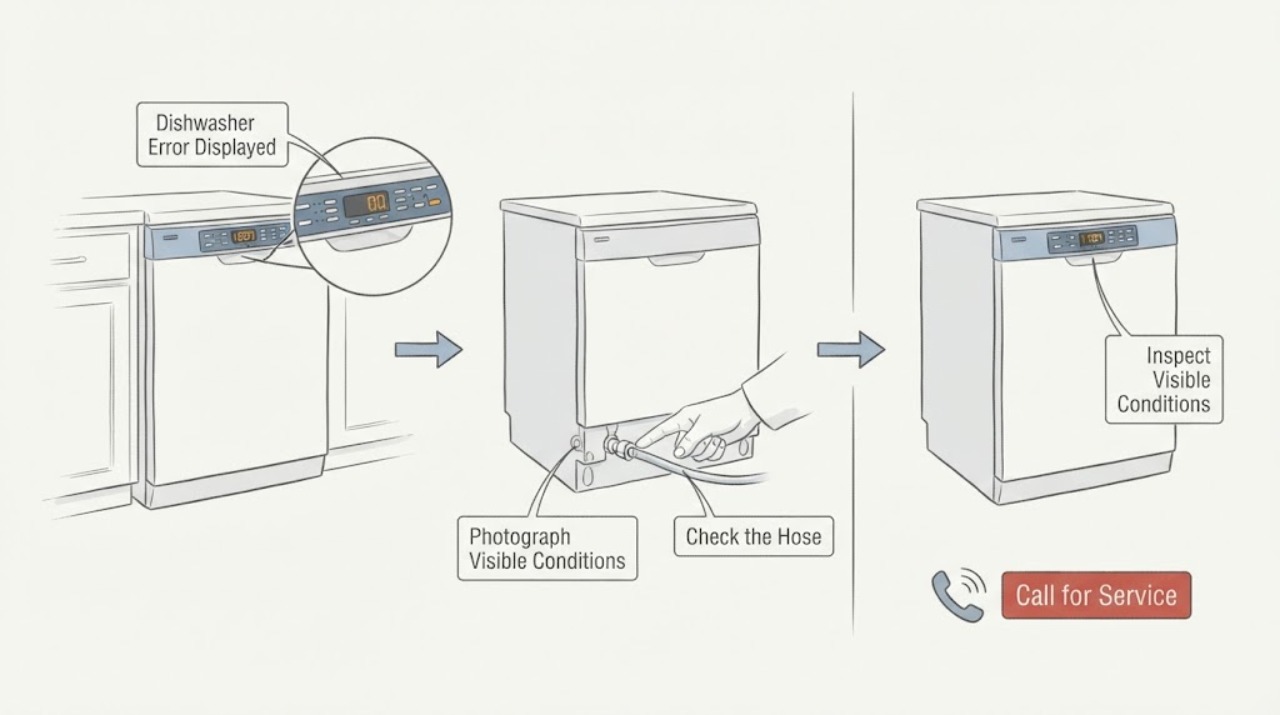
When a Whirlpool dishwasher displays an error, record the exact F#E# code or two-part light pattern before resetting. Match it to the exact model manual, then follow only the safe external check for that code—such as the filter and drain path for a long-drain indication or a water and leak check for an overfill indication. Use one documented power cycle when appropriate, and stop for water under the unit, repeated faults, smoke, damaged wiring, or an unclear indication that returns.
Work through in order
Diagnostic checks
Use only checks that match the exact appliance or system and its official guide.
-
Check 1
Record the exact display or light pattern before pressing buttons: photograph the code, count the first and second flash groups around their pause, note whether the clean light or all lights flash, and write down what the dishwasher was doing and whether water remains.
Expected result: The display shows an F#E# code, the clean light repeats a two-part pattern, a generic indicator is lit, or the pattern is unclear or changes after a button press.
Next step: Use the full model number to open the exact owner manual and match the recorded indication before attempting a reset or ordering a component.
Why this matters
Why: Whirlpool uses model-dependent digital and two-part flashing indications; an incomplete pattern can lead to the wrong diagnosis. A code identifies a fault category or condition, not automatically a failed part.
-
Check 2
If the recorded indication is F9E1 or otherwise identifies a long drain, switch the dishwasher off and inspect only the accessible filter, drain hose route, sink or disposer connection, and air-gap area. If water drains to a disposer, confirm the knockout plug was removed during installation; do not disconnect wet plumbing.
Expected result: The filter is soiled, the hose is kinked or pinched, the sink or air gap is backed up, or the visible drain path is clear.
Next step: Correct only a safe visible obstruction or routing issue, then follow the exact manual’s drain or cancel sequence once. Arrange service when the path is clear or the code returns.
Why this matters
Why: Whirlpool associates F9E1 with a long drain and directs checks of the filter, hose, disposer, knockout plug, and air gap. A clear external path makes an internal pump or control issue more likely.
-
Check 3
If the indication points to water in a drip tray, overfill, or water under the dishwasher, do not remove access panels. Look for water at the floor or toe-kick edge without touching wiring, and turn off the water supply if it is safe and accessible.
Expected result: There is visible water under the unit, an overfill indication, no water outside the cabinet, or water cannot be safely isolated.
Next step: Keep the door closed when water cannot be controlled, leave the appliance out of service, and arrange qualified service for visible water, overfill, or a returning code.
Why this matters
Why: Whirlpool code guidance separates drip-tray or under-unit water from a simple interface indication. Water under the appliance can reflect a leak or float condition that requires service rather than a control reset.
-
Check 4
For a control or unexpected-light indication with no leak, use Whirlpool’s documented reset only after recording the code: press Cancel/Drain if the manual permits, disconnect the appliance at its plug or dedicated breaker, wait at least one minute, restore power, close the door, and select a cycle.
Expected result: The indication clears and a normal cycle completes, or the same code or light sequence returns.
Next step: Stop repeated resets and use the exact model documentation or schedule Whirlpool service with the recorded indication and checks completed.
Why this matters
Why: A single successful power cycle can clear a transient control state, but a recurring indication is evidence that the underlying condition remains. Resetting does not establish which board, sensor, pump, or valve is at fault.
-
Check 5
Check for a model-specific water or interface condition shown by the code, such as H2O or a user-interface indication, without entering service diagnostics or removing covers. Verify only the visible water supply valve and control-lock or door state when the manual identifies those as applicable.
Expected result: The water supply is off or kinked, the control is locked or the door is not latched, the panel responds normally, or the same code remains with those conditions normal.
Next step: Correct the visible setting or supply condition once, then stop for a recurring code, a door or control fault, or any unsafe condition.
Why this matters
Why: Whirlpool guidance treats water detection, control state, door condition, and interface communication as separate code families. A normal visible supply and control state with a recurring code points toward a service diagnosis.
Use your observations
Decision map
Find the observation that best matches what you see, then follow the next safe action.
-
PATH 01Next step
What you see
The code is recorded as F9E1 and a blocked filter, hose, disposer, or air gap is found.
Do this next
Correct the safe visible condition, run one model-approved drain or reset sequence, and call service if the code returns.
Why this path and its safety boundary
Why it matters: A drain-path restriction is more likely than a failed electronic control.
-
PATH 02Next step
What you see
The code indicates water under the unit, an overfill, or a drip-tray condition, or water is visible at the floor or toe-kick.
Do this next
Turn off water and power only if safe, keep the door closed if water cannot be controlled, and obtain qualified service.
Why this path and its safety boundary
Why it matters: A leak, float, or water-management condition is more likely than a harmless indicator state.
-
PATH 03Next step
What you see
The code or flashing sequence clears after one documented power cycle and a complete cycle runs normally.
Do this next
Monitor the next use and keep the model, code, and reset details; stop and schedule service if it returns.
Why this path and its safety boundary
Why it matters: A transient control state is possible, but the original code should remain in the service record.
-
PATH 04Next step
What you see
The code is unclear, the exact manual gives a different meaning, or the same interface, fill, motor, or drain indication returns after the documented check.
Do this next
Leave the dishwasher out of service as appropriate and contact Whirlpool authorized service with the model, serial, exact pattern, water status, and steps completed.
Why this path and its safety boundary
Why it matters: Model-specific interpretation or an internal fault is required; the code alone cannot identify a safe replacement part.
Helpful context
Understand the symptom
Record the indication before clearing it
Whirlpool dishwashers may show a digital F#E# code or communicate through two groups of flashing lights. The same broad symptom can lead to different actions, so preserve the first pattern, water status, and cycle state before pressing Cancel or cycling power.
Treat examples as scoped
F9E1 is used in Whirlpool guidance for a long-drain concern, while F8E4 can indicate water in a drip tray; exact codes and meanings vary by model. Use the full model number and owner manual before applying a code-specific step.
Only after diagnosis
Potential parts
- Whirlpool dishwasher drain pump or filter assembly
Consider only after a confirmed long-drain indication and safe filter, hose, sink, disposer, and air-gap checks leave an appliance-side fault likely.
Confirm the complete model and revision; do not infer a failed pump or fit from an error label alone. - Whirlpool dishwasher float switch or control component
Consider only after a water-under-unit or interface indication is confirmed by the exact manual and qualified diagnosis.
Water and control faults may have several causes; verify model compatibility and service diagnosis before ordering.
When checks do not resolve it
Need a professional?
Use Whirlpool authorized service when the exact code persists, water or overfill is present, the interface cannot be interpreted, or internal pump, sensor, float, valve, wiring, or control work is suspected.
Have this ready
- Provide the full model and serial, exact digital or flash pattern, cycle state, water level or leak location, filter and drain observations, reset performed, and whether the code returned.
Common questions
FAQ
Should I reset the dishwasher before writing down the code?
No. Record the exact digital code or two-part flash pattern first. A reset may clear the visible indication and remove the evidence needed to match the model manual.
Does F9E1 prove that the drain pump has failed?
No. Whirlpool’s F9E1 guidance starts with the filter, drain hose, disposer knockout plug, and air gap. If those checks are normal and the indication returns, qualified service is needed before a pump or control part is selected.
Read the exact guide
Official sources
- Whirlpool Dishwasher Installation Instructions: Error CodesWhirlpool Corporation · Applies to the dishwasher installation and code table in this document; confirm exact model and product revision before using a code-specific instruction.
- Dishwasher Error Codes - Reading - Product Help | WhirlpoolWhirlpool Corporation · Applies to Whirlpool dishwasher code displays and flashing-light patterns; exact meanings vary by model.
- Resetting the Dishwasher’s Controls (Cycle Power) - Product Help | WhirlpoolWhirlpool Corporation · Use for Whirlpool dishwasher control resets after recording the indication; exact controls and safety steps remain model-specific.
- Clean Light Flashing - Dishwasher - Product Help | WhirlpoolWhirlpool Corporation · Applies to Whirlpool dishwasher models using a two-part flashing sequence; use the exact model manual for interpretation.
Community feedback
Share a repair observation
Share a plain-text repair observation. Accepted observations are published automatically; this page may take a moment to update.