
On this page
Start here
Quick answer
If a Whirlpool dishwasher finishes with cool water, cool dishes, or no steam, first separate a cold incoming supply or a low-heat cycle from a failed internal heating circuit. Run a cycle with the available heated or high-temperature option, make sure hot water reaches the dishwasher, and note whether the cycle pauses for heating or ends cold. A one-time power reset may clear a heater-disabled control state on some models, but it does not repair the cause. If the dishwasher remains cold after these checks, shows an error code, repeatedly trips the breaker, smells hot or burnt, or has damaged wiring, stop using it and arrange qualified service with the model number and the observations recorded.
Work through in order
Diagnostic checks
Use only checks that match the exact appliance or system and its official guide.
-
Check 1
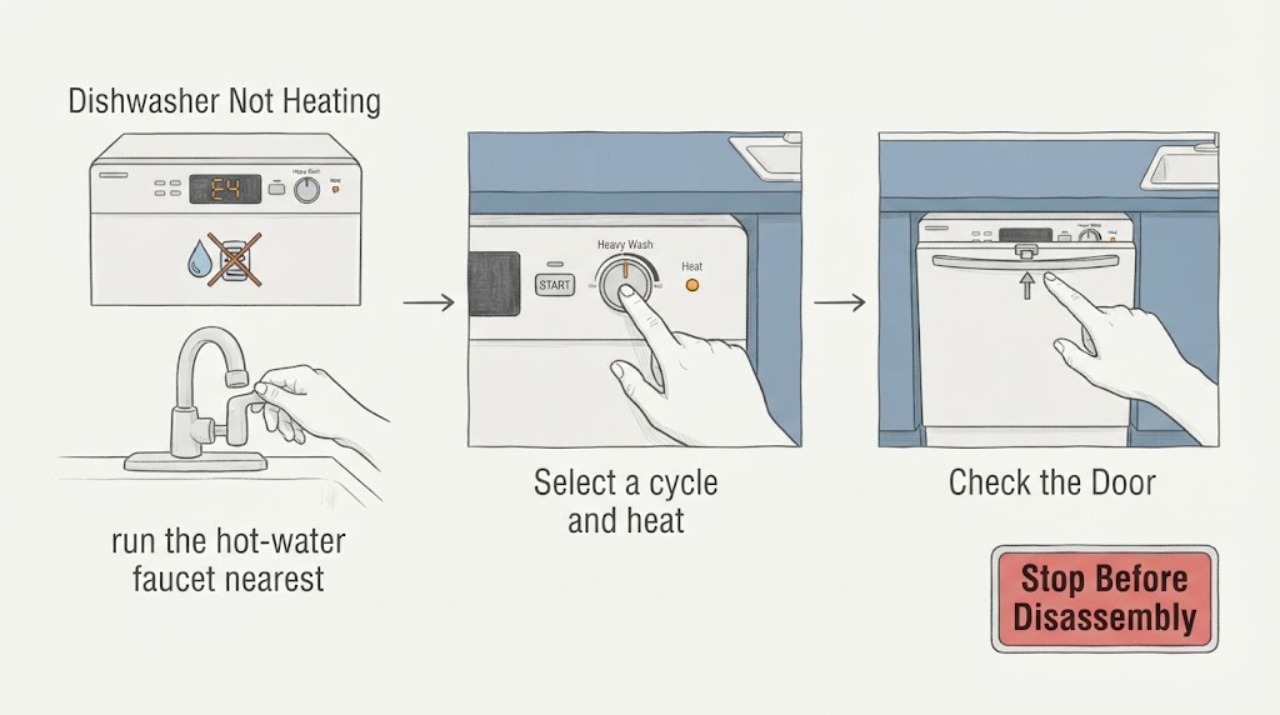
Before starting the next supervised cycle, run the hot-water faucet nearest the dishwasher until the water is hot. Fill a cup and check it with a thermometer if available, then confirm that the dishwasher inlet is connected to the household hot-water line and that the shutoff valve under the sink is fully open.
Expected result: The tap water is around 120°F (49°C) and the dishwasher is connected to the hot line; the tap water is cool; or the inlet is on a cold line or the valve is partly closed.
Next step: Correct only an accessible supply or valve issue, run the hot tap before one test cycle, and compare the result. If the supply is hot and the dishwasher remains cold, continue with the cycle and control checks.
Why this matters
Why: Cool incoming water can leave the wash cold, lengthen the cycle, and reduce cleaning and drying performance even when the dishwasher has an internal heater. A hot supply with an open valve makes an internal heating or sensing issue more likely if the machine still finishes cold.
-
Check 2
Select a cycle and heat option that your exact Whirlpool model actually provides, such as Heated Dry, High Temperature, Sani Rinse, or Sanitize. Avoid using an Eco or Quick cycle as the only test, and load the racks so the spray arms can turn freely and the dishes do not block one another.
Expected result: The selected cycle has a heated option and the spray arms are unobstructed; only a lower-heat cycle was used; or the option is unavailable or cancels itself.
Next step: Run one complete supervised test with the supported heat option. Do not force an option or use a different model's button sequence; use the model manual when the control behavior is unclear.
Why this matters
Why: Cycle and option choices affect wash and final-rinse temperature, so a cool result on a low-heat cycle does not establish a failed heater. If a supported heated test cycle is selected but the option will not stay enabled, record that control behavior for model-specific diagnosis.
-
Check 3
At the end of the test cycle, open the door carefully and keep your face and hands away from escaping steam. Note whether the tub feels warm, whether there is steam, whether the dishes are warm, and whether the cycle paused or ran unusually long while waiting for heat.
Expected result: The tub and dishes are warm and steam is present; the tub is cool but the cycle was unusually long; or the tub and dishes are cool at the end of a supported heated cycle.
Next step: If the result is warm, review loading and rinse-aid guidance for a drying complaint. If it remains cold, record the cycle and options and move to one safe reset only; do not keep repeating heated cycles to test a suspected fault.
Why this matters
Why: Warmth or steam indicates that the heating function operated during that cycle, while a long cycle can indicate the dishwasher was trying to reach temperature. A consistently cool tub after hot incoming water and a supported heat option makes a heating circuit, temperature-sensing, or control fault more likely, without identifying which component failed.
-
Check 4
If the dishwasher is stopped, cool, and showing no electrical warning, perform one control reset using the method for your model: unplug it for about 30 seconds when it has a plug, or switch off its dedicated breaker for about 30 seconds when it is hard-wired. Restore power and run only one supervised test; do not repeatedly cycle the breaker.
Expected result: Heating returns once after the reset; the dishwasher is still cold; an error code appears; or the breaker trips again.
Next step: If heat does not return, or the code or trip recurs, stop testing and arrange qualified service. Keep the dishwasher disconnected if there is a burning smell, smoke, sparking, abnormal heat, or damaged wiring.
Why this matters
Why: A reset can clear a temporary control condition on some Whirlpool models, but a return of heat after a reset does not prove the underlying fault is fixed. Persistent no-heat, a code, or a tripped breaker points to a condition that needs model-specific diagnosis.
-
Check 5
Before contacting support, record the full model and serial information from the door frame, the cycle and options used, the incoming tap temperature if measured, the final tub and dish temperature, any unusual cycle delay, and every displayed code or flashing light. Do not remove the lower access panel or test heater terminals while energized.
Expected result: No code is present; a code or flashing pattern appears; or the electrical connection is hot, scorched, loose, or damaged.
Next step: Give the recorded details to Whirlpool support or a qualified appliance technician. For smoke, sparks, burning odor, abnormal heat, damaged wiring, or repeated breaker trips, stop use and isolate power only if it is safe to do so.
Why this matters
Why: No code does not rule out a heater, sensor, connection, or control problem. Model-specific documentation is needed to interpret a code, and heat or damage at the power connection raises an immediate electrical safety concern.
Use your observations
Decision map
Find the observation that best matches what you see, then follow the next safe action.
-
PATH 01Next step
What you see
The tap is below the recommended incoming temperature, the dishwasher is connected to the cold line, or the under-sink valve is not fully open, and the final water is cool.
Do this next
Correct the accessible hot-water supply, run the nearby hot tap before starting one cycle, and reassess the final tub temperature. Escalate if the supply is hot and the symptom remains.
Why this path and its safety boundary
Why it matters: The supply side can explain the symptom before an internal heater fault is assumed. The appliance may need extra time to heat or may not reach its target during the selected cycle.
-
PATH 02Next step
What you see
The incoming water is hot, a supported heated cycle or option is selected, and the dishwasher finishes with a cool tub and cool dishes.
Do this next
Stop repeated testing, record the model, cycle, options, and final temperature, and arrange qualified appliance service for model-specific electrical and diagnostic checks.
Why this path and its safety boundary
Why it matters: A heating circuit, temperature sensor, wiring connection, or control problem is more likely than a simple cycle-selection issue. The observation does not identify a particular replacement part.
-
PATH 03Next step
What you see
The cycle runs unusually long or pauses for thermal holds, but the final tub is warm and steam is present.
Do this next
Use the model's normal heated options, confirm the hot-water supply, and review loading and rinse-aid guidance. Arrange service if later heated cycles finish cold or show a code.
Why this path and its safety boundary
Why it matters: The dishwasher is likely spending time bringing the water to temperature, so the heating function operated during that cycle. A drying complaint may instead involve rinse aid, loading, plastic items, or the selected cycle.
-
PATH 04Next step
What you see
The no-heat symptom remains after one safe reset, an error code appears, the breaker trips again, or the plug, wiring, or surrounding area is hot, scorched, smoky, or sparking.
Do this next
Stop using the dishwasher and arrange qualified appliance or electrical service. Isolate power only when it can be done safely, and do not remove covers, make live measurements, or keep resetting the breaker.
Why this path and its safety boundary
Why it matters: This is a professional service and safety boundary. The reset did not establish a repair, and electrical or control faults can make continued operation unsafe.
Helpful context
Understand the symptom
A Whirlpool dishwasher may feel cool because the first fill was cold, the selected cycle reduces heat, or the machine has not reached its programmed thermal hold yet. A true no-heat symptom is more persuasive when the incoming water is hot, a heated option is selected, and the tub and dishes are still cool at the end of the supervised cycle. The symptom alone cannot identify whether the failed part is the heater, a temperature sensor, a connection, or the electronic control.
Whirlpool models differ in cycles, options, diagnostic access, and heater design. Use the exact model manual for any option names or model-specific error procedure. Do not remove panels or make live electrical measurements as an ordinary user; those checks belong to a qualified appliance technician.
Only after diagnosis
Potential parts
- dishwasher heating element
Consider this part only if a qualified diagnosis finds an open or failed heater circuit after the hot-water supply and cycle settings are confirmed.
Confirm the complete model number and the manufacturer's fit information before ordering; Whirlpool dishwasher heater designs vary by model. - dishwasher temperature sensor
Consider this part only if model-specific diagnostics identify a temperature-sensing fault rather than a supply, heater, wiring, or control problem.
Use the exact model documentation and fit information; the symptom alone does not establish sensor compatibility or failure.
When checks do not resolve it
Need a professional?
Arrange qualified Whirlpool appliance service when the dishwasher remains cold after hot incoming water, a supported heated cycle, and one safe reset; when an error code or repeated breaker trip occurs; or when a heater, sensor, wiring, or control diagnosis is needed. Give the technician the full model and serial information, cycle and options, measured tap temperature, final tub temperature, unusual delays, and any code. Stop using the dishwasher for smoke, sparks, a burning smell, abnormal heat, a hot or damaged plug or wiring, or repeated electrical protection trips.
Common questions
FAQ
Can a Whirlpool dishwasher run a cycle without heating the water right away?
Yes. Some cycles pause for thermal holds and may run longer while the dishwasher brings water to temperature. A single cool first fill does not prove a failed heater; check the hot-water supply and the selected cycle, then judge the final tub temperature after a supported heated cycle.
What does it mean if the dishes are cool but the dishwasher completed normally?
Check whether the cycle or options reduce heat, whether the incoming water was hot, and whether the tub contains warmth or steam at the end. If a supported heated cycle remains consistently cool with hot incoming water, arrange service because the symptom can involve the heater, sensor, wiring, or control.
Should I replace the heating element when my Whirlpool dishwasher is not heating?
Do not choose a part from the symptom alone. The same symptom can result from cold supply water, a temperature sensor, an open connection, a heater circuit, or the control. Use the exact model documentation and qualified diagnosis before ordering or replacing a part.
Read the exact guide
Official sources
- Whirlpool® Manuals & LiteratureWhirlpool · Whirlpool model-number lookup for the exact dishwasher owner manual and product documentation.
- Tech Sheet - W10751166 - Rev CWhirlpool · Whirlpool dishwasher service documentation describing no-heat causes, heater circuits, temperature sensing, diagnostics, and power-disconnection requirements for qualified service work.
- Dishwasher Water Temperature TroubleshootingWhirlpool Product Help · Whirlpool dishwasher water-temperature troubleshooting, approximately 120°F (49°C) incoming water, hot-line checks, high-heat options, and internal heater or sensor symptom interpretation.
- Dishes Not Drying: Quick Fix GuideWhirlpool Product Help · Whirlpool dishwasher heated-dry testing, warm tub and steam observations, one-minute breaker reset guidance, and service boundary when the dishwasher does not heat or displays an error code.
- Water Temperature - DishwasherWhirlpool Product Help · Whirlpool dishwasher hot-water connection, incoming temperature, and normal thermal-hold behavior during cycles.
- Not Starting or Operating - DishwasherWhirlpool Product Help · Whirlpool dishwasher control-reset guidance and basic power, water, and door checks.
- Reach Out To Whirlpool: Contact UsWhirlpool · Whirlpool customer-support routing and the model and serial information needed for appliance support.
Community feedback
Share a repair observation
Share a plain-text repair observation. Accepted observations are published automatically; this page may take a moment to update.