
On this page
Start here
Quick answer
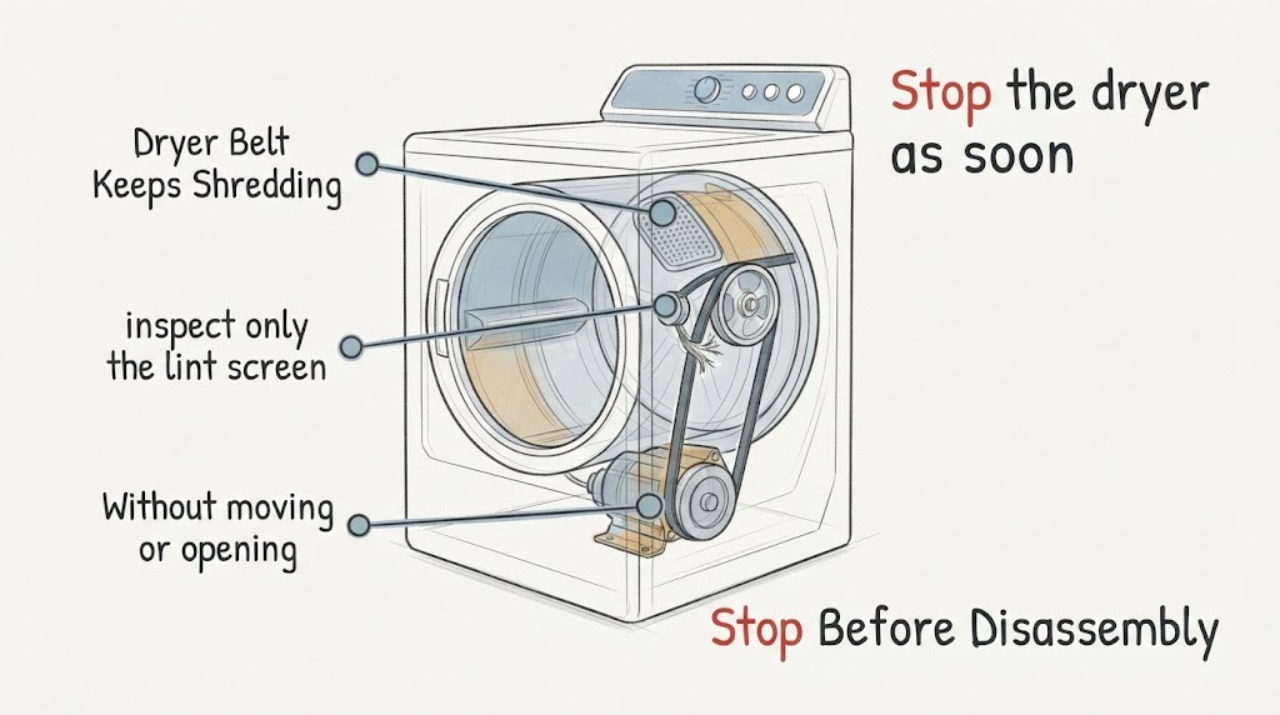
Do not keep running the Whirlpool YWED49STBW1 after the drum belt has shredded repeatedly. A new belt cannot be treated as the fix when the cause of the repeated damage is unknown. Whirlpool's dryer guidance identifies lint buildup and belt/pulley wear as service issues and directs owners to authorized service for parts decisions. Turn the dryer off, record the model and what failed, and limit any user check to the outside, lint screen, drum edges and installation condition; do not open the cabinet, route a belt, or infer that the rollers, idler or motor is the cause.
Work through in order
Diagnostic checks
Use only checks that match the exact appliance or system and its official guide.
-
Check 1
Stop the dryer as soon as a belt shreds, comes off, produces rubber dust or is accompanied by a burning-rubber smell. From a safe position, note whether the drum stopped, whether heat continued, and whether smoke or an electrical smell is present; do not restart it to see whether a replacement belt survives.
Expected result: The belt has failed again, rubber dust is present, the drum no longer turns, or there is a burning smell/smoke.
Next step: Leave the dryer unused and arrange qualified Whirlpool or appliance service. If there is smoke, an active burning smell or an electrical hazard, keep away from the appliance and use the normal safe power-disconnect/service route; do not open it.
Why this matters
Why: Repeated belt damage is not a normal belt-maintenance event. Whirlpool says belt and pulley wear can require replacement selected by authorized service, and internal lint buildup can require a service call to remove the back panel and clean the dryer.
-
Check 2
With the dryer off and cool, inspect only the lint screen, the visible front and rear drum edges, and the floor area for loose belt fragments, coins, screws or other foreign objects. Do not reach into the cabinet, remove a panel or put hands near the motor, pulley or drum support.
Expected result: A loose object is visible at a drum edge or in the lint-screen area, or there is only rubber dust/fragmentation with no visible external object.
Next step: Remove only a clearly loose object that is safely reachable without disassembly, keep the lint screen installed, and do not run the dryer after repeated belt failure until service evaluates the belt path.
Why this matters
Why: Whirlpool documents foreign objects at the drum seam and in the lint path as possible noise causes and warns that internal lint buildup may need a service call. A clear exterior does not rule out an internal alignment or support problem and does not identify a component.
-
Check 3
Without moving or opening the cabinet, check that the dryer has all four feet in contact with the floor and is not visibly rocking, and note whether anything is pressing against the cabinet or vent. Do not treat leveling as a repair for a shredded belt.
Expected result: The cabinet rocks, a leg is missing, the vent or another object is pressing against the dryer, or the installation is stable but the belt still shreds.
Next step: Correct only a plainly missing-foot or external-clearance issue if it can be done safely without opening the dryer, then leave the dryer unused because repeated belt damage still requires service. Do not test by running another load.
Why this matters
Why: Whirlpool links missing legs, an unlevel cabinet and surrounding contact with vibration/noise, but those checks do not prove why a belt repeatedly tears. A stable installation makes a continuing internal mechanical problem more important to have inspected.
-
Check 4
Record the full rating-plate model and serial information, the number of belt failures, which other work was already done, the load size, any sound or smell before each failure, and photographs of the failed belt and accessible rubber dust. Use the exact model in Whirlpool's manuals search.
Expected result: The label confirms YWED49STBW1, or the label has a different suffix/model than the assigned topic.
Next step: Give the exact identity and failure history to authorized service. If the label differs, do not order a belt or maintenance kit from this page's topic; use the actual model documentation instead.
Why this matters
Why: Whirlpool requires the model number to locate the applicable literature and troubleshooting material. A suffix mismatch can change the belt path or service documentation, so it must be resolved before parts or procedures are selected.
Use your observations
Decision map
Find the observation that best matches what you see, then follow the next safe action.
-
PATH 01Next step
What you see
The belt has shredded more than once, or the latest failure produced rubber dust, a burning smell or loss of drum rotation.
Do this next
Keep the dryer out of service and arrange qualified inspection before another belt is installed or the dryer is energized.
Why this path and its safety boundary
Why it matters: The belt is being treated as a symptom of an unresolved mechanical or contamination condition, not as a standalone consumable replacement.
-
PATH 02Next step
What you see
A loose object is visible at the drum edge or lint-screen area, but the belt has already shredded repeatedly.
Do this next
Remove only the safely reachable object, leave the dryer unused and disclose it to service along with the belt history.
Why this path and its safety boundary
Why it matters: The object may explain a sound or obstruction, but removing it does not establish that it caused the repeated belt damage or cleared the internal belt path.
-
PATH 03Next step
What you see
The dryer is stable and clear externally, but the belt continues to shred or slip after prior belt-path work.
Do this next
Use the exact model and serial information to request professional service. Do not open the cabinet, run the dryer with a damaged belt or select a replacement part from a generic diagram.
Why this path and its safety boundary
Why it matters: The remaining cause is not identifiable from external observation; an internal belt, drum, pulley, support or motor relationship must not be guessed.
-
PATH 04Next step
What you see
There is smoke, active burning odor, exposed damaged wiring, or any need to remove a panel or touch the belt path.
Do this next
Keep the appliance off and obtain qualified appliance service. Do not bypass a thermal device, run with the lint screen removed, or perform live testing.
Why this path and its safety boundary
Why it matters: The dryer has an electrical, fire or moving-mechanism hazard beyond safe external checks.
Helpful context
Understand the symptom
Why replacing the belt again is not the diagnosis
The reported history is repeated shredding after other belt-path work. That pattern is a continuing mechanical-risk signal, but it does not identify which internal surface or support is damaging the belt. Whirlpool's public dryer guidance discusses belt and pulley wear, lint and foreign objects, leveling and service without providing a universal cabinet procedure for this exact model. Keep the dryer out of operation until the cause is inspected.
Keep the check outside the cabinet
The exact YWED49STBW1 manual must be selected through Whirlpool's model-number documentation path before any model-specific access instruction is considered. A smell, rubber dust or another failed belt is useful information for service, not permission to remove panels or test a running belt path.
Common questions
FAQ
Should I install another belt to see if this one lasts?
No. A belt that has shredded repeatedly should be treated as an unresolved mechanical problem. Stop using the dryer and have the exact model and belt path evaluated before another test run.
Does rubber dust prove that the idler pulley or rollers are bad?
No. Whirlpool's general guidance identifies belt and pulley wear as possible service issues, but belt dust alone does not establish which component or surface caused the damage. Do not order or fit a specific part from the symptom alone.
What information should I give the technician?
Provide the full model and serial information, the number of belt failures, prior work, load size, sound or smell before failure, and photos of the belt and visible debris. Whirlpool's manual path uses the model number to select the applicable literature.
Read the exact guide
Official sources
- Squealing or Squeaking Sound - DryerWhirlpool Product Help · Opened official Whirlpool dryer-family guidance used for the external checks and professional-service boundary; it does not diagnose the exact YWED49STBW1 internal cause.
- Sounds or Noises in a DryerWhirlpool Product Help · Opened official Whirlpool guidance used for safe external observation only; it does not identify a belt-shredding component for the assigned model.
- Kitchen And Laundry Appliance ManualsWhirlpool · The opened official Whirlpool page requires the exact model number to retrieve appliance manuals and related literature; it is the identity/documentation path for YWED49STBW1, not proof of a specific internal failure.
Community feedback
Share a repair observation
Share a plain-text repair observation. Accepted observations are published automatically; this page may take a moment to update.