
On this page
Start here
Quick answer
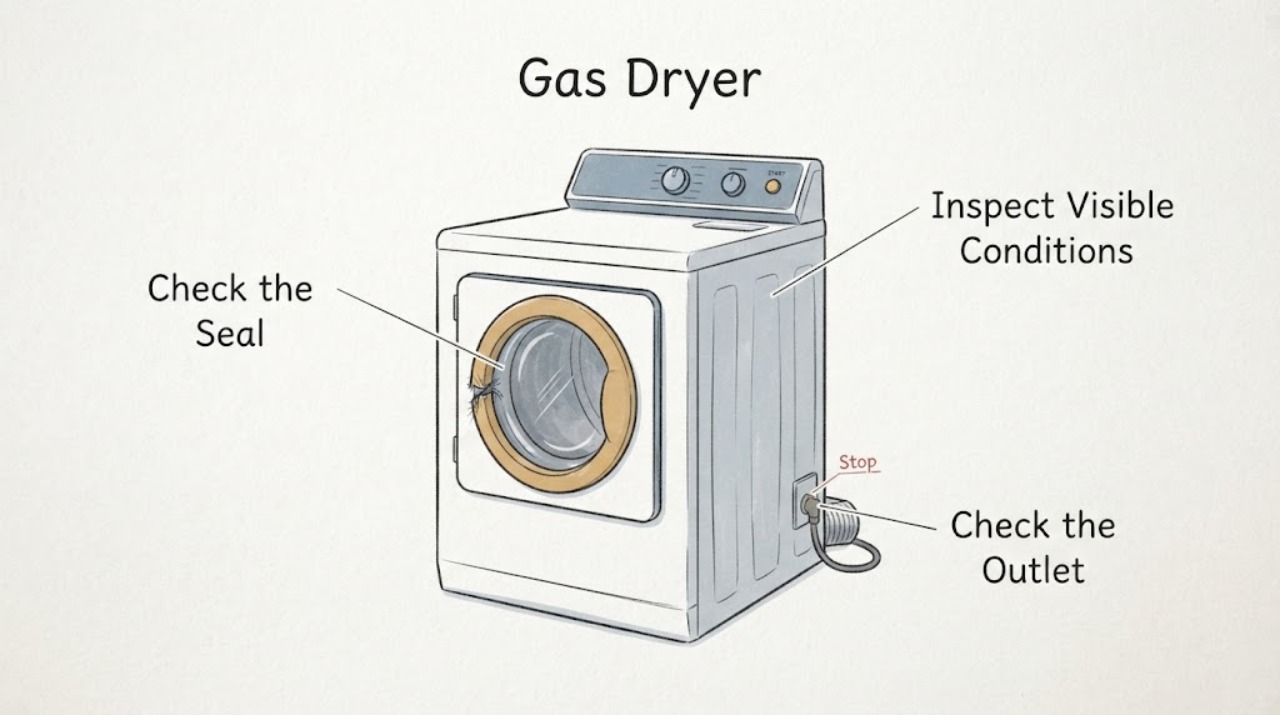
A torn or loose felt seal on the Whirlpool GGQ9800PW3 gas dryer is a stop-use repair condition, not a reason to reach blindly around the pulley. With the dryer cool, disconnect electrical power and close the gas supply before any service. Whirlpool's gas-dryer instructions warn against operating a dryer that is damaged, noisy, too hot, missing parts, or missing panels, and require panels to be secure before power is restored. The opened Whirlpool instructions show that a gas-dryer service reassembly must leave the drum seal correctly flared, the belt centered and tight, door-switch wires secured away from the drum, and all panels installed. Because the exact service layout for this assigned model was not exposed by Whirlpool's public model lookup, do not transfer a pulley-removal route from another dryer; arrange qualified appliance service and provide the full model tag.
Work through in order
Diagnostic checks
Use only checks that match the exact appliance or system and its official guide.
-
Check 1
Stop the dryer, wait until it is cool, unplug it or disconnect the electrical supply, and close the dryer gas shutoff before anyone opens a panel. Do not start another cycle to test the damaged seal.
Expected result: The dryer is isolated and cool, or the supply cannot be safely disconnected, the gas valve cannot be identified, or a gas smell is present.
Next step: Keep the dryer out of use. If gas is smelled, do not operate electrical switches or ignite anything; leave the area and contact the gas supplier or emergency service from a safe location. Otherwise arrange qualified appliance service.
Why this matters
Why: The first case permits only a planned, model-specific service inspection. The second case is a safety or gas emergency rather than a pulley-access problem.
-
Check 2
With power and gas isolated and the door open, use a light to look at the accessible drum rim and felt area. Record whether the felt is torn, detached, shredded, folded into the gap, or leaving a visible drum-to-panel gap. Do not reach into a hidden pulley or blower area.
Expected result: The felt is visibly damaged or displaced, the drum edge is rough or marked, lint is collecting at the gap, or the damage cannot be seen clearly from the opening.
Next step: Photograph the symptom with the appliance off and give the service provider the model tag. If the area cannot be inspected safely, stop rather than removing the cabinet.
Why this matters
Why: A visible seal defect supports a service repair, but it does not identify which related drum-support or drive parts are compatible or how this gas model must be opened.
-
Check 3
Look externally at the lint screen, exhaust outlet, cabinet seams, and floor area without removing panels. Note excessive lint, a hot or discolored cabinet, smoke residue, gas odor, or a loose or missing panel.
Expected result: There is smoke, a burning or gas odor, unusual heat, heavy lint accumulation, a damaged panel, or no visible external hazard.
Next step: For smoke, gas odor, or abnormal heat, keep the dryer off and follow emergency or qualified-service guidance. For lint or a missing panel, do not operate until it is safely corrected by the appropriate qualified person.
Why this matters
Why: Smoke, gas odor, abnormal heat, or missing panels increases fire, gas, and contact risk. A clean exterior does not prove that the seal or internal drive path is sound.
-
Check 4
Read the complete model and serial tag and ask Whirlpool or a qualified appliance technician to confirm the GGQ9800PW3 service instructions before ordering a felt seal or planning pulley access.
Expected result: The tag matches GGQ9800PW3 and the provider confirms a model-specific procedure, or the tag differs, is incomplete, or the provider proposes instructions for another dryer.
Next step: Use the confirmed model-specific instructions or schedule service. Do not order a seal, belt, pulley, or repair kit from a generic family listing when the full model match has not been verified.
Why this matters
Why: Only the first case establishes an appropriate repair path. A similar-looking Whirlpool gas dryer is not sufficient proof of the same access route or part fit.
-
Check 5
Before power or gas is restored after qualified service, verify with the technician that the drum seal is flared and seated, the belt is centered and tight, the door-switch wires are clipped away from the drum, and every removed panel is secure.
Expected result: All reassembly checks pass, or the seal remains loose, the belt is off-center, wiring can touch the drum, or a panel is missing or loose.
Next step: Do not energize or operate the dryer until the failed reassembly point is corrected by the qualified service provider.
Why this matters
Why: A passing set of checks supports a controlled return to service under the exact manual. A failed check leaves a rotating, electrical, or gas hazard.
Use your observations
Decision map
Find the observation that best matches what you see, then follow the next safe action.
-
PATH 01Next step
What you see
If the felt is visibly torn, detached, or shredded, or the drum leaves marks near the seal
Do this next
Keep the dryer off and arrange model-confirmed qualified service.
Why this path and its safety boundary
Why it matters: The symptom is consistent with a seal or drum-clearance repair need, but it does not prove a specific compatible part or pulley fault.
-
PATH 02Next step
What you see
If the drum cannot be inspected without removing the cabinet, reaching around the blower, or disturbing gas or electrical components
Do this next
Stop the inspection and give the full model tag and photographs to a qualified appliance technician.
Why this path and its safety boundary
Why it matters: The requested pulley access has crossed the user-level safety boundary.
-
PATH 03Next step
What you see
If there is gas odor, smoke, scorching, abnormal heat, or a repeated rubbing noise
Do this next
Do not run the dryer. For gas odor, leave the area without operating switches and contact the gas supplier or emergency service from a safe location; otherwise arrange urgent qualified service.
Why this path and its safety boundary
Why it matters: There may be an immediate gas, fire, rotating-part, or lint hazard.
-
PATH 04Next step
What you see
If the provider confirms the model-specific procedure and the seal, belt, wiring clips, and panels pass the reassembly checks
Do this next
Restore power and gas only under the confirmed service instructions, then stop immediately if rubbing, odor, smoke, or abnormal heat returns.
Why this path and its safety boundary
Why it matters: The documented safety checks are satisfied, but they do not guarantee that an unobserved internal defect is absent.
Helpful context
Understand the symptom
Treat a damaged felt seal as a stop-use condition
A felt seal that is torn, detached, shredded, or leaving a gap can let the rotating drum rub or expose a path for lint and heat. That visual symptom does not establish whether the seal, drum edge, bulkhead, belt, pulley, or another part also needs work. Keep the dryer cool and do not run a test load to see whether the damage gets worse. Whirlpool's safety instructions say not to operate a dryer that is damaged, noisy, too hot, or missing parts.
Why a gas dryer needs a different pulley-access decision
The assigned topic is a gas dryer, and the user-facing question is about reaching the pulley to remove the drum. The opened Whirlpool instructions describe a gas-dryer front-panel route for qualified service work, including disconnecting power, removing the top and front panel, protecting the door-switch wiring, and checking the seal and belt during reassembly. They do not establish that every GGQ9800PW3 access step or fastener arrangement is safe to copy from another model. Do not reach through a blower or vent assembly, remove gas components, or make a blind belt-removal attempt.
Use the model tag to resolve the service path
Record the complete model and serial information from the dryer's identification plate before arranging service. Whirlpool says its model number is used to locate manuals and troubleshooting material. The public lookup page opened here did not expose a model-specific GGQ9800PW3 repair document, so the service provider should confirm the exact gas-dryer construction before selecting a seal, removing the drum, or planning pulley access. No part number or compatibility claim is made in this article.
What a qualified repair must verify before a test cycle
Whirlpool's opened instructions identify the post-service checks that matter: the drum seal is flared and seated against the panel, the belt is centered and tight on the drum, door-switch wire clips are anchored so wires cannot touch the rotating drum, and the front and top panels are fully secured. Power and gas should remain disconnected until those checks and any model-specific service instructions are complete.
When checks do not resolve it
Need a professional?
Arrange qualified Whirlpool or appliance service for the damaged felt seal, any drum-to-panel gap, inaccessible pulley, rubbing, scorching, repeated noise, missing panel, or uncertainty about the gas-dryer access route. Use the gas supplier or emergency service for a gas smell.
Have this ready
- Provide the complete GGQ9800PW3 model and serial information, photographs of the felt and drum rim, the location of any marks or lint, whether the dryer was noisy or hot, and whether there was any smoke or gas odor.
Common questions
FAQ
Can I reach the pulley from the front of a Whirlpool GGQ9800PW3 gas dryer?
The opened Whirlpool gas-dryer instructions show a front-panel service route and reassembly checks, but the public model lookup did not expose a model-specific GGQ9800PW3 service document in this research session. Do not use a route from another dryer; have a qualified technician confirm the exact access procedure.
Can I keep using the dryer until the felt seal is replaced?
No. Whirlpool says not to operate a dryer that is damaged, noisy, too hot, missing parts, or missing panels. A torn or detached felt seal should be treated as a stop-use repair condition.
Does a damaged felt seal identify the pulley or belt as the failed part?
No. The seal symptom does not prove a pulley, belt, drum, bulkhead, blower, or motor fault. The opened Whirlpool instructions only state the belt and seal checks that must pass during documented reassembly.
What should I do if I smell gas while inspecting the dryer?
Do not try to light an appliance, touch an electrical switch, or use a phone in the building. Clear the area and contact the gas supplier from a neighbor's phone; if the supplier cannot be reached, call the fire department.
Read the exact guide
Official sources
- Whirlpool Gas Dryer Use and Care GuideWhirlpool · Opened Whirlpool's official gas-dryer guide. It describes a gas-dryer front-panel service route and says after reassembly the drum seal must be flared and seated, the belt centered and tight, door-switch wire clips anchored away from the drum, and panels secured. The guide is used for shared gas-dryer safety and reassembly checks only; it is not presented as a complete GGQ9800PW3-specific repair manual.
- Home - Product Help | WhirlpoolWhirlpool · Opened Whirlpool Product Help. It says to use the exact model number to locate manuals and documents for installation, use, and troubleshooting. The opened page did not expose a GGQ9800PW3-specific service document, so it is used only to set the model-confirmation boundary.
- Whirlpool Drying Guide for Gas and Electric DryersWhirlpool · Opened Whirlpool's official gas/electric dryer safety guide. It gives gas-smell emergency steps, requires disconnecting electrical power and gas before service, prohibits operation with missing or broken parts or removed panels, and directs qualified installation/service.
Community feedback
Share a repair observation
Share a plain-text repair observation. Accepted observations are published automatically; this page may take a moment to update.