
On this page
Start here
Quick answer
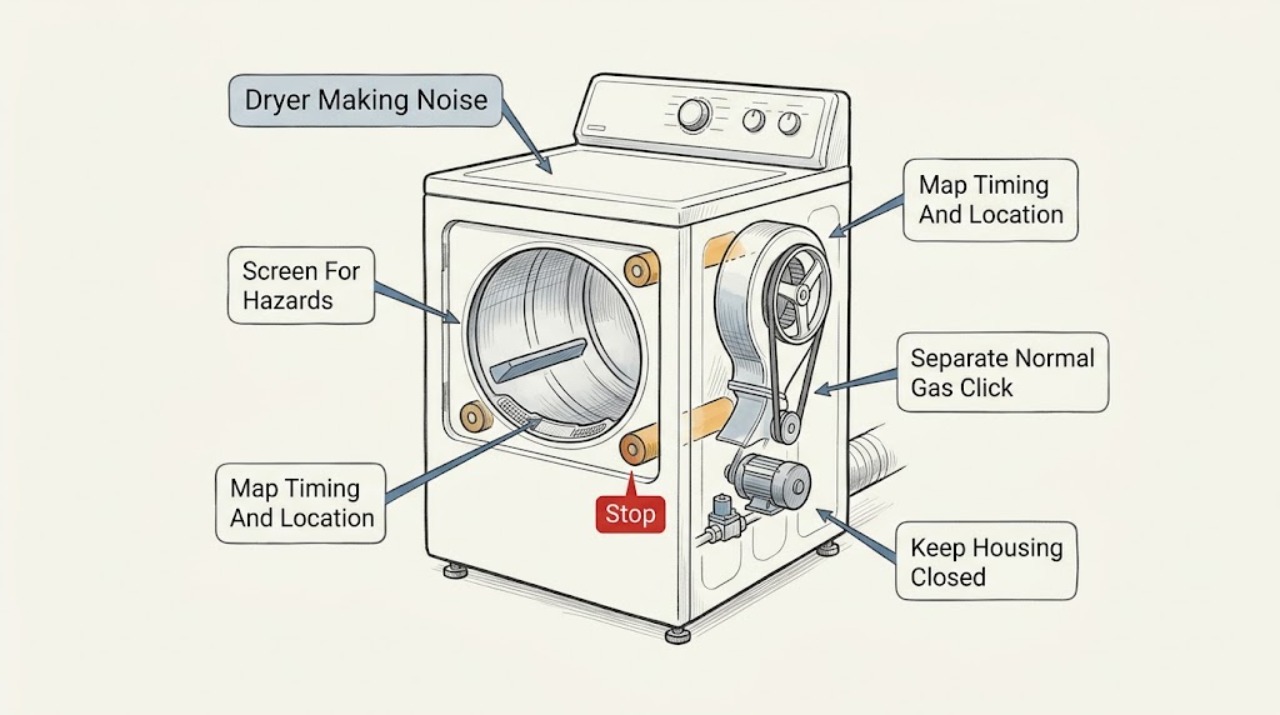
First identify when and where the Whirlpool dryer makes the sound: a brief light thump at startup or after a long idle period can come from drum-support rollers, a click during a gas dryer's cycle can be the gas valve, and a thump or rattle that follows the load often comes from bunched fabric, shoes, pockets, a pedestal, or objects touching the cabinet. With the dryer stopped and safe to inspect, remove loose items, check the drum edges and lint-screen opening for visible foreign objects, clear space around the cabinet and vent, and confirm all legs are present and the dryer is stable. A persistent squeal can point to lint inside or worn belt, pulley, roller, blower, or motor components; do not remove panels or lubricate by guesswork. Stop immediately for smoke, burning or gas odor, sparks, abnormal heat, a scraping or grinding sound that worsens, violent movement, a damaged drum or cabinet, or a breaker that trips, and arrange qualified Whirlpool service.
Before you begin
Safety first
- This article supports safe external observation and removal of clearly accessible loose items only. Do not open panels, work on wiring or gas components, enter the blower or motor housing, lubricate internal parts, crush the vent, or bypass any safety function.
Work through in order
Diagnostic checks
Use only checks that match the exact appliance or system and its official guide.
-
Check 1
Before listening again, stop the cycle and inspect from a safe position for gas odor, smoke, burning or melting odor, sparks, abnormal heat, a damaged cord or cabinet, water near the appliance, violent movement, or a breaker that has tripped.
Expected result: Record whether the sound is merely unusual or is accompanied by gas odor, smoke, heat, visible damage, electrical signs, or movement that could strike the wall or floor.
Next step: If a hazard is present, keep the dryer off and keep people away. For gas odor, avoid flames, electrical switches, and phones in the building, leave the area, and contact the gas supplier or emergency service from a safe location. For fire or electrical signs, use the appropriate emergency and qualified-service path.
Stop if: Do not run another cycle, reset a tripping circuit repeatedly, test for a gas leak, open the cabinet, or touch a wet or damaged electrical connection.
Why this matters
Why: A hazard changes the task from noise classification to immediate shutdown. Gas odor, smoke, arcing, overheating, water contact, or repeated electrical protection is not a normal operating sound; continued tumbling can worsen a mechanical or fire risk.
-
Check 2
From outside the appliance, note the exact sound type and when it occurs: startup, steady tumbling, airflow or venting, gas-heating cycles, drum slowdown, or after the dryer stops; identify whether it seems to come from the drum edge, lint opening, cabinet, floor, or vent.
Expected result: Record a brief click, startup thump, load-dependent rattle, scrape at the drum seam, squeal that continues, buzz caused by cabinet contact, or a sound that persists after the motor stops.
Next step: Use the matching branch below and capture a short audio or video from a safe distance if service will be needed; do not move panels or place hands near moving parts to locate the sound.
Stop if: Do not reach through the door, remove the lint screen while the drum or blower is running, or keep operating if the sound becomes metallic, grinding, hot, smoky, or violent.
Why this matters
Why: Timing can separate a normal gas-valve click or temporary roller sound from a load or foreign-object noise, cabinet vibration, blower interference, or a belt, pulley, roller, or motor service condition. A sound that continues after the expected operating phase needs model-specific assessment.
-
Check 3
If the dryer is gas-heated, note whether the sound is a brief, repeating click associated with the burner cycling and whether the dryer otherwise operates normally; do not open or adjust the gas system.
Expected result: Record a regular click without odor, smoke, unusual flame, delayed ignition, or heating abnormality, or record gas odor, a loud ignition, popping, abnormal flame, or a click that is accompanied by another hazard.
Next step: Treat only the quiet, regular click as a possible normal sound and verify the exact model guide. For any gas odor or abnormal ignition sign, stop, leave the area, and use qualified gas-appliance service or the emergency gas path.
Stop if: Do not light the burner manually, repeat ignition attempts, adjust a gas valve, search for a leak, or operate the dryer with gas odor, smoke, or abnormal flame.
Why this matters
Why: Whirlpool identifies gas-valve clicking during a gas dryer's cycle as a normal operating sound when the rest of the appliance is normal. Gas odor, delayed or loud ignition, abnormal flame, smoke, or heat is not explained by normal valve clicking.
-
Check 4
With the dryer stopped, unloaded, and safe to access, check pockets and garments for zippers, buckles, buttons, rivets, coins, paper clips, pens, shoes, or other loose items; untangle or redistribute large sheets and other fabric that has balled up.
Expected result: Record a foreign item, a twisted or balled load, shoes that were tumbled, or a clean and evenly distributed load; note whether the sound follows the load rather than the drum speed.
Next step: Remove or rearrange only the load items permitted by the care labels and the dryer instructions, then make one monitored test. If the same noise remains empty or returns with ordinary loads, arrange service.
Stop if: Do not put unsuitable items in the dryer to reproduce the noise, reach into a moving drum, or continue if an item has damaged the drum, seal, or cabinet.
Why this matters
Why: Whirlpool associates rattling, clicking, thumping, and vibration with loose garment hardware, pocket items, balled fabric, and shoes. If the sound remains with an empty drum, the load is less likely to be the cause and a drum, blower, cabinet, or support issue becomes more relevant.
-
Check 5
With power off and the drum stationary, use ordinary safe access to look along the visible front and rear drum seams and inside the lint-screen opening for a coin, paper clip, screw, sock, or other object; keep the lint screen installed for operation.
Expected result: Record no object, an object caught at a visible seam, an object in the lint chute, lint accumulation, or a scrape that persists without a visible obstruction.
Next step: Remove only a clearly accessible loose object with the appliance stopped and a dryer-specific lint brush where the official instructions allow it. If the object is trapped or the sound persists, keep the dryer off and request service.
Stop if: Do not use a sharp tool, dismantle the lint housing, reach toward the blower, remove panels, or operate without the lint screen installed.
Why this matters
Why: Whirlpool says small hardware can scrape at the drum seam and objects in the lint chute can contact the blower wheel and create a knocking sound. No visible object with persistent scraping, squealing, or rattling points to a concealed support or rotating component.
-
Check 6
Inspect the outside of the dryer for objects on top or leaning against it, contact with a nearby washer or wall, a pedestal drawer containing loose items, and a vent that is pressed against the cabinet; clear only external contact without moving the appliance unsafely.
Expected result: Record a quiet surrounding area, an item that rattles, cabinet contact during washer spin, pedestal contents, or a vent touching the dryer; note whether the sound changes when the surrounding contact is removed.
Next step: Remove loose external objects and restore safe clearance as the installation instructions permit, then make one monitored test. If the vent or appliance cannot be repositioned without force, ask a qualified installer or servicer.
Stop if: Do not climb on the dryer, pull a stacked unit, crush or puncture the vent, disconnect the vent while running, or continue if the cabinet is unstable.
Why this matters
Why: Whirlpool identifies external objects, washer-to-dryer vibration, pedestal contents, and vent contact as sources of knocking, rattling, or buzzing. If the sound remains with the cabinet clear, an internal or installation cause is more likely.
-
Check 7
From the outside, check whether all dryer legs are present and whether the cabinet rocks or teeters on the floor; confirm the unit is stable and level according to the installation instructions without opening the cabinet.
Expected result: Record all legs present and firm contact, a missing leg, rocking, an uneven floor, or vibration that increases when the drum turns.
Next step: Correct only an obvious external leveling or missing-leg condition using the exact installation instructions. If the dryer remains unstable, stacked, damaged, or difficult to level safely, arrange service or installation help.
Stop if: Do not lift a heavy or stacked dryer alone, remove structural parts, operate an appliance that walks, or continue with a damaged floor or cabinet.
Why this matters
Why: Whirlpool links pounding and thumping noises to missing legs or an unlevel dryer. A stable level cabinet makes an external support problem less likely; persistent vibration after leveling can indicate a load, drum support, or installation issue.
-
Check 8
If the noise is only a light thump at the first cycles after installation or after a long period unused, compare it with the official description while monitoring the dryer from outside; do not leave the dryer unattended to wait for the sound to change.
Expected result: Record a light sound that diminishes as the dryer operates normally, or a thump that persists, grows louder, occurs throughout the cycle, or is accompanied by vibration, scrape, heat, odor, or damage.
Next step: If the sound is brief and diminishing with normal operation and no hazard, document it and check the exact manual. If it persists or any unsafe sign appears, stop and arrange service for rollers, drum support, belt, blower, or motor as diagnosed.
Stop if: Do not keep running a dryer to force a sound to disappear, lubricate internal parts, remove panels, or ignore smoke, burning smell, overheating, scraping, or grinding.
Why this matters
Why: Whirlpool explains that new or long-idle drum-support rollers can temporarily make a light thump as they conform again. Persistence, worsening, or a different sound is not established as normal roller settling and needs diagnosis.
-
Check 9
If the sound persists after the load, external-contact, visible-object, and stability checks, stop troubleshooting and provide the model number, sound recording, timing, location, load condition, and any gas or electrical symptom to Whirlpool service.
Expected result: Record persistent squealing, squeaking, humming, buzzing, scraping, grinding, repeated thumping, a sound with an empty drum, or a noise that appears during blower or shutdown operation.
Next step: Keep the dryer off when the sound is persistent, metallic, hot, smoky, or worsening, and arrange model-specific qualified service through Whirlpool's official support route.
Stop if: Do not remove the back panel, open the motor or blower housing, lubricate by guesswork, or continue operation after a severe or hazardous sound.
Why this matters
Why: Whirlpool notes that lint inside, worn belt or pulley components, the blower wheel, drum supports, or other internal parts can require service. A sound that survives ordinary checks cannot be safely assigned to one part from sound alone.
Use your observations
Decision map
Find the observation that best matches what you see, then follow the next safe action.
-
PATH 01Safety boundary
What you see
The noise is accompanied by gas odor, smoke, burning or melting odor, sparks, abnormal heat, water near electrical parts, violent movement, cabinet damage, or a repeated breaker trip.
Do this next
Stop using the dryer and keep people away. For gas odor, avoid flames, electrical switches, and phones in the building, leave the area, and contact the gas supplier or emergency service from a safe location. Use appropriate emergency or qualified electrical service for fire and electrical signs.
Why this path and its safety boundary
Why it matters: This is not a normal noise classification problem and continued operation can increase fire, shock, gas, or mechanical risk.
Safety stop: Do not run another cycle, test a gas leak, reset protection repeatedly, or open the appliance.
-
PATH 02Safety boundary
What you see
A gas dryer makes a quiet, regular click during heating, with no gas odor, abnormal ignition, smoke, heat, or performance change.
Do this next
Monitor only from outside and verify the exact model guide. If the click becomes loud, irregular, delayed, or accompanied by odor or flame concern, stop and use qualified gas service.
Why this path and its safety boundary
Why it matters: Whirlpool identifies gas-valve clicking as a normal operating sound when the rest of the cycle is normal.
Safety stop: Do not manually ignite, adjust gas components, repeat ignition attempts, or search for a leak.
-
PATH 03Safety boundary
What you see
A light thump occurs only at startup or after a long idle period and diminishes during otherwise normal operation.
Do this next
Document the timing and check the exact model instructions; arrange service if it persists, worsens, or changes character.
Why this path and its safety boundary
Why it matters: Temporary roller flat spots or new-installation roller settling may explain the sound.
Safety stop: Do not keep running the dryer unattended or treat grinding, smoke, heat, or violent vibration as normal settling.
-
PATH 04Safety boundary
What you see
The rattle, click, or thump follows a load containing loose hardware, pockets, bunched fabric, or shoes.
Do this next
Stop, remove loose objects, untangle or redistribute suitable laundry, and make one monitored test with an appropriate load.
Why this path and its safety boundary
Why it matters: The load itself can contact the drum and cause noise or vibration.
Safety stop: Do not dry unsuitable items or continue if the load damaged the drum, seal, or cabinet.
-
PATH 05Safety boundary
What you see
The sound changes when objects, the vent, a nearby washer, pedestal contents, or an unlevel cabinet is corrected.
Do this next
Restore safe clearance and leveling only as the installation instructions allow, then monitor one cycle; ask for installation help when the unit is stacked or unsafe to move.
Why this path and its safety boundary
Why it matters: External contact, installation, or stability is a more likely source than an internal rotating part.
Safety stop: Do not pull a stacked unit, crush the vent, or operate an unstable dryer.
-
PATH 06Safety boundary
What you see
A coin, fastener, or other object is visible at the drum seam or lint-screen opening.
Do this next
Remove only a clearly accessible object with the dryer stopped and the permitted lint tool; use service when it is trapped or the noise remains.
Why this path and its safety boundary
Why it matters: The object can scrape the drum or contact the blower wheel and explain the noise.
Safety stop: Do not pry, dismantle the lint chute, reach toward the blower, or operate without the lint screen.
-
PATH 07Safety boundary
What you see
The sound remains with a suitable load and clear surroundings, occurs with an empty drum, or is squealing, scraping, grinding, or worsening.
Do this next
Keep the dryer off as appropriate and provide Whirlpool service the model, sound timing, location, recording, and checks performed.
Why this path and its safety boundary
Why it matters: An internal belt, pulley, roller, blower, motor, support, or other component may need qualified diagnosis; sound alone cannot identify the part.
Safety stop: Do not open panels, lubricate internal parts, or keep operating a dryer with severe or hazardous noise.
Helpful context
Understand the symptom
Classify the noise by timing and location
Listen only from a safe position and note whether the sound occurs during startup, while the drum tumbles, when the blower or vent is moving air, when a gas burner cycles, or as the drum slows after the cycle. Also note whether it is a click, thump, rattle, scrape, squeal, buzz, hum, or grinding sound and whether it comes from the drum edge, front or rear, lint-screen opening, cabinet, floor, or vent. Timing and location are more useful than a generic label such as noisy.
Some brief sounds can be normal, but they still need a boundary
Whirlpool says a gas dryer can click when its gas valve turns on and off. A light thump during the first minutes after installation or a period of non-use can come from rollers settling back into shape. Those explanations apply only when the sound is brief, the dryer remains stable, and there is no gas odor, smoke, burning smell, overheating, or damage. A new, worsening, metallic, or persistent sound should not be normalized.
Keep internal belt, pulley, blower, and motor work professional
Lint inside the dryer can contribute to squealing, and aging belt or pulley components may need replacement. A foreign object can also reach the lint chute and contact the blower wheel. Whirlpool's user-level guidance is limited to safe visual checks and removing accessible objects with the lint screen installed; panel removal, internal cleaning, component diagnosis, and part replacement belong to a qualified servicer.
Safety boundary
Stop conditions
- Stop immediately for gas odor, smoke, burning or melting odor, sparks, abnormal heat, water near electrical equipment, damaged wiring or cabinet, violent movement, or a repeated breaker trip.
- Do not manually ignite or adjust a gas dryer, test for a gas leak, operate electrical controls in a gas-smelling area, or continue after abnormal ignition or flame signs.
- Do not reach into a moving drum or blower, remove panels, dismantle the lint chute, lubricate internal parts by guesswork, or operate without the lint screen installed.
- Do not pull a stacked unit, crush or puncture a vent, force a damaged drum or door, or run an unstable dryer unattended.
- Do not normalize a persistent, metallic, scraping, grinding, squealing, overheating, or worsening sound; arrange qualified Whirlpool service.
Only after diagnosis
Potential parts
- drum support roller or related support
Consider this category only when a qualified diagnosis confirms persistent startup thumping or drum-support wear after suitable-load, stability, and external-contact checks.
Confirm the exact Whirlpool model and support design; do not open the cabinet or lubricate the roller by guesswork. - dryer belt or pulley
Consider this category only when persistent squealing or squeaking remains and an authorized servicer confirms belt or pulley wear or lint-related internal interference.
Match the exact model and have the internal work performed by a qualified servicer. - blower wheel or lint-chute component
Consider this category only when a visible-object check is clear but the sound is localized to airflow or the lint opening and a qualified diagnosis confirms blower or chute damage.
Confirm the exact model and do not dismantle the lint housing or blower without qualified service. - motor or motor-related component
Consider this category only when a qualified diagnosis links a persistent hum, grinding, or speed-related noise to the motor after load, support, blower, and belt causes are excluded.
Exact model diagnosis and fitment are required; sound alone does not establish a motor replacement.
When checks do not resolve it
Need a professional?
Arrange Whirlpool or qualified appliance service when the sound persists after removing suitable-load and external-contact causes, occurs with an empty drum, is a squeal, scrape, grind, or worsening hum, follows a visible object that cannot be safely removed, or requires panel, blower, belt, pulley, roller, motor, vent, gas, or electrical work. Use urgent emergency or qualified service for gas odor, smoke, fire, sparks, severe overheating, water near electrical parts, violent movement, or repeated breaker trips.
Safety scope: This article supports safe external observation and removal of clearly accessible loose items only. Do not open panels, work on wiring or gas components, enter the blower or motor housing, lubricate internal parts, crush the vent, or bypass any safety function.
Common questions
FAQ
Is a clicking sound normal on a Whirlpool gas dryer?
A quiet, regular click associated with gas-valve cycling can be normal when the dryer otherwise operates normally. Gas odor, loud or delayed ignition, abnormal flame, smoke, or heat is not normal; stop, leave the area for gas odor, and use qualified service.
Why does my Whirlpool dryer thump at startup?
A light thump during the first cycles after installation or after a long idle period can come from drum-support rollers settling. Balled laundry, shoes, missing legs, or an unlevel floor can also thump. A persistent, loud, metallic, or worsening sound needs service.
What should I check when my dryer rattles?
Stop the dryer and check pockets and garment hardware, visible drum seams, the lint-screen opening, objects on or beside the cabinet, pedestal contents, nearby washer contact, and vent contact. Keep the lint screen installed for operation. If the rattle remains, arrange service.
Can lint cause a Whirlpool dryer to squeal?
Whirlpool says lint buildup inside can contribute to squealing or squeaking around belt and pulley areas, and objects in the lint chute can contact the blower wheel. Do only accessible visual checks; internal cleaning or part replacement requires qualified service.
When should I stop using a noisy dryer?
Stop for smoke, burning or gas odor, sparks, abnormal heat, water near electrical parts, violent movement, grinding or worsening scraping, damaged parts, or a repeated breaker trip. Do not run another test; use the appropriate emergency or qualified Whirlpool service path.
Read the exact guide
Official sources
- Buzzing Sound - DryerWhirlpool Product Help · Official Whirlpool Product Help troubleshooting page for household dryers.
- Knocking or Rattling Sound - DryerWhirlpool Product Help · Official Whirlpool Product Help troubleshooting page for household dryers.
- Sounds or Noises in a DryerWhirlpool Product Help · Official Whirlpool Product Help guidance for household dryers; the exact model's documentation controls installation and service procedures.
- Thumping Sound - DryerWhirlpool Product Help · Official Whirlpool Product Help troubleshooting page for household dryers.
- Dryer - Product HelpWhirlpool Product Help · Official Whirlpool Product Help category for household dryers; use the model number for manuals and service details.
- Squealing or Squeaking Sound - DryerWhirlpool Product Help · Official Whirlpool Product Help troubleshooting page for household dryers.
Community feedback
Share a repair observation
Share a plain-text repair observation. Accepted observations are published automatically; this page may take a moment to update.