
On this page
Start here
Quick answer
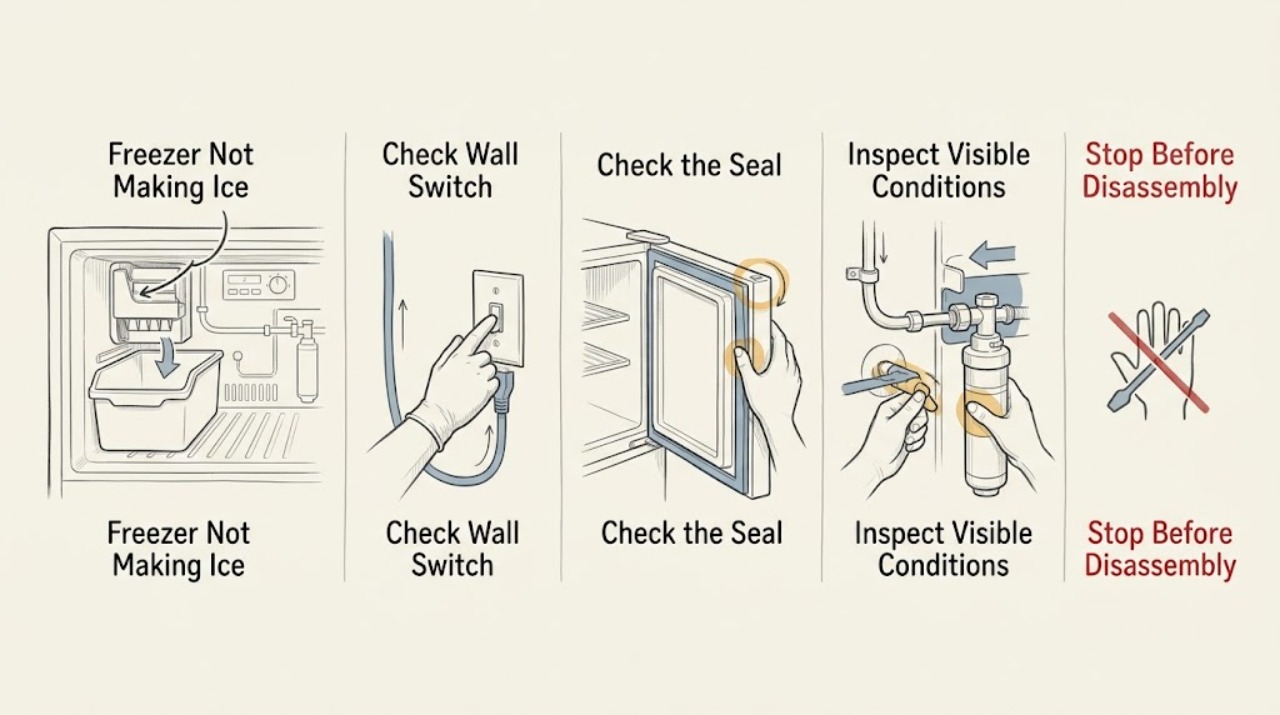
First determine whether the Whirlpool freezer has a manual ice tray or a plumbed automatic ice maker. For an automatic system, confirm the ice maker is on, the freezer is cold enough, the door closes fully, the ice bin and ejector are not jammed, and the water line is open and unkinked. Whirlpool says a freezer temperature around 0 to 5 degrees Fahrenheit supports ice production on applicable models, while a clogged or incorrectly installed filter can reduce or stop water flow. Check the filter is seated and locked according to the model instructions, and use only a non-forceful external check for an ice jam. If the freezer is warm, water is leaking, the line or filter housing is damaged, food is thawing, or the appliance has smoke, a burning smell, sparks, or a repeated breaker trip, stop and arrange qualified service; do not bypass the door switch or test the valve live.
Work through in order
Diagnostic checks
Use only checks that match the exact appliance or system and its official guide.
-
Check 1
With the freezer door open only briefly, identify whether it uses a manual tray or an automatic ice maker. For an automatic unit, check the ice-maker switch or shutoff arm, the ice bin position, and any visible display or control mode; do not force the arm or reach into the mechanism.
Expected result: A manual tray has no automatic harvest cycle and needs the freezer to freeze the filled tray. An automatic maker that is switched off, has a raised shutoff arm, has a misplaced bin, or is in a vacation/showroom mode can make no ice without a component failure.
Next step: If the automatic controls are off, correct the setting using the manual and observe the next safe cycle. If they are on and the bin is seated, continue to temperature and door checks.
Why this matters
Why: This separates a missing water-valve diagnosis from a control or setup issue. Whirlpool lists an accidentally turned-off ice maker as a common cause and says the bin must be installed correctly on applicable models.
-
Check 2
Check the freezer temperature display or an independent appliance thermometer, and inspect the door gasket and shelves for anything preventing a complete seal. Keep the door closed while the freezer recovers; do not repeatedly change the control to its coldest setting.
Expected result: A warm freezer, a door that does not close, or a gasket gap can prevent normal ice production. On applicable Whirlpool models, the manufacturer gives about 0 to 5 degrees Fahrenheit as an optimal freezer range for ice production; a correctly cold compartment shifts attention toward water flow or the ice mechanism.
Next step: Remove only an obstruction that is plainly preventing the door from closing, then allow the freezer to stabilize according to the manual. If it remains warm or food is thawing, stop relying on the ice-maker test and arrange cooling-system service.
Why this matters
Why: Ice production depends on the freezer reaching its operating temperature, not just the ice-maker switch being on. A warm compartment also creates a food-safety concern and should be treated separately from a simple ice-maker fault.
-
Check 3
For a plumbed automatic ice maker, inspect the accessible water line from the shutoff valve to the freezer and confirm the valve is open. Look for a kink, pinch behind the cabinet, or a line pushed tightly against the wall; do not disconnect a pressurized fitting.
Expected result: A kinked or pinched line can reduce water flow and produce little or no ice. A line that is open, secure, and unkinked makes the filter, inlet valve, ice-maker fill path, or control a more likely next branch.
Next step: Correct only a safe, visible routing problem and wait for the next fill opportunity. If the line leaks, the shutoff will not operate, or the flow remains absent, close the shutoff only if safely reachable and request qualified help.
Why this matters
Why: Whirlpool identifies a restricted or turned-off water supply as a frequent ice-maker cause and warns that pushing the appliance too far back can pinch the line. This is an external plumbing check, not a reason to open the valve assembly.
-
Check 4
Inspect the water filter indicator and the filter seating without forcing the housing. If the model has a dispenser, compare normal water flow with the filter installed and follow the model instructions for removal, replacement, or bypass; keep the filter locked and the housing dry after the check.
Expected result: Low water flow, thin or hollow cubes, no water dispensing, a filter warning, or a filter that is not locked points to a clogged or incorrectly installed filter. Normal flow with a correctly seated filter makes the supply line or ice-maker fill valve a more likely branch.
Next step: Use the model's approved filter procedure and flush the water system when the manual requires it. If the housing leaks, the filter cannot seal, or no ice follows a confirmed water-flow correction, stop and arrange service.
Why this matters
Why: Whirlpool says a clogged or incorrectly installed filter can reduce water flow to the ice maker and can result in no ice. Filter locations and bypass arrangements vary, so a filter must not be left loose or partially engaged.
-
Check 5
With the ice maker stopped and the freezer door open briefly, look for cubes stuck in the ejector arm, a packed ice bin, or ice clumping that prevents movement. Remove only loose ice that the manual permits, using a plastic utensil if necessary; never pry the mechanism or use a sharp tool.
Expected result: A visible loose cube or packed bin can prevent a harvest cycle and explains why the maker is cold and supplied but produces no new ice. A clear bin and free-looking ejector do not prove the motor, thermostat, valve, or control is good.
Next step: Restore the bin and door only after all loose ice is removed safely, then observe one normal harvest opportunity. If the ejector will not move normally or the jam returns, stop rather than forcing it and request service.
Why this matters
Why: A jam is a mechanical obstruction branch, while a clear mechanism shifts suspicion to temperature, water fill, or an internal component. Ice that has repeatedly refrozen into a solid mass may also indicate a storage or dispensing problem rather than a failed maker.
-
Check 6
After the temperature, door, control, water line, filter, bin, and visible-jam checks, perform at most one model-approved reset or power cycle if the manual allows it. Record whether the ice maker fills, makes a harvest sound, or shows a fault; do not repeatedly reset a leaking, warm, sparking, or noisy appliance.
Expected result: A single reset that restores a fill or harvest suggests a transient control state. No fill with good water flow, no harvest despite a cold freezer, a recurring warning, or a new leak points to an inlet valve, ice-maker, wiring, control, or cooling fault that needs diagnosis.
Next step: If production does not resume after the safe single test and the model's normal wait period, leave the unit operating only if it is safe and cold, and arrange qualified service with the recorded symptoms and model number.
Why this matters
Why: Whirlpool describes a reset or one-minute power cycle as a possible minor remedy on applicable models, but a reset cannot verify a valve or energized component and must not replace a service diagnosis.
Use your observations
Decision map
Find the observation that best matches what you see, then follow the next safe action.
-
PATH 01Next step
What you see
The freezer uses a manual ice tray rather than a plumbed automatic ice maker.
Do this next
Confirm the freezer reaches its normal cold temperature and the tray is filled and positioned as the manual specifies; if the freezer is warm or food is thawing, pursue a cooling diagnosis instead of an ice-maker diagnosis.
-
PATH 02Next step
What you see
The automatic ice maker is off, the shutoff arm is raised, the control mode disables it, or the ice bin is not seated.
Do this next
Correct the setting or bin position using the manual and allow a normal cycle; do not force the arm or bypass the door switch.
-
PATH 03Next step
What you see
The freezer is warm, the door does not seal, or the temperature cannot remain in the model's normal range.
Do this next
Protect perishable food and arrange cooling-system service if the temperature does not recover; ice production will not be a reliable test while the freezer is warm.
-
PATH 04Next step
What you see
The water line is kinked or the shutoff is closed, or a recently changed filter is loose, clogged, or not locked.
Do this next
Correct the safe external line or filter seating using the model instructions, then allow the next fill cycle. Stop for leaks or a filter housing that will not seal.
-
PATH 05Next step
What you see
A cube is visibly jammed in the ejector or the bin is packed or clumped.
Do this next
Remove only loose ice with a plastic utensil when the manual permits; if the mechanism will not move normally or the jam returns, request service rather than prying it.
-
PATH 06Next step
What you see
Water flow and temperature are normal but the maker never fills or harvests, or a leak, smoke, burning smell, spark, damaged cord, repeated trip, or unusual heat appears.
Do this next
Stop troubleshooting. Isolate power or water only from a safe, dry position, protect food and flooring, and arrange qualified appliance service; use emergency help for smoke or fire.
Helpful context
Understand the symptom
Identify the ice system before troubleshooting it
A freezer with a refillable manual tray has no water valve or harvest mechanism to diagnose. An automatic ice maker has an on/off control or arm, an ice bin, and—on plumbed models—a water line and filter. Record which system is fitted, whether the freezer is actually cold, and whether the problem is no ice at all, thin or hollow cubes, or an ice bin that is not dispensing. Model controls and reset methods vary, so use the manual for the exact location and sequence.
Protect food, water, and electrical connections
Move perishable food to a safe cold appliance if the freezer is warming. Stop if water reaches wiring or the floor, the cabinet is unusually hot, the cord is damaged, a breaker trips again, or there is smoke, a burning odor, or arcing. Do not use a knife or metal tool to break ice, force the ejector, bypass a door switch, or remove energized covers.
When checks do not resolve it
Need a professional?
Arrange qualified appliance service when a correctly cold freezer has water supply and filter flow but the automatic maker still does not fill or harvest, or when a fault returns after one safe reset., Stop immediately for a water leak toward wiring or the floor, food thawing with a warm freezer, smoke, burning or electrical odor, sparks, a damaged cord, unusual cabinet heat, or a repeated breaker trip., Do not open an energized control or valve compartment, bypass the door switch, force the ejector, or use a knife or metal tool to clear ice., If household water pressure or a shutoff valve is the suspected cause and it cannot be safely checked externally, use a qualified plumber or appliance technician rather than disconnecting pressurized fittings.
Common questions
FAQ
Why is my Whirlpool freezer not making any ice?
Check whether the automatic ice maker is on, the freezer is cold, the door and bin are seated, the water line is open and unkinked, and the filter is installed correctly. A recurring failure after those checks needs service.
What temperature should a Whirlpool freezer be for ice making?
Whirlpool gives about 0 to 5 degrees Fahrenheit for optimal ice production on applicable models. Use your model manual and a reliable thermometer; if the freezer is warm or food is thawing, address cooling and food safety first.
Can a Whirlpool water filter stop the freezer from making ice?
Yes. Whirlpool says a clogged or incorrectly installed filter can reduce water flow and cause low or no ice production. Check the filter's seating and lock position using the model instructions, and stop if the housing leaks.
How do I clear a jammed Whirlpool ice maker?
Look for loose cubes around the ejector and remove only what the manual permits, using a plastic utensil if necessary. Never force the arm or use a knife or metal tool. If the jam returns or the mechanism will not move normally, call for service.
Should I reset a Whirlpool freezer ice maker?
A single model-approved reset or power cycle may clear a minor control state. Record the result and wait for the model's normal production period; repeated resets cannot fix a blocked water path, failed valve, warm freezer, or electrical fault.
Why are my Whirlpool ice cubes small or hollow?
Small or hollow cubes can indicate low water flow. Check the water line, shutoff, and filter without disconnecting pressurized fittings. Whirlpool also notes that reverse-osmosis systems can reduce pressure; use a qualified plumber if supply pressure needs testing.
Read the exact guide
Official sources
- Ice Maker Not Working - Troubleshooting - Product Help | WhirlpoolWhirlpool · Whirlpool refrigerator and freezer automatic ice maker troubleshooting, temperature, water supply, controls, filters, and service
- Not Making Ice - Exisiting Installation - Upright Freezer - Product Help | WhirlpoolWhirlpool · Whirlpool upright freezer automatic ice maker water line, controls, jammed ejector, and water pressure checks
- Does the Water Filter Need to be Replaced? - Product Help | WhirlpoolWhirlpool · Whirlpool refrigerator water-filter flow, installation, replacement, and ice-production symptoms
- Owner's ManualWhirlpool · Whirlpool freezer and ice-maker owner guidance, food protection, door/bin checks, and electrical safety
Community feedback
Share a repair observation
Share a plain-text repair observation. Accepted observations are published automatically; this page may take a moment to update.