
On this page
Start here
Quick answer
Treat visible sparks, arcing, smoke, a burning smell, or a flash as an electrical safety event: stop using the Whirlpool freezer and disconnect power only from a dry, safe position, or switch off the freezer circuit if the plug cannot be reached safely. Do not open the cabinet or perform any energized inspection. Whirlpool's official freezer guidance says a sizzling, hissing, or dripping noise during the defrost cycle can be water dripping onto the defrost heater and may be normal, but that is not the same as seeing an electrical spark. If the report is only that normal-sounding noise, note when it occurs and confirm the exact model's manual; if there is an actual flash, repeated crackle with visible arc, char, smoke, heat damage, or uncertainty about what was seen, leave the freezer off and arrange qualified service.
Before you begin
Safety first
- This article permits only safe external observation and power removal from a dry, reachable position. It does not authorize energized testing, cabinet or liner removal, heater or wiring access, breaker bypass, ice-tool use, or electrical repairs.
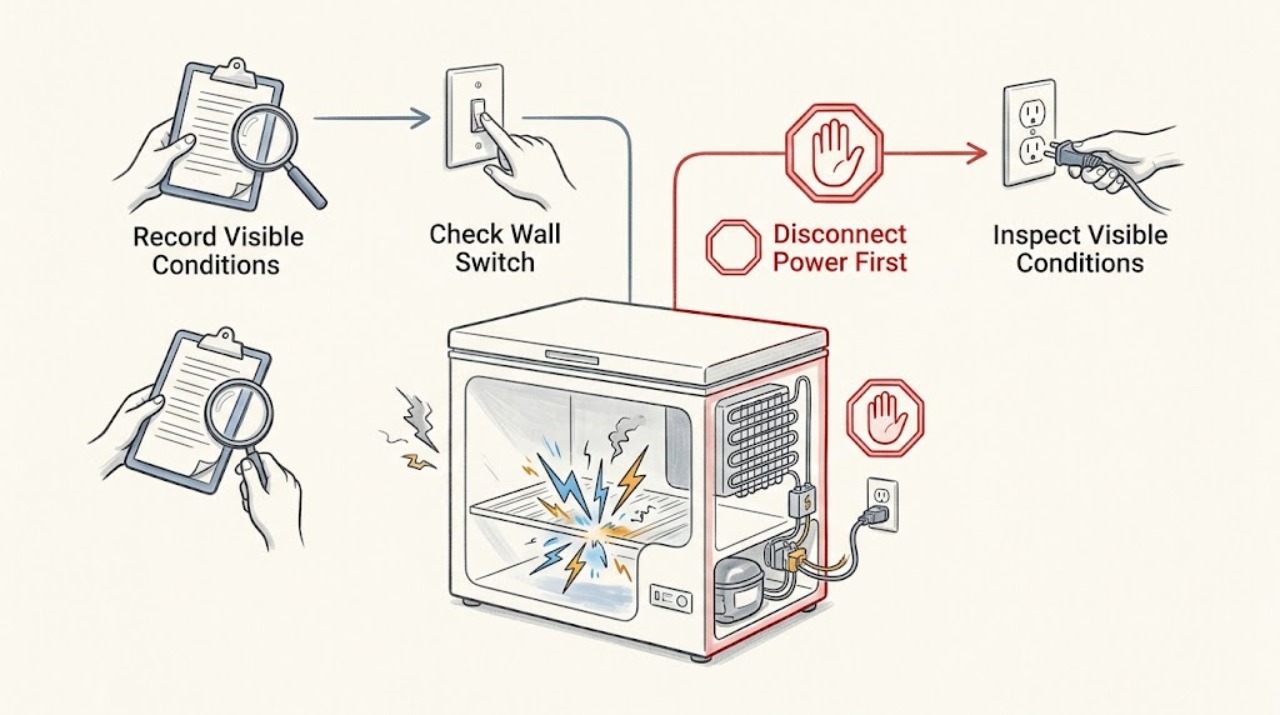
Work through in order
Diagnostic checks
Use only checks that match the exact appliance or system and its official guide.
-
Check 1
From a safe position, record exactly what happened: sound only or visible flash, the location (inside the cabinet, behind the freezer, at the outlet, or at a control), whether it coincided with a defrost pause or restart, and whether there was smoke, odor, heat, a breaker trip, or visible damage. Do not move the freezer or open any panel to look closer.
Expected result: There was only a brief sizzle, hiss, or drip with no visible light or damage; there was an actual flash or arc; smoke/odor/heat damage is present; or the event cannot be classified safely.
Next step: Use the normal-defrost-sound branch only when no visible arc or safety symptom occurred. For a flash, damage, smoke, odor, breaker trip, or uncertainty, keep the freezer off and arrange qualified service.
Stop if: Do not recreate the event, reach into the freezer while energized, remove covers, or touch a suspected damaged component.
Why this matters
Why: A sound-only defrost event can match Whirlpool's documented water-on-defrost-heater explanation. A visible flash or any accompanying damage is not established as normal, and an unknown event cannot be safely diagnosed by a generic freezer procedure.
-
Check 2
If there was any visible spark, flash, smoke, burning smell, melted plastic, blackened area, repeated crackling, or breaker operation, stop using the freezer. Disconnect the plug only if it is dry and reachable without approaching the suspected fault; otherwise switch off the appliance's circuit at the electrical panel and keep clear.
Expected result: Power is safely removed and the event does not recur, or the outlet/cord/wall area is hot, damaged, wet, smoking, or still arcing.
Next step: Leave the freezer off, do not restore power for a test, and arrange qualified appliance service; use a licensed electrician if the outlet, cord, breaker, or house wiring is implicated. Preserve food safely by an alternate method.
Stop if: Do not reset a tripped breaker repeatedly, use an extension cord, bypass a fuse or thermal device, or open the electrical compartment.
Why this matters
Why: Removing power stops the immediate electrical hazard but does not identify or repair the failed heater, wiring, control, outlet, or supply. Continued operation could worsen fire, shock, or food-loss risk.
-
Check 3
If the event was sound-only, observe from outside the cabinet whether it happens during a defrost interval and whether the freezer otherwise cools normally, without opening the rear, liner, heater cover, or control housing. Record the model number and consult its Whirlpool manual for the applicable noise description.
Expected result: A brief sizzle, hiss, or drip occurs during defrost with no visible flash, odor, damage, or cooling problem; the sound occurs continuously or outside defrost; or cooling performance changes.
Next step: For the documented sound-only pattern, monitor without opening the appliance and follow the model manual. For continuous/unknown noise, warming food, odor, or any visible spark, keep the freezer off and request service.
Stop if: Do not remove ice with a sharp tool, pour water into the freezer, or inspect the defrost heater or wiring while energized.
Why this matters
Why: Whirlpool says a sizzling, hissing, or dripping defrost-cycle noise can be water dripping onto the defrost heater and part of normal operation. A sound outside that pattern, a visible flash, or worsening cooling requires model-specific diagnosis.
Use your observations
Decision map
Find the observation that best matches what you see, then follow the next safe action.
-
PATH 01Next step
What you see
The report is a brief sizzle, hiss, or drip during a defrost interval, with no visible flash, smoke, burning odor, damage, breaker trip, or cooling change.
Do this next
Monitor from a safe position and use the exact model manual. If a flash, odor, damage, repeated breaker trip, or cooling problem appears, stop using the freezer and request service.
Why this path and its safety boundary
Why it matters: This matches Whirlpool's documented normal explanation of water dripping onto the defrost heater during defrost more closely than an electrical arc.
-
PATH 02Next step
What you see
A visible spark or flash occurred, or the sound is accompanied by smoke, burning odor, blackened or melted material, heat, breaker operation, or a warm freezer.
Do this next
Keep power off and arrange qualified appliance service. Have a licensed electrician assess the house supply when the outlet, cord, breaker, or wall wiring is involved.
Why this path and its safety boundary
Why it matters: An electrical, defrost-circuit, control, outlet, or wiring fault is possible; the event is not safely classified as the normal defrost sound.
-
PATH 03Next step
What you see
The user cannot tell whether the event was a sound or a visible arc, cannot identify its location, or would need to open or move the freezer to investigate.
Do this next
Leave the freezer off, record the model and external observations, protect or relocate food safely, and arrange qualified service without attempting an internal inspection.
Why this path and its safety boundary
Why it matters: The evidence is insufficient to choose between a normal defrost noise and an electrical fault, and further testing could expose the user to shock or fire risk.
Helpful context
Understand the symptom
First decide whether it was a sound or a visible arc
People often describe a sharp sizzle, hiss, crackle, or drip as sparking. Whirlpool documents sizzling, hissing, or dripping during defrost as water contacting the defrost heater and calls that normal operation for the applicable convertible chest-freezer guidance. A visible flash, arc, smoke, burning odor, or damaged part is a different and potentially hazardous condition. Do not reproduce it to identify the source.
Keep all checks external and de-energized
Whirlpool's freezer support is model-specific and directs owners to use the model number for manuals and troubleshooting. For this symptom, the safe scope is to note the time, location, sound, visible flash, odor, and display behavior from a safe position. Do not remove the liner, rear cover, defrost shield, wiring, heater, or control panel, and do not test live voltage.
The defrost explanation does not excuse visible sparking
A normal defrost sound may occur without a fault, but an actual spark cannot be classified from sound alone. If the freezer is warm, repeatedly trips a breaker, smells burned, shows melted or blackened material, or sparks visibly, keep it off and have a qualified technician inspect the defrost circuit and electrical supply.
When checks do not resolve it
Need a professional?
Arrange qualified appliance service for any visible spark or arc, smoke, burning odor, heat damage, repeated crackling, breaker trip, warming freezer, or uncertain source. Use a licensed electrician when the outlet, power cord, breaker, or house wiring is implicated. Do not restore power just to reproduce the event and do not open the freezer cabinet.
Safety scope: This article permits only safe external observation and power removal from a dry, reachable position. It does not authorize energized testing, cabinet or liner removal, heater or wiring access, breaker bypass, ice-tool use, or electrical repairs.
Common questions
FAQ
Can a Whirlpool freezer make a sizzling sound without a fault?
Yes, Whirlpool says a sizzling, hissing, or dripping noise can occur during defrost when water drips onto the defrost heater. That explanation applies to a sound-only event; a visible spark, smoke, burning odor, damage, or breaker trip requires the freezer to remain off and be serviced.
What should I do if I actually see a spark inside the freezer?
Stop using it and remove power only from a dry, safe position, or switch off the appliance circuit if the plug cannot be reached safely. Do not open panels or restore power for a test. Arrange qualified appliance service, and involve a licensed electrician if the outlet, cord, breaker, or house wiring is involved.
Can I remove the freezer cover to check the defrost heater?
No. A freezer that visibly sparks or has an uncertain electrical event should be de-energized and professionally inspected. This page does not authorize internal or energized checks of the heater, wiring, controls, or power supply.
Read the exact guide
Official sources
- Sizzling or Hissing Noise - Convertible Chest Freezer - Product HelpWhirlpool · Official Whirlpool Product Help article for the described convertible chest-freezer noise; exact model and freezer configuration control.
- Upright Freezer - Product HelpWhirlpool · Official Whirlpool Product Help category; use the exact model number and applicable configuration for service guidance.
Community feedback
Share a repair observation
Share a plain-text repair observation. Accepted observations are published automatically; this page may take a moment to update.