
On this page
Start here
Quick answer
Treat a visible spark, flash, arc, smoke, burning smell, heat, or charred material as an electrical safety event. From a dry, safe position, switch the freezer off or unplug it only if the plug is reachable without approaching the suspected fault; otherwise turn off the freezer circuit at the breaker. If the spark was inside the freezer, keep the door closed and do not continue troubleshooting. Do not restore power to reproduce the event, remove panels, or test wiring. Have a qualified appliance technician inspect the freezer, and use a licensed electrician when the outlet, cord, breaker, or household wiring is involved.
Before you begin
Safety first
- This article permits only safe observation from outside the freezer and power removal from a dry, reachable position. It does not authorize energized testing, cabinet or liner removal, electrical-panel or outlet repair, breaker bypass, or restoring power to reproduce the event.
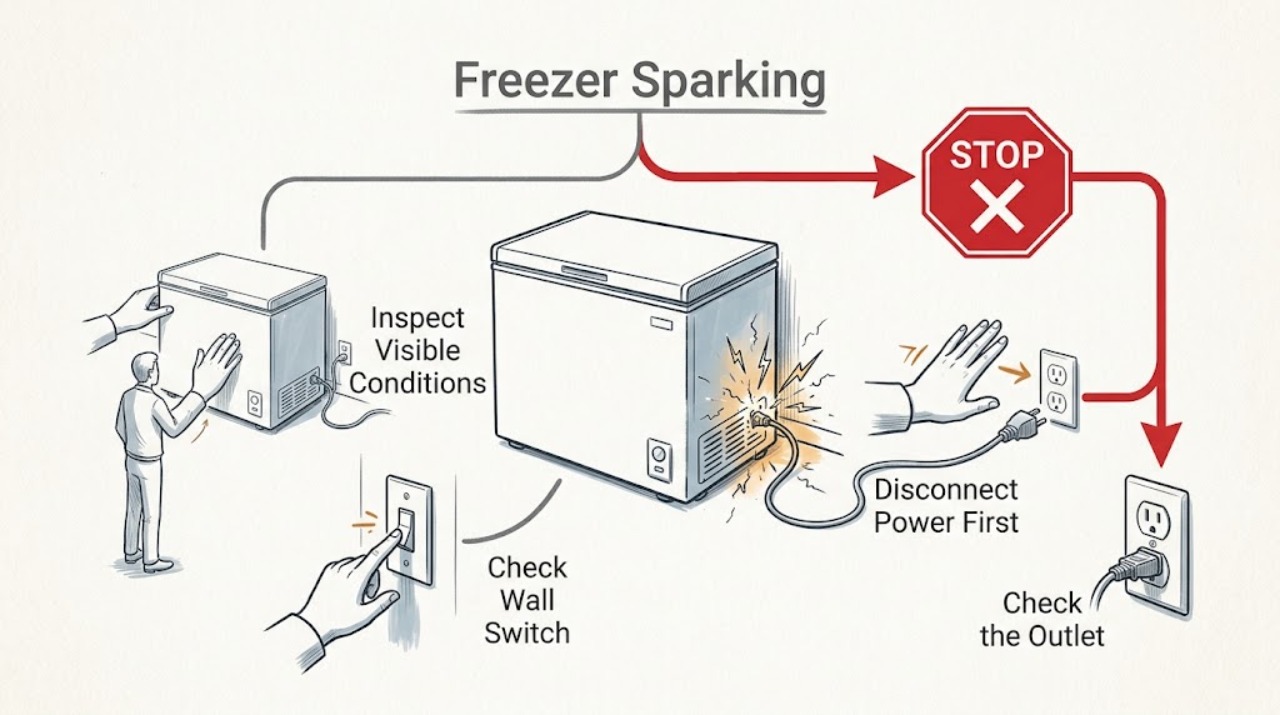
Work through in order
Diagnostic checks
Use only checks that match the exact appliance or system and its official guide.
-
Check 1
From a safe position, record what was actually observed: visible flash or arc versus sound only, the location, whether smoke or a burning smell was present, and whether the event happened at startup, after a door movement, or without an identifiable trigger. Do not move the freezer or open any panel to get a closer view.
Expected result: There was a visible spark or flash; there was only an unidentified sound; the source was at the outlet, plug, or cord; or smoke, odor, heat, or damage is present.
Next step: Use the power-isolation check immediately for a visible event, any damage, or uncertainty. Do not recreate a sound-only event to decide whether it was safe.
Stop if: Stop all investigation if you would need to move the freezer, open a cover, touch a damaged area, or approach smoke, heat, water, or active arcing.
Why this matters
Why: A visible arc or any accompanying safety symptom cannot be classified as normal from a generic freezer procedure. An unknown sound and unknown location are also insufficient grounds to keep operating the appliance.
-
Check 2
If there was a visible spark, flash, smoke, burning odor, heat, or repeated crackling, remove power only from a dry, safe position: unplug the freezer if the plug is plainly reachable without approaching the suspected fault, or switch off its circuit at the breaker when it is not safe to reach the plug. Do not pull a cord through a damaged or wet area.
Expected result: The freezer is de-energized without approaching the suspected fault, or the plug, outlet, cord, wall, or breaker area is hot, wet, smoking, melted, blackened, or still arcing.
Next step: Leave the freezer off and do not reset the breaker or reconnect it for a test. Arrange qualified appliance service; use a licensed electrician when the outlet, cord, breaker, or household wiring is implicated.
Stop if: Do not repeatedly reset a breaker, bypass a fuse or protective device, use an extension cord, or touch a hot, wet, smoking, or charred electrical surface.
Why this matters
Why: Power removal limits the immediate hazard but does not identify or repair the fault. A symptom at the plug, outlet, breaker, or house wiring points beyond an appliance-only diagnosis.
-
Check 3
Once power is off and only if the area is dry and free of active smoke or arcing, look from outside at the accessible cord, plug, outlet face, and nearby wall. Do not remove covers or probe anything. Note cuts, looseness, melting, black marks, heat, a tripped breaker, or damage that extends beyond the plug.
Expected result: The external supply looks undamaged and cool; the cord or plug is damaged; the outlet or wall is discolored or hot; or the breaker trips again when the circuit is used by another qualified person.
Next step: Keep the freezer disconnected. Give the technician the exact location and timing, the model and serial information if available, the breaker behavior, and photos of external damage only. Have an electrician assess the building supply when it is implicated.
Stop if: Do not open the freezer cabinet, rear service area, outlet, or electrical panel, and do not reconnect the freezer to see whether the symptom returns.
Why this matters
Why: An undamaged exterior does not clear an internal freezer fault. Cord, plug, outlet, breaker, or wall symptoms make the electrical supply a separate possible source and require the appropriate professional rather than a parts guess.
-
Check 4
If the spark was visibly inside the freezer, keep the door closed after power is removed and wait for qualified service. If the freezer is smoking, burning, or in immediate danger, leave the area and contact local emergency services; do not open the door to investigate.
Expected result: The interior event has stopped with power off and no emergency condition is present, or smoke, fire, active arcing, or an unsafe area remains.
Next step: For a stopped event, keep the freezer off and arrange a qualified appliance inspection. For active danger, evacuate and contact emergency services from a safe location.
Stop if: Do not reopen the door, restore power, remove an interior panel, or reach toward the suspected spark source.
Why this matters
Why: The first pattern supports a service handoff without further user diagnosis. Ongoing smoke, fire, or arcing is an emergency, not an appliance troubleshooting branch.
Use your observations
Decision map
Find the observation that best matches what you see, then follow the next safe action.
-
PATH 01Next step
What you see
A visible flash or arc occurred inside the freezer, or the user cannot safely identify whether the event was inside, at the plug, or at the outlet.
Do this next
Keep the freezer off, keep the door closed if the event was inside, and arrange qualified appliance service. Do not restore power for a test.
Why this path and its safety boundary
Why it matters: The source and fault mechanism are not safe to determine with a generic user procedure; Sub-Zero's manufacturer guidance for visible freezer sparks directs power-off, doors closed, and no further troubleshooting.
-
PATH 02Next step
What you see
The spark, smoke, heat, melting, blackening, repeated crackling, or breaker behavior is at the cord, plug, outlet, wall, or electrical panel rather than clearly inside the freezer.
Do this next
Leave the freezer disconnected and have a licensed electrician assess the outlet, cord, breaker, and household wiring; arrange appliance service as well when the freezer itself is implicated.
Why this path and its safety boundary
Why it matters: The building supply or external connection may be contributing to the hazard, so an appliance-only parts replacement would be unsafe and premature.
-
PATH 03Next step
What you see
There was only a brief sound with no visible light, smoke, odor, heat, damage, breaker operation, or cooling complaint, but the user is not certain what happened.
Do this next
Keep the freezer off until the exact model manual or a qualified technician can classify the sound. Escalate promptly if any visible spark or other safety symptom occurs.
Why this path and its safety boundary
Why it matters: The available observation does not prove a harmless operating sound, and uncertainty is not a reason to reproduce an electrical event.
Helpful context
Understand the symptom
First separate a visible spark from a sound you cannot identify
Write down whether you saw a flash or arc, heard only a crackle, and where the event appeared: inside the freezer compartment, at the plug or outlet, or near the external cord or wall. Do not move the freezer, open a cover, or recreate the event. A sound alone does not establish that the event was harmless, especially when the location is unknown or there is a burning odor, heat, smoke, or damage.
Keep the inspection external and de-energized
After power is safely removed, limit observation to the accessible plug, cord, outlet face, and surrounding wall from a dry position. Do not remove the rear cover, liner, electrical box, or control panel, and do not use a meter or another appliance to test a suspect outlet. A freezer that sparks can involve the appliance or the building supply; identifying the exact failed component requires qualified service.
Do not reopen a freezer that sparked inside
When the visible event was inside the cabinet, keep the door closed while arranging service. This limits exposure while the unit remains out of use. If the outlet, plug, or cord is hot, wet, smoking, melted, blackened, or still arcing, keep clear and obtain electrical help; if there is an active fire or immediate danger, leave the area and contact local emergency services.
When checks do not resolve it
Need a professional?
Call a qualified appliance technician for any visible freezer spark or arc, smoke, burning odor, heat, melted or blackened material, repeated crackling, breaker trip, or uncertain source. Call a licensed electrician when the outlet, cord, breaker, wall, or household wiring is involved. If there is active fire or immediate danger, leave the area and contact local emergency services.
Safety scope: This article permits only safe observation from outside the freezer and power removal from a dry, reachable position. It does not authorize energized testing, cabinet or liner removal, electrical-panel or outlet repair, breaker bypass, or restoring power to reproduce the event.
Common questions
FAQ
Should I unplug a freezer that is sparking?
Only if the plug is dry and plainly reachable without approaching the suspected fault. Otherwise switch off the freezer circuit at the breaker if that can be done safely. Keep the freezer off and do not reconnect it for a test.
What if the spark came from the outlet or power cord?
Leave the freezer disconnected and keep clear of a hot, wet, smoking, melted, or blackened connection. Have a licensed electrician assess the outlet, cord, breaker, or household wiring, and arrange appliance service when the freezer may also be damaged.
Can I remove the freezer's rear cover to find the spark?
No. Do not open the cabinet, liner, rear service area, outlet, or electrical panel, and do not test live wiring. A visible or uncertain spark requires the freezer to remain off and be professionally inspected.
Read the exact guide
Official sources
- Sparks in Refrigerator or FreezerSub-Zero · Official Sub-Zero assistance page; used as a conservative manufacturer safety boundary for a visible freezer spark, not as a model-specific diagnosis for every freezer brand.
- The CPSC Guide to Home Wiring HazardsU.S. Consumer Product Safety Commission · U.S. government consumer-safety guide used for external power-supply triage; it does not identify a freezer's internal component.
- ESFI Holiday Gift Guide: Protecting Big Ticket ItemsElectrical Safety Foundation International · Electrical-safety foundation guidance used for the stop-use and authorized-repair boundary; it is not a freezer repair manual.
Community feedback
Share a repair observation
Share a plain-text repair observation. Accepted observations are published automatically; this page may take a moment to update.