
On this page
Start here
Quick answer
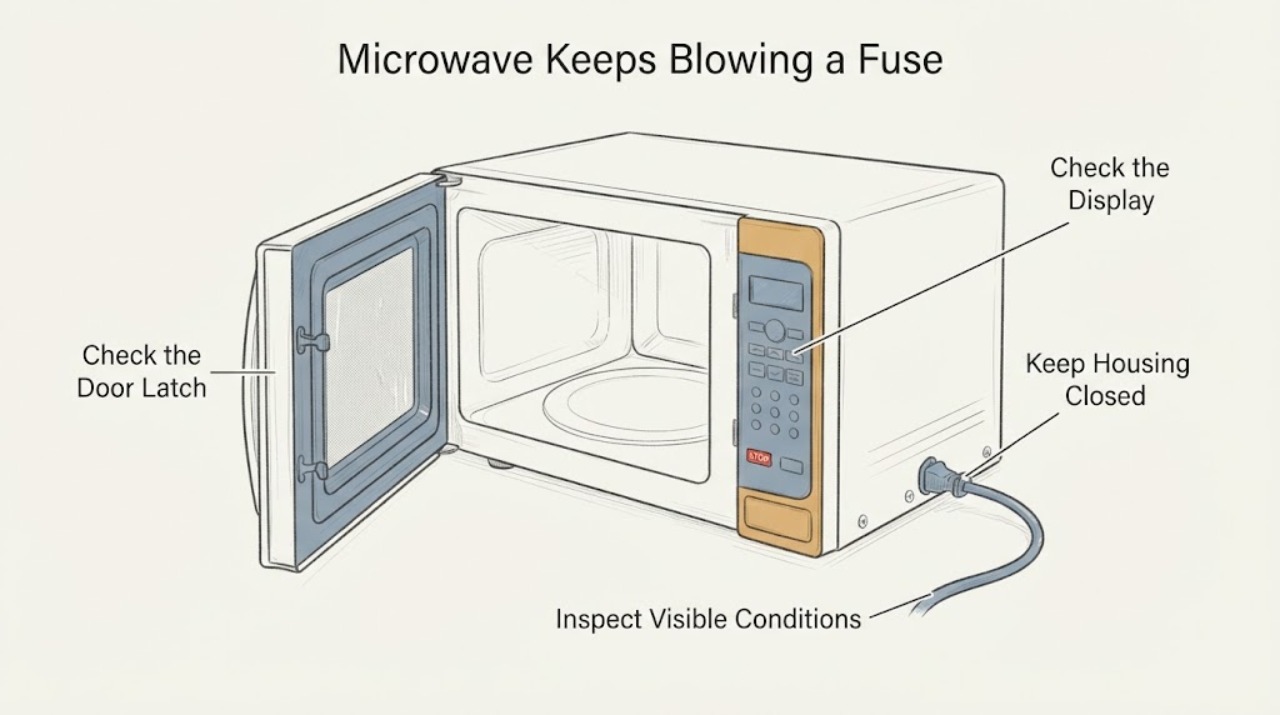
Stop using the Whirlpool microwave as soon as the fuse or circuit breaker opens again. Disconnect its power or turn off the controlling breaker, and do not keep fitting fuses, rechecking switch wiring, opening the door to reproduce the fault, or bypassing an interlock. Whirlpool's public guidance says not to continue operating when the fuse or breaker opens again, and its service documentation treats the door interlock, door/latch alignment, microwave-generation system and high-voltage components as technician work. Make only an external visual check that the door closes fully and is not visibly damaged, then arrange qualified Whirlpool microwave service with the timing of the fuse failure and the model number.
Work through in order
Diagnostic checks
Use only checks that match the exact appliance or system and its official guide.
-
Check 1
After the fuse or breaker opens, stop using the microwave. Disconnect its power cord if it can be reached without contacting damaged or wet parts, or turn off the breaker that controls it; do not install another fuse merely to repeat the test.
Expected result: The fuse or breaker has opened again, the microwave is completely dead, or the outlet/breaker shows heat, sparking or visible damage.
Next step: Leave the microwave isolated and arrange qualified service. If there is smoke, burning odor, arcing or a hot/damaged receptacle, keep clear and use the appropriate electrical emergency/service route rather than touching the appliance.
Why this matters
Why: Whirlpool treats a fuse or breaker that opens again as a condition in which operation should stop. A damaged outlet or breaker may also require an electrician, separate from microwave service.
-
Check 2
With power isolated, inspect only the outside of the closed door, latch area and visible seal surfaces. Look for a door that will not close fully, a cracked or bent latch/door hook, a loose hinge, burn marks or visible arcing; do not remove the cover, reach into the switch cradle or operate the oven with the door open.
Expected result: The door closes fully with no visible damage, or it is misaligned, loose, cracked, damaged or leaves visible arcing or seal damage.
Next step: If any damage or misalignment is visible, keep the microwave off and report it to the technician. If the exterior looks normal but the fuse still opens, do not infer that the replacement switches or their wiring are correct; proceed to service.
Why this matters
Why: A visible door, latch, hinge or seal problem can affect the interlock safety checks. A normal-looking exterior does not prove that the interlock sequence or wiring is correct after a switch replacement.
-
Check 3
Write down exactly when the fuse or breaker opens: when the plug is connected, when the door is opened or closed, when Start is pressed, or during heating. Record the model number from the rating label and which switches were replaced, without opening the cabinet to look for more parts.
Expected result: The failure occurs at connection, door movement, Start, or only when microwave heating should begin, and the model number and repair history are available.
Next step: Give the timeline, model number, replacement-part information and any visible door damage to Whirlpool or a qualified microwave technician. Do not perform an energized test to obtain a more precise timing point.
Why this matters
Why: The timing gives the service technician useful symptom information, but it is not a safe component diagnosis. Different microwave designs and switch arrangements require the exact wiring and safety procedure for that model.
-
Check 4
Keep the microwave out of service until the technician has checked the complete door-interlock and microwave-generation safety path. Do not bypass a monitor/interlock switch, bridge a fuse, use a fuse with different markings, perform any high-voltage internal test, or run the oven with a panel or door safety part removed.
Expected result: The microwave requires internal switch, wiring, high-voltage or leakage work, or the technician cannot verify the door and seal safety checks.
Next step: Have a qualified technician complete the model-specific repair and safety/leakage checks before the appliance is returned to use. If service is not economical, leave the unit disconnected and use an approved replacement/disposal route.
Why this matters
Why: Whirlpool's service documentation reserves these checks and repairs for the service procedure and warns of excessive microwave-energy exposure and high-voltage injury. Replacing the same visible switch again would not establish that the complete safety system is correct.
Use your observations
Decision map
Find the observation that best matches what you see, then follow the next safe action.
-
PATH 01Next step
What you see
The fuse or breaker opens as soon as the microwave is plugged in or when the door moves.
Do this next
Keep the microwave disconnected and do not operate the door to reproduce the event. Give the timing and prior switch work to a qualified technician.
Why this path and its safety boundary
Why it matters: The failure is present before a normal heating cycle can be evaluated; the door-interlock or another input-power fault remains unresolved.
-
PATH 02Next step
What you see
The microwave powers up but the fuse opens when Start is pressed or heating begins.
Do this next
Do not run another heating test or open the cabinet. Disconnect power and arrange service that includes the model-specific high-voltage and interlock safety checks.
Why this path and its safety boundary
Why it matters: A fault is occurring when the microwave enters an operating state; the timing does not distinguish a door-interlock problem from another internal power or microwave-generation fault.
-
PATH 03Next step
What you see
The door does not close fully, the latch or hinge is visibly damaged, or arcing/burn marks are present.
Do this next
Do not operate the microwave. Keep it isolated and request qualified service; do not bend, shim or bypass the latch or interlock.
Why this path and its safety boundary
Why it matters: The required door and sealing safety conditions are not established, regardless of whether the replacement switches appear new.
-
PATH 04Next step
What you see
The outside door and outlet look normal, but the fuse continues to open after the switches were replaced.
Do this next
Leave the unit disconnected and provide the technician with the model, event timing and repair history. Do not select a magnetron, capacitor, transformer, board or further switch from the symptom alone.
Why this path and its safety boundary
Why it matters: No safe external check has explained the repeated fault, and the visible replacement history does not prove correct wiring or a healthy internal circuit.
Helpful context
Understand the symptom
Treat repeated fuse opening as a stop-use condition
A fuse that opens again after a door-switch replacement means the original repair did not establish a safe operating condition. The timing may help a technician distinguish the event, but it does not identify a switch, control board, transformer, capacitor or magnetron for a homeowner. Leave the microwave isolated and preserve the sequence of what happened.
Why the door-interlock area needs professional handling
Whirlpool's service material treats interlock operation, proper door closing, sealing surfaces, hinges and latches as safety checks before microwave power is activated. It also warns about high voltage at the magnetron and capacitor and requires a leakage check before an oven is released. Those requirements are why this article stops at external observation and service triage.
When checks do not resolve it
Need a professional?
Arrange qualified Whirlpool microwave service as soon as a fuse or breaker opens again, especially after door-switch replacement. Do not continue testing the oven, and do not attempt cabinet, high-voltage, interlock-wiring or leakage work as a household repair.
Have this ready
- Provide the model number, whether the fuse opens at plug-in, door movement, Start or heating, whether the breaker also trips, which switches were replaced, and any visible door/latch/seal damage or arcing.
Common questions
FAQ
Should I replace all the door switches again?
No. Replacing more switches without a model-specific safety diagnosis can leave wiring, latch alignment or another internal fault unresolved. Whirlpool says door-switch replacement may require control-panel disassembly and connected wiring, so repeated fuse opening should go to a professional.
Can I test the microwave with the door open or bypass the switch to find the bad part?
No. Whirlpool's service sheet expressly requires interlock and door checks before microwave power is activated and warns against operating with the door open. Keep the appliance disconnected and arrange qualified service.
What if the new fuse stays intact for one test?
A single successful test does not prove that the interlock or microwave-generation system is safe. If the fuse or breaker opens again, stop immediately; any continued evaluation should follow the exact service procedure and safety/leakage checks.
Read the exact guide
Official sources
- Cavity or Interior Light Not Working - Over-the-Range MicrowaveWhirlpool · Official over-the-range microwave support for power, fuse/breaker reset and stop-use boundary when the fuse or breaker opens again.
- Tech Sheet - W11398326 - Rev AWhirlpool · Official service-technician document used only for high-voltage, interlock, door/seal, latch, operating and leakage-check safety boundaries; it is not a homeowner repair procedure.
- Microwave Not Heating: Possible Causes and FixesWhirlpool · Official family-level guidance that door-switch replacement may require control-panel/wiring disassembly and that damaged internal microwave parts require professional help.
- Microwave is Not Starting or Operating - Countertop MicrowaveWhirlpool · Official external door-closing and service guidance for Whirlpool countertop microwaves; used only for visible door-closure checks.
Community feedback
Share a repair observation
Share a plain-text repair observation. Accepted observations are published automatically; this page may take a moment to update.