
On this page
Start here
Quick answer
If a Whirlpool microwave runs but does not heat, test it with one cup of water for one minute at the model's high-power setting, then check the selected power level, control lock or demo mode, door closure, and whether it is connected directly to the intended outlet rather than an inverter or generator. If the water stays cold after those checks, stop using the microwave and arrange service; do not open the cabinet because the heating circuit is not a user repair.
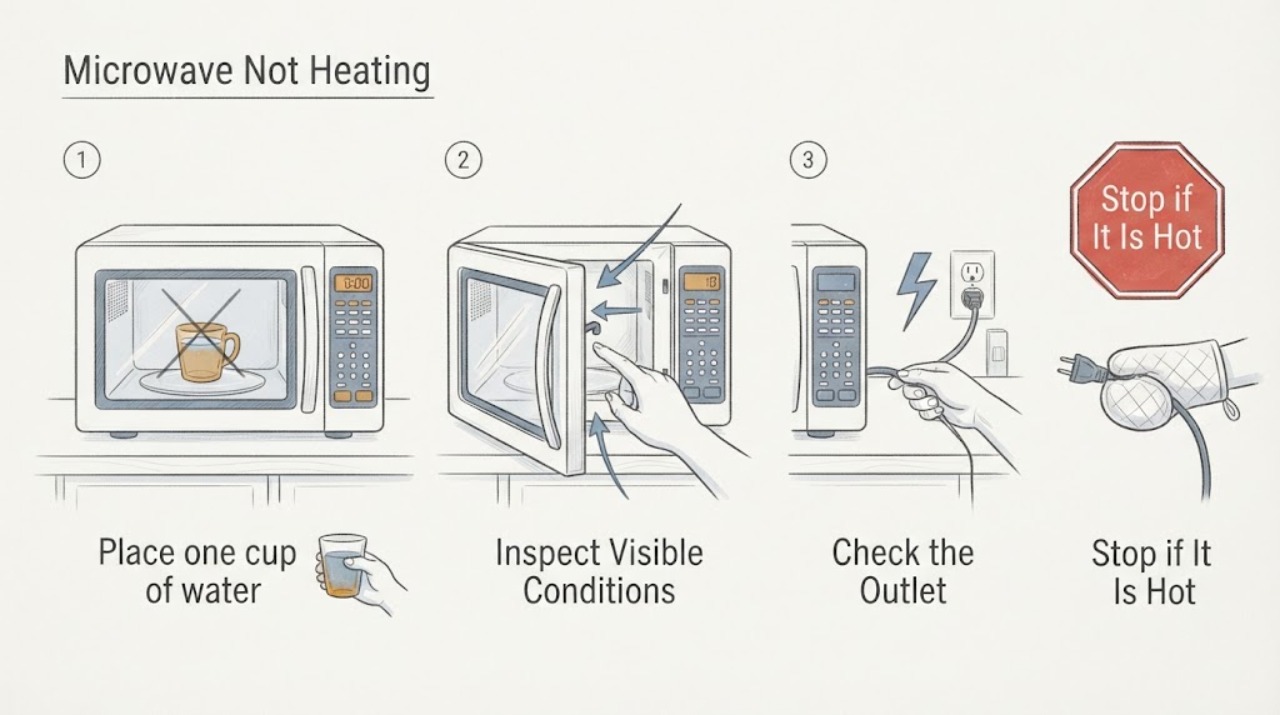
Work through in order
Diagnostic checks
Use only checks that match the exact appliance or system and its official guide.
-
Check 1
Place one cup of water in a microwave-safe container on the turntable and run the model's documented high-power one-minute test. Do not run the oven empty.
Expected result: The water warms, remains cold, or the microwave does not start the test.
Next step: Use the result to choose controls, power, door, or service checks below.
Stop if: Stop if there is smoke, arcing, burning odor, damaged interior, or an unusual loud sound.
Why this matters
Why: Warm water confirms that the oven is producing heat; cold water with a normal run indicates a no-heat condition, while failure to start follows the operating or power path.
-
Check 2
Check Cook Time, Start, and Cook Power settings, and look for a control-lock indicator or a demo-mode indication. Select the cooking function and power level described by the model manual.
Expected result: The unit was in demo mode, locked, or set to reduced power, or controls were already correct.
Next step: Disable the lock or demo mode using the model instructions, then repeat one supervised water test.
Stop if: Do not guess a button sequence when the model manual does not match the panel.
Why this matters
Why: Demo mode can operate the light, fan, and turntable without heating; reduced power can heat slowly. Correct controls with no heat make a user-setting issue less likely.
-
Check 3
Confirm the microwave is connected to the intended operational wall outlet. If it is on an inverter, generator, or other alternate source, use the model-approved outlet and check the household breaker or fuse without repeatedly resetting it.
Expected result: The microwave was on an alternate power source, the outlet is not operational, or the supply is normal.
Next step: Correct only the accessible supply issue; call an electrician for a failed outlet or recurring breaker trip.
Stop if: Do not use a damaged cord or continue operating after a breaker or fuse trips again.
Why this matters
Why: Whirlpool says an alternate source can power lights and controls without supplying the heating source. An inoperative outlet or breaker is a household electrical issue; normal supply leaves the appliance path.
-
Check 4
Inspect that the door closes firmly with no packaging, food, or debris blocking the latch area. Check that the turntable and container are positioned as the manual describes, then repeat the water test only if the door closes normally.
Expected result: The door was not fully closed or obstructed, or it closes correctly while the water remains cold.
Next step: Remove only the obstruction identified by the manual. If the latch, hinge, seal, or door is damaged, arrange service.
Stop if: Do not defeat the door interlock or operate with a bent or damaged door.
Why this matters
Why: The safety interlock prevents a microwave from operating correctly when the door is not closed; a correctly closed door with cold water points beyond this accessible check.
-
Check 5
If the microwave still runs without heating after the documented test and all external checks, record the model, display codes, power source, and whether the fan and turntable operate. Disconnect it if safe and request qualified Whirlpool service.
Expected result: The water remains cold, an error returns, or the appliance shows signs of electrical or physical damage.
Next step: Stop using the microwave and provide the recorded observations to service; do not order an internal part from the symptom alone.
Stop if: Do not open the cabinet or touch internal components even when unplugged.
Why this matters
Why: The remaining possibilities include internal heating, control, or door-interlock components that cannot be identified safely from the outside.
Use your observations
Decision map
Find the observation that best matches what you see, then follow the next safe action.
-
PATH 01Next step
What you see
The water warms in the one-minute high-power test.
Do this next
Use the correct cooking setting and model guidance for the food rather than replacing a heating component.
Why this path and its safety boundary
Why it matters: The microwave is producing heat; the concern may be cookware, quantity, power level, or expected heating time.
-
PATH 02Next step
What you see
The light, fan, or turntable operates but the water stays cold and demo mode or a lock is active.
Do this next
Disable the mode using the exact manual and repeat one supervised test.
Why this path and its safety boundary
Why it matters: A control mode is preventing normal heating.
-
PATH 03Next step
What you see
Controls and door are normal, the outlet is correct, and the water remains cold.
Do this next
Stop operating the microwave and schedule qualified service.
Why this path and its safety boundary
Why it matters: An internal heating, control, or interlock fault is possible.
-
PATH 04Next step
What you see
The door is damaged, the unit sparks or smells burnt, or the breaker trips again.
Do this next
Disconnect power if safe and arrange qualified appliance service or electrical service.
Why this path and its safety boundary
Why it matters: There is a safety hazard beyond user troubleshooting.
Helpful context
Understand the symptom
Confirm that heating is the symptom
A microwave can have a light, fan, and rotating turntable while demo mode or a control setting prevents the magnetron from heating. Whirlpool separates a true no-heat result from a control, door, or power-source issue. Use the model-specific instructions when the control layout differs.
Keep the high-voltage boundary closed
Whirlpool's public checks end with the water test, controls, door, and power source. A microwave that still does not heat needs qualified service; do not remove covers or attempt magnetron, capacitor, diode, or interlock testing.
When checks do not resolve it
Need a professional?
Give service the exact model, installation type, test result, controls and display codes, outlet or breaker behavior, and any door, arcing, or odor observations.
Common questions
FAQ
Why does my Whirlpool microwave run but not heat?
A microwave can run its light, fan, and turntable in demo mode or at a reduced power level without producing the expected heat. Check the controls and perform Whirlpool's water test; persistent cold water needs service.
Can I replace the magnetron myself?
No. Whirlpool's public troubleshooting path directs service when the water test fails after the external checks. Keep the cabinet closed and arrange qualified service.
Read the exact guide
Official sources
- Not Heating - Has Power - Over-the-Range Microwave | Whirlpool Product HelpWhirlpool Corporation · Whirlpool over-the-range microwave control, door, demo-mode, start, and heating checks
- Microwave is Not Heating - Countertop Microwave | Whirlpool Product HelpWhirlpool Corporation · Whirlpool countertop microwave heating test, alternate power source, controls, demo mode, and error checks
- Microwave is Not Starting or Operating - Countertop Microwave | Whirlpool Product HelpWhirlpool Corporation · Whirlpool microwave outlet, breaker, door, and service boundary guidance
Community feedback
Share a repair observation
Share a plain-text repair observation. Accepted observations are published automatically; this page may take a moment to update.