
On this page
Start here
Quick answer
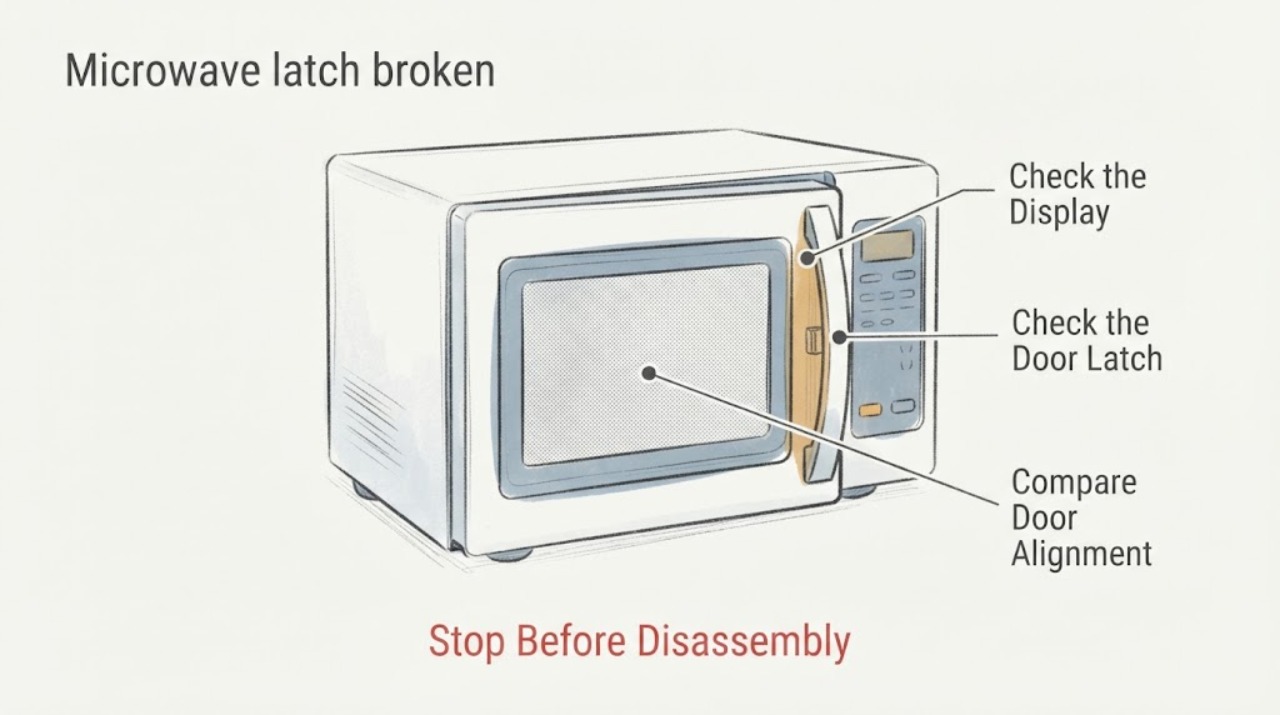
Do not run a Whirlpool Gold Series microwave if the door latch is broken, loose, bent, fails to catch, or leaves the door misaligned. Whirlpool's safety instructions say not to operate a microwave with broken or loosened hinges or latches, a damaged door, or damaged seals, and say that the safety interlocks must not be defeated or tampered with. With the microwave unplugged and cool, check only for an accessible obstruction, oversized dish, misplaced rack, packing material, or soil on the door contact area; do not force the door, hold an interlock closed, open the cabinet, or try to adjust the latch. Gold Series is not a complete model number, so use the rating label to obtain the exact Whirlpool model before any parts or manual lookup. If the latch remains broken or the door does not close squarely, leave the microwave out of service and arrange qualified Whirlpool or appliance service.
Work through in order
Diagnostic checks
Use only checks that match the exact appliance or system and its official guide.
-
Check 1
Stop using the microwave and unplug it if the plug is accessible without touching a damaged cord or wet area. If it is over-the-range or built-in and the plug is not accessible, leave the controls off and do not remove panels to reach it.
Expected result: The latch is visibly broken, loose, bent, or missing; the door is bent or does not close squarely; or the door and latch appear intact but an object blocks closure.
Next step: Keep the microwave out of service for any damage or misalignment. If an object is plainly accessible, remove it without force and continue only with the visual checks below; do not power the microwave to test a damaged door.
Why this matters
Why: A broken or loosened latch, bent door, or damaged seal is a safety condition under Whirlpool's manual. A plainly visible obstruction is the only low-risk condition to investigate externally before service.
-
Check 2
With power disconnected, inspect the outside of the latch opening, door hooks, door edge, and contact area using a light. Remove only loose packing material, food soil, or a plainly accessible item; do not push the latch, bend a hook, or reach behind the door or control panel.
Expected result: Packing material, soil, an oversized dish, or a rack is blocking the latch path, or the path is clear but the latch remains broken, loose, or unable to catch.
Next step: Remove only the accessible obstruction and close the door gently by hand without forcing it. If the latch still fails, leave the microwave unplugged and arrange qualified service; do not continue operating it.
Why this matters
Why: Whirlpool identifies those visible obstructions as possible reasons a door may not close. A clear path with a damaged or non-catching latch is not an obstruction problem and does not identify which door or interlock part is compatible.
-
Check 3
Check whether the door closes evenly against the frame without lifting, pressing, slamming, or holding it in a special position. Look for a bent door, loose hinge, damaged seal, gap, or frame distortion from the outside.
Expected result: The door closes squarely with intact visible sealing surfaces, or it closes only when pushed, lifted, held, or forced and shows damage or a gap.
Next step: For any gap, bent part, loose hinge, damaged seal, or forced closure, keep the microwave off and request service. Do not test heating with the door held shut and do not add tape, a shim, or a replacement latch without exact model verification.
Why this matters
Why: A door that needs force or a special position is not a confirmed safe latch. Whirlpool requires proper door closure and intact hinges, latches, seals, and sealing surfaces; the symptom cannot be converted into a safe adjustment procedure.
-
Check 4
Record the complete model and serial information from the rating label or owner documentation. Use the exact model on Whirlpool's manuals/support page and tell service whether the door opens, closes, latches, and displays a door-related message.
Expected result: The full model identifies a matching manual and support path, or only the Gold Series family name is available.
Next step: Use only the exact model's user-level instructions. If the model is unavailable or the latch remains faulty, leave the microwave unused and arrange qualified Whirlpool service with the recorded symptom.
Why this matters
Why: Whirlpool's manuals page uses the model number to retrieve appliance literature. Gold Series alone cannot establish the door mechanism, installation type, or compatible latch/interlock assembly.
-
Check 5
Before service, check for secondary warning signs without operating the microwave: arcing, smoke, burning odor, damaged cord, unusual heat, a door that opened during a cycle, or any attempt by a previous repair to bypass an interlock.
Expected result: A warning sign or interlock alteration is present, or the problem is limited to the latch not catching with no other sign.
Next step: Keep the microwave disconnected and arrange qualified appliance service. Do not restore or defeat an interlock, open the high-voltage cabinet, or attempt a live test.
Why this matters
Why: A warning sign increases the urgency and rules out further user testing. Even without those signs, a broken latch still prevents safe operation and requires a model-specific repair assessment.
Use your observations
Decision map
Find the observation that best matches what you see, then follow the next safe action.
-
PATH 01Next step
What you see
The door will not close because packing material, soil, an oversized dish, or a misplaced rack is plainly blocking the latch path, and the door and latch are otherwise undamaged.
Do this next
Remove only the accessible obstruction, close the door gently, and stop if it still does not latch or if any damage becomes visible. Do not run the microwave until the door closes and latches normally.
Why this path and its safety boundary
Why it matters: This matches Whirlpool's external obstruction checks rather than proving a broken latch or interlock.
-
PATH 02Next step
What you see
The latch is broken, loose, bent, missing, or the door closes only when pressed, lifted, held, or forced.
Do this next
Leave the microwave unplugged or otherwise unused and request qualified Whirlpool or appliance service. Do not bend, glue, shim, bypass, or replace a latch without exact model verification.
Why this path and its safety boundary
Why it matters: The microwave does not meet Whirlpool's safe door and latch condition; the exact failed part is not established.
-
PATH 03Next step
What you see
The door appears closed but a door/open message remains or the microwave will not start, with no visible obstruction.
Do this next
Check the exact model manual for a user-level door-message instruction. If the message persists, keep the microwave off and arrange service; never hold or bypass an interlock to make it run.
Why this path and its safety boundary
Why it matters: The latch or door-sensing system may not be registering closure, but the symptom does not identify a switch, hook, actuator, or control-board part.
-
PATH 04Next step
What you see
There is arcing, smoke, burning odor, abnormal heat, a damaged cord, a door or seal defect, or evidence that an interlock has been bypassed.
Do this next
Stop using the microwave, disconnect it only if safe and accessible, keep people away from the hazard, and obtain qualified appliance or electrical service. Do not open the cabinet or perform another test run.
Why this path and its safety boundary
Why it matters: This is an immediate appliance safety condition, not a latch-adjustment problem.
Helpful context
Understand the symptom
A broken latch is a safety stop, not a cosmetic repair
The task identifies a Whirlpool Gold Series microwave but does not provide the complete model number. Gold Series is therefore treated as a family label, not proof of one latch design or compatible part. Whirlpool's opened manual says a microwave with a bent door or broken or loosened hinges and latches must not be operated, and that the door should close properly with intact seals and sealing surfaces. A latch that sometimes catches is still not a reason to keep testing the oven.
Only rule out simple external obstruction
Whirlpool's support guidance for a door that will not close starts with the latch area: check for packing material, an oversized dish or bakeware, a rack out of position, incorrect leveling, or soil on the door contact area. These checks are appropriate only from the outside and only when the door and latch are not visibly damaged. Do not bend the hooks, push a latch back into place, add a shim, or hold the door switch or interlock in a closed position.
The exact model controls any repair path
Whirlpool's manuals page requires the model number to retrieve the correct manual and appliance literature. A Gold Series label does not establish whether the microwave is countertop, over-the-range, built-in, or a combination unit, and the latch, door, and interlock arrangement can differ. Once the model is recorded, give the technician the visible symptom and whether the door closes, latches, and seals; leave internal door or interlock work to qualified service.
When checks do not resolve it
Need a professional?
Do not operate a microwave with a broken or loosened latch, bent or misaligned door, damaged seal, persistent door message, arcing, smoke, burning odor, or an altered interlock. Keep it unused and use qualified Whirlpool or appliance service for door, latch, hinge, seal, and interlock work.
Have this ready
- Provide the complete Whirlpool model and serial information, installation type, whether the door opens and closes normally, the visible latch or hinge symptom, any door message, and any arcing, smoke, odor, heat, or prior repair or interlock alteration.
Common questions
FAQ
Can I run the microwave if the latch sometimes catches?
No. Whirlpool says not to operate a microwave with broken or loosened hinges or latches, a damaged door, or damaged seals. A latch that catches only intermittently is not a safe operating condition.
Can I hold the latch or door switch closed to test the microwave?
No. Whirlpool specifically warns not to defeat or tamper with the safety interlocks. Do not hold, tape, shim, bend, or bypass the latch or switch, and do not open the cabinet.
What can I check before calling service?
With power disconnected, check only for an accessible obstruction such as packing material, an oversized dish, a misplaced rack, or soil on the door contact area. Also note whether the microwave is level and whether the door closes squarely. Stop if the latch or door is damaged or still fails to catch.
Is Gold Series enough to order a replacement latch?
No. Gold Series is not the complete model number. Whirlpool uses the full model number to locate the correct manual and appliance literature, and latch or interlock designs can vary by model and installation type. Give the exact model to service before considering any part.
Read the exact guide
Official sources
- Whirlpool Manuals & LiteratureWhirlpool · Opened Whirlpool manual portal used only to establish that the complete model number is needed for the correct manual and appliance resources; it does not supply a Gold Series latch diagnosis or part match.
- Door Will Not Close - Over-the-Range MicrowaveWhirlpool Product Help · Opened Whirlpool support page used for external obstruction, level, contact-area cleaning, packaging, and service checks. It is not used to infer that every Gold Series model is over-the-range or to identify a latch part.
- Owner's Manual W11752381Whirlpool · Opened Whirlpool owner manual used for family-level safety boundaries: do not operate with broken or loosened hinges/latches or damaged doors/seals, do not tamper with interlocks, and use qualified service. The task supplies only the Gold Series family label, so this is not treated as an exact model manual.
Community feedback
Share a repair observation
Share a plain-text repair observation. Accepted observations are published automatically; this page may take a moment to update.