
On this page
Start here
Quick answer
Do not run the Whirlpool WMH53521HZ-4 after finding a roughly 0.5-inch opening in the inside ceiling with gray material coming through it after popcorn. The public Whirlpool material identifies the WMH53521HZ as a 2.1-cu.-ft. over-the-range microwave and separately warns that the cavity and microwave inlet cover can be damaged by arcing or contamination; it does not confirm that this exact hole is a normal feature. The gray material could be a damaged inlet/waveguide-cover layer or another cavity-layer failure, but appearance alone cannot establish which. Leave the oven off, isolate power only from a dry and safely accessible point, and arrange Whirlpool-qualified inspection. Do not fill the opening, scrape the material away, install a random cover, remove the cavity cover, open the cabinet, or perform a home microwave-leakage test.
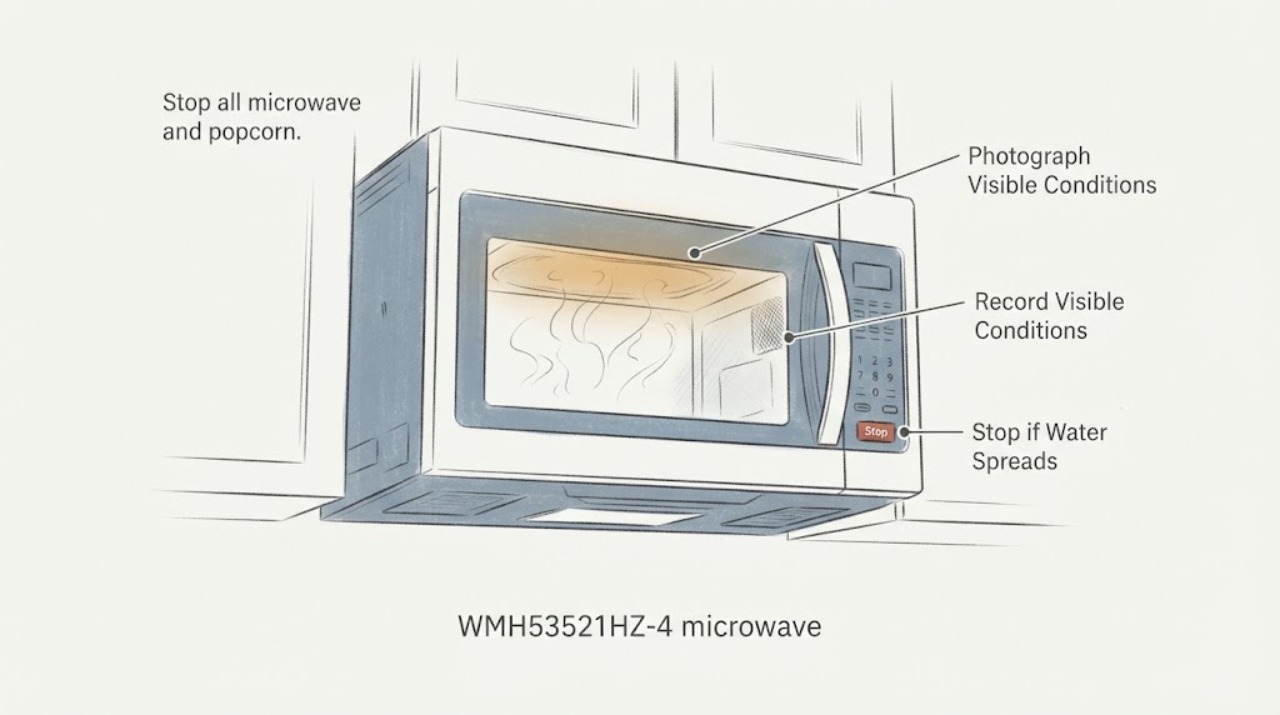
Work through in order
Diagnostic checks
Use only checks that match the exact appliance or system and its official guide.
-
Check 1
Stop all microwave and popcorn use immediately. When the cavity is cool, remove only loose food or the removable turntable from a safe position; do not touch the gray material or put a tool into the opening. If a cord or disconnect is safely reachable without moving the over-the-range unit, isolate power from a dry position.
Expected result: The opening remains visible, the gray material is soft or loose, there are burn marks or a sharp odor, or the cavity only has ordinary removable food soil and no opening.
Next step: Keep the appliance out of service and continue with documentation and model identification. If there was smoke, fire, repeated sparking, a burning odor, damaged wiring, or a breaker trip, leave power isolated when safe and request qualified appliance or electrical service.
Stop if: Do not restart the microwave to see whether it still heats, and do not move or pull down the installed hood microwave to reach a plug or label.
Why this matters
Why: A persistent opening or melted-looking material is a physical-damage observation, not a normal popcorn setting result. Smoke, arcing, burning odor, or a tripped breaker raises the urgency. Only ordinary removable soil with no opening belongs to Whirlpool's cleaning guidance, but the original report still needs clarification before reuse.
-
Check 2
From outside the cavity and only after it is cool and de-energized, take clear photographs of the ceiling, the opening, the gray residue, any discoloration, and the door area. Record whether the issue was first noticed immediately after the popcorn cycle, whether there was a flash, crackle, smoke, or unusual smell, and whether the residue has hardened.
Expected result: The photo shows a true opening, a detached or burned cover-like surface, a darkened edge, only a surface smear, or an area that cannot be seen clearly without scraping or removing a component.
Next step: Send the photographs with the complete model and serial information to Whirlpool service or a qualified microwave technician. Preserve the residue and opening as found; do not clean, fill, or peel it for a better picture.
Stop if: Do not perform a microwave-leakage meter test, place a phone or other object in the cavity as a test, or energize the oven while photographing the damage.
Why this matters
Why: A photograph can help the manufacturer distinguish a cavity surface, inlet-cover area, or foreign residue, but it cannot certify microwave containment or prove that a replacement cover is appropriate. An unclear view is not permission to probe the area.
-
Check 3
Read the full model and serial label from an accessible location without moving the installed unit. Compare the label with Whirlpool's owner page and manual lookup, recording the complete suffix exactly as printed rather than converting WMH53521HZ-4 to another suffix or dropping the suffix.
Expected result: The label confirms WMH53521HZ-4, shows a different suffix, is unreadable, or the public Whirlpool owner page shows only the base WMH53521HZ entry.
Next step: Give Whirlpool the complete label information and ask for the exact literature or service parts path. If the suffix cannot be confirmed, treat the cavity construction and cover identity as unresolved and do not order a part.
Stop if: Do not remove trim, lower the hood microwave, or open the outer cabinet just to find the label.
Why this matters
Why: Whirlpool's public owner page confirms the WMH53521HZ product family, but the manual portal requires a model number to retrieve model-specific literature. Suffix differences can change the inlet-cover, cavity, mounting, and service parts, so family resemblance is not fitment evidence.
-
Check 4
Separate an unrelated wipeable popcorn splatter from the reported opening without touching the damaged spot: with controls off and the cavity cool, inspect only the surrounding intact surface. If there is clearly no opening and no charring, use a soft cloth and mild soap and water on the intact surface; do not use abrasives, metal, a scraper, solvent, caulk, paint, or adhesive.
Expected result: The suspected hole disappears as ordinary surface soil is removed, or a real opening, lifted layer, gray plug, melting, charring, or rough edge remains.
Next step: If any opening or damaged layer remains, stop cleaning and arrange model-specific inspection. If it was only clearly separate surface soil, keep the appliance off until Whirlpool confirms that the original observation was not structural damage.
Stop if: Do not pull down a cover, chip hardened material, expose a waveguide, or use a powered test after cleaning.
Why this matters
Why: Whirlpool's cleaning guidance applies to normal cavity soil and says the microwave cover should be kept clean; it does not approve scraping or rebuilding a damaged cavity or inlet-cover surface. A remaining opening or lifted/melted layer keeps the oven in the service-only branch.
-
Check 5
Prepare the service request with the complete model and serial, installation type, photographs, the time and food used when the material appeared, any preceding sparks or popping sounds, whether the door closes normally, and whether the unit was still powered afterward. State explicitly that no patch, scrape, cabinet opening, or leakage test has been performed.
Expected result: Service can identify the exact model and confirm whether the affected surface is an inlet/waveguide cover, cavity metal, coating, or another assembly; or the technician cannot identify it without internal inspection.
Next step: Follow the manufacturer's inspection or replacement decision. If the metal cavity, waveguide, shielding, or other microwave-generation component is damaged, do not accept a cosmetic patch as a safety repair.
Stop if: Do not resume operation while waiting for service, even if the fan, light, display, or turntable still works.
Why this matters
Why: The visible symptom does not establish a replaceable part or a safe operating condition. A qualified technician must verify cavity and microwave-generation integrity before returning the appliance to use.
Use your observations
Decision map
Find the observation that best matches what you see, then follow the next safe action.
-
PATH 01Next step
What you see
A real opening, melted or hardened gray material, lifted surface, charring, or a loose cover remains in the cavity ceiling after the unit is cool.
Do this next
Keep the microwave off and obtain Whirlpool-qualified inspection with the complete model and photographs. Do not fill, scrape, remove, or electrically test the area.
Why this path and its safety boundary
Why it matters: This is a possible cavity or microwave-inlet/waveguide-cover damage path. Whirlpool's public guidance does not establish that the observed material is normal or that a generic replacement cover fits this suffix.
-
PATH 02Next step
What you see
There was smoke, a flame, blue arcing, crackling, a burning smell, damaged wiring, a breaker trip, or the door does not close firmly.
Do this next
Keep the oven out of service, isolate power only from a safe dry location, and contact qualified appliance service; use an electrician if the household supply or breaker is involved. Do not reopen the issue with a test cycle.
Why this path and its safety boundary
Why it matters: The event has fire, electrical, interlock, or possible microwave-containment implications beyond an owner cleaning check. A working display or fan does not make it safe.
-
PATH 03Next step
What you see
The full label is not available, the suffix differs from WMH53521HZ-4, or the only available documentation is for another Whirlpool microwave.
Do this next
Use Whirlpool's model lookup or service channel with the complete label information. Keep the damaged appliance off until the exact model and repair path are confirmed.
Why this path and its safety boundary
Why it matters: The model-specific identity is unresolved. Inlet-cover shape, mounting, cavity layers, and service procedures cannot be inferred from the shared WMH53521HZ styling or a different suffix.
-
PATH 04Next step
What you see
After cooling, there is no opening, no lifted or melted layer, no charring, and the observation is clearly only removable food soil separate from the ceiling feature.
Do this next
Clean only the intact surface with a soft cloth and mild soap and water, then ask Whirlpool to confirm the original observation before using the microwave. If any opening or damage is found, return to the service-only branch.
Why this path and its safety boundary
Why it matters: This fits Whirlpool's ordinary cavity-cleaning branch more closely, but it does not prove that a reported hole was harmless. If the original opening or material remains uncertain, do not resume use from visual judgment alone.
Helpful context
Understand the symptom
Whirlpool's opened owner page identifies WMH53521HZ as a 2.1-cu.-ft. over-the-range microwave, while the task includes a -4 suffix. That suffix must be checked against the appliance rating label and Whirlpool's model lookup. Do not borrow a cavity-cover or service instruction from WMH53521HZ0, HZ3, HZ5, or another Whirlpool microwave just because the front styling is similar.
A cavity-ceiling opening with material extruding from it is not safely classifiable as food soil, paint, sealant, or a replaceable cover from a verbal description. Whirlpool's over-the-range guidance names the cavity and microwave cover as areas where soil buildup can cause arcing and says prolonged arcing can damage the oven. A hole, melted-looking residue, charring, or a loose cover therefore needs a model-specific inspection before any further heating.
Whirlpool and the FDA reserve microwave repairs and radiation-safety decisions for qualified service. The FDA says a damaged microwave may present a leakage risk and recommends contacting the manufacturer for assistance; Whirlpool says not to operate a damaged oven or service it except through qualified personnel. Do not attempt to seal, paint, glue, scrape, drill, remove, or test the damaged area yourself.
Only after diagnosis
Potential parts
- microwave inlet or waveguide cover
Consider this category only if qualified Whirlpool service confirms that the gray material is a damaged, replaceable inlet/waveguide cover and that the cavity and waveguide remain intact.
The Whirlpool owner page displays the base WMH53521HZ while the task includes the -4 suffix; verify the complete label and manufacturer fit information before ordering any part. A cover cannot repair a damaged metal cavity or waveguide assembly.
When checks do not resolve it
Need a professional?
Have this ready
- Complete model and serial label, country, installation type, photographs of the cavity ceiling and door, when the issue appeared after popcorn, whether there was arcing/smoke/odor, whether the door closes firmly, and confirmation that the unit has not been patched, scraped, opened, or leak-tested.
Common questions
FAQ
Is a gray blob coming through a hole in the ceiling of the WMH53521HZ-4 normal?
Do not treat it as normal. Whirlpool's public pages refer to the cavity and microwave inlet cover, but they do not identify a fingertip-sized opening with gray material as an intentional feature of this suffix. Keep the microwave off and have the exact model inspected.
Could the gray material be the microwave waveguide cover?
It may be a damaged inlet or waveguide-cover layer, but a description cannot prove that. It could also involve another cavity surface or residue. Do not pull it down or order a cover until Whirlpool or a qualified technician confirms the component and the cavity behind it.
Can I cover the hole with microwave-safe caulk or paint?
No. A household patch does not verify microwave containment, cavity integrity, heat resistance, or fit. Filling or scraping can hide damage and may introduce material into the microwave path. Leave the unit off and use a model-specific professional repair decision.
Can I run a cup of water to see whether the microwave still works?
Not when there is a suspected opening or melted-looking cavity material. Water heating checks performance; it cannot certify that a damaged cavity, inlet cover, waveguide, or shielding is safe. Wait for qualified inspection.
What model information should I give Whirlpool?
Give the complete model and serial exactly as printed on the accessible rating label, including the suffix represented here as WMH53521HZ-4, plus the photos and the circumstances of the popcorn event. Whirlpool's manual lookup requires a model number, and the public owner page lists the base WMH53521HZ entry.
Read the exact guide
Official sources
- Microwave OvensU.S. Food and Drug Administration · The opened FDA page explains that a damaged microwave may present a microwave-energy leakage risk, directs consumers to contact the manufacturer for assistance, and distinguishes qualified safety guidance from home testing.
- WMH53521HZ | WhirlpoolWhirlpool · The opened Whirlpool owner page identifies WMH53521HZ as a 2.1-cu.-ft. over-the-range microwave and exposes manufacturer support and model literature routes; the task reports the suffix as WMH53521HZ-4, but the page displays the base model rather than proving every suffix.
- General Arcing and Sparking - Over-the-Range MicrowaveWhirlpool Product Help · The opened Whirlpool guidance applies to over-the-range microwave arcing and identifies cavity walls, the microwave cover, rack supports, and door-contact area as places where soil buildup can cause arcing.
- Cleaning the Interior or Cavity - Over-the-Range MicrowaveWhirlpool Product Help · The opened Whirlpool page describes cleaning an intact cavity and keeping the cavity and microwave inlet cover clean; it does not authorize repair of openings, lifted layers, or melted material.
- Kitchen And Laundry Appliance Manuals | WhirlpoolWhirlpool · The opened Whirlpool manuals page requires entering the model number to access manuals and literature, which is relevant because the task's suffix must not be silently replaced by another model.
Community feedback
Share a repair observation
Share a plain-text repair observation. Accepted observations are published automatically; this page may take a moment to update.