
On this page
Start here
Quick answer
Do not run the Whirlpool WMH31017AS1 again after an arc at the WPW10498011 light-socket area, even if the magnetron still heats and the display and buttons work. Disconnect power only from a safe, dry position, without touching a hot, scorched, wet, or damaged cord or outlet. Do not open the cabinet, probe the socket, replace an internal fuse or board, or repeat a heating test. Whirlpool says prolonged arcing can damage an over-the-range microwave and says not to continue operating after a breaker or fuse trips again. Record the arc and the loss of the interior light, turntable, and fan, then arrange qualified microwave service; use an electrician as well if the outlet, cord, or household breaker is suspect.
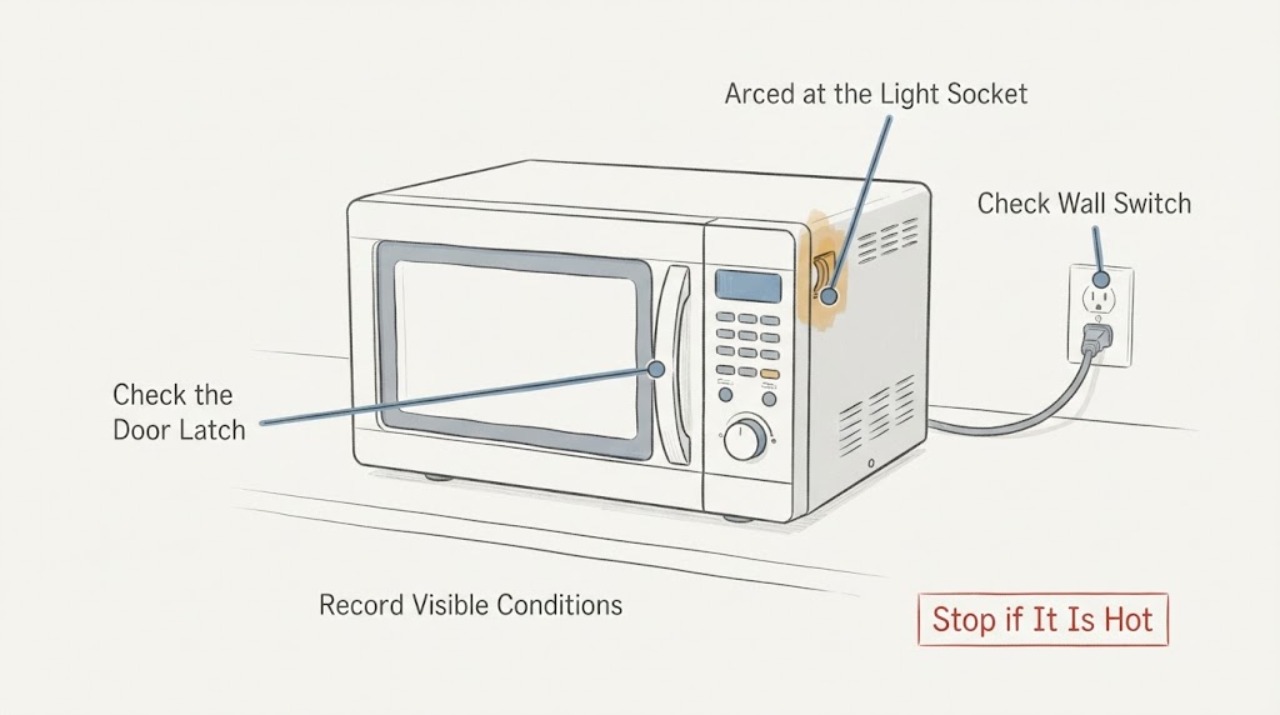
Work through in order
Diagnostic checks
Use only checks that match the exact appliance or system and its official guide.
-
Check 1
Stop operating the microwave immediately. From a safe, dry position, unplug it or switch off its dedicated breaker only if the cord, plug, outlet, surrounding floor, and breaker access are not hot, wet, scorched, smoking, or otherwise damaged. If reaching the plug is unsafe, leave it isolated at the breaker and keep clear.
Expected result: Power is isolated without touching damaged equipment, or there is smoke, a burning smell, heat, renewed sparking, exposed wiring, water, a hot outlet, or a breaker that will not remain on.
Next step: Keep the microwave disconnected. Leave the area and use emergency help for an uncontrolled fire or smoke event; arrange electrical service for a damaged outlet, cord, or recurring household breaker and qualified microwave service for the appliance.
Stop if: Do not pull a damaged plug, reset a tripped breaker repeatedly, or approach through smoke, heat, water, or exposed wiring.
Why this matters
Why: The arc and subsequent loss of several loads make continued operation an electrical and appliance-safety concern; smoke, heat, odor, or supply damage raises it to an urgent hazard rather than a troubleshooting check.
-
Check 2
Once the unit is cool and power is isolated, write down the sequence without reproducing it: the full rating-label model and serial, what was being tested, the stated WPW10498011 part number, where the arc appeared, whether a breaker operated, and which light, turntable, fan, heating, and display functions changed afterward.
Expected result: The arc location, timing, breaker response, odor or sound, and affected functions can be recorded, or the origin and sequence are uncertain.
Next step: Give the notes and photos to the service provider and have them verify the exact AS1 suffix and market documentation before selecting parts or procedures.
Stop if: Do not re-energize the microwave to confirm a symptom, test the socket with a meter, or order an internal part from this sequence alone.
Why this matters
Why: A timeline distinguishes the user-visible event from a technician's eventual finding; it does not identify a failed socket, fuse, control, fan motor, turntable motor, or magnetron. Uncertainty is a reason to preserve more information, not to try another test.
-
Check 3
With power still isolated, make only a visual check from outside and at the normally accessible cavity opening: look for scorch marks, melted or cracked plastic, damaged inlet-cover or cavity surfaces, a bent door or latch area, a damaged cord or plug, outlet discoloration, or heat damage to the cabinet. Do not touch, remove, clean, or probe the bulb socket or any cover.
Expected result: Any cavity, door, latch, cord, plug, outlet, cabinet, or visible wiring area is scorched, melted, cracked, loose, or otherwise damaged, or no visible damage is found.
Next step: Keep power off and provide the visual record to qualified appliance service; include an electrician when the outlet, cord, plug, or household supply shows damage.
Stop if: Do not straighten the door, scrape the cavity, remove the inlet cover, pull down the over-the-range unit, or restore power for a visual confirmation.
Why this matters
Why: Visible damage is a direct stop-use finding. No visible damage does not clear hidden wiring, the control path, protection circuits, or high-voltage sections after an arc and multi-function failure.
-
Check 4
Confirm the appliance's supply information only from the rating label and the accessible outlet or breaker area. Do not repeatedly reset the breaker or use an extension cord, inverter, or alternate source to see whether the light, fan, or turntable returns.
Expected result: The outlet and supply appear normal, the breaker tripped once and stays on, the breaker trips again, or the outlet/cord is damaged or not operational.
Next step: Have an electrician assess a failed or damaged outlet or recurring breaker. Otherwise leave the appliance disconnected and proceed with qualified microwave service.
Stop if: Do not repeatedly cycle the breaker, use a damaged outlet or cord, or treat a normal breaker as proof that the microwave is safe.
Why this matters
Why: Whirlpool's guidance distinguishes an operational grounded outlet from a household supply fault and says not to continue operating when a breaker or fuse trips again. A normal supply still leaves the post-arc appliance fault unresolved.
-
Check 5
Request a qualified microwave-appliance inspection and provide the exact model label, the arc timeline, photographs, the WPW10498011 number as a user-supplied reference, and the fact that heating and display remained available while the light, turntable, and fan stopped.
Expected result: The technician can verify the model documentation and safely assess the socket/light circuit, fan and turntable circuits, controls, wiring, door protection, and any arc damage, or the model suffix cannot be confirmed.
Next step: Follow the qualified technician's repair-or-replace recommendation after model verification. Keep the microwave disconnected until service explicitly returns it to operation.
Stop if: Do not open the cabinet, perform live measurements, replace an internal fuse or control board, discharge or handle high-voltage components, or bypass an interlock.
Why this matters
Why: The symptom pattern can involve more than the bulb and cannot safely select a replacement part from outside. An unconfirmed suffix also makes a model-specific part or procedure unreliable.
Use your observations
Decision map
Find the observation that best matches what you see, then follow the next safe action.
-
PATH 01Next step
What you see
There is continuing smoke, heat, burning odor, renewed sparking, exposed wiring, a hot or damaged outlet, or a breaker that trips again.
Do this next
Keep clear and disconnect power only from a safe position; use emergency help for an uncontrolled event and arrange electrical and appliance service. Do not restore power.
Why this path and its safety boundary
Why it matters: This is an urgent fire or electrical hazard, not a safe bulb, fan, or turntable check.
-
PATH 02Next step
What you see
Power is isolated and the arc was followed by the inside light, turntable, and fan becoming inoperative while heating and the display still work.
Do this next
Keep the microwave out of service, preserve the sequence and photos, and arrange qualified microwave service without a repeat power-on test.
Why this path and its safety boundary
Why it matters: The timing makes an electrical or control-side fault possible but does not identify the socket, fuse, board, motor, wiring, interlock, or any high-voltage component. A working magnetron or display does not establish safe operation.
-
PATH 03Next step
What you see
The appliance has no visible scorch marks or supply damage after it is cool and isolated.
Do this next
Do not clean, probe, or power the unit for confirmation. Give the record to qualified service and keep it disconnected until assessed.
Why this path and its safety boundary
Why it matters: No visible damage is not a safety clearance after an arc and simultaneous loss of multiple functions; hidden damage cannot be excluded by inspection from outside.
-
PATH 04Next step
What you see
The rating label does not clearly confirm WMH31017AS1, or Whirlpool's manual search returns a different suffix or market.
Do this next
Pause part selection and ask qualified service or Whirlpool support to verify the complete model and market. Keep the appliance off because the safety boundary is unchanged.
Why this path and its safety boundary
Why it matters: Model-specific parts and procedures are not established, and the opened Whirlpool Owner's Center page identifies only the WMH31017AS base model.
Helpful context
Understand the symptom
This report concerns a Whirlpool WMH31017AS1 over-the-range microwave: power arced while the WPW10498011 bulb-socket area was being tested, and afterward the inside light, turntable, and fan no longer operated while heating and the display still worked. Whirlpool's public Owner's Center page is for the WMH31017AS base model, so confirm the complete AS1 rating-label model and use Whirlpool's model-number manual search for any model-specific instruction. Nothing below assumes that a listed part fits the AS1 variant.
Whirlpool's over-the-range guidance says prolonged arcing can damage the oven and directs the user to stop and obtain service when the problem persists. Because this arc was followed by a multi-function failure, do not treat the remaining heat as a clearance signal and do not run a cup-of-water, empty-cavity, light, fan, or turntable test. The article's purpose is safe isolation and a useful handoff, not an internal diagnosis.
If the unit is cool and isolated, a safe visual record can include the cavity, door edge, inlet-cover area, visible underside, cord, plug, outlet, and nearby cabinetry. Do not remove a cover, reach into the bulb-socket area, scrape an arc mark, or restore power to see which functions return. A lack of visible damage cannot rule out damage behind the cabinet.
When checks do not resolve it
Need a professional?
Arrange qualified microwave service now because an arc at the socket was followed by the inside light, turntable, and fan failing together. Escalate urgently for smoke, heat, burning odor, renewed sparking, exposed wiring, damaged door or cavity, a damaged outlet or cord, or a breaker that trips again. Use an electrician for a failed or damaged household supply. Do not restore power for a test, open the cabinet, take live measurements, replace an internal fuse or control board, or bypass any interlock.
Common questions
FAQ
Can I keep using the Whirlpool microwave because it still heats?
No. Heating and display operation do not clear a microwave after an arc followed by several other functions failing. Keep it disconnected and arrange qualified inspection.
Should I replace the WPW10498011 socket, bulb, fuse, or control board?
Not from this symptom alone. Do not access or test the socket, replace an internal fuse or board, or order a part until a qualified technician verifies the complete model and safely diagnoses the post-arc failure.
What can I safely record before service?
Record the full rating-label model and serial, the arc's location and timing, any breaker response, smell or sound, and which light, turntable, fan, heating, and display functions changed. From a safe position, photograph visible damage to the cavity, door, cord, outlet, or cabinetry without touching or removing anything.
Read the exact guide
Official sources
- Kitchen And Laundry Appliance Manuals | WhirlpoolWhirlpool · Whirlpool instructs users to enter the model number to access appliance manuals and literature, and says the manuals cover microwaves and troubleshooting resources. This supports verifying the complete WMH31017AS1 suffix and market before using model-specific instructions.
- WMH31017AS | WhirlpoolWhirlpool · The opened Whirlpool Owner's Center page identifies the WMH31017AS base model as a 1.7 cu. ft. over-the-range microwave with hidden vent. It does not display the AS1 suffix, so the article preserves that suffix as user-supplied identity and explicitly requires rating-label/manual confirmation before variant-specific work.
- General Arcing and Sparking - Over-the-Range MicrowaveWhirlpool Product Help · Whirlpool's official over-the-range guidance says prolonged arcing can damage the oven, lists cavity contamination and objects as arcing contexts, and directs users to contact or schedule service when help is needed. It does not identify the cause of this socket event or authorize internal testing.
- Not Powering On - Over-the-Range MicrowaveWhirlpool Product Help · Whirlpool says to verify a polarized grounded operational outlet, permits a one-minute power-down/up step for ordinary power diagnosis, and explicitly says not to continue attempting operation if the breaker or fuse trips again. Because this incident included arcing and multiple function failures, the article uses only the safe isolation and escalation boundary, not the ordinary reset step.
Community feedback
Share a repair observation
Share a plain-text repair observation. Accepted observations are published automatically; this page may take a moment to update.