
On this page
Start here
Quick answer
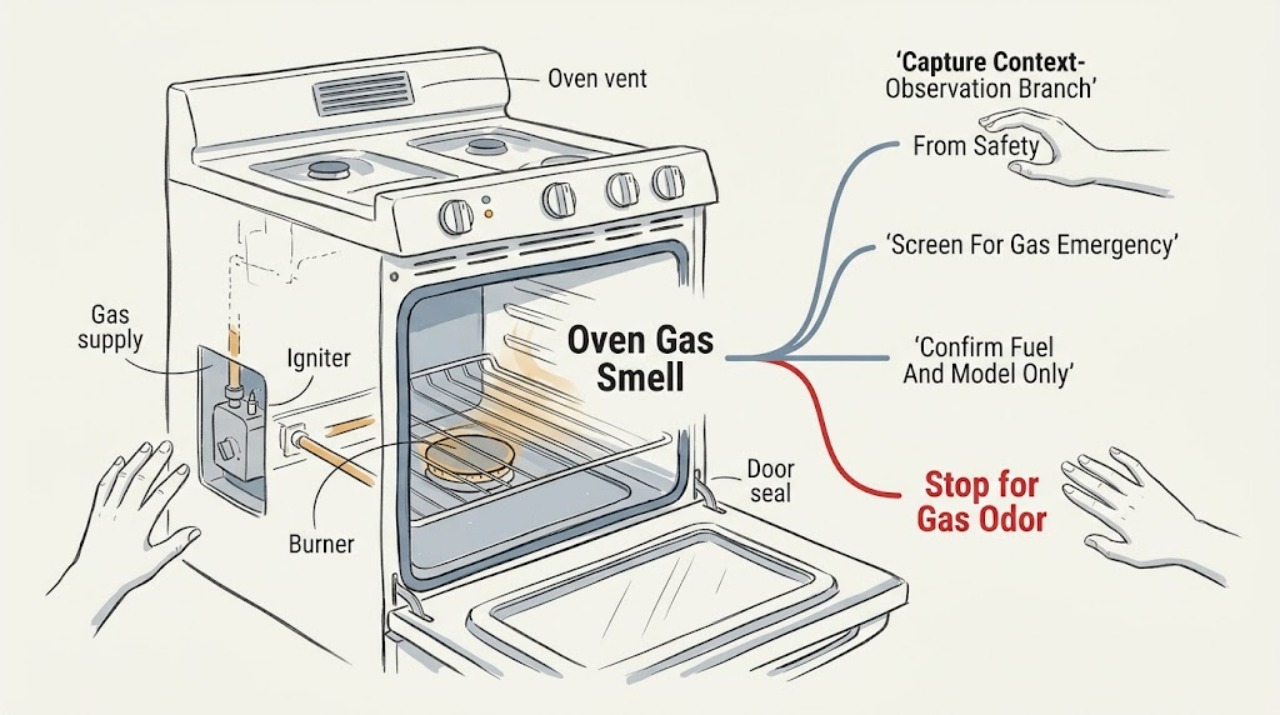
Treat an unexplained or persistent gas smell from a Whirlpool oven as a safety event, not a normal troubleshooting clue. Leave immediately if the odor is strong, continues while the oven is off, returns after a start, or comes with hissing, a delayed whoosh or boom, an abnormal flame, soot, smoke, dizziness, headache, or a carbon-monoxide alarm. Do not light anything, operate electrical switches, search for the leak, move the range, or retry the oven; contact the gas supplier or emergency service from a safe location. Whirlpool notes that a brief, faint odor during preheating or a small new-oven odor can occur in a defined context, but that distinction should be made only when the odor has fully cleared and the exact model guidance supports it. A suspected gas leak, delayed ignition, or abnormal combustion requires qualified service before reuse.
Work through in order
Diagnostic checks
Use only checks that match the exact appliance or system and its official guide.
-
Check 1
From a safe position, record the Whirlpool model if already accessible, the oven or range identity, gas or dual-fuel configuration, cavity, selected mode, whether the oven was on or off, and when the smell began; do not approach the appliance to obtain a detail.
Expected result: The odor began during preheating, after cancellation, while the oven was off, after installation or reconnection, or alongside a sound, flame, smoke, or physical symptom.
Next step: If the smell remains or the context is uncertain, leave immediately and use the gas or emergency route. Record the details only after the area is declared safe.
Stop if: Do not return to the appliance to reproduce or locate the odor.
Why this matters
Why: Timing helps a qualified professional separate a brief ignition context, new-appliance odor, residue, delayed ignition, and a possible leak, but it is not a remote diagnosis.
-
Check 2
Treat any continuing or unexplained odor as an emergency screen and note only from safety whether there is hissing, a delayed whoosh or boom, abnormal or yellow flame, soot, smoke, dizziness, headache, a carbon-monoxide alarm, or an electrical burning odor.
Expected result: The odor is strong or persistent, occurs with the oven off, follows an ignition attempt, or appears with any combustion, health, smoke, or electrical warning sign.
Next step: Leave immediately without lighting anything or operating electrical switches. From a safe location contact the gas supplier or emergency service and arrange qualified service before reuse.
Stop if: Do not light an appliance, operate a switch, use an ignition source, search for a leak, move the appliance, or retry the oven.
Why this matters
Why: These findings can indicate a gas leak, delayed ignition, incomplete combustion, fire, or electrical hazard. Delayed ignition can allow unburned gas to accumulate before it ignites.
-
Check 3
Only after the odor has completely cleared and the area is safe, confirm the fuel type and exact model from the appliance documentation or an already visible label; compare the manual's warnings and normal-operation description without opening the oven or its panels.
Expected result: The documentation confirms gas, dual fuel, or electric operation; the model is unknown; or the documentation does not match the appliance.
Next step: Use only the matching Whirlpool manual. If the fuel type or model remains uncertain after a safe check, keep the appliance off and give the label details to qualified service.
Stop if: Do not remove panels, inspect a connector, or treat an electric-model odor as proof that a gas path is safe.
Why this matters
Why: Fuel type determines whether gas supply, ignition, combustion, and gas-leak routes apply. A mismatched manual can make a normal odor or a hazard assessment wrong.
-
Check 4
If the odor was only a brief, faint whiff during a normal preheat and has fully cleared with no smoke, abnormal flame, delayed ignition, or health symptom, compare that context with the exact Whirlpool guidance; do not start another cycle just to test the distinction.
Expected result: The odor was brief and limited to ignition, persists after preheat, recurs on every start, occurs when off, or was accompanied by delayed ignition or abnormal flame.
Next step: For a truly cleared, model-supported brief odor, follow the manual and monitor without repeating tests. For any other result, keep the oven off and call qualified gas-appliance service or emergency assistance as appropriate.
Stop if: Do not normalize an odor that is strong, persistent, worsening, or paired with a combustion symptom.
Why this matters
Why: Whirlpool describes a quick preheat odor as a possible normal context, but persistence, recurrence, off-state odor, or combustion warning signs shifts the decision to service or emergency handling.
-
Check 5
If the appliance is newly installed and there is no current gas odor or hazard, check the cool oven only for remaining packaging, spilled food, or a liner that the exact Whirlpool instructions identify; do not clean or heat the oven while an unexplained gas odor remains.
Expected result: The smell is limited to first use, packaging or residue is visible, foil or a liner covers the bottom or vent area, or no benign source is evident.
Next step: Once safe and cool, remove only packaging or a prohibited liner as the matching manual directs, clean with approved instructions, and monitor only as directed. If the odor remains or its source is uncertain, call qualified service.
Stop if: Do not use a self-clean cycle, strong chemical, flame, or improvised test to remove or identify the odor.
Why this matters
Why: Whirlpool says new parts, protective materials, packaging, and residue can produce temporary odors, while a liner can trap residue or affect airflow. None of those explanations should be used to dismiss a live gas odor.
-
Check 6
After the odor has cleared and the oven is cool, compare visible vent or control conditions with the matching Whirlpool manual, including any downward airflow pointed at the appliance and any control or mode that could leave heating active; do not disturb gas hardware.
Expected result: A vent is blocked or pointed toward the appliance, a mode is unexpected, the oven continues heating after cancellation, or no visible condition explains the odor.
Next step: Correct only a clearly safe, manual-directed visible setting. If heating remains active, odor returns, or a flame is abnormal, stop use and arrange qualified service.
Stop if: Do not open panels, adjust the vent installation, or run another cycle with an unexplained odor or uncontrolled heat.
Why this matters
Why: Whirlpool warns that airflow can affect gas ignition and combustion, while continuing heat or an unexplained odor can indicate a control or combustion fault. A visible condition does not authorize internal repair.
-
Check 7
Only when there is no odor, smoke, abnormal heat, arcing, or other hazard and the exact Whirlpool manual permits it, perform the manual's single normal power or control reset; observe whether the display and mode return normally without relighting or opening the appliance.
Expected result: The display remains normal, a code returns, controls do not respond, the oven heats unexpectedly, or the odor returns after power is restored.
Next step: Keep the oven off and arrange qualified appliance or gas service for any returning code, odor, or abnormal operation. Use emergency gas handling first if an odor returns.
Stop if: Do not repeat resets, relight, enter diagnostics, or continue an operating cycle to see whether the smell fades.
Why this matters
Why: A reset can clear a transient control state but cannot prove that a gas valve, igniter, burner, sensor, or wiring condition is safe. A returning odor or abnormal operation is a stop condition.
-
Check 8
After the area is safe, prepare the exact model, fuel type, cavity, odor timing, mode, duration, recurrence, display, flame or sound observations, and any gas-utility or emergency findings for qualified service; do not attempt to reproduce the event for the technician.
Expected result: The odor was transient but recurring, occurred only during preheat, occurred while off, followed an installation or reconnection, or came with delayed ignition, flame, smoke, or health symptoms.
Next step: Keep the oven out of service until qualified service clears the cause. Follow any gas-supplier or emergency instruction already given.
Stop if: Do not replace an igniter or valve, move the range, search for a leak, or resume use based only on the smell's duration.
Why this matters
Why: A precise history lets a qualified professional assess the igniter, burner, valve, connector, vent, control, and combustion branches without asking the user to create another gas event.
Use your observations
Decision map
Find the observation that best matches what you see, then follow the next safe action.
-
PATH 01Next step
What you see
The odor is strong, persistent, present while the oven is off, or not clearly limited to a brief normal ignition context.
Do this next
Leave immediately without operating switches or ignition sources. From a safe location contact the gas supplier or emergency service and arrange qualified service before reuse.
-
PATH 02Next step
What you see
A whoosh, boom, delayed ignition, abnormal flame, soot, smoke, or carbon-monoxide alarm accompanies the odor.
Do this next
Stop using the oven, leave for suspected gas or combustion danger, and use the gas or emergency route from safety. Do not reopen or relight the oven.
-
PATH 03Next step
What you see
The odor resembles burning plastic or wire, or there is arcing, crackling, a hot connection, uncontrolled heat, or a repeated circuit trip.
Do this next
Stop use and keep clear. Isolate power only from a dry safe position when possible and arrange qualified electrical or appliance service; use the local fire route for smoke or flame.
-
PATH 04Next step
What you see
The odor was brief and faint during a normal preheat, fully cleared, and had no abnormal flame, smoke, delayed ignition, health symptom, or recurrence.
Do this next
Compare the event with the exact Whirlpool model guidance and monitor without deliberately repeating the cycle. Request service if the odor returns or changes.
-
PATH 05Next step
What you see
The oven is new and the cleared odor is limited to first use, with packaging or protective-material context and no gas or combustion warning.
Do this next
Follow the matching Whirlpool first-use guidance only after the appliance is safe and cool, including removal of packaging and ventilation. Escalate if the odor persists beyond the documented context.
-
PATH 06Next step
What you see
There is no current gas odor and the cool oven has visible food residue, packaging, or a liner that may trap residue or affect airflow.
Do this next
Use only the model's safe cleaning and liner guidance. Do not use flame or a high-temperature test to identify a smell, and call service if the odor returns.
-
PATH 07Next step
What you see
A documented, single reset was permitted and the odor, abnormal operation, or a display issue returns.
Do this next
Keep the oven off and provide the model, complete history, and reset result to qualified appliance or gas service. Do not repeat resets or ignition attempts.
-
PATH 08Next step
What you see
The odor source, fuel type, model, or relationship to the oven cannot be established safely.
Do this next
Treat it as unexplained, keep the oven out of service, and use qualified gas-appliance service; use the gas or emergency route first if the odor is present or returns.
Helpful context
Understand the symptom
Gas smell is a stop-first symptom
A smell can come from brief ignition, a new appliance, food or cleaning residue, or an actual gas or combustion fault. The smell alone cannot prove which one is present. If the source is not clearly benign and the odor is still present, do not investigate from close range. Leave and use the gas or emergency route from safety.
Keep the gas-oven identity exact
Confirm whether the Whirlpool appliance is a gas oven or a dual-fuel range from its label or manual when it is safe to do so. An electric oven can have a burning or residue odor without using gas, while a gas model can have both fuel and electrical ignition hazards. Do not infer the fuel system from the symptom or a similar model.
A qualified inspection comes before reuse
A gas connector, valve, igniter, burner, vent, or control may need inspection after an odor, delayed ignition, abnormal flame, or repeated failure. Do not move the appliance, open its panels, adjust gas pressure, test for a leak with a flame, or replace a part by guesswork. Keep the oven out of service until the appropriate qualified professional says it is safe.
Only after diagnosis
Potential parts
- gas-oven igniter or burner ignition assembly
Consider only after qualified diagnosis links recurring odor, delayed ignition, or failed ignition to the model-specific ignition assembly.
Confirm the exact Whirlpool model and fuel configuration before ordering; do not replace this part after an odor by guesswork. - gas valve or regulator assembly
Consider only when qualified gas-appliance diagnosis identifies a supply or valve fault after the appliance is safely isolated.
Gas-path work requires qualified service and exact model matching. Do not adjust pressure or test the valve yourself. - oven control or temperature-sensing assembly
Consider only when qualified diagnosis links continued heating, control behavior, or a model-specific code to this assembly rather than a leak or combustion fault.
Confirm the exact model, cavity, and control generation. An odor alone does not establish compatibility or cause.
When checks do not resolve it
Need a professional?
Keep the Whirlpool oven out of service and call qualified appliance or gas service for any persistent, recurring, off-state, or unexplained gas odor, delayed ignition, abnormal flame, no-heat result, or odor that returns after a model-approved check. Use gas-utility or emergency assistance first for strong odor, hissing, a boom, smoke, a carbon-monoxide alarm, or symptoms.
Have this ready
- Provide the exact model and serial information if safely available, fuel type, cavity, odor timing and duration, selected mode, display, ignition sound, flame or smoke observations, recent installation or reconnection, and any safe utility or emergency findings.
Common questions
FAQ
Is a brief gas smell during Whirlpool oven preheating normal?
Whirlpool says a quick faint whiff can occur as a gas oven preheats, but it should not be used to dismiss a strong, persistent, off-state, recurring, or delayed-ignition odor. Stop and use the gas-safety route whenever the context is unclear.
What should I do if my Whirlpool oven smells like gas when it is off?
Leave immediately for suspected gas danger without operating switches or ignition sources. From a safe location contact the gas supplier or emergency service; do not search for a leak, move the range, or retry it.
Can a dirty Whirlpool oven cause a gas-like odor?
Food residue, packaging, or a liner can create smoke or an odor when the oven heats, especially on a new appliance, but these explanations apply only after gas and combustion danger has been ruled out. Clean only when cool and only as the exact manual directs.
What does a boom or delayed whoosh mean in a gas oven?
Treat it as a delayed-ignition or combustion hazard. Stop using the oven, leave, and use gas or emergency assistance from a safe location; do not open the oven to investigate or try another ignition.
Can I replace the Whirlpool igniter when I smell gas?
No. Do not open panels or replace a gas-path or ignition part while an odor or delayed-ignition event is unexplained. Keep the oven off and use qualified appliance or gas service after the area is safe.
Read the exact guide
Official sources
- Odors or SmellsWhirlpool Corporation · The page addresses Whirlpool gas cooktops; its gas-odor emergency instructions apply as general gas-appliance safety, not as an oven component diagnosis.
- Appliance and Electrical Fire SafetyU.S. Fire Administration · General appliance electrical safety, not Whirlpool-specific diagnosis.
- Odors and Smells of Newly Installed Range or OvenWhirlpool Corporation · Use only for a new or recently installed Whirlpool range or oven after gas-safety screening is clear.
- owners-manual-w11702310-reva.pdfWhirlpool Corporation · Use only when the exact Whirlpool model matches this manual family; otherwise use the correct model manual.
- CookingU.S. Fire Administration · General cooking-fire safety, not Whirlpool-specific diagnosis.
- gasU.S. Consumer Product Safety Commission · General gas-appliance safety; qualified professionals should inspect connectors and users should leave for a suspected leak.
- Why Does My Oven Smell Like Gas?Whirlpool Corporation · Whirlpool consumer guidance; exact model manual and gas-safety instructions take precedence.
- Gas Range Delayed Ignitions - Tests and Examinations of RangesU.S. Consumer Product Safety Commission · General safety research for gas ovens; it does not identify a Whirlpool model or part.
Community feedback
Share a repair observation
Share a plain-text repair observation. Accepted observations are published automatically; this page may take a moment to update.