
On this page
Start here
Quick answer
First decide whether the Whirlpool oven is completely without power or has a display that will not start a cooking cycle. From a dry, safe position, check the household breaker or fuse, the display, the control lock, the selected mode, any delayed start or demo mode, and the door. Gas and dual-fuel models also need a safe, model-appropriate gas-supply check; electric models do not. Do not remove panels or test live wiring. If there is gas odor, delayed ignition, an abnormal flame, smoke, a burning smell, arcing, a hot outlet, repeated tripping, or a CO alarm, stop using the oven and leave the area as appropriate. A single manufacturer-authorized power reset is reasonable only when there is no immediate hazard; a recurring failure needs Whirlpool service or a qualified electrician.
Before you begin
Safety first
- This article permits only dry, external, model-manual-guided observations and one authorized reset when no hazard exists. It does not authorize live electrical tests, panel removal, gas adjustment, ignition repetition after failure, lock bypass, or operation after a safety symptom.
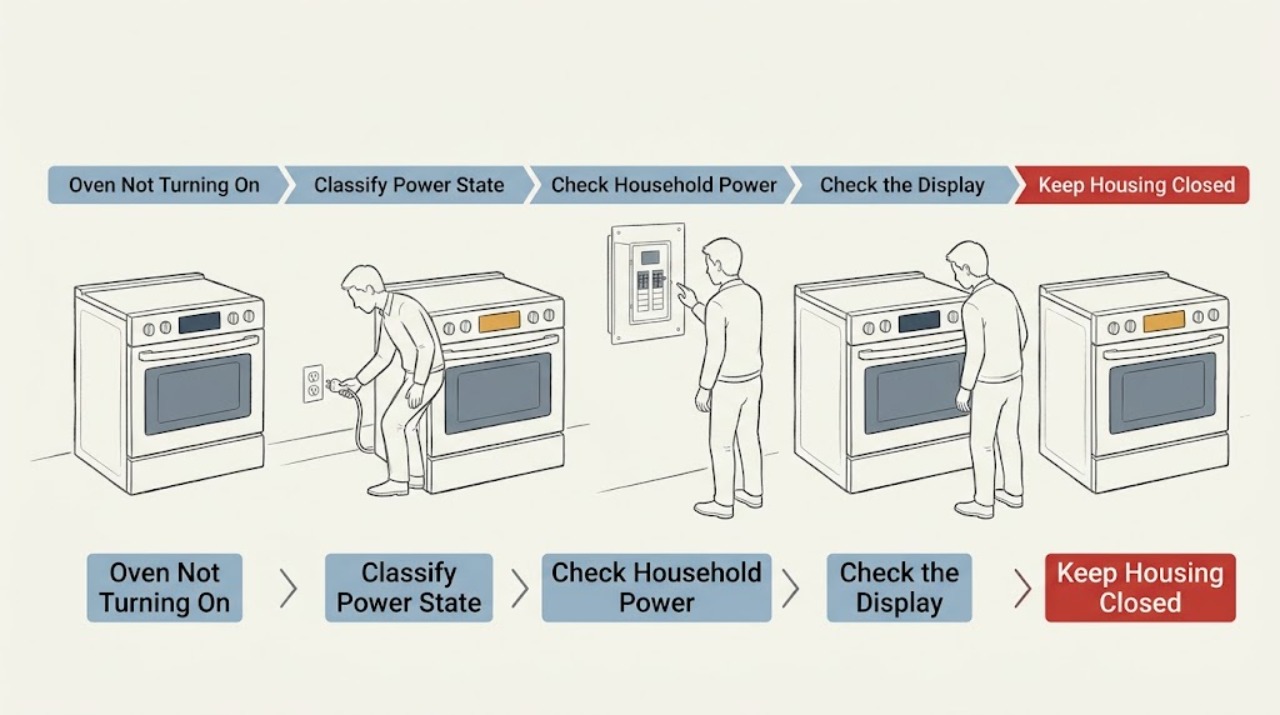
Work through in order
Diagnostic checks
Use only checks that match the exact appliance or system and its official guide.
-
Check 1
From a dry position, observe the control display, interior light, clock, and any other Whirlpool range or wall-oven functions without opening panels or touching wiring.
Expected result: Record whether everything is blank, the display is partial or frozen, a lock or error message is present, or the display works but a cooking cycle will not begin.
Next step: Use the matching branch below and photograph or transcribe the exact display message, symbols, and any repeating code before attempting a reset.
Stop if: Stop immediately for smoke, fire, gas or fuel odor, a hot or damaged outlet, visible arcing, a burning smell, or a CO alarm.
Why this matters
Why: A completely blank appliance points toward supply, breaker, fuse, connection, or control power. A lit but unresponsive display points toward a lock, control state, or control fault; a working display with no heat needs a mode, door, gas, or heating-path branch.
-
Check 2
Check the appliance's accessible plug or household breaker/fuse from a dry, safe position; do not remove a wall-oven panel or inspect live terminals.
Expected result: Note whether the breaker is tripped, a fuse is open, the oven shares a dead circuit, or the supply appears normal while the display remains blank. For a gas range, note whether the grounded outlet is accessible and appears operational without using an extension or adapter.
Next step: If there is no immediate hazard, make only the single reset authorized by the model guidance; if the breaker trips again, the outlet is hot/damaged, or the supply is uncertain, leave the appliance off and call a licensed electrician or Whirlpool service.
Stop if: Do not repeatedly reset a breaker, substitute a fuse, use an extension cord, touch wet equipment, measure voltage, or open electrical covers.
Why this matters
Why: A tripped breaker or blown fuse can explain a blank control, but a repeat trip may indicate a fault. Whirlpool says continuing power problems require qualified electrical help; a normal-looking breaker does not prove a wall oven has correct voltage or wiring.
-
Check 3
With the oven off and cool, inspect the display for Control Lock, LOC, a padlock, Demo mode, Sabbath mode, or Delayed Start; use only the unlock or cancel sequence in the exact owner's manual.
Expected result: The keypads may begin responding after the documented unlock sequence, or the display may continue to show a lock, demo presentation, delayed time, or an error.
Next step: Cancel the delay or demo state only as the manual directs, select a normal cooking mode, and proceed to the door and fuel-type checks if the controls respond.
Stop if: Do not guess at hidden service modes, bypass a lock, force a latch, or continue if the display is erratic, the oven is hot, or an error returns.
Why this matters
Why: A locked control intentionally ignores commands. Demo mode can prevent operation, and Delayed Start can defer ignition or heating without indicating a dead oven. A persistent lock or error after the model-specific sequence points to service rather than a guessed button combination.
-
Check 4
Confirm the intended mode and temperature, cancel any delayed start, close the door fully, and press Start once according to the model's control guide; do not run Self-Clean as a diagnostic test.
Expected result: Record whether the display accepts Bake or another appropriate mode, whether Start produces a response, whether the door or latch is visibly obstructed, and whether the oven begins its normal preheat indication.
Next step: Stop ordinary testing and arrange Whirlpool service when a correct command is accepted but the oven does not respond, or when the door cannot close or latch normally.
Stop if: Do not force the door, bypass the door switch, start repeated cycles, use Self-Clean to provoke heating, or open the appliance to inspect an element or igniter.
Why this matters
Why: An incorrect mode, delay, lock, or door position can block a start command. If the controls accept the command but there is no normal heating or ignition response, the fault has moved to the model-specific electrical, gas, igniter, element, sensor, or control path.
-
Check 5
Only for a gas or dual-fuel Whirlpool model and only when there is no gas odor or other hazard, identify whether the cooktop and oven share a gas supply and observe the accessible main gas shutoff position without moving fittings or opening the appliance.
Expected result: A cooktop may work while the oven does not; the main valve may be off, or an ignition attempt may produce clicking without a safe flame. A recently reconnected line may have air, but the model manual must control any approved procedure.
Next step: Do not keep trying to ignite. If the accessible valve position is clearly wrong and the manual supports a safe correction, follow the manual once; otherwise leave the appliance off and call Whirlpool or a qualified gas-appliance technician.
Stop if: For any gas smell, hissing, delayed ignition, flare, yellow or unstable flame, smoke, CO alarm, or symptoms such as headache or dizziness, do not operate switches or electronics inside; leave and contact emergency or gas authorities from outside.
Why this matters
Why: Whirlpool notes that gas oven ignition also depends on a grounded outlet and gas supply. A cooktop working does not prove the oven branch or regulator path is sound; a no-flame, delayed ignition, abnormal flame, or repeated clicking is a service condition.
-
Check 6
If there is no gas, fire, smoke, water, heat, or electrical hazard and the manual or Whirlpool guidance permits it, switch off the oven's breaker for the documented short interval, restore it once, and observe before pressing controls.
Expected result: Record whether the display returns normally, an F9 or F9 E0 or other exact message reappears, the control remains blank, or the breaker trips again.
Next step: If the reset does not restore normal operation, keep the oven off and provide the exact code, model, fuel type, and outage history to Whirlpool service or a qualified electrician.
Stop if: Do not repeat the reset, replace a fuse with a different rating, defeat a breaker, or energize an appliance showing damage or exposed moisture.
Why this matters
Why: A normal restart can clear a transient outage or control state, but a recurring code, blank display, repeat trip, or abnormal behavior points to a supply, wiring, control, or appliance fault that a professional must diagnose.
-
Check 7
Prepare a service record with the Whirlpool model and serial information, electric/gas/dual-fuel type, exact display text, what still has power, breaker history, selected mode, door state, and any odor, sound, heat, or flame observation.
Expected result: Confirm whether the failure is no power, no accepted command, no heat, no ignition, a recurring code, or a door/control problem, and whether the issue began after an outage, installation, cleaning cycle, or gas reconnection.
Next step: Give the record to Whirlpool support, a qualified appliance technician, or a licensed electrician as appropriate, and keep the oven out of service until the cause and safe operation are confirmed.
Stop if: Do not remove panels, access a terminal block, adjust gas components, bypass a door or safety control, or continue operating after a safety symptom.
Why this matters
Why: These observations distinguish an electrician or supply issue from Whirlpool appliance service without requiring hazardous internal tests. Missing model or fuel information means model-specific instructions cannot safely be assumed.
Use your observations
Decision map
Find the observation that best matches what you see, then follow the next safe action.
-
PATH 01Safety boundary
What you see
The display, clock, and oven functions are all blank.
Do this next
Check the accessible breaker or fuse once from a dry position; if it is normal, trips again, or the supply is uncertain, keep the oven off and call a licensed electrician or Whirlpool service.
Why this path and its safety boundary
Why it matters: Power delivery, breaker/fuse, installation wiring, or the control power supply is more likely than a simple mode setting.
Safety stop: Do not open the wall oven, repeatedly reset the breaker, or touch wiring.
-
PATH 02Safety boundary
What you see
The display works but ignores Start or shows a lock, delay, demo, Sabbath, or error state.
Do this next
Record the exact message and use only the model's documented unlock, cancel, or reset sequence; escalate when it persists.
Why this path and its safety boundary
Why it matters: The oven has control power, but a mode, lock, delayed operation, recent-outage state, or control fault may prevent starting.
Safety stop: Do not bypass a lock or guess at service-mode combinations.
-
PATH 03Safety boundary
What you see
The oven is electric and the controls accept a normal mode but there is no heating or operation.
Do this next
Keep the mode and exact symptoms in the service record and arrange Whirlpool appliance service or qualified electrical evaluation.
Why this path and its safety boundary
Why it matters: The remaining possibilities include supply voltage, a fault after an outage, heating or sensing components, wiring, or control failure; internal testing is not an ordinary-user check.
Safety stop: Do not probe terminals, remove panels, or keep operating after a repeat breaker trip, smoke, odor, arcing, or abnormal heat.
-
PATH 04Safety boundary
What you see
The oven is gas or dual fuel, the cooktop may work, but the oven does not ignite or start.
Do this next
Make only the model-authorized external observations and arrange qualified gas-appliance service for no flame, repeated clicking, or failed ignition.
Why this path and its safety boundary
Why it matters: The gas supply, grounded ignition supply, door position, regulator path, igniter, or control may be involved; cooktop operation does not prove the oven path is safe.
Safety stop: For odor, hissing, delayed ignition, flare, abnormal flame, smoke, CO alarm, or illness, leave immediately and contact emergency or gas authorities from outside.
-
PATH 05Safety boundary
What you see
The breaker trips again, the outlet or control is hot, there is smoke, burning odor, arcing, fuel odor, water exposure, or a CO alarm.
Do this next
Stop using the appliance. Leave for gas, smoke, fire, or CO danger and contact emergency services, gas authorities, a licensed electrician, or qualified appliance service from a safe location.
Why this path and its safety boundary
Why it matters: This exceeds routine troubleshooting and may involve fire, shock, gas, or carbon-monoxide risk.
Safety stop: Do not reset, relight, test, or re-enter a hazardous area until the responsible professional or emergency authority clears it.
Helpful context
Understand the symptom
Separate no power from no start
A blank display, an unresponsive keypad, and a lit display that refuses to begin Bake are different symptoms. A recent outage can leave a Whirlpool control showing a fault or needing a reset, while a locked panel, demo mode, delayed start, or an unconfirmed door can make a powered oven appear dead. Record exactly what the display shows before resetting anything and use the model's manual for controls that vary by design.
Fuel type changes the safe branch
An electric oven can be limited to external power and control observations. A gas or dual-fuel range also depends on a grounded supply for ignition and on the gas supply being available, but a gas odor, delayed ignition, abnormal flame, smoke, or a CO alarm is not a troubleshooting invitation. Stop, leave the hazard area, and use the appropriate emergency or qualified-service route.
A reset is a diagnostic checkpoint, not a repair
Whirlpool documents a brief breaker reset for some control and outage symptoms. If the oven remains dead, the same code returns, the breaker trips again, or the appliance behaves unpredictably, leave power off and arrange service. Do not remove the oven, open a junction box, bypass a door or gas safety device, or probe energized wiring.
Safety boundary
Stop conditions
- Stop immediately for gas odor, hissing, delayed ignition, flare, yellow or unstable flame, smoke, burning smell, arcing, a hot or damaged outlet, repeated breaker trips, water exposure, or a CO alarm.
- If gas is suspected, do not operate lights, switches, phones, or other electronics inside; leave and contact gas or emergency authorities from outside.
- If a CO alarm sounds or anyone has headache, dizziness, nausea, confusion, or breathing symptoms, move outside, call emergency services, and do not re-enter until cleared.
- Do not remove oven or terminal panels, measure live voltage, touch wiring, bypass a door or gas safety device, adjust gas components, or use an extension cord or two-prong adapter.
- Do not repeatedly reset a breaker, keep trying to ignite a gas oven, run Self-Clean as a test, or operate an oven that behaves unpredictably or shows a recurring fault.
When checks do not resolve it
Need a professional?
Call Whirlpool service or a qualified appliance technician when a correct mode and safe one-time reset do not restore operation, a display code returns, the door or lock will not behave normally, a gas oven will not ignite, or the cause requires internal testing. Call a licensed electrician for an uncertain supply, miswired installation, hot outlet, or recurring breaker/fuse fault. For gas odor, fire, smoke, a CO alarm, or immediate electrical danger, leave and contact emergency or gas authorities from a safe location.
Safety scope: This article permits only dry, external, model-manual-guided observations and one authorized reset when no hazard exists. It does not authorize live electrical tests, panel removal, gas adjustment, ignition repetition after failure, lock bypass, or operation after a safety symptom.
Common questions
FAQ
Why is my Whirlpool oven display on but the oven will not start?
Check for Control Lock, LOC, Demo mode, Sabbath mode, Delayed Start, an unconfirmed door, or an exact error message. Use only the control sequence in the model's manual. If a normal mode is accepted but there is no heating or ignition, stop repeated testing and arrange qualified service.
What should I do if the Whirlpool oven is completely blank?
From a dry position, check the household breaker or fuse and record any recent outage. If a safe, single reset does not restore normal operation, or the breaker trips again, keep the oven off and contact a licensed electrician or Whirlpool service. Do not remove panels or test live wiring.
Can I keep trying to light a Whirlpool gas oven that does not start?
No. If ignition fails, stop repeated attempts and arrange qualified gas-appliance service. Any gas odor, hissing, delayed ignition, abnormal flame, smoke, or CO alarm requires immediate safety action rather than more testing.
Does a working cooktop prove a Whirlpool gas oven has gas and power?
No. Whirlpool treats oven ignition as dependent on a grounded electrical path and the oven's gas supply path; a cooktop can work while the oven branch, regulator path, igniter, control, or door condition prevents operation. Keep checks external and model-specific.
Read the exact guide
Official sources
- No or Partial Display - Wall OvenWhirlpool Product Help · Whirlpool wall ovens; exact unlock controls vary by single- or double-oven model.
- Oven Not Working - ElectricWhirlpool Product Help · Whirlpool electric range ovens; exact controls and reset timing vary by model.
- Oven Not Working - Cooktop Working - Not ClickingWhirlpool Product Help · Whirlpool gas ranges where cooktop operation differs from oven ignition.
- Oven Not Working - Gas and Dual Fuel RangeWhirlpool Product Help · Whirlpool gas and dual-fuel range ovens; use the model manual for exact controls and installation.
- Locked, Lock or Loc - RangeWhirlpool Product Help · Whirlpool ranges showing Locked, Lock, or Loc; button timing varies by model.
- Carbon Monoxide Fact SheetU.S. Consumer Product Safety Commission · U.S. consumer safety guidance for fuel-burning appliances and CO alarms.
Community feedback
Share a repair observation
Share a plain-text repair observation. Accepted observations are published automatically; this page may take a moment to update.