
On this page
Start here
Quick answer
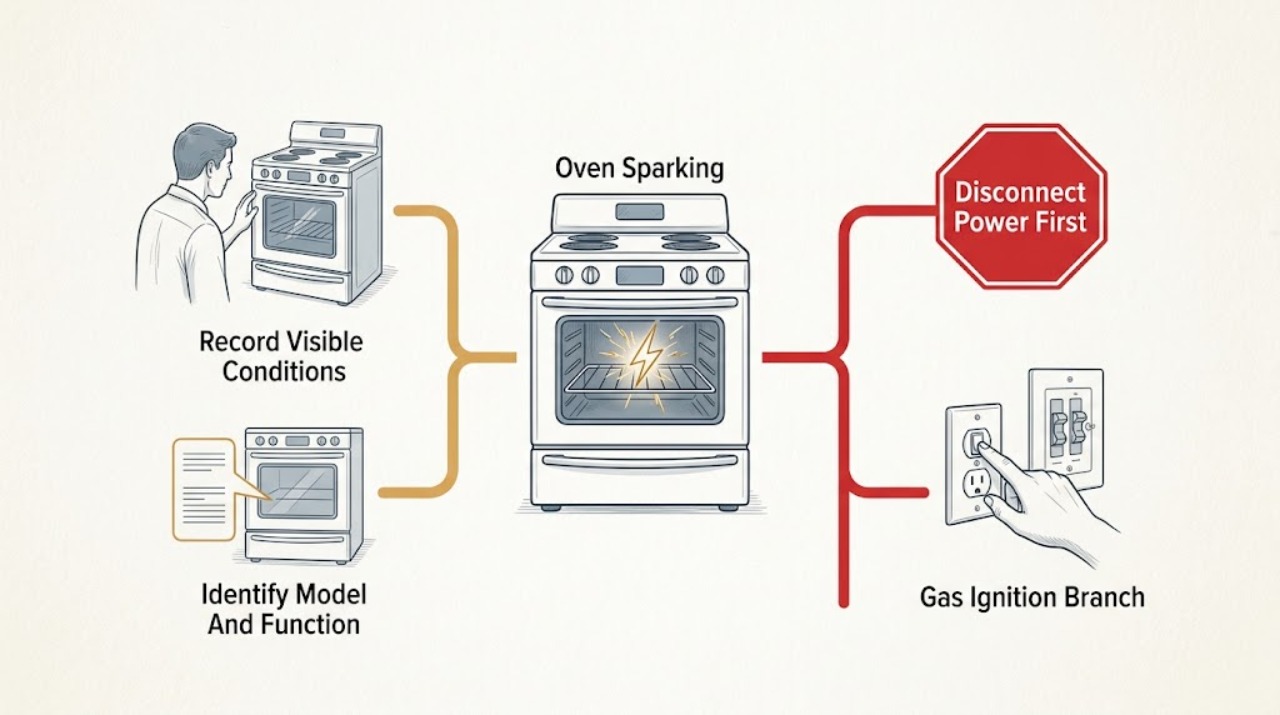
Visible arcing or a spark outside the normal gas-ignition sequence is not a keep-testing symptom. Turn the Whirlpool oven off immediately and do not restart it to reproduce the event. From a safe position, identify whether this is a gas oven making a brief ignition spark, a microwave function in a wall-oven combination, or a conventional electric oven showing an arc. A gas igniter may click briefly until flame is detected, but continued clicking or sparking after the control is off, a delayed pop, gas odor, abnormal flame, smoke, or any electrical arc requires service. In microwave mode, metal or foil used incorrectly, a rack, or soil in the cavity can cause arcing, but the unit must still be stopped before any safe visual cleanup. Do not open covers, test live parts, light gas by hand, or use the oven again until the cause is cleared.
Work through in order
Diagnostic checks
Use only checks that match the exact appliance or system and its official guide.
-
Check 1
Turn the oven control off immediately and stop any cooking cycle. From a safe position, record where the flash or spark appeared, whether it was inside the cavity or behind the controls, whether it repeated after shutoff, and whether there was smoke, odor, flame, or a breaker trip.
Expected result: The event was a single brief ignition spark with no hazard, a repeated spark, a blue arc, smoke or flame, a gas odor, or an electrical trip.
Next step: Keep the oven off. For smoke, flame, gas odor, or an electrical hazard, leave the area and use the appropriate emergency or utility response. Otherwise continue only with external identification and arrange appliance service.
Why this matters
Why: A brief gas ignition event can be normal only in the narrow sequence described by the Whirlpool gas guidance. Repeated or visible arcing, smoke, flame, gas odor, or a trip is not a normal user check and can indicate fire, gas, or shock risk.
-
Check 2
With the oven off and cool, read the external model label and note whether the affected function was gas bake or broil, conventional electric bake or broil, or microwave operation in a combination wall oven. Do not remove panels, racks that are hot, insulation, or control covers to find the label.
Expected result: The fuel and function are clear; or the appliance is a combination unit or the fuel type is unknown.
Next step: Give the model, function, timing, and location of the spark to a Whirlpool-qualified appliance technician. Use the model manual for any model-specific cleaning or accessory rule; do not substitute a generic ignition procedure.
Why this matters
Why: Gas ignition clicks have a different interpretation from an arc in an electric heating circuit. Microwave cavity rules also differ from conventional oven rules, so an unknown function prevents a safe specific test.
-
Check 3
If the affected function was gas bake or broil, do not run another ignition cycle. Use the recorded event to distinguish a short click while a flame was being detected from clicking or sparking after the control was off, a delayed ignition, or an unusual flame; inspect only the visible door and control state without opening the burner area.
Expected result: The spark stopped promptly after flame detection and there was no odor or abnormal flame; or it continued, the flame did not appear normally, ignition was delayed, or gas odor was noticed.
Next step: For the normal narrow pattern, keep the model manual and service path available and do not repeat the cycle solely to confirm it. For any other pattern, keep the oven off, avoid all ignition attempts, and request qualified gas-appliance service.
Why this matters
Why: Whirlpool says short clicking until flame detection can be normal. Continued sparking, failure to establish flame, delayed ignition, or gas odor can leave unburned gas or indicate an igniter, burner, control, or supply fault.
-
Check 4
If the spark happened during microwave operation in a Whirlpool combination wall oven, leave the oven off and cool. From the doorway, note any metal or foil, a rack or accessory, baked-on soil, a damaged cavity cover, or a mark on the cavity or door area; do not touch a damaged surface or reach into a still-hot cavity.
Expected result: The event involved a listed accessory or food residue, or it occurred with no visible object and there is a cavity, door, or cover mark.
Next step: Only after the unit is fully cool and the manual permits it, remove a loose non-damaged accessory or clean accessible residue using the manual's method. Do not operate the microwave to see whether the spark returns; request service for unexplained or damaged-cavity arcing.
Why this matters
Why: Whirlpool lists incorrect metal or foil use, a rack used in the wrong function, and soil buildup as possible microwave arcing causes. A mark, damaged cover, or unexplained arc needs service because repeated arcing can damage the oven or utensil.
-
Check 5
If this was a conventional electric Whirlpool oven, keep it off and visually check only the accessible door, cavity floor, racks, and control area for a loose element, melted material, scorch mark, damaged cord or plug, or evidence of a trip. Do not test voltage or remove the rear panel, move a hardwired unit, or touch an element or wiring.
Expected result: The arc was near an element or cavity, behind the controls, at the cord or receptacle, or no source is visible.
Next step: Leave the appliance out of service and give the location and photos to a qualified appliance technician; involve a qualified electrician when the cord, receptacle, circuit, or wiring is implicated.
Why this matters
Why: A visible arc in a conventional electric heating or control circuit is not the normal gas-ignition pattern. Smoke, scorching, hot electrical parts, or a trip can indicate a shock or fire hazard even when the oven later appears to work.
Use your observations
Decision map
Find the observation that best matches what you see, then follow the next safe action.
-
PATH 01Next step
What you see
The oven is confirmed gas, the event was a brief click or spark during ignition, flame was detected promptly, and there was no odor, smoke, delayed bang, or abnormal flame.
Do this next
Treat that narrow sequence as potentially normal according to Whirlpool, but do not repeat a cycle solely for testing. Use the exact model manual and request service if the event changes or recurs outside ignition.
-
PATH 02Next step
What you see
A gas oven keeps clicking or sparking after the control is off, fails to ignite normally, ignites late, shows an unusual flame, or produces gas odor.
Do this next
Keep the oven off, do not light or test it again, avoid flames and electrical switches if gas odor is present, leave the area if needed, and obtain qualified gas-appliance or emergency help.
-
PATH 03Next step
What you see
Sparking occurred in microwave mode and a rack, foil, metal, food soil, or cavity mark is visible.
Do this next
Keep the oven off. Once fully cool and only if the model manual allows, remove the loose accessory or clean accessible residue; do not operate again when the cavity, door, or cover is damaged or the cause is uncertain.
-
PATH 04Next step
What you see
A conventional electric oven arcs, the flash is behind the controls, the cord or receptacle is involved, or no safe external cause is visible.
Do this next
Keep the appliance out of service and arrange qualified appliance and, when the circuit is implicated, electrical inspection. Do not test live voltage or remove panels, and do not reset the breaker to retry.
-
PATH 05Next step
What you see
Smoke or flame is present in the oven, or the spark is accompanied by a burning odor and heat damage.
Do this next
Keep the oven door closed, turn off the heat only if safely reachable, leave the area, and call emergency fire help. Do not open the door to inspect or use water on an oven fire.
Helpful context
Understand the symptom
A gas ignition spark is not the same as an electrical arc
A gas Whirlpool oven can make short clicks while its igniter lights the burner, and a click or pop at ignition can be normal. That does not make every visible spark safe. A spark that continues after the flame should be established or the control is off, appears behind the control panel, or comes with a delayed bang, gas odor, smoke, or an abnormal flame is a stop-and-service event. A conventional electric oven should not be treated like a gas igniter system.
First identify the cooking function
The word oven may describe a conventional electric or gas cavity, or a Whirlpool wall oven that also has microwave operation. Microwave arcing can be caused by unsuitable metal or foil use, a rack in the wrong function, food soil, or a damaged cavity area. These possibilities do not justify a live inspection or a repeat run; use the model manual and service support after the appliance is stopped.
Fire and gas boundaries
If there is smoke or flame, keep the oven door closed, turn off the heat only if the control is safely reachable, leave the area, and use emergency help. If gas odor or delayed ignition is suspected, do not use switches, flames, or a hand-held lighter to investigate. Do not remove panels or attempt a gas or high-voltage repair.
Safety boundary
Stop conditions
- Stop immediately for gas odor, delayed ignition, a bang, abnormal flame, smoke, flame, or a carbon-monoxide alarm.
- Stop for any visible arc outside the brief, model-appropriate gas ignition sequence, including an arc behind controls or near a cord or receptacle.
- Do not reset a tripped breaker to retry, test live voltage, remove covers, or access gas, high-voltage, or burner components.
- Do not use a hand-held flame to light or diagnose the oven, and do not use switches when gas odor is present.
- Do not reopen the oven after a fire or use water on an oven fire; leave and use emergency help.
Only after diagnosis
Potential parts
- gas oven igniter
Consider this category only if a qualified diagnosis confirms a gas ignition fault and identifies the exact model part.
Confirm the complete model and the manufacturer's fit information; do not infer compatibility from a similar-looking igniter. - microwave cavity cover
Consider this category only if the combination wall oven model manual and a qualified inspection identify a damaged microwave cavity cover as the cause.
Microwave safety parts require exact model matching and correct installation by a qualified service person.
When checks do not resolve it
Need a professional?
Call qualified appliance service for continued gas-igniter sparking, delayed or failed ignition, any abnormal flame, unexplained microwave arcing, a marked cavity or cover, or any conventional electric oven arc. Involve a qualified electrician for a hot or damaged cord, plug, receptacle, circuit, or breaker. Use emergency gas, fire, or medical response for gas odor, smoke, flame, a bang, carbon-monoxide alarm, or immediate electrical danger.
Have this ready
- Provide the Whirlpool model, fuel type, cooking function, exact spark location, whether it stopped after ignition or continued after shutoff, flame behavior, timing, photos taken only after the unit is safe and cool, and any gas odor, smoke, scorch, breaker trip, or electrical history.
Common questions
FAQ
Is a spark in a Whirlpool gas oven always dangerous?
No, but the safe exception is narrow: Whirlpool describes short igniter clicking until the gas flame is detected as normal. A spark or clicking that continues after shutoff, a delayed ignition, unusual flame, gas odor, smoke, or an arc outside the ignition point means stop using the oven and obtain service.
What should I do if a Whirlpool wall-oven microwave sparks?
Turn it off immediately and do not run it again to test. Once cool, note whether the event involved an incorrect rack or metal or foil use, food soil, or a damaged cavity area. Only remove a loose safe accessory or clean accessible residue when the model manual allows; a cavity mark, damaged cover, or unexplained spark needs service.
Can I remove the back panel to find the source of an oven spark?
No. Keep the oven out of service and do not access gas, high-voltage, heating-element, control, or wiring areas. Provide the model, function, spark location, and any smoke, odor, scorch, or breaker information to a qualified technician.
Read the exact guide
Official sources
- Clicking Noise in a Gas OvenWhirlpool Product Help · Whirlpool gas-oven igniter clicking and flame-detection behavior
- CPSC Guide to Home Wiring HazardsU.S. Consumer Product Safety Commission · sparks, smoke, hot plugs, and damaged appliance wiring
- Popping or Cracking - RangeWhirlpool Product Help · Whirlpool gas-oven clicking and model-specific manuals or service escalation
- Recipe for Safer CookingU.S. Consumer Product Safety Commission · kitchen and oven fire response
- Microwave Arcing or Sparking - Wall OvenWhirlpool Product Help · Whirlpool wall-oven microwave arcing, rack, metal, foil, and cavity-soil causes
- Oven Not Working - Cooktop Working - ClickingWhirlpool Product Help · Whirlpool gas-oven ignition, regulator shutoff, door, and burner-area safety checks
Community feedback
Share a repair observation
Share a plain-text repair observation. Accepted observations are published automatically; this page may take a moment to update.