
On this page
Start here
Quick answer
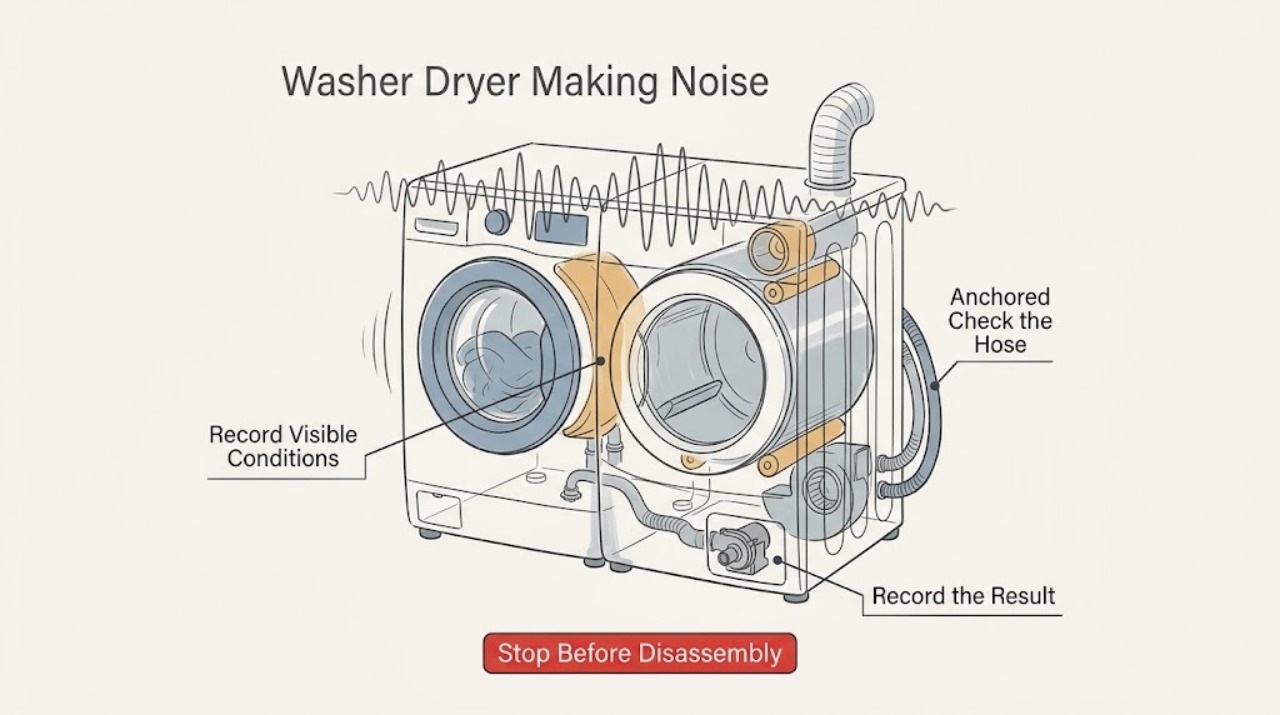
First identify whether the sound comes from the washer side or the dryer side and note exactly when it happens. Washer spray, sloshing, a brief drive-system clunk, or end-of-drain gurgling can be normal; banging during spin more often points to a load, leveling, hose, or installation issue. Dryer thumping can follow a balled-up load, a dryer that has sat unused, or an unlevel cabinet, while rattling or scraping can come from pocket items at the drum edge or lint chute. Stop using the appliance immediately for violent impact, persistent metal scraping, a leak, overheating, burning odor, gas odor, smoke, sparks, or a tripped breaker; arrange qualified service instead of opening the cabinet.
Work through in order
Diagnostic checks
Use only checks that match the exact appliance or system and its official guide.
-
Check 1
With the appliance stopped, identify which cabinet is making the sound and write down the cycle stage. On the washer, compare fill or spray, agitation or tumble, drain, and spin. On the dryer, compare start, tumbling, heat, and the end of the cycle. Keep clear of the drums while they move.
Expected result: Spraying, splashing, or sloshing occurs during fill or rinse; a short clunk occurs as the washer changes between agitation and spin; gurgling occurs only near the end of drain; or the noise is a repeating thump, rattle, scrape, or bang from the dryer.
Next step: If a sound is brief and stage-specific with no hazard, continue to the matching washer or dryer check. If it is violent, metallic and persistent, or accompanied by a leak, heat, odor, smoke, spark, or breaker trip, stop and arrange service without another test cycle.
Why this matters
Why: The stage separates normal water or drive sounds from a load or balance problem and prevents treating a washer vibration as a dryer fault. Whirlpool describes fill, agitation, and rinse water sounds as normal and identifies a brief drive change clunk as normal on applicable washers.
-
Check 2
For a washer-side bang, clunk, or vibration, stop the cycle and redistribute the load loosely. Remove coins, buttons, and other pocket items, avoid a single heavy item or an overloaded basket, and look around the outside for an object leaning against the cabinet. Check that the drain and inlet hoses are not free to strike the rear panel. With the washer idle, rock it gently corner-to-corner and confirm all four feet are firmly on the floor; adjust only as described in the model installation instructions.
Expected result: The sound disappears after the load is balanced or an outside object or hose is secured; the washer rocks or a foot is not firmly planted; or the noise remains with an empty, balanced load and clear surroundings.
Next step: Run one normal, supervised check only after the load and surroundings are safe. If the washer still bangs, walks, leaks, or the drum strikes the cabinet, stop using it and request service; do not remove panels or attempt suspension, bearing, or drive repairs.
Why this matters
Why: Improvement after redistribution points to load balance or a loose external contact. Rocking indicates leveling or installation needs attention. A persistent noise with an empty, stable washer is less consistent with a simple load and needs professional diagnosis.
-
Check 3
If the washer noise is concentrated during drain, observe whether water leaves normally and whether the sound is a smooth hum or end-of-drain gurgle rather than a grinding or repeated hard rattle. Check only the visible drain hose for kinks, cabinet contact, or an obvious obstruction. Keep the washer stopped if water is standing, a hose is leaking, or access would require removing a pump cover or reaching inside.
Expected result: A smooth hum or brief gurgle occurs only while the tub finishes draining and the water clears; the hose taps the cabinet; water remains or drains slowly; or the pump area produces grinding, hard rattling, or a leak.
Next step: Secure a visibly contacting hose if the model instructions allow it and run no more than one supervised drain check. If water remains, the harsh noise repeats, or a leak appears, stop, protect the area from water and electricity, and call a qualified appliance technician.
Why this matters
Why: Whirlpool explains that the pump runs through drain and may pull air near the end, producing a normal gurgle. A hose contact can make a separate knock. Remaining water, a persistent harsh noise, or a leak suggests a blocked drain path, pump, or other fault beyond an external check.
-
Check 4
For a dryer-side thump, rattle, or scrape, stop the dryer, allow hot surfaces to cool, and remove the load. Check pockets and garment hardware, then inspect the visible front and rear drum seams and the lint-screen opening for a loose coin, clip, fastener, sock, or other object. Remove only an object that is plainly reachable without tools or cabinet access. Do not reach into a moving drum or blower path.
Expected result: The load was balled up or contained loose hardware; a small object is visible at a drum seam or lint opening; a light thump occurs only during the first minutes after long non-use; or the empty dryer still scrapes, bangs, or makes a repeating high-pitched noise.
Next step: Correct the load or remove the plainly visible object and make one short, supervised check. If the noise persists, worsens, or involves metal-on-metal contact, stop and arrange service; do not open the dryer cabinet or attempt roller, idler, blower, heating, or gas repairs.
Why this matters
Why: A twisted load, pocket item, or accessible foreign object can explain a new intermittent sound. Whirlpool also notes that support rollers can make a light initial thump after non-use and that loose items can reach the lint chute and contact the blower. A persistent empty-drum scrape or bang points to an internal drum support, blower, or drive problem.
-
Check 5
With the dryer cool and disconnected according to its manual, check the lint screen, the visible vent hose behind the unit, and the outside hood for lint, crushing, kinks, debris, or a flap that cannot open freely. Remove lint from the screen and only the accessible external path. Also check that the dryer is level, all legs contact the floor, and the cabinet is not touching the washer or another object.
Expected result: Airflow is weak, lint is visible around the screen or outlet, the hose is crushed, the hood is obstructed, the dryer rocks, or the sound is unchanged despite clear airflow and stable clearance.
Next step: Correct only visible lint, clearance, or leveling issues allowed by the model instructions. Do not bypass a safety control or continue operating with overheating, burning odor, smoke, sparks, gas odor, or a tripped breaker; arrange qualified service for any recurring unusual noise.
Why this matters
Why: Restricted airflow can raise heat and make the dryer noisy or inefficient; an unlevel dryer or contact with the washer can transmit vibration. If those external causes are absent, an internal fan, roller, belt, motor, heating, or gas-system problem is more likely.
Use your observations
Decision map
Find the observation that best matches what you see, then follow the next safe action.
-
PATH 01Next step
What you see
The sound is washer spray, sloshing, a brief drive-change clunk, or an end-of-drain gurgle, with normal operation and no hazard.
Do this next
Monitor the next normal cycle from a safe distance; escalate if the sound becomes harsh, continuous, or changes the washer's movement or drainage.
Why this path and its safety boundary
Why it matters: These stage-specific sounds can be normal on Whirlpool washers.
-
PATH 02Next step
What you see
The washer bangs mainly during spin and improves after redistributing the load, securing a hose, or correcting a rocking foot.
Do this next
Use balanced loads and the model's leveling instructions; request service if the behavior returns with an empty balanced load.
Why this path and its safety boundary
Why it matters: Load balance, external contact, or leveling is the likely first cause.
-
PATH 03Next step
What you see
The washer noise is a harsh drain rattle, grinding sound, slow drain, standing water, or leak.
Do this next
Stop the washer, avoid opening a water-filled pump area, protect nearby electrical equipment, and call a qualified technician.
Why this path and its safety boundary
Why it matters: A drain-path or pump fault is possible and cannot be confirmed safely from an external sound check.
-
PATH 04Next step
What you see
The dryer thump or rattle follows a balled load, pocket item, cabinet contact, or long period of non-use and improves after the safe correction.
Do this next
Keep pockets clear, load large items loosely, maintain clearance, and monitor; schedule service if the noise remains with an empty load.
Why this path and its safety boundary
Why it matters: The sound is consistent with load, loose-object, clearance, or temporarily flattened-roller guidance from Whirlpool.
-
PATH 05Next step
What you see
Either appliance has violent impact, persistent metal scraping, water leakage, overheating, burning odor, gas odor, smoke, sparks, or a breaker trip.
Do this next
Stop the cycle and leave the appliance off. For gas odor, leave the area and contact the local gas emergency service from a safe location; for smoke, sparks, or an electrical fault, use the property's emergency procedure. Arrange qualified appliance service and do not open the cabinet.
Why this path and its safety boundary
Why it matters: This is a safety stop, not a routine sound adjustment.
Helpful context
Understand the symptom
Start with the timing, not the part name
A washer-dryer pair can transmit vibration through a shared floor, so listen with both machines idle and then identify the exact stage: fill, tumble or agitation, drain, spin, dryer start, dryer tumbling, or dryer heat. A short recording from a safe distance and a note of the stage will help a technician without requiring repeated noisy cycles. Do not put hands, tools, or loose objects into a moving drum.
What counts as a safe check
The checks below are limited to the load, visible surfaces, feet, hoses, lint screen, and accessible vent path. Disconnect power using the normal control and follow the model manual before any visual inspection. Do not remove panels, reach into a pump or blower, work on wiring, or disturb gas connections.
Safety boundary
Stop conditions
- Stop immediately for a violent bang, metal-on-metal scraping, smoke, sparks, burning odor, overheating, or a breaker that trips again.
- Stop the washer for any leak, standing water near electrical equipment, or harsh drain noise that does not clear.
- For gas odor, do not operate switches or the appliance; leave the area and seek gas-emergency help from a safe location.
- Do not remove panels, reach into a pump or blower, handle internal wiring, or work on heating or gas components as a homeowner check.
Only after diagnosis
Potential parts
- washer suspension or leveling hardware
Consider only when a properly distributed load still produces movement or cabinet contact and a technician confirms a suspension or leveling fault.
Confirm the complete model identification and manufacturer fit information before ordering any part. - washer drain pump or drain-path component
Consider only when the drain path is externally clear but a technician confirms slow drainage, pump noise, or a pump fault.
Drain components vary by model; verify fitment from the model-specific documentation. - dryer drum support or drive component
Consider only when an empty dryer continues to thump, scrape, squeal, or bang after load and clearance checks and service diagnosis identifies a worn moving component.
Use the exact dryer model and approved fit information; do not infer compatibility from appearance. - dryer blower or vent-path component
Consider only when a technician confirms a persistent blower noise or an internal airflow fault after the lint screen and visible vent path are clear.
Confirm model-specific compatibility and have internal work performed by a qualified technician.
When checks do not resolve it
Need a professional?
Call a qualified appliance technician when the noise persists with an empty, balanced, level appliance; returns after visible load and hose checks; coincides with slow drainage, standing water, a leak, or an error; or requires access behind a panel, to a pump or blower, to internal wiring, to heating parts, or to a gas connection. Stop immediately for violent impact, metal scraping, overheating, burning odor, gas odor, smoke, sparks, or a tripped breaker.
Common questions
FAQ
Is a Whirlpool washer clunk always a failure?
No. A brief clunk while the drive changes between agitation and spin can be normal, but repeated banging during spin should be checked for load balance, leveling, hose contact, and foreign objects.
Why does a Whirlpool dryer thump after sitting unused?
Whirlpool says a light thump during the first few minutes can occur when drum support rollers have developed temporary flat spots during non-use. A heavy, persistent, or metallic noise is not a reason to keep running the dryer; stop and request service.
What should I do if the noise comes with a gas smell or burning smell?
Stop using the appliance immediately. Do not operate switches or attempt an internal inspection; leave the area for gas odor and seek emergency help from a safe location, or follow the property's emergency procedure for smoke, sparks, or burning odor.
Read the exact guide
Official sources
- Knocking or Rattling Sound - DryerWhirlpool Product Help · Whirlpool dryer leveling, external contact, loose items, and lint-chute checks
- Dryer is not Drying or Experiencing Long Dry TimesWhirlpool Product Help · Whirlpool dryer lint screen, vent hose, outside hood, airflow, heat, and unusual-noise service boundary
- Gurgling or Slurping - NoiseWhirlpool Product Help · Whirlpool washer drain-pump gurgling and end-of-drain behavior
- Sounds: Spraying, Splashing, or Sloshing noiseWhirlpool Product Help · Whirlpool washer normal fill, agitation, rinse, load balance, leveling, and pocket-item noise
- Bang or Banging - NoiseWhirlpool Product Help · Whirlpool top-load washer banging, hoses, load balance, and leveling
- Thumping Sound - DryerWhirlpool Product Help · Whirlpool dryer thumping, load bunching, non-use, and leveling
- Sounds: Clunk or Clunking Noise During SpinWhirlpool Product Help · Whirlpool top-load washer clunking, unbalanced load, foreign objects, and leveling
- Rattling - NoiseWhirlpool Product Help · Whirlpool top-load washer hose, external-object, and rattling noise checks
- Sounds or Noises in a DryerWhirlpool Product Help · Whirlpool dryer clicking, thumping, pounding, scraping, rattling, loose objects, rollers, and leveling
Community feedback
Share a repair observation
Share a plain-text repair observation. Accepted observations are published automatically; this page may take a moment to update.