
On this page
Start here
Quick answer
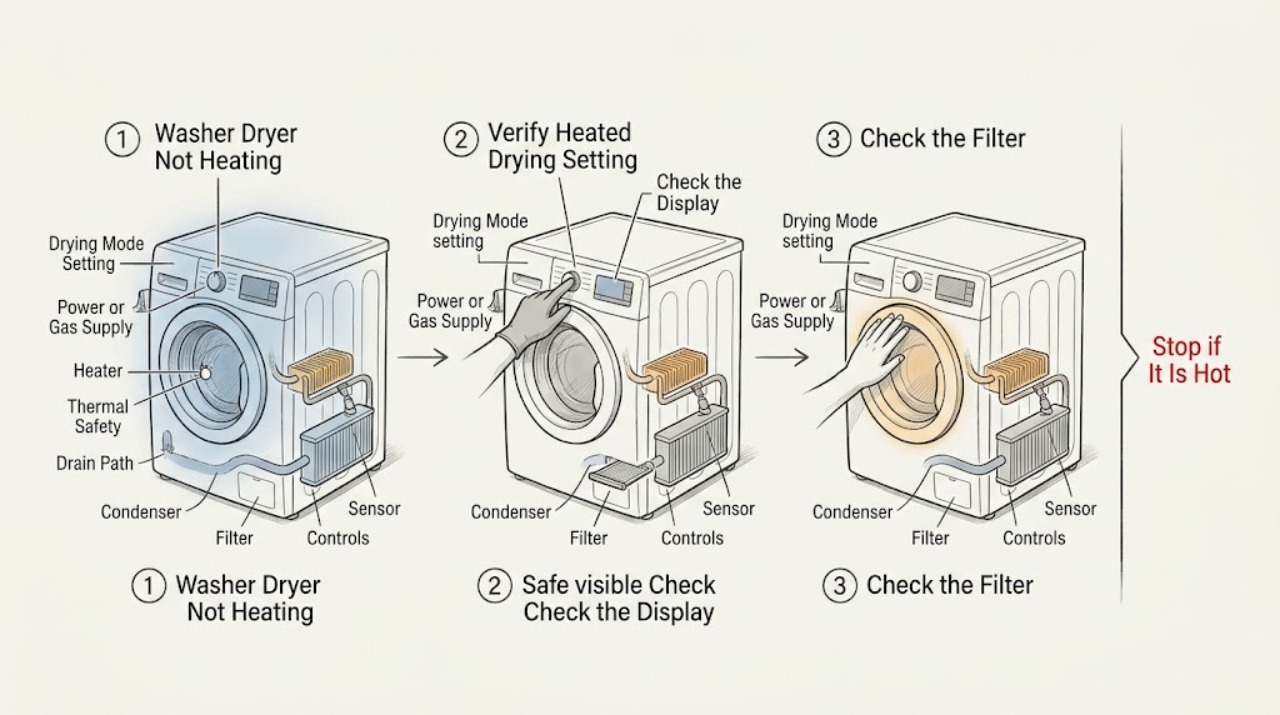
If the drying side of a Whirlpool washer-dryer is not heating, first confirm that a heated Auto Drying or Timed Drying function was selected and that the cycle is not Air Only or Off. Then test a small, well-spun load and check only the external plug, breakers or fuses, door closure, model-specific filter or drain path, and any required water or gas supply. Whirlpool all-in-one units may use ventless condensing drying, so they do not behave like a vented dryer and the drain path matters. If the load remains cold, the cycle will not run, or there is a gas smell, burning smell, smoke, visible sparking, overheating, a hot cord or plug, or a breaker trip, stop and arrange qualified service; do not open the cabinet or work on energized or gas components.
Work through in order
Diagnostic checks
Use only checks that match the exact appliance or system and its official guide.
-
Check 1
On the Whirlpool control panel, confirm that Auto Drying or Timed Drying is selected with a heated dryness level, not Off or Air Only; for a dry-only test, select the documented Drying Only function and close the door fully.
Expected result: The display shows a heated drying mode and the cycle enters drying, or the washer completes without a drying phase or reports that drying cannot start.
Next step: Correct only the setting or a simple door-closure obstruction and test a small load. If the cycle still will not run, continue to the safe external supply and drain checks.
Why this matters
Why: If drying was Off or Air Only, the lack of heat is a setting result. If a correctly selected heated cycle will not run, door closure, drain-pump filter, water supply, power, or a control fault becomes more likely.
-
Check 2
Remove excess laundry, separate bulky items, keep the drum no more than about half full for the test, and use the fastest spin speed allowed by the fabric and model before starting the heated dry cycle.
Expected result: The smaller load tumbles freely and enters drying with less water; if the load is still cold or remains unusually wet after spin, the symptom persists independently of overload.
Next step: If the small load is warm but damp, check the condensation and drain branch. If it remains cold, check external supply and arrange service for the heat circuit rather than repeating large loads.
Why this matters
Why: Whirlpool says a large or heavy load can dry slowly and recommends a half-full-or-less drum and high-speed spin for all-in-one drying. A controlled small load helps distinguish poor extraction from a no-heat fault.
-
Check 3
With the machine stopped, consult the exact Whirlpool manual for its drain-pump filter, condenser, or model-specific lint-filter procedure; inspect only the documented accessible area and the external drain hose for a visible kink or blockage.
Expected result: A documented filter is clogged, missing, or not seated, or the drain path cannot carry condenser water away; alternatively, the documented path is clear and the unit still produces no heat.
Next step: Clean or reseat only the accessible filter as the manual directs, contain residual water, and secure the filter before testing. Do not remove cabinet panels or continue if water is near electrical parts.
Why this matters
Why: Whirlpool lists a missing or clogged drain-pump filter as a reason the all-in-one dry cycle may not run, and its ventless condenser sends water through the washer drain hose. A clear path shifts the diagnosis toward heater, thermal safety, sensor, or control.
-
Check 4
Check the external plug, outlet condition, and household breaker or fuse without opening the appliance; read the model manual to determine whether the drying system is electric or gas, and for a gas model confirm only the normal supply-valve position when there is no gas odor.
Expected result: The display is dead, a breaker or fuse has opened, the plug or outlet is damaged, or the model's required power or gas supply is absent; alternatively, the appliance powers on and the external supply appears normal.
Next step: Correct one simple external setting or supply issue only when safe and allowed by the manual. Do not test voltage, access wiring, adjust a regulator, or open the gas path; use a qualified electrician, gas professional, or appliance technician.
Why this matters
Why: Whirlpool identifies the required electrical supply and, for applicable dryer designs, gas supply as basic checks. A repeated trip, damaged plug, or abnormal gas condition is a safety fault, not an invitation to keep resetting the appliance.
-
Check 5
Run only a correctly selected heated cycle with a small compatible load and observe from outside whether the load becomes warm, stays cold, remains warm but damp, stops with an error, or produces an unusual sound; do not touch internal components.
Expected result: Warm but damp points toward moisture removal, load, drain, condenser, filter, or installation conditions. Cold clothes or a cycle that never heats points toward supply, heater, thermal safety, sensor, or controls.
Next step: Record the model, cycle and dryness setting, load size, spin result, temperature clue, error text, and any noise. Arrange service if the safe checks do not restore heat or if a fault repeats.
Why this matters
Why: Whirlpool distinguishes normal longer ventless drying from a dryer that does not heat. The result narrows the branch but does not justify user replacement of an internal heating or safety component.
-
Check 6
Stop immediately if there is a gas smell, burning smell, smoke, visible sparking, overheating, a hot or damaged cord or plug, water near electrical parts, repeated breaker trips, persistent error text, or unusual mechanical noise.
Expected result: The hazardous sign remains, the unit cannot safely complete a heated cycle, or it stays cold after the documented setting, load, drain, and external supply checks.
Next step: Stop the cycle. If safe, unplug the appliance and close the gas valve on a gas model; if gas odor or damaged wiring makes that unsafe, leave the area and contact the appropriate emergency or qualified service channel from a safe location. Do not remove panels, test energized circuits, bypass a safety device, or open gas lines.
Stop if: Stop using the washer-dryer and arrange qualified service.
Why this matters
Why: These signs can involve fire, gas, electric shock, water damage, moving parts, or a failed heater and control system. Repeated resets or continued heated operation can worsen the hazard.
Use your observations
Decision map
Find the observation that best matches what you see, then follow the next safe action.
-
PATH 01Next step
What you see
The drying function is Off, Air Only, or no Drying Only mode was selected.
Do this next
Choose the model's heated Auto Drying or Timed Drying setting and retest with a small load; do not diagnose the heater until the control mode is correct.
-
PATH 02Next step
What you see
The drum is more than half full, bulky fabrics are mixed together, or the load leaves spin holding excess water.
Do this next
Reduce the load, separate fabrics, and use the model-approved high-speed spin before drying. Recheck temperature with the controlled load.
-
PATH 03Next step
What you see
The model documents a drain-pump filter or condenser path and it is blocked, missing, or unable to move water.
Do this next
Stop and clean or reseat only the accessible item as the exact manual directs; persistent drainage or internal condenser problems require service.
-
PATH 04Next step
What you see
A small load warms but remains damp after the correct heated mode and spin.
Do this next
Prioritize load, condenser water drainage, documented filter care, and installation ventilation conditions. If the result persists, arrange service.
-
PATH 05Next step
What you see
The load stays cold, the dry cycle will not run, or an error returns after low-risk checks.
Do this next
Check only the external supply, door closure, documented water requirement, drain-pump filter, and cycle selection. A heater, thermal safety, sensor, or control diagnosis belongs to qualified service.
-
PATH 06Next step
What you see
There is gas odor, burning odor, smoke, sparking, overheating, a hot cord or plug, water near electrical parts, or repeated breaker trips.
Do this next
Stop immediately, move people away, and use the safe emergency boundary. Do not restart, access wiring, open gas lines, or continue a heated cycle.
Helpful context
Understand the symptom
Confirm that the drying side is actually selected
A Whirlpool all-in-one can run wash and dry, dry only, wash only, or no drying. In the referenced Whirlpool interface, Auto Drying defaults off after power is connected, and Air Only does not add heat. A wash cycle that ends with wet clothes therefore does not by itself prove a failed heater. Check the exact model's controls and choose a heated dryness level or timed cycle before diagnosing hardware.
Use temperature and moisture as separate clues
A small load that is warm but damp points toward load size, spin extraction, condensing-water drainage, filter or airflow restrictions, or installation conditions. A small load that stays cold points toward the selected cycle, supply, heater, thermal safety, sensor, or control. Whirlpool recommends no more than a half-full drum for its all-in-one drying guidance and a high-speed spin when washing and drying. Compare results only after those variables are controlled.
Know the ventless and supply differences
Many Whirlpool all-in-one models use a ventless condenser: heated air removes moisture, the condenser turns that moisture into water, and the water leaves through the washer drain hose. The appliance may not have a conventional outside exhaust or a user-cleanable lint screen. Do not invent a vent or filter procedure; use the model manual. If the model requires water connected for the drying cycle, or uses gas, those supplies must be handled according to its instructions and safety limits.
Only after diagnosis
Potential parts
- dryer heating system component
Only consider this category after a qualified diagnosis confirms a correctly selected cycle and safe external supply but no heat.
Confirm the complete Whirlpool model number and use model-specific service information; no fit is implied. - thermal safety component
Only consider this after a technician identifies a thermal cutoff or related safety fault and rules out load, drain, setting, and supply causes.
This is a diagnostic category, not a confirmed part or compatibility claim. - drain pump or condenser component
Only consider this if the ventless drying path cannot remove condenser water after the documented filter and hose checks.
Confirm model-specific compatibility through Whirlpool documentation or qualified service diagnosis.
When checks do not resolve it
Need a professional?
Arrange qualified Whirlpool appliance service when the drying cycle will not run, the drum stays cold, heat returns intermittently, an error persists, drainage or filter checks do not help, or internal heater, thermal safety, sensor, condenser, pump, control, electrical, or gas diagnosis is needed.
Common questions
FAQ
Why does my Whirlpool washer-dryer run but produce no heat?
First confirm a heated Auto Drying or Timed Drying mode was selected rather than Off or Air Only. Then compare a small, well-spun load. If it stays cold with the correct setting and normal external supply, a heater, thermal safety, sensor, or control fault needs qualified service.
Does a Whirlpool all-in-one need an outside dryer vent to heat?
The referenced Whirlpool all-in-one uses ventless condensing drying: moisture is condensed to water and drains through the washer hose. Use the exact model's installation instructions; do not add or inspect a conventional vent unless that model specifically has one.
Can an overloaded drum make the dryer seem like it is not heating?
Yes. A large, heavy load can tumble poorly and retain water even when heat is present. Whirlpool recommends no more than a half-full drum for its all-in-one guidance and a high-speed spin when washing and drying.
What should I check if the drying cycle will not start?
Check the door closure, selected drying function, documented drain-pump filter, household protection devices, required power, and required water connection. If those checks do not help, do not open the cabinet; arrange service.
When should I stop using the Whirlpool washer-dryer?
Stop for gas odor, burning odor, smoke, visible sparking, overheating, a hot or damaged plug or cord, water near electrical parts, repeated breaker trips, persistent errors, or unusual noise. Do not keep restarting a heated cycle or work on gas or energized components.
Read the exact guide
Official sources
- ALL-IN-ONE WASHER & DRYER OWNER'S MANUALWhirlpool Corporation · Whirlpool all-in-one washer-dryer load, ventless drying, and model-specific maintenance guidance covered by the manual
- Dryer Not Heating - All-In-One Washer DryerWhirlpool Product Help · Whirlpool all-in-one washer-dryer heating and external power-supply troubleshooting
- Drying Function - All-In-One Washer DryerWhirlpool Product Help · Whirlpool all-in-one washer-dryer Auto Drying, Timed Drying, Drying Only, and Air Only control behavior
- Dry Cycle Will Not Run - All-In-One Washer DryerWhirlpool Product Help · Whirlpool all-in-one washer-dryer start checks including door, drain-pump filter, protection devices, water, and cycle selection
- Dryer is not Drying or Experiencing Long Dry TimesWhirlpool Product Help · Whirlpool dryer heat, power or gas supply, cycle, load, airflow, and service escalation checks
- Dryer Not Drying or Long Dry Times- All-In-One Washer DryerWhirlpool Product Help · Whirlpool all-in-one washer-dryer ventless condensing operation, load, spin, drainage, and installation ventilation
Community feedback
Share a repair observation
Share a plain-text repair observation. Accepted observations are published automatically; this page may take a moment to update.