
On this page
Start here
Quick answer
Do not interpret a Whirlpool washer code from a partial display or from another model. Photograph or write down the complete code, model number, washer style, cycle stage, water level, and whether the door or lid is locked. Then use the exact Whirlpool Owner's Manual or model-specific Product Help page. Common examples are not universal: F8 E1 or LF/Lo FL can indicate a fill or water-supply issue, F9 E1 or drn can indicate a long-drain issue, Sud/Sd can indicate excess suds, and F5 E2 or a lid-lock message concerns an interlock on applicable models. A single model-authorized clear or power reset is reasonable only after motion and water hazards are safe; if the code returns, water leaks, the washer vibrates violently, smells hot, sparks, or trips the breaker, stop using it and arrange qualified service.
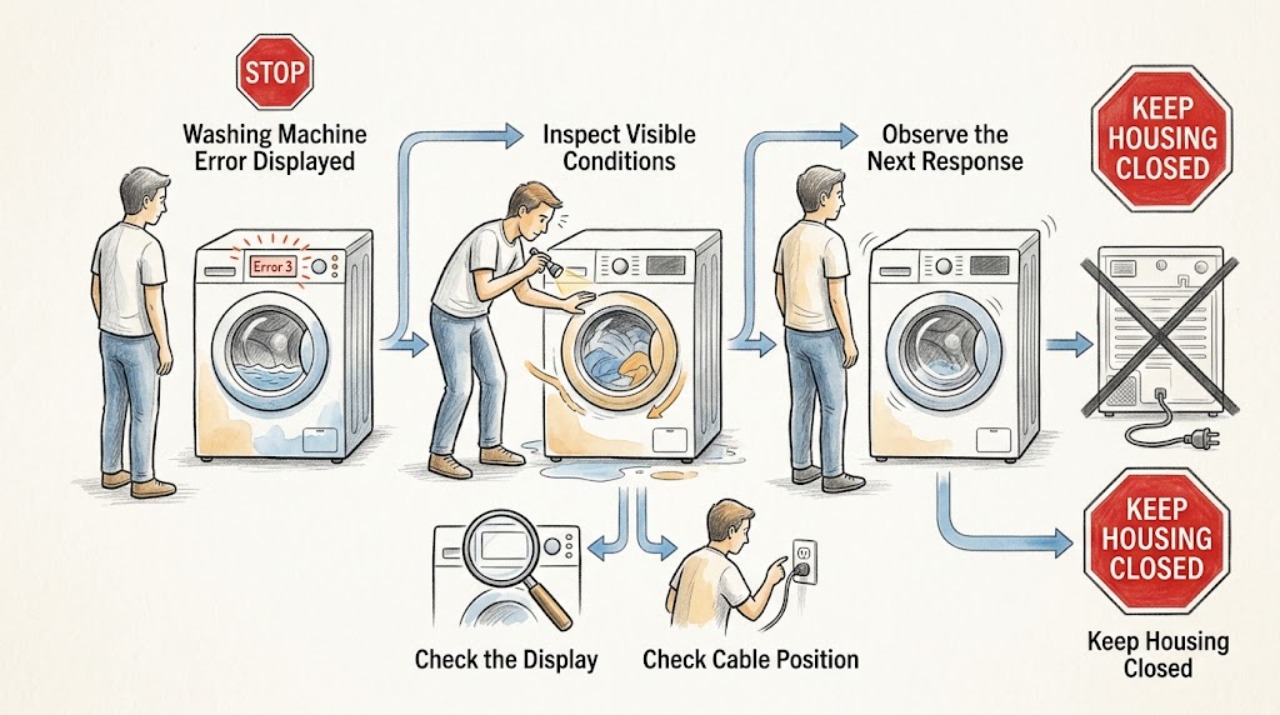
Work through in order
Diagnostic checks
Use only checks that match the exact appliance or system and its official guide.
-
Check 1
Stop and observe from a safe position. Record the complete display, flashing lights, model number, front-load or top-load design, cycle stage, water level, and whether the door or lid is locked. Look for standing water near electrical equipment, a leak, smoke, burning odor, arcing, a hot plug, violent movement, or repeated breaker trips.
Expected result: The washer is moving unexpectedly, water is near electricity, a leak is uncontrolled, smoke or burning odor is present, the connection is hot, or the breaker trips again.
Next step: Stop the cycle and keep clear. Close the water supply or isolate power only from a safe dry location; do not touch a moving drum, wet plug, or exposed wiring. Arrange qualified appliance, electrical, or emergency service.
Stop if: Stop immediately for smoke, burning odor, arcing, water contacting energized equipment, violent walking, an uncontrolled leak, or repeated breaker trips.
Why this matters
Why: This is an injury, water, fire, or electrical event before it is an ordinary code lookup.
-
Check 2
Transcribe the code exactly, including spaces, dashes, letters, numbers, and indicator names, and identify the model and washer family in the Whirlpool manual search. Note whether the message appeared during fill, wash, drain, spin, Clean Washer, or at the end of a cycle.
Expected result: The code matches a model-specific Whirlpool page, matches only a general family list, or cannot be identified from the display or model information.
Next step: Use only the instructions attached to the exact model or family. If the code remains ambiguous, do not guess; arrange service and provide a photo of the display and model tag.
Stop if: Stop if the model cannot be identified and the next step would require opening the cabinet, bypassing an interlock, or guessing a code meaning.
Why this matters
Why: A model-specific match can supply a limited safe check; a partial or cross-family match cannot safely establish the meaning or part involved.
-
Check 3
For a fill-related code such as F8 E1, LF, or Lo FL on an applicable Whirlpool washer, check only that the hot and cold supply valves are open, the inlet hoses are not kinked, and the connections are dry. Do not remove inlet screens or disconnect a hose while pressurized unless the exact manual authorizes that work.
Expected result: A valve is closed, a hose is kinked, a connection leaks, an anti-flood device or restriction is present, or accessible supply conditions look normal.
Next step: Correct only an obvious valve or hose position when safe, then use the model's single clear/reset procedure. If the code returns or a connection leaks, stop and arrange service.
Stop if: Stop for a burst hose, uncontrolled leak, wet electrical equipment, a valve that will not close, or any need to open the cabinet or bypass the water-level system.
Why this matters
Why: A visible supply restriction can explain a fill code; normal accessible supply shifts the problem toward the inlet screen, valve, sensor, control, or another model-specific cause.
-
Check 4
For a drain-related code such as F9 E1 or drn on an applicable Whirlpool washer, wait until the basket is still and inspect the visible drain hose for a kink, pinch, blockage, incorrect insertion, or an end placed too deeply in the standpipe. Observe the household drain for backup without adding more water.
Expected result: The hose is kinked or blocked, inserted too far, too high, or unsecured; the household drain backs up; or the visible hose and plumbing appear correct.
Next step: Correct only a visible routing issue documented for the model and run one supervised drain attempt if the floor and connections are dry. If the code returns, water remains, or the household drain backs up, stop and arrange appliance or plumbing service.
Stop if: Stop for sewage, overflow, a leaking hose, water near electricity, a pump that smells hot, or any need to open the pump or cabinet.
Why this matters
Why: Whirlpool identifies hose routing and blockage as possible long-drain causes, but a clear visible path with retained water can indicate a pump, internal hose, control, or household plumbing problem.
-
Check 5
For a lid, door, or control-lock message, wait for all motion to stop and check that no clothing or object blocks the door or lid, then identify whether Control Lock or a safety interlock is active. Do not force the door, hold a lid switch closed, or reach into a locked machine.
Expected result: The door or lid is not fully closed, an object is in the latch area, a control lock indicator is active, water remains, or the interlock appears closed but the code persists.
Next step: Close the door or lid and clear only the exact model's documented lock setting. If the lock remains, keep the washer off and arrange service rather than forcing it.
Stop if: Stop for a damaged latch, hot or moving basket, retained water above the door, or any attempt to bypass the lock or remove a panel.
Why this matters
Why: A visible closure or control-lock condition may clear safely; retained water or a persistent interlock can require a latch, sensor, drain, or control diagnosis.
-
Check 6
For Sud/Sd, balance, motor, or cycle-stage messages, note whether the machine is still performing a documented suds-reduction, sensing, or drain routine. After all motion stops, check only the load size and visible balance; do not restart a violently vibrating or overloaded washer.
Expected result: The washer is adding rinse water or pausing to reduce suds, the load is tightly packed or uneven, the drum is stable but the code persists, or the washer walks, strikes, or makes metal noise.
Next step: Allow a documented routine to complete when safe, use only the model's detergent and load guidance, and run no more than one supervised retry after the basket is still. Arrange service for recurring codes or abnormal movement.
Stop if: Stop for walking, impact, metal scraping, smoke, burning odor, water leakage, or any need to inspect the drive or suspension inside the cabinet.
Why this matters
Why: A temporary suds or balance routine may be normal for the applicable model; persistent codes or violent movement point toward a load, level, suspension, drive, or control problem.
-
Check 7
After the model's documented safe condition is met, perform at most one authorized code-clear or power-reset procedure. If the same code returns, record the sequence and stop troubleshooting by trial-and-error; arrange qualified service with the display and model evidence.
Expected result: The code clears and the washer completes one supervised cycle, or the code returns immediately or during the same stage.
Next step: If the code returns, leave the washer out of use and request service. Do not repeat resets, substitute parts, bypass a lock, or open live electrical or water components.
Stop if: Stop for a returning code, repeated drain or fill loop, smoke, burning odor, leak, arcing, hot connection, or repeated breaker trip.
Why this matters
Why: A successful one-time clear may have removed a transient state; a returning code is evidence of an unresolved supply, drain, lock, balance, motor, sensor, or control condition.
Use your observations
Decision map
Find the observation that best matches what you see, then follow the next safe action.
-
PATH 01Next step
What you see
The complete code matches the exact Whirlpool model page and the page provides a visible, low-risk check
Do this next
Perform one supervised check, then stop and arrange service if the code returns.
Why this path and its safety boundary
Why it matters: Use only that model-specific remedy and its stated clear or reset sequence
-
PATH 02Next step
What you see
F8 E1, LF, or Lo FL appears on an applicable Whirlpool washer and an inlet valve, hose, or supply issue is visible
Do this next
Correct only the safe visible condition, then use the model's authorized clear procedure; service a returning code or leak.
Why this path and its safety boundary
Why it matters: A water-supply or fill restriction is more likely
-
PATH 03Next step
What you see
F9 E1, drn, or a similar drain message appears and the visible hose is kinked, blocked, too deep, or the household drain backs up
Do this next
Stop further water input, correct only a documented visible hose issue, and call appliance or plumbing service if flow does not return.
Why this path and its safety boundary
Why it matters: An installation, hose, or household-plumbing restriction is more likely
-
PATH 04Next step
What you see
Sud/Sd or a balance-related message occurs while the washer is safely reducing suds or correcting a load
Do this next
Allow the documented routine to finish, avoid excess detergent or unsuitable loads, and arrange service for a returning code or violent movement.
Why this path and its safety boundary
Why it matters: A temporary suds or load-balance routine may be active
-
PATH 05Next step
What you see
A door, lid, or Control Lock message persists after the closure and model-specific lock checks
Do this next
Keep the washer off and arrange service; do not force or bypass the lock.
Why this path and its safety boundary
Why it matters: An interlock, latch, water-level, or control issue is more likely
-
PATH 06Next step
What you see
The code cannot be matched to the model, returns after one authorized reset, or requires internal access to diagnose
Do this next
Provide the exact model, code, cycle stage, water level, photos, and safe observations to a qualified technician.
Why this path and its safety boundary
Why it matters: A model-specific service diagnosis is required
-
PATH 07Next step
What you see
The code is accompanied by smoke, burning odor, arcing, hot wiring or plug, uncontrolled water, violent impact, or repeated breaker trips
Do this next
Stop using the washer and isolate water or power only from a safe dry location; arrange qualified appliance, electrical, or emergency help.
Why this path and its safety boundary
Why it matters: Immediate safety boundary
Helpful context
Understand the symptom
The complete code and model are the diagnosis starting point
Whirlpool uses different codes and clearing procedures across front-load, top-load, all-in-one, and laundry-center designs. A display such as F8 E1, F9 E1, drn, Sd, LOC, or a flashing indicator can have a specific meaning only on the applicable washer family. Record the exact model and the point in the cycle when the message appeared. Do not replace a pump, inlet valve, latch, motor, or control board from a generic code list.
Separate fill, drain, lock, and motor symptoms
A fill code calls for an accessible water-supply and hose check; a drain code calls for a safe drain-hose and plumbing observation; a lock code calls for a closed door or lid and an interlock check; and a motor or balance code calls for the load and movement to be safe before any restart. Excess suds can extend or pause a cycle. These are symptom paths, not permission to open the cabinet or bypass a safety lock.
Reset only after the code's safe condition is met
Whirlpool's general guides sometimes specify Pause/Cancel and Power sequences or disconnecting power for five minutes, but the exact procedure varies. Let a washer finish a documented drain or suds-reduction routine when there is no hazard, and never reach into a moving basket. If a code returns after the one authorized reset, preserve the evidence and use service rather than repeating the reset.
Only after diagnosis
Potential parts
- water inlet valve or inlet screen
Consider only when the exact model's fill-code diagnosis confirms normal household supply but a valve or screen fault remains.
Confirm the complete Whirlpool model and the manufacturer's fit information before selecting a component. - drain pump or drain hose
Consider only when a returning model-specific drain code remains after safe visible hose and household-drain checks.
Confirm the model, pump design, hose routing, and technician diagnosis before replacement. - door or lid lock assembly
Consider only when the exact model's interlock diagnosis confirms a latch or lock fault after the door or lid closes correctly.
Verify the washer style, complete model, connector, and manufacturer's fit information before selecting a component.
Common questions
FAQ
Can I use a Whirlpool error-code list for any washing machine?
No. Whirlpool says its front-load and top-load lists may not include every code for every model. Record the complete code and use the exact Owner's Manual or model-specific Product Help page.
What does F9E1 or drn mean on a Whirlpool washer?
On applicable models it indicates a long or abnormal drain, but the exact label depends on washer family. Check the visible drain-hose routing and household drain without opening the cabinet; arrange service if the code returns or water remains.
What does F8E1, LF, or Lo FL mean?
On applicable models it indicates that the washer is not detecting the expected water fill. Check only the accessible hot and cold valves and hoses, then follow the exact model instructions; do not assume the code identifies a particular valve or part.
Should I unplug a Whirlpool washer when an error appears?
Only follow a reset procedure the exact model guide authorizes, and first make sure the basket is still and there is no leak or electrical hazard. A returning code should not be cleared repeatedly; preserve the code and arrange service.
When should I stop and call for service?
Stop for a returning or unidentified code, a locked door with water inside, uncontrolled leak, smoke, burning odor, arcing, hot plug, violent movement, or repeated breaker trip. Give the technician the full code, model, cycle stage, and photos.
Read the exact guide
Official sources
- Error Codes in Top Load HE WashersWhirlpool Product Help · Whirlpool top-load HE washer guidance only; use the exact manual for another washer family.
- Error Codes in Front Load WashersWhirlpool Product Help · Whirlpool front-load washers and listed code families only; use the exact Owner's Manual for other models.
- Guidelines for Cleaning Safely After a DisasterCenters for Disease Control and Prevention · General public-safety guidance; local emergency and electrical instructions apply.
- F9E1 - Error CodeWhirlpool Product Help · Whirlpool top-load washer models covered by this Product Help page only.
- Owner's ManualWhirlpool Corporation · One Whirlpool washer model family; use it as an example of model-specific boundaries, not a universal code chart.
Community feedback
Share a repair observation
Share a plain-text repair observation. Accepted observations are published automatically; this page may take a moment to update.