
On this page
Start here
Quick answer
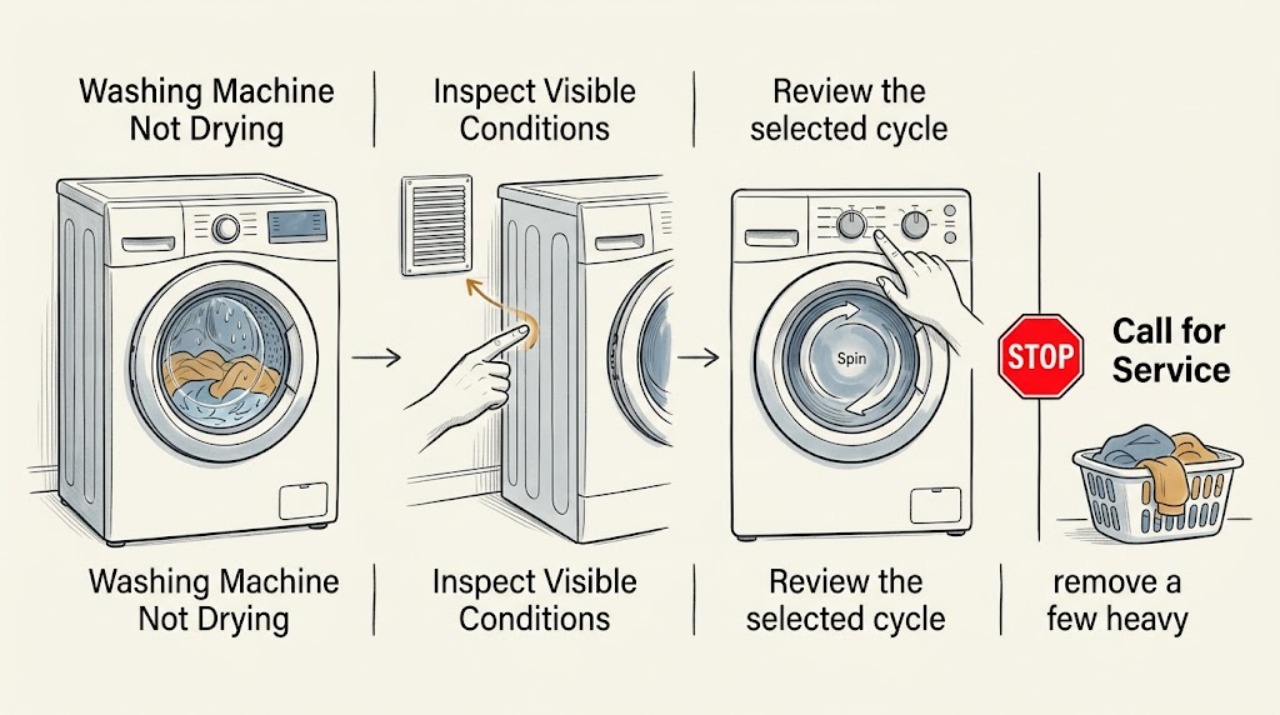
A Whirlpool washer does not normally dry laundry with heat; it removes moisture during drain and spin. If clothes are wetter than expected at the end, first check whether water remains in the tub, whether the selected cycle used a low or no spin, and whether the load was tightly packed or unbalanced. Then check the visible drain path and excess suds. This guidance is for a washer whose clothes remain wet after washing, not for a washer-dryer combo's heated drying function.
Work through in order
Diagnostic checks
Use only checks that match the exact appliance or system and its official guide.
-
Check 1
Look at the washer immediately after the cycle: check whether the tub is empty and whether the basket completed a fast final spin.
Expected result: The pattern is one of these: water is standing in the tub; the tub is empty but the load never reached a fast spin; or the tub is empty and a fast spin completed.
Next step: Follow the matching branch below rather than treating “not drying” as proof of a failed heating component.
Why this matters
Why: Standing water makes a drain-path problem more likely. No fast spin makes load balance, spin selection, suds, lid/pause behavior, or an interrupted cycle more likely. An empty tub after a completed fast spin means the washer did extract water, so the remaining dampness may be expected for a washer-only cycle.
-
Check 2
Review the selected cycle and spin setting, then use the model's Drain & Spin option with the load arranged evenly if that option is available.
Expected result: A higher-spin or Drain & Spin cycle completes and the load is noticeably less wet, or the washer still does not accelerate into spin.
Next step: Use the garment-appropriate higher spin setting when permitted by the care label; if the washer still will not complete a fast spin, stop repeated tests and arrange service.
Why this matters
Why: Low or no spin removes less water. Improvement points to the prior cycle or setting rather than a drying system. Failure to accelerate after a correctly arranged load leaves a spin-control, lid, drive, or drain fault possible, but the model is needed before naming a part.
-
Check 3
When the washer is stopped and the lid is unlocked, remove a few heavy or bulky items, loosen the load, and distribute it evenly around the basket before retrying the appropriate spin.
Expected result: The washer had loud shaking or repeated rebalancing, or the redistributed smaller load spins normally; alternatively, the same problem occurs with a small, evenly spread load.
Next step: For a balanced-load improvement, use smaller loads and the cycle intended for bulky items when applicable. If the small balanced load still will not spin, use the service boundary below.
Why this matters
Why: Noise, excessive movement, and wet clothes together support an out-of-balance or overloaded load that can reduce or stop spin. A persistent failure with a small balanced load makes a simple load-distribution explanation less likely.
-
Check 4
Watch the visible drain hose and outlet during the drain portion; look only for a kink, an obvious accessible blockage, or water backing up into the tub or utility sink.
Expected result: Water exits freely and the tub empties, or water drains slowly, backs up, or remains in the tub.
Next step: Straighten a visible kink and clear only an accessible outlet blockage according to the model manual. Do not reach into a moving washer or dismantle the pump; arrange service if the restriction is internal, inaccessible, or returns.
Why this matters
Why: A slow or backed-up drain makes hose routing, a clogged drain path, or a pump restriction more likely and can prevent the washer from reaching proper spin. A freely emptying tub makes a primary drain blockage less likely, though it does not prove every internal component is healthy.
-
Check 5
Check the finished load and dispenser history for persistent foam, and note whether more detergent than the product instructions call for was used.
Expected result: There is substantial foam or the wet-load symptom follows detergent-heavy loads, or there is no unusual foam.
Next step: If foam is present, do not add more detergent; run the model-appropriate rinse or Drain & Spin cycle and use only the detergent type and amount specified for the washer. If the symptom persists without foam, continue to service rather than guessing at a part.
Why this matters
Why: Excess suds can slow or stop draining and spinning, leaving the load very wet. Without excess foam, suds are less likely to explain the symptom and the balance, spin, and drain observations carry more weight.
Use your observations
Decision map
Find the observation that best matches what you see, then follow the next safe action.
-
PATH 01Next step
What you see
Water remains in the tub, drains slowly, or backs up while the washer is emptying.
Do this next
Check visible hose routing and the accessible drain opening. If correcting those does not restore an empty tub, stop using the washer and arrange qualified service for the internal drain system.
-
PATH 02Next step
What you see
The tub is empty but the washer shook, stopped before a fast spin, or improves after a smaller evenly distributed load or a higher-spin selection.
Do this next
Use smaller balanced loads and the garment-appropriate spin setting. If a small balanced load still cannot complete fast spin, arrange service rather than ordering an unverified motor, switch, or control.
-
PATH 03Next step
What you see
The tub empties, but persistent foam is present or the problem appears after using too much detergent.
Do this next
Run the model-appropriate rinse or Drain & Spin without adding detergent, then measure the specified detergent amount on future loads. If the symptom returns with correct detergent use, arrange service.
-
PATH 04Next step
What you see
The tub empties, the final fast spin completes, and the load is only damp—especially after a bulky load or a cycle interruption during spin.
Do this next
Use the cycle and spin speed recommended for the fabric, redistribute bulky items, and run Drain & Spin if the model provides it. If ordinary loads become unusually soaked despite a complete fast spin and clear drain path, arrange service for model-specific testing.
Helpful context
Understand the symptom
What “not drying” means on a washer
A washer's final drain and spin extracts water; it is not the same as a separate dryer's heated cycle. The useful distinction is whether the tub still contains water, whether the basket reached a fast spin, or whether the load finished a normal spin but is simply damp. That distinction determines whether to investigate draining, spin conditions, or normal moisture left for a separate drying step.
Use the result, not a guessed part
Do not start by replacing a motor, pump, or control. A wet load can result from a low-spin selection, a load that could not balance, excess detergent, a restricted drain path, or a power interruption during spin. Work through the visible checks below and only escalate to internal diagnosis if the matching symptom remains.
When checks do not resolve it
Need a professional?
Arrange qualified appliance service if the washer leaves standing water after visible drain checks, cannot complete a fast spin with a small balanced load, repeatedly stops or displays a fault, or remains unusually wet after the drain, balance, spin, and suds checks pass.
Common questions
FAQ
Does a Whirlpool washing machine dry clothes?
A washer removes moisture through draining and spinning. Unless the model specifically includes a drying function, it does not replace a separate heated dryer. For this problem, “not drying” means the load is wetter than expected after the washer cycle.
Why are my clothes still wet when the Whirlpool washer finishes?
Common decision points are standing water from a restricted drain, reduced spin from an unbalanced or bulky load, a low or no-spin selection, excess suds, or a power interruption during spin. Check which pattern is present before considering internal service.
Should I replace the drain pump or motor because the washer is not drying?
Not from that symptom alone. First establish whether the tub drains, whether the load balances, whether a fast spin completes, and whether foam is present. A part is conditional on model-specific testing after those observations; do not order a component based only on the phrase “not drying.”
Read the exact guide
Official sources
- Washer Not Draining or Spinning? Troubleshooting Guide - Product HelpWhirlpool · Washer drain and spin troubleshooting; lid, load balance, spin speed, suds, drain hose, and pump filter checks
- Wet Clothes at the End of the Cycle - Washer - Product HelpWhirlpool · Wet loads after a washer cycle; balance, bulky loads, drain hose, level, spin selection, and power interruption
- TROUBLESHOOTINGWhirlpool · Washer drain/spin operation, wet-load causes, balanced loading, drain hose, and excess detergent guidance
Community feedback
Share a repair observation
Share a plain-text repair observation. Accepted observations are published automatically; this page may take a moment to update.