
On this page
Start here
Quick answer
A Whirlpool washer may appear not to spin because the selected cycle uses a low or no-spin setting, the washer is waiting to drain, the door or lid is not latched, the load is unbalanced or over-sudsed, or the cabinet is not level. First note when the problem occurs and whether water remains. If there is standing or hot water, a leak, walking, scraping metal, burning smell, smoke, arcing, or a repeated trip, stop and arrange service rather than trying another cycle.
Before you begin
Safety first
- A technician should diagnose interlocks, pump and drain components, controls, drive parts, and suspension before any replacement is selected.
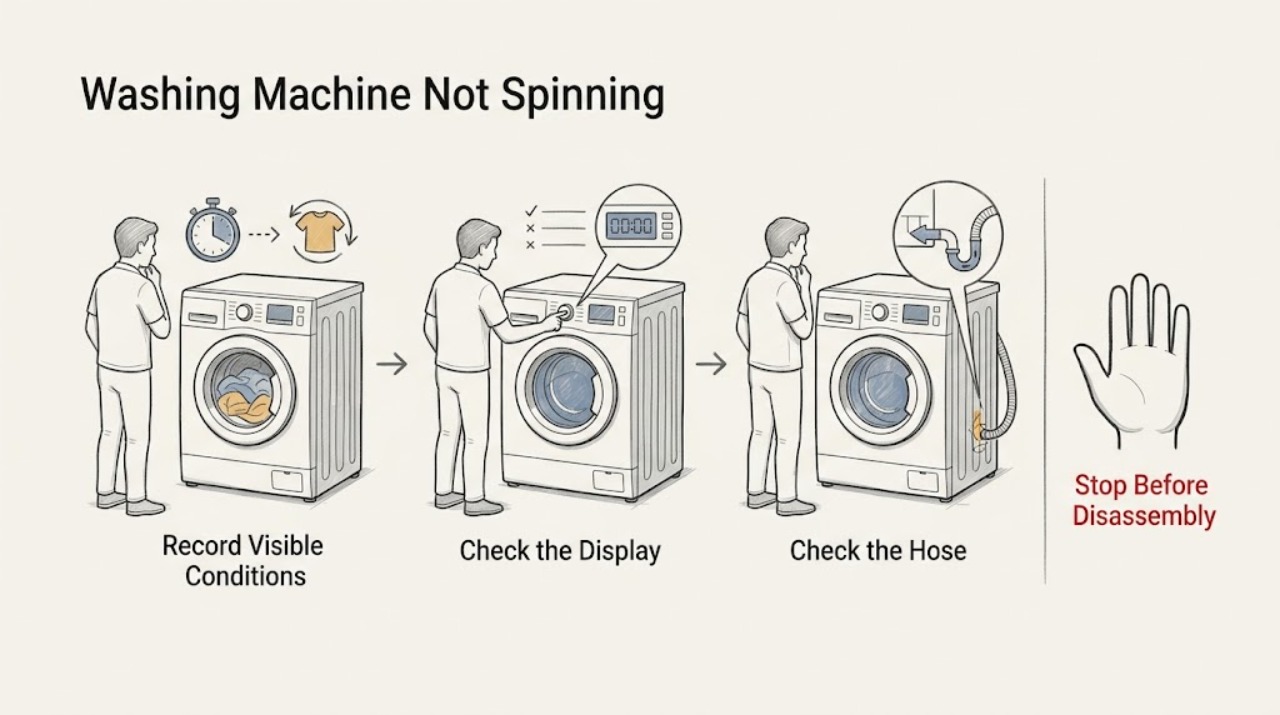
Work through in order
Diagnostic checks
Use only checks that match the exact appliance or system and its official guide.
-
Check 1
Record the exact cycle, display message, and point at which the washer stops: before agitation, during drain, at spin, or after a short spin. With the washer idle, note whether the basket or drum is empty, full of wet clothes, or holding visible water.
Expected result: A low-speed or no-spin cycle, a pause while the load is being redistributed, or soaked clothes with standing water are different symptoms from a basket that never moves on any cycle.
Next step: If water is present, continue to the drain-path check. If there is no water, continue to the cycle and lock checks; stop for hot water, a leak, or an electrical hazard.
Why this matters
Why: The stage and water status identify whether to check settings, draining, balance, or the interlock first; they do not by themselves prove a failed motor or control.
-
Check 2
Review the selected cycle and spin option on the control panel, then compare it with the model manual. If the washer is empty of standing water and there is no hazard, use the model-authorized Drain and Spin or a normal spin-capable cycle once.
Expected result: A gentle, low, or no-spin choice can leave clothes wetter without indicating a mechanical failure. A correct spin-capable cycle that still will not accelerate points to the next checks.
Next step: Record the setting that was used. If the correct cycle still stops, check drainage and the door or lid interlock rather than repeatedly restarting it.
Why this matters
Why: The control selection can intentionally limit spin; a repeat failure on a suitable cycle makes settings less likely to be the cause.
-
Check 3
With the washer stopped and safe to approach, inspect the visible drain hose for a sharp kink, crushing, or an obviously obstructed outlet. Do not handle hot water or wastewater. A pump filter or clean-out is model-specific: use it only when the Whirlpool manual identifies one and gives a safe access procedure.
Expected result: Standing water, a kinked hose, slow drainage, or a drain fault indicates that the washer may be preventing spin because it has not completed draining. A clear visible hose does not rule out an internal restriction.
Next step: If water remains, stop after the safe external check and arrange service if the manual does not provide an appropriate user step. Do not tilt the washer or open internal plumbing.
Why this matters
Why: Drain completion is an interlock for many cycles; treating a drainage symptom as a spin-drive failure can send the diagnosis in the wrong direction.
-
Check 4
Check that the door on a front-load model or lid on a top-load model closes fully and that no clothing, residue, or object is blocking the latch area. Check the control panel for Control Lock or a similar lock indicator and use only the release sequence in the manual.
Expected result: A latch that does not engage, a lock indicator that remains on, or a control that does not accept Start can prevent the washer from entering spin. Never hold, bypass, or defeat the interlock.
Next step: If the latch will not engage or the lock returns after a model-authorized release, stop using the washer and provide the model and displayed message to a technician.
Why this matters
Why: The washer uses the door or lid state as a safety condition; an apparent no-spin fault may actually be a lock or control-state issue.
-
Check 5
When the washer is stopped and the basket or drum is stationary, redistribute a small or single bulky load and remove excess items so the load is within the manual's limits. Use the detergent amount and product type specified for the model; do not add more detergent to correct a suds condition.
Expected result: A single heavy item, an overloaded basket, or visible excess suds can leave clothes wet, cause vibration, or make the washer pause and retry balance. A balanced normal load that still fails points elsewhere.
Next step: Run one suitable test only when the basket is stable and there is no leak or unusual noise. Stop immediately if the cabinet walks, impacts surrounding objects, or produces scraping metal, smoke, or a burning smell.
Why this matters
Why: Load sensing and suds management can limit or interrupt spin to protect the washer; a successful spin after redistribution makes a load condition more likely than a part failure.
-
Check 6
From outside the washer, check whether it rocks on the floor and whether the feet appear to sit firmly. If this is a new installation, check the model manual for transport hardware and installation requirements; do not remove panels, tilt the appliance, or disassemble suspension parts as a diagnostic shortcut.
Expected result: A rocking cabinet, severe vibration, or movement during spin supports an installation or leveling issue. Transport hardware is relevant only when the manual and installation history make it applicable.
Next step: Correct only an external, manual-authorized leveling issue. If movement persists, or if the washer is newly installed and transport hardware may still be present, stop and use installation or service support.
Why this matters
Why: An unlevel washer can reduce or interrupt spin and can damage surrounding surfaces if it walks; a stable, level washer with the same fault needs a different branch.
-
Check 7
Write down every displayed code or indicator, the model number, the cycle, and whether the failure occurs with an empty drum or a normal load. If the manual authorizes one control reset, follow that exact procedure once; do not repeatedly restore power or restart after a trip.
Expected result: A recurring code, no-spin condition with an empty drum, or a failure after the external checks is evidence for a model-specific lock, drain, control, drive, or suspension diagnosis rather than another load adjustment.
Next step: Arrange appliance service and provide the model, code, cycle stage, water status, load result, and any unusual sound. Keep the washer out of use if the fault is accompanied by a leak, electrical symptom, smoke, or repeated trip.
Why this matters
Why: Whirlpool manuals and product help use model-specific controls and reset behavior; the model number is needed before interpreting a code or naming a replacement part.
Use your observations
Decision map
Find the observation that best matches what you see, then follow the next safe action.
-
PATH 01Next step
What you see
The washer stops with standing water or reports a drain problem.
Do this next
Do not run another spin test with hot water, wastewater, a leak, or liquid near electrical parts.
Why this path and its safety boundary
Why it matters: Treat drainage as the first branch: perform only the safe visible hose check and model-manual check, then arrange service if water remains or the blockage is not user-accessible.
-
PATH 02Next step
What you see
There is no standing water, and the selected cycle or spin option is gentle or disabled.
Do this next
If the correct cycle still fails, continue to the latch, load, and leveling branches.
Why this path and its safety boundary
Why it matters: Select a model-appropriate spin-capable cycle and compare the result once; wetter clothing alone can be expected from a low-spin selection.
-
PATH 03Next step
What you see
The washer pauses, vibrates, or walks with a single bulky, overloaded, or sudsy load.
Do this next
If a balanced normal load still fails or the cabinet impacts nearby objects, stop and request service.
Why this path and its safety boundary
Why it matters: Stop the cycle, wait until the basket is stationary, and correct the load or detergent amount within the manual's limits.
-
PATH 04Next step
What you see
The door or lid does not latch, Control Lock remains active, or a lock-related code returns.
Do this next
If the latch cannot engage after the external obstruction check, keep the washer out of use and arrange service.
Why this path and its safety boundary
Why it matters: Use only the model-specific control-lock or latch guidance; do not defeat the interlock or force the door or lid.
-
PATH 05Next step
What you see
The washer fails to spin empty or on a balanced normal load after the correct cycle and safe drain checks.
Do this next
Arrange service with the model, code, cycle stage, water status, and sound or vibration description.
Why this path and its safety boundary
Why it matters: A repeat model-specific fault may involve the lock, drain pump, control, drive, or suspension system and needs diagnosis rather than a guessed part.
-
PATH 06Next step
What you see
There is hot water, a leak, walking or impact, metal scraping, burning smell, smoke, visible arcing, or a repeated electrical trip.
Do this next
Use appropriate emergency or qualified appliance service support once the area is safe.
Why this path and its safety boundary
Why it matters: Stop the washer and keep people away from the hazard; do not run another test or open the appliance.
Helpful context
Understand the symptom
Start by separating a normal pause from a failed spin. A front-load or top-load washer can tumble, rebalance, or pause while it senses the load. The useful clues are the stage shown on the display, whether the basket or drum ever accelerates, whether clothes are merely damp or soaked, and whether water remains in the tub. Whirlpool notes that an unbalanced load can reduce spin, create vibration, or make the washer stop spinning while it attempts to correct itself.
Use the checks below in order. They are limited to external controls, visible hose and load observations, and model-authorized instructions. Do not reach into a moving basket or drum, open an electrical panel, defeat a door or lid interlock, or work on a gas or water connection.
Safety boundary
Stop conditions
- Stop if hot water or wastewater is present and cannot be handled safely.
- Stop and keep liquid away from electrical parts if there is a leak or standing water near the cord, outlet, or controls.
- Stop if the washer walks, bangs the surrounding structure, or has severe uncontrolled vibration.
- Stop if you hear metal scraping or see damage that could contact the moving basket or drum.
- Stop immediately for a burning smell, smoke, visible arc, melted material, or a repeated electrical trip; do not retry the cycle.
- Do not bypass a door or lid lock, open an electrical panel, tilt the washer, or remove internal parts as a user check.
Only after diagnosis
Potential parts
- door or lid lock assembly
Consider only if the latch does not engage or a lock fault is confirmed for the exact model.
Confirm the complete Whirlpool model and the manufacturer's fit information before selecting any part. - drain pump or model-specific pump filter component
Consider only after a drain fault is confirmed and the exact model's service information identifies the component.
Not every Whirlpool washer has the same filter access or pump design; verify model fitment through service documentation. - spin drive or suspension component
Consider only when a balanced, draining washer still fails to spin or shows a confirmed drive or suspension symptom.
Do not infer a part from the symptom alone; a technician must identify the model-specific cause and fit.
When checks do not resolve it
Need a professional?
No spin remains after safe checks, a model-specific code or lock fault returns, or any stop condition is present.
Safety scope: A technician should diagnose interlocks, pump and drain components, controls, drive parts, and suspension before any replacement is selected.
Have this ready
- Whirlpool model number, exact display code, cycle and spin setting, point of failure, water status, load result, and description of vibration or sound.
Common questions
FAQ
Why is my Whirlpool washer not spinning but still filling or washing?
Note the cycle stage first. A washer may pause for load sensing, but a door or lid that does not latch, a drain problem, a low-spin selection, excess suds, or an unbalanced load can keep it from completing spin. A recurring code or failure with a normal load needs model-specific service.
Why are my clothes wet when the Whirlpool washer finishes?
Check whether the selected cycle limits spin and whether water remains. An unbalanced or overloaded load, excess suds, a kinked drain hose, or a drain fault can reduce or prevent final spin. Do not handle hot or wastewater as a routine check.
Can I use Drain and Spin to fix a Whirlpool washer that will not spin?
Only use a model-appropriate Drain and Spin selection when there is no leak, hot water, standing water near electrical parts, smoke, burning smell, unusual scraping, or repeated trip. If it fails again, record the stage and arrange service instead of repeatedly restarting it.
Could an unbalanced load stop a Whirlpool washer from spinning?
Yes. A single bulky item, an overloaded basket, or excess suds can cause vibration, a pause, or reduced spin. Wait until the basket is stationary before redistributing a safe load. If the cabinet walks or bangs, stop and request service.
What should I give a technician when a Whirlpool washer will not spin?
Provide the complete model number, any display code, cycle and spin setting, the stage where it stopped, whether water remains, whether an empty or balanced load changes the result, and any vibration, scraping, burning smell, smoke, leak, or electrical symptom.
Read the exact guide
Official sources
- Not Spinning - WasherWhirlpool · Whirlpool top-load washer cycle concerns, including balance, movement, leveling, drainage, and service guidance
- Washer Not Draining or Spinning? Troubleshooting GuideWhirlpool · Whirlpool washer assistance for linked not-draining and not-spinning symptoms
- Kitchen And Laundry Appliance Manuals | WhirlpoolWhirlpool · Whirlpool appliance manuals and model-specific troubleshooting literature
- 8 possible reasons why your washing machine is not spinningWhirlpool · Whirlpool washers; common causes and safe troubleshooting context for a washer that is not spinning
- Not Starting - WasherWhirlpool · Whirlpool washer start, lid, control-lock, Start-button, and model-specific reset guidance
Community feedback
Share a repair observation
Share a plain-text repair observation. Accepted observations are published automatically; this page may take a moment to update.