
On this page
Start here
Quick answer
First distinguish warm wash water or warm clothing from a hot cabinet, plug, cord, or burning odor. Whirlpool washers intentionally regulate incoming hot and cold water, and some models use a heater for Steam Clean or heated cycles. A water-temperature error such as F0E4 can indicate water that is too hot or incorrectly connected. If the cabinet, plug, or cord is abnormally hot, or there is smoke, a burning smell, melting, a leak near electrical parts, or a trip, stop using the washer and arrange qualified service; do not run another test or open the appliance.
Before you begin
Safety first
- A technician should determine whether the cause is supply temperature, sensor, heater, pump, motor, wiring, control, cord, plug, or outlet before selecting a component.
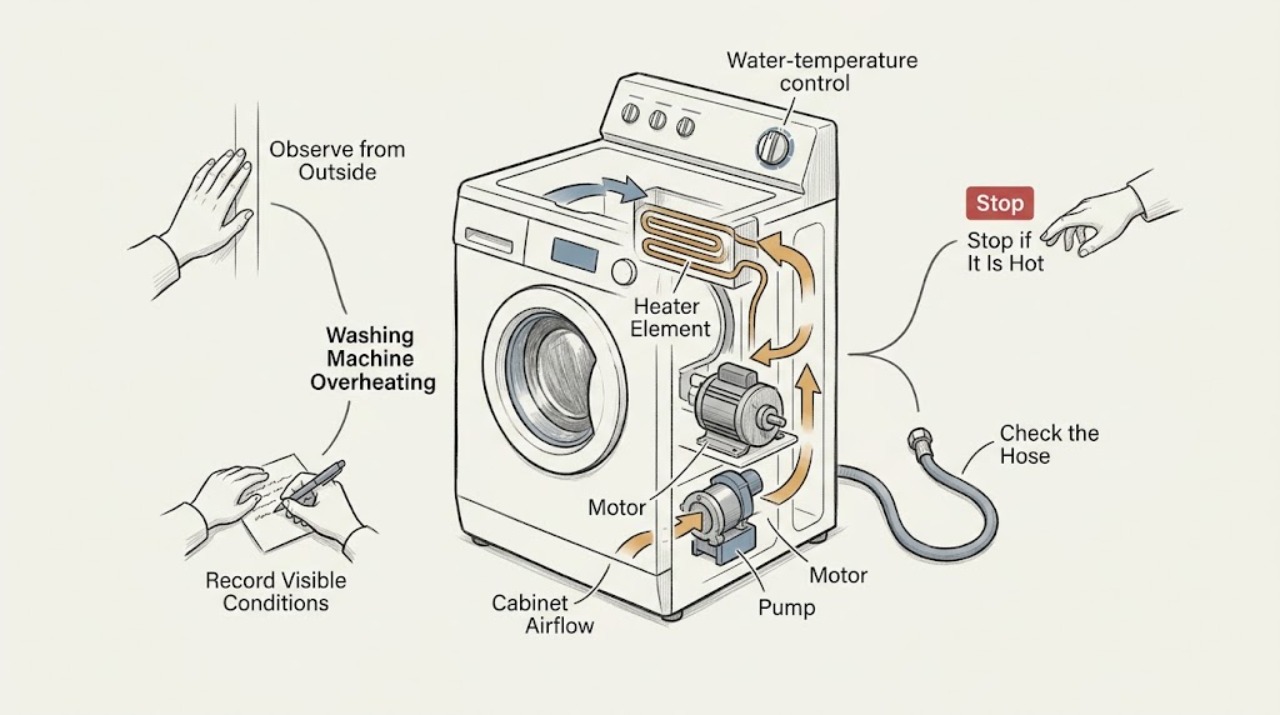
Work through in order
Diagnostic checks
Use only checks that match the exact appliance or system and its official guide.
-
Check 1
Stop the cycle and identify the heat location without touching a hot surface: wash water or clothing, the cabinet, the plug or cord, or a nearby wall or outlet. Record any odor, smoke, discoloration, melting, leak, unusual sound, or trip.
Expected result: Warm water on a selected heated cycle is different from a hot plug, cord, cabinet, burning odor, smoke, melting, or heat concentrated at an outlet.
Next step: If the cabinet, plug, cord, outlet, or surrounding material is abnormally hot, or if there is smoke, burning odor, melting, liquid near electrical parts, or a trip, stop and arrange qualified service without another test.
Why this matters
Why: The location separates expected water-temperature behavior from a possible electrical, motor, pump, heater, or control fault.
-
Check 2
Record the selected cycle, temperature, options, and stage when the heat appears. Check the model manual to see whether the cycle includes Sanitize, Steam Clean, or another heated phase; do not change to a hotter option as a test.
Expected result: A heated or steam option may intentionally warm water and lengthen the cycle, while heat during an unheated cycle or while the washer is idle is not explained by that selection.
Next step: If the heat matches a documented heated phase and no hazard is present, compare one normal, non-heated cycle only after the washer is cool and stable. If heat persists outside that phase, stop and request service.
Why this matters
Why: Cycle and option selection can explain water warmth but cannot explain an overheating plug, cord, cabinet, smoke, or burning smell.
-
Check 3
If water temperature is the reported problem and the area is dry and safe, read the complete model manual and inspect only the visible hot and cold hose routing at the household connection. Do not loosen a hose or handle hot water while the washer is hot or pressurized.
Expected result: Reversed hot and cold hoses, a hot fill on a cold selection, or a model-specific F0E4 water-temperature code points to a supply or sensing issue rather than a drive fault.
Next step: If routing is uncertain, water is too hot to handle, a hose leaks, or the code returns after the manual-authorized correction, turn off water only if safely accessible and arrange service. Do not improvise a connection or temperature test.
Why this matters
Why: Whirlpool documents that the washer regulates hot and cold inlets and that F0E4 means sensed water is too hot; model-specific installation instructions control the safe correction.
-
Check 4
With the washer cool and idle, note the load size, fabric type, water level, and whether clothing or the tub remains unusually hot after a cycle. Check that the load and detergent amount follow the model guidance; do not add detergent or run repeated heated cycles to reproduce the symptom.
Expected result: A hot load after a documented heated cycle differs from fabric damage, a hot odor, persistent heat after the cycle, or heat with a small normal load and ordinary settings.
Next step: If clothing is scorched, discolored, shrinking unexpectedly, or still abnormally hot after cooling time, keep the washer out of use and provide those observations to service.
Why this matters
Why: Load and cycle choices can affect heat and cycle time, but persistent or damaging heat suggests a heater, sensor, motor, pump, or control issue that needs diagnosis.
-
Check 5
Observe the washer's surroundings from a safe standing position: check for blocked external clearance, lint or debris around any model-provided openings, water under the cabinet, and a cord or plug that is strained, loose, discolored, or hot. Do not remove covers or move the washer while it is connected or wet.
Expected result: A leak, wet floor, damaged cord or plug, heat at the outlet, or restricted clearance raises an electrical or water-contact risk; a clear dry area does not rule out an internal fault.
Next step: Stop immediately for liquid near electrical parts, melting, scorch marks, smoke, an abnormal odor, or repeated tripping. Do not move, dry internally, or retest the washer under those conditions.
Why this matters
Why: External conditions can contribute to heat or make continued operation unsafe, but internal airflow, pump, motor, heater, and control causes require professional assessment.
-
Check 6
Write down every displayed code or indicator, the model number, cycle, temperature, stage, water status, and whether the heat is at the water, cabinet, cord, or outlet. Use a reset only when the exact Whirlpool manual authorizes it and only after the washer is cool and no hazard is present.
Expected result: A recurring code, heat outside a documented heated phase, an idle washer that remains hot, or a normal load that causes the same symptom supports a model-specific component or control diagnosis.
Next step: Arrange appliance service and provide the model, code, cycle, temperature selection, timing, location of heat, and any odor, smoke, leak, noise, or trip. Do not repeat a failed reset or power cycle.
Why this matters
Why: Whirlpool's error and reset instructions are model-specific; an F0E4-style temperature issue is not proof of a failed heater or valve without the model's procedure.
-
Check 7
If the washer is cool, dry, stable, and has no warning sign, compare the symptom on one ordinary, non-heated cycle while remaining nearby. Stop the cycle if the cabinet or controls heat rapidly, the motor or pump sounds strained, or any warning sign appears.
Expected result: Heat only during a documented heated phase is a different result from rapid cabinet heat, an abnormal smell, a hot plug or cord, smoke, a leak, or a trip on an ordinary cycle.
Next step: Keep the washer out of use and request qualified service for any repeat symptom or any stop condition; do not run more cycles to increase confidence.
Why this matters
Why: The comparison can narrow the timing to a cycle feature, but it cannot safely identify an internal heater, motor, pump, wiring, or control failure.
Use your observations
Decision map
Find the observation that best matches what you see, then follow the next safe action.
-
PATH 01Next step
What you see
Only the water or clothing feels warm during a documented heated, steam, or hot cycle, with no odor or damage.
Do this next
If warmth occurs outside that phase or remains after cooling, stop and arrange service.
Why this path and its safety boundary
Why it matters: Treat the cycle and temperature setting as the leading explanation and compare the model manual's expected behavior.
-
PATH 02Next step
What you see
A water-temperature warning such as F0E4 appears, or the washer fills hotter than the selected setting.
Do this next
If hose routing is uncertain, water is too hot to handle, a hose leaks, or the warning returns, keep the washer out of use and request service.
Why this path and its safety boundary
Why it matters: Check the complete model number and use Whirlpool's model-specific hose and temperature guidance; do not assume a heater or valve is the failed part.
-
PATH 03Next step
What you see
Heat is at the cabinet, plug, cord, outlet, or surrounding material, or clothing is damaged.
Do this next
Arrange qualified appliance or electrical service as appropriate, supplying the exact location and timing of the heat.
Why this path and its safety boundary
Why it matters: Stop operation and do not perform live testing or open the appliance.
-
PATH 04Next step
What you see
Heat occurs with smoke, a burning or electrical odor, melting, visible arcing, water near electrical parts, or a repeated trip.
Do this next
Use appropriate emergency help for active smoke or fire, or qualified service once the area is safe. Do not open panels or inspect energized parts.
Why this path and its safety boundary
Why it matters: Treat it as an immediate stop condition; keep people away and do not restore operation or repeat the cycle.
-
PATH 05Next step
What you see
The washer is hot while idle, overheats on an ordinary cycle, or repeats the symptom after a model-authorized reset.
Do this next
Keep the washer out of use and arrange service with the model, code, cycle, stage, and heat location.
Why this path and its safety boundary
Why it matters: A heater, sensor, motor, pump, wiring, or control issue cannot be identified safely from the outside.
Helpful context
Understand the symptom
Overheating is not one symptom. Warm water during a warm, hot, sanitized, or steam-capable cycle can be expected, while an unusually hot outer cabinet, plug, cord, or clothing load is a stop signal. Note which part feels hot without touching a hot surface, and note whether the washer is filling, washing, draining, spinning, or sitting idle when the heat appears.
The checks below stay at the controls and other safe external observations. Do not perform live electrical tests, open a panel, bypass a lid or door lock, work on internal wiring, or dismantle a pump, motor, heater, or control. A model-specific manual is required before any access or reset step.
Safety boundary
Stop conditions
- Stop immediately for smoke, flame, visible arcing, a burning or electrical odor, melting, scorch marks, or a hot plug, cord, or outlet.
- Stop for a leak, standing water, or any liquid near the cord, outlet, controls, or other electrical parts.
- Stop if the cabinet or controls heat rapidly, clothing is damaged by heat, or the washer remains hot while idle.
- Stop after a repeated electrical trip; do not keep restoring power or run another cycle.
- Do not perform live electrical tests, open panels, bypass a lock, handle hot or pressurized water, or dismantle the pump, motor, heater, or control.
- Do not move a wet or connected washer to investigate an overheating symptom.
Only after diagnosis
Potential parts
- water-temperature sensor or inlet valve
Consider only if the exact model's service diagnosis confirms a temperature-sensing or inlet-control fault after safe hose and cycle checks.
Confirm the complete Whirlpool model and manufacturer fit information; a water-temperature symptom alone does not identify a part. - heater assembly
Consider only on a model equipped with a heater and only after a technician confirms abnormal heating outside the selected heated phase.
Heated and steam features vary by model; do not assume every Whirlpool washer has the same heater or access method. - pump, motor, or electronic control
Consider only after service identifies a component that is generating abnormal heat or drawing abnormal load.
The symptom does not establish component fit or failure; model-specific service information and professional diagnosis are required.
When checks do not resolve it
Need a professional?
Persistent or unexplained heat, a returning temperature code, a hot cabinet or electrical connection, water near electrical parts, or any stop condition.
Safety scope: A technician should determine whether the cause is supply temperature, sensor, heater, pump, motor, wiring, control, cord, plug, or outlet before selecting a component.
Have this ready
- Complete Whirlpool model number, code or indicator, cycle and temperature, stage, heat location, timing, load details, water status, and any odor, smoke, leak, noise, damage, or trip.
Common questions
FAQ
Is warm water normal in a Whirlpool washing machine?
It can be normal during a selected warm, hot, sanitize, or steam-capable cycle. Check the model manual and cycle options. A hot cabinet, plug, cord, outlet, burning odor, smoke, melting, or heat outside the documented phase is not a normal test result; stop and arrange service.
Why does my Whirlpool washer show a water-temperature error?
For models that use F0E4, Whirlpool describes it as water sensed too hot and directs the user to verify hose installation and use model-specific reset or service guidance. Record the complete model number and do not improvise a hot-water connection.
Can a Steam Clean or Sanitize cycle make a Whirlpool washer feel hot?
Some Whirlpool models use a heater for Steam Clean or heated cycles, and those cycles can take longer. This does not explain smoke, a burning odor, melting, a hot plug or cord, or a cabinet that remains hot while idle.
What should I do if my washer plug or cabinet is hot?
Stop the washer and do not run another cycle, open a panel, or perform live testing. If there is smoke, burning odor, melting, visible arcing, a leak near electrical parts, or a repeated trip, keep people away and use appropriate emergency or qualified service support when safe.
Which part causes a Whirlpool washing machine to overheat?
The symptom does not identify a part. Depending on the model and where the heat appears, a technician may need to evaluate water-temperature sensing, inlet control, a heater, pump, motor, wiring, electronic control, cord, plug, or outlet before selecting anything.
Read the exact guide
Official sources
- Kitchen And Laundry Appliance Manuals | WhirlpoolWhirlpool · Whirlpool model-specific appliance manuals and troubleshooting literature
- Long Cycles on a Front Load WasherWhirlpool · Whirlpool front-load washer cycle duration, suds, balance, heated-cycle, and steam-option behavior
- Checking the Fill Hoses if the Washer is not FillingWhirlpool · Whirlpool washer hot and cold fill hose routing, water supply, and model manual guidance
- Getting Cold Water when Warm or Hot was SelectedWhirlpool · Whirlpool washer water-temperature selection, hot and cold inlet behavior, and model variation
- Cycles, Options, and Modifiers on a Top Load HE WasherWhirlpool · Whirlpool top-load HE washer cycle, temperature, Steam Clean, and spin-option behavior
- F0E4 - Error CodeWhirlpool · Whirlpool top-load washer F0E4 water-temperature error guidance
Community feedback
Share a repair observation
Share a plain-text repair observation. Accepted observations are published automatically; this page may take a moment to update.