
On this page
Start here
Quick answer
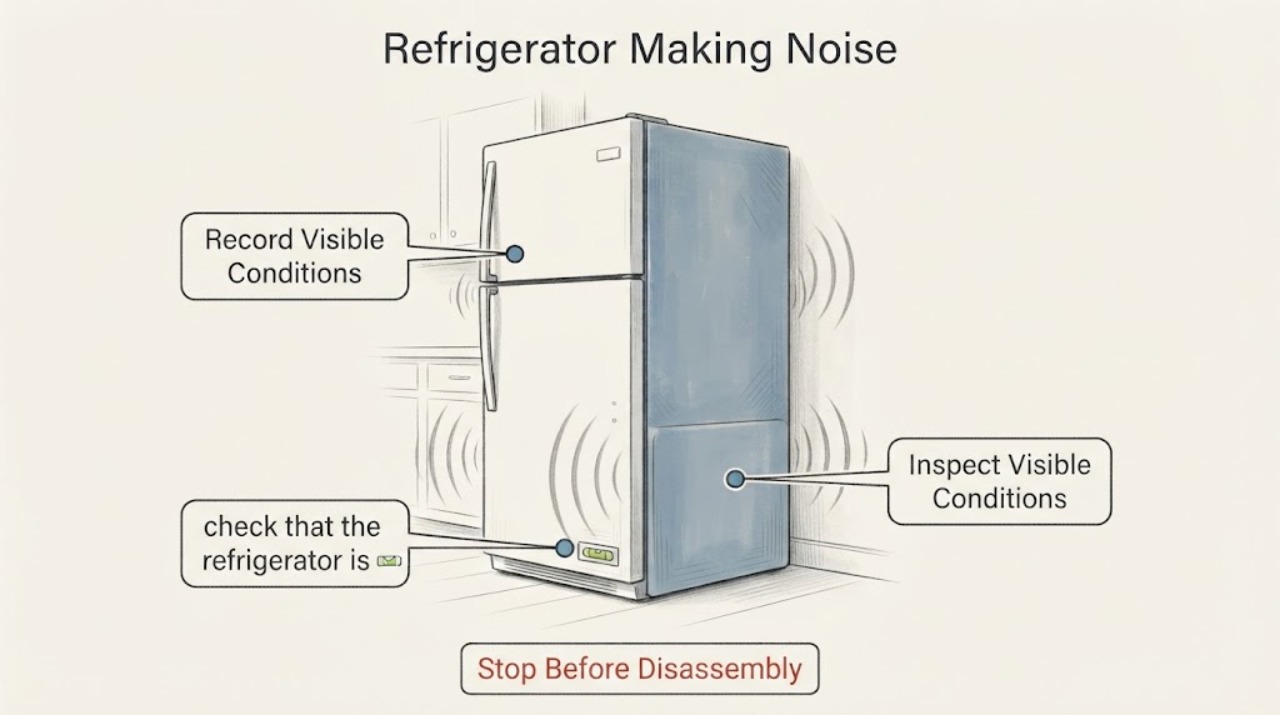
A White-Westinghouse refrigerator can make normal compressor, fan, clicking, or refrigerant gurgling sounds, but a new scrape, harsh rattle, vibration, or noise with poor cooling needs investigation. Record when the sound occurs, check level and loose contents from outside, and stop for burning odor, smoke, electrical trips, or a fan that is obstructed by ice.
Work through in order
Diagnostic checks
Use only checks that match the exact appliance or system and its official guide.
-
Check 1
Stand beside the closed refrigerator and record whether the sound is a hum, click, gurgle, buzz, rattle, scrape, or knock, and whether it occurs during cooling, door opening, or defrost. Check whether cooling and lights remain normal.
Expected result: Periodic hum, click, gurgle, or airflow can match normal compressor, refrigerant, or fan operation; a new scrape/knock or noise with warm food needs further checks.
Next step: Continue only with exterior checks if there is no hazard; stop and arrange service for smoke, burning odor, repeated trips, or rapidly worsening noise.
Why this matters
Why: This observation narrows the likely cause but does not identify an internal part by itself.
-
Check 2
From outside, check that the refrigerator is level and that bottles, shelves, kickplates, and items on top are not touching or vibrating. Do not pull the appliance by its refrigerant tubing or remove covers.
Expected result: The noise changing when a loose item is moved or the cabinet is stabilized points to vibration rather than a confirmed internal failure.
Next step: Secure the accessible item or correct obvious leveling per the manual. If the noise remains with the cabinet clear, continue recording rather than guessing at a part.
Why this matters
Why: This observation narrows the likely cause but does not identify an internal part by itself.
-
Check 3
Open the door only when the sound is safe to observe and note whether it changes when a door switch is actuated normally, without pressing hidden controls or reaching toward a fan. Look for visible frost blocking an air path.
Expected result: A sound that changes with door position can involve an evaporator fan or airflow; visible frost can support an airflow/defrost issue but does not identify the failed component.
Next step: Do not remove an interior panel or chip ice. If frost blocks airflow or food is warming, arrange model-specific service.
Why this matters
Why: This observation narrows the likely cause but does not identify an internal part by itself.
-
Check 4
Listen at the rear without touching hot, moving, or electrical parts and note whether the noise is strongest during compressor operation or when the cabinet vibrates against a wall. Keep required clearance around the appliance.
Expected result: A rear hum with normal cooling may be normal compressor operation; a harsh mechanical noise, overheating, or strong vibration needs service.
Next step: Keep hands clear and provide the recording and timing to a technician if the sound persists after leveling and clearance checks.
Why this matters
Why: This observation narrows the likely cause but does not identify an internal part by itself.
-
Check 5
Record the model, PNC/serial information if shown, sound recording, time pattern, temperature symptoms, and whether the noise started after moving or cleaning.
Expected result: Westinghouse service guidance uses model and product identifiers to route the correct documentation and service.
Next step: Arrange qualified appliance service when the sound is persistent, new, or tied to poor cooling; do not replace a motor or compressor from sound alone.
Why this matters
Why: This observation narrows the likely cause but does not identify an internal part by itself.
Use your observations
Decision map
Find the observation that best matches what you see, then follow the next safe action.
-
PATH 01Next step
What you see
The sound is a periodic hum, click, fan airflow, or refrigerant gurgle and cooling remains normal.
Do this next
Monitor it after checking for loose items and clearance; service it if the pattern changes or cooling declines.
Why this path and its safety boundary
Why it matters: This pattern is consistent with normal operating sounds described by the manual.
-
PATH 02Next step
What you see
The sound is a metallic scrape that changes with fan operation, with visible frost or reduced cooling.
Do this next
Keep panels in place, avoid chipping ice, protect food, and arrange model-specific service.
Why this path and its safety boundary
Why it matters: An airflow, ice, fan, or defrost issue is more likely than normal gurgling.
-
PATH 03Next step
What you see
The sound is a rattle or buzz that changes when the cabinet, shelf, bottle, or wall clearance is corrected.
Do this next
Secure the item or correct leveling/clearance and monitor one cooling cycle.
Why this path and its safety boundary
Why it matters: External vibration or a loose accessible item is more likely than an internal compressor defect.
-
PATH 04Next step
What you see
Noise is accompanied by burning odor, smoke, hot wiring, repeated trips, leaks, or failure to cool.
Do this next
Stop using the appliance, isolate power only if safe, and arrange qualified service.
Why this path and its safety boundary
Why it matters: The noise is part of a safety or performance fault that is not suitable for home diagnosis.
Helpful context
Understand the symptom
Sound timing is diagnostic: periodic clicks or gurgling during cooling can be normal, while scraping that follows fan operation, a rattling cabinet, or a noise that began with poor cooling needs a different next step.
White-Westinghouse models differ in fan and defrost layout. The sound pattern can narrow the area but cannot prove a motor, compressor, or fan part without model-specific service.
When checks do not resolve it
Need a professional?
Arrange qualified Westinghouse appliance service for a persistent new scrape, harsh buzz, worsening knock, visible frost with poor cooling, or a sound accompanied by temperature loss. Supply model/PNC/serial details and a recording.
Common questions
FAQ
Are gurgling and clicking sounds normal?
The Westinghouse manual describes refrigerant gurgling and motor/compressor or fan sounds as normal operating noises in many cycles. A new harsh sound or one with poor cooling still needs service.
How can I tell if a refrigerator rattle is external?
With the appliance closed and safe, remove or stabilize accessible bottles and shelves, check level and wall clearance, and observe whether the sound changes. Do not remove covers.
Should I replace the fan or compressor because of a noise?
No. Sound alone cannot identify a part. Record the pattern and cooling symptoms and use model-specific qualified service.
Read the exact guide
Official sources
- User ManualWestinghouse / White-Westinghouse · White-Westinghouse/Westinghouse refrigerator normal operating sounds, including compressor, refrigerant gurgling, and fan noise, plus service information.
Community feedback
Share a repair observation
Share a plain-text repair observation. Accepted observations are published automatically; this page may take a moment to update.