
On this page
Start here
Quick answer
A White-Westinghouse refrigerator that is warm should first be checked for a changed temperature setting, blocked internal airflow, a door that is not sealing, and whether the unit has power and is completing a cooling cycle. Move perishable food if the compartment is not staying cold. If the compressor never starts, frost blocks the air path, or cooling does not return after accessible checks, arrange model-specific service.
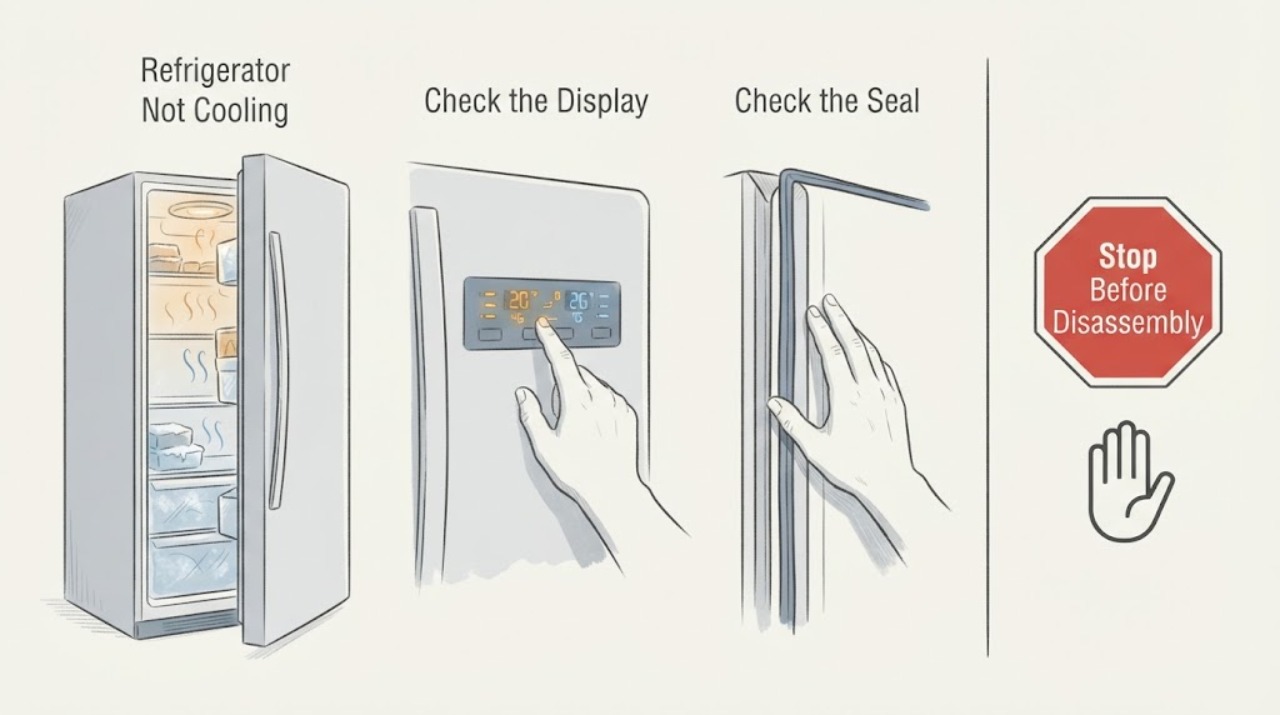
Work through in order
Diagnostic checks
Use only checks that match the exact appliance or system and its official guide.
-
Check 1
Check power, display, interior light, and temperature controls without changing multiple settings at once.
Expected result: The display and light are off, controls are set warmer than expected, or the appliance appears powered.
Next step: Restore only an intact supply and record the current setting before a controlled retest.
Why this matters
Why: No power or altered setpoint can explain warmth; a powered unit shifts attention to airflow and cooling operation.
-
Check 2
Inspect the door gasket and closure around the full perimeter, including food or shelves preventing closure.
Expected result: The gasket is displaced, dirty, torn, or the door closes evenly with a continuous seal.
Next step: Reposition the load and clean the accessible gasket; do not keep running a damaged seal.
Why this matters
Why: A gap admits warm humid air and can prevent stable temperatures; a good seal makes airflow or refrigeration operation more likely.
-
Check 3
Look for blocked vents or heavy frost inside the fresh-food and freezer compartments.
Expected result: Packages cover vents, frost forms a solid panel around an air path, or the interior is clear.
Next step: Move items without covering vents and use only the manual’s defrost procedure; do not chip frost.
Why this matters
Why: Blocked circulation or frost can keep one compartment warm even while another feels colder.
-
Check 4
Listen during one cooling period for fan airflow, compressor starting, unusual clicking, or repeated cycling.
Expected result: Air moves and cooling starts, or there is no airflow, repeated clicking, or immediate shutdown.
Next step: Do not remove panels or handle refrigerant components; record the pattern for service.
Why this matters
Why: Normal airflow supports an air-distribution issue; absent or repeated-start behavior points to an internal fault.
-
Check 5
Check food temperature and whether the symptom affects one compartment or both.
Expected result: Only one compartment is warm, both are warm, or food is warming despite the display.
Next step: Protect perishable food and arrange service when temperature remains unsafe.
Why this matters
Why: The pattern helps distinguish circulation, door-seal, control, and system-level faults.
Use your observations
Decision map
Find the observation that best matches what you see, then follow the next safe action.
-
PATH 01Next step
What you see
The unit is powered but frost blocks vents or air cannot circulate.
Do this next
Clear only accessible obstructions and follow the manual’s defrost guidance.
Why this path and its safety boundary
Why it matters: An airflow or defrost condition is more likely than an immediate compressor diagnosis.
-
PATH 02Next step
What you see
Both compartments are warm and the compressor never starts, clicks repeatedly, or trips protection.
Do this next
Keep the unit off if it trips or overheats and arrange qualified service.
Why this path and its safety boundary
Why it matters: A supply, start, control, or sealed-system fault is more likely.
-
PATH 03Next step
What you see
The refrigerator cools after a door-seal or setting correction but warms again.
Do this next
Record recurrence and contact support with the model and observations.
Why this path and its safety boundary
Why it matters: A persistent seal, control, airflow, or refrigeration fault remains.
Helpful context
Understand the symptom
Use the refrigerator manual to keep the checks model-specific. The decision changes are whether the unit has power, can move air, can maintain a door seal, and shows a repeatable internal cooling fault.
When checks do not resolve it
Need a professional?
Move perishables if cooling is inadequate. Stop for repeated tripping, burning smell, smoke, damaged cord, water near electrical parts, a hot cabinet, or any need to open electrical or sealed refrigeration components.
Common questions
FAQ
Can a blocked vent make only one section warm?
Yes. Refrigerators distribute cold air through internal vents, so a blocked path can create a compartment-specific symptom.
Should I chip away heavy frost?
No. Use the manual’s defrost procedure; sharp tools can damage the liner or refrigeration path.
When should I stop troubleshooting?
Stop for electrical damage, abnormal heat, water near electrics, or a repeatable no-cooling condition after accessible checks.
Read the exact guide
Official sources
- User Manual RefrigeratorWestinghouse / Electrolux · Westinghouse refrigerator models covered by the manual
- Listing of Dishwasher Distributors by Brand NameGovernment of Canada · White-Westinghouse appliances and refrigerators/dishwashers
Community feedback
Share a repair observation
Share a plain-text repair observation. Accepted observations are published automatically; this page may take a moment to update.