
On this page
Start here
Quick answer
If a wine cooler is freezing, first measure the cabinet temperature and identify whether only bottles beside the evaporator or the whole cabinet is too cold. Check the documented temperature setting, door seal, and bottle spacing; if frost is present, use the model's safe defrost procedure and never chip the evaporator. A setting that will not hold, a display mismatch, or rapidly returning ice needs qualified refrigeration service.
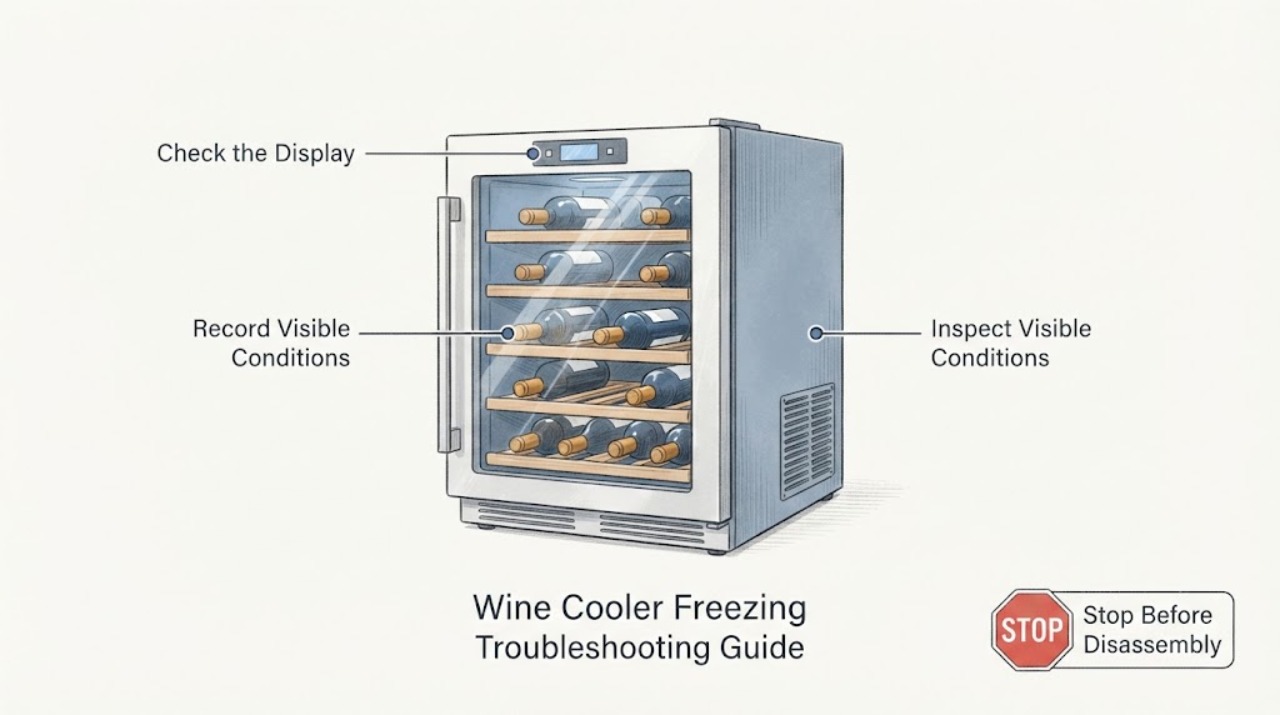
Work through in order
Diagnostic checks
Use only checks that match the exact appliance or system and its official guide.
-
Check 1
Measure the actual cabinet temperature with a separate thermometer and note where bottles or containers are freezing. Compare the measured result with the model's documented storage range rather than relying only on the display.
Expected result: Only items next to the evaporator freeze, the whole cabinet is below the selected range, or the display and independent reading disagree.
Next step: Move contents away from the evaporator as the model allows and raise the setting within the documented range. Do not adjust a hidden sensor or control board.
Why this matters
Why: A local cold spot supports evaporator loading or airflow distribution; a whole-cabinet low reading raises a setting, sensor, or control issue; a display mismatch needs model-specific diagnosis.
-
Check 2
Check the temperature setting, lock state, and zone selection on the front controls. Record whether the setting changes the displayed target and whether the cooler returns to the same low temperature after a stable observation period.
Expected result: The setpoint was unusually low or locked, the setting changes normally, or the control does not change the target or immediately returns to the prior value.
Next step: Use the exact manual to unlock or adjust the setpoint. If the control will not hold it, disconnect safely and arrange service.
Why this matters
Why: A low setting can directly explain freezing. A control that cannot hold its setting makes a sensor or control fault more likely, but does not identify the replacement part.
-
Check 3
With the door closed and the cooler powered off only when safe, inspect the accessible door gasket, shelves, and internal airflow space. Look for a door that does not seal, bottles against the evaporator, or shelves blocking circulation.
Expected result: The gasket is dirty or uneven, the door does not close, or bottles are pressed against the cold surface; alternatively, the door and loading are normal.
Next step: Clean and reseat the gasket or rearrange the load only as the manual allows. Do not force the door or remove panels.
Why this matters
Why: A door or loading problem can create uneven temperature and frost patterns. A normal seal and spacing shift attention to sensor, control, or sealed-system diagnosis.
-
Check 4
If frost or ice is present, stop normal use and follow the model's safe defrost instruction; Vinotemp's guide calls for unplugging to defrost. Do not chip ice with a sharp tool or apply heat to the cabinet.
Expected result: The frost clears after a complete documented defrost and the temperature normalizes, or ice returns quickly or will not clear.
Next step: Keep the cooler out of service for recurring icing and arrange qualified refrigeration service.
Why this matters
Why: A one-time icing event can distort temperature. Rapid recurrence suggests airflow, seal, sensor, control, or refrigerant issues that a reset cannot distinguish.
Use your observations
Decision map
Find the observation that best matches what you see, then follow the next safe action.
-
PATH 01Next step
What you see
Only bottles next to the evaporator freeze, while a higher documented setting and corrected spacing restore a normal independent temperature reading.
Do this next
Maintain the model's spacing and setting and monitor; escalate if the cold spot returns with normal loading.
Why this path and its safety boundary
Why it matters: Local evaporator contact or airflow distribution is more likely than a confirmed sealed-system failure.
-
PATH 02Next step
What you see
The whole cabinet remains below the selected range, the setting will not hold, or the display disagrees with an independent thermometer.
Do this next
Stop changing hidden controls and arrange qualified service with the measured temperature and setpoint record.
Why this path and its safety boundary
Why it matters: A sensor, control, or model-specific temperature-management fault is more likely.
-
PATH 03Next step
What you see
Frost returns quickly after a documented defrost or the evaporator remains iced with correct loading and a sealed door.
Do this next
Keep the cooler unplugged when safe and use qualified refrigeration service; do not puncture or chip the evaporator.
Why this path and its safety boundary
Why it matters: The remaining possibilities include airflow, sensor, control, fan, or sealed-system faults.
Helpful context
Understand the symptom
Freezing can be local or cabinet-wide. A bottle touching an evaporator, an overly low setpoint, a door seal problem, and an iced evaporator produce different observations. Use an independent temperature reading and the model's documented range so a display alone does not drive a parts decision.
When checks do not resolve it
Need a professional?
Stop using the cooler and arrange qualified refrigeration service for a damaged cord, burning odor, repeated circuit trips, refrigerant or sealed-system suspicion, persistent icing, water near electrical parts, or any sealed system, sensor, compressor, fan, or control work.
Common questions
FAQ
Can I scrape the ice off the evaporator?
No. Use the model's safe defrost procedure. Vinotemp directs owners to unplug for defrosting; sharp tools or applied heat can damage the cooler.
Why is only one bottle freezing?
A local cold spot or bottle placement next to the evaporator is possible. Correct spacing as the model allows and verify the actual cabinet temperature.
When is a sensor part justified?
Only when the exact model guide or a qualified technician connects the measured temperature and control behavior to that sensor. Ice alone does not establish fit.
Read the exact guide
Official sources
- Wine Coolers Frequently Asked QuestionsVinotemp · wine cooler operation, temperature control, door seal, ambient conditions, and service boundary
- Too ColdNewAir Support Center · wine and beverage cooler too-cold condition, setting, and evaporator loading
- Wine & Beverage Coolers: Troubleshooting Solutions GuideVinotemp · wine cooler temperature too low, icing, airflow, sensors, controls, compressor, and service
Community feedback
Share a repair observation
Share a plain-text repair observation. Accepted observations are published automatically; this page may take a moment to update.