
On this page
Start here
Quick answer
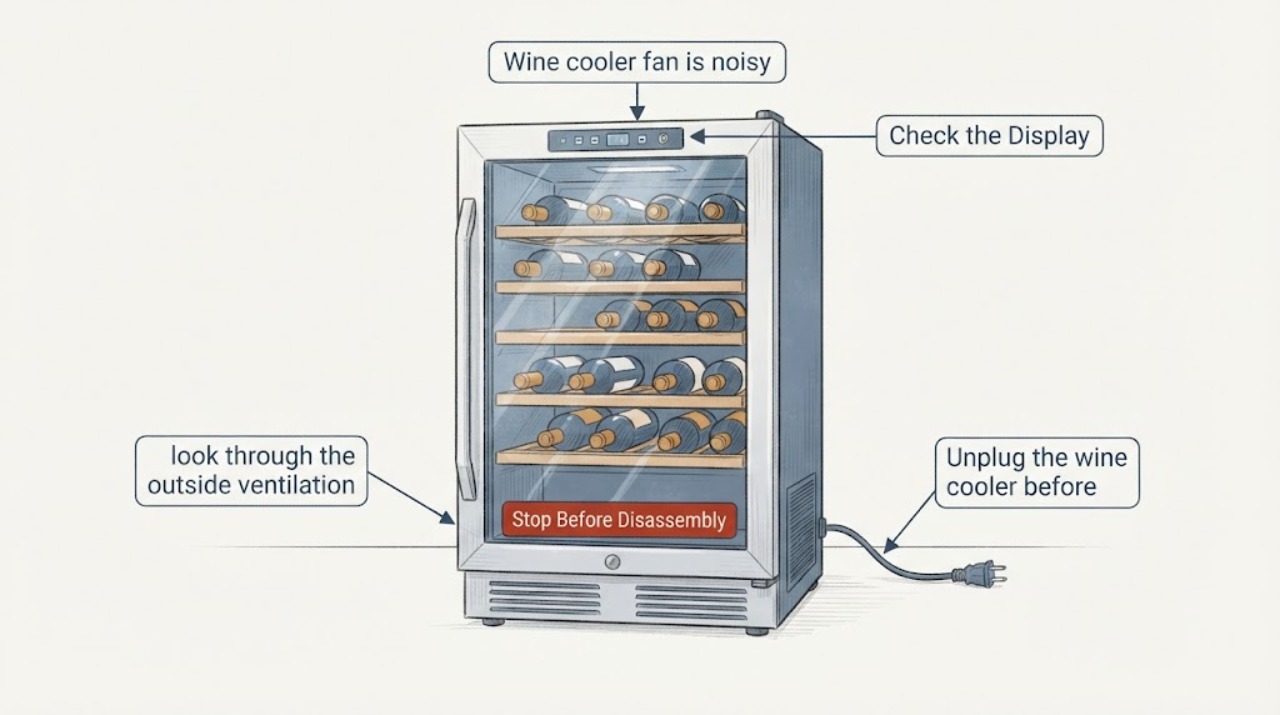
A CAVA28SM fan that cycles briefly can be normal, but an intermittent roaring or scraping sound is not enough to justify choosing a replacement fan by size or voltage. First listen for whether the sound is the normal fan cycle or a separate rattle, confirm that the cellar is level and that bottles, shelves and the cabinet are not vibrating, and inspect the outside ventilation openings for dust or an obstruction with power disconnected. Do not open the cabinet, reach into the fan or install an unverified replacement. If the noise is clearly from the fan, the fan stops completely, cooling changes, or there is heat, burning odor or damaged wiring, unplug the cellar and use CAVAVIN or qualified service.
Work through in order
Diagnostic checks
Use only checks that match the exact appliance or system and its official guide.
-
Check 1
Turn the control to its normal setting and listen from outside the cabinet for one complete operating interval without touching the grille or inserting anything into a vent. Note whether the sound is a brief on/off fan cycle, a steady roar, a scrape, a rattle or a click, and whether cooling remains normal.
Expected result: CAVAVIN says fan cycling can be normal, while a fan that stops completely and fails to complete its cycle is non-operational; refrigerant and cabinet sounds can also be normal.
Next step: If the noise is a new roar, scrape or repeated mechanical rattle, stop trying to identify it by repeated runs and continue with the powered-off checks.
Why this matters
Why: A brief repeating airflow sound is different from a new mechanical roar or scrape. Sound alone does not identify a fan model or a failed part.
-
Check 2
Unplug the wine cooler before inspecting accessible areas. Check that the cellar stands level, bottles do not touch one another or the shelves, and nothing is pressing on the outside cabinet or ventilation opening.
Expected result: The sound changes when a bottle, shelf or nearby object is moved, or the cabinet rocks on its feet; CAVAVIN identifies leveling and vibration as possible noise sources.
Next step: Correct only the visible placement or leveling issue according to the operating instructions. If the roar remains with the cabinet clear and level, leave the unit unplugged for service.
Why this matters
Why: An external vibration source can mimic a fan problem, but it does not explain a fan that audibly scrapes or a fan that stops completing its cycle.
-
Check 3
With power disconnected, look through the outside ventilation openings for heavy dust, a loose label or an obstruction. Clean only the accessible grille surface with the method allowed by the manual; do not remove the fan cover, kickplate or cabinet to reach the fan.
Expected result: An external obstruction is visible, or the grille is clear while the sound is still localized to the interior fan area.
Next step: Remove only the loose external obstruction. If the sound remains or the fan cannot complete its cycle, arrange service rather than opening the unit.
Why this matters
Why: A clear grille does not prove a fan bearing, bracket or motor fault, and an obstruction should not be used to justify a replacement part without model-specific evidence.
-
Check 4
Check the operating symptoms without disassembly: confirm whether the cellar still reaches its set temperature, whether the door gasket closes, and whether there is a burning smell, unusual heat, damaged cord or visible wiring damage.
Expected result: Cooling loss, a damaged cord or wiring, burning odor or unusual heat accompanies the fan noise.
Next step: Keep the unit unplugged and contact CAVAVIN or qualified service. Do not run it repeatedly to compare sounds.
Why this matters
Why: The problem has moved beyond a harmless sound or leveling check and may involve an electrical or cooling hazard that cannot be diagnosed from the post.
-
Check 5
Prepare the service request with CAVA28SM, serial number, the exact sound description, when the sound starts and stops, whether cooling remains normal, the result of the level and obstruction checks, and any odor or visible damage.
Expected result: Service receives the identity and symptom pattern needed to verify the fan assembly and any model-specific replacement information.
Next step: Wait for model-specific service guidance before ordering or installing a fan.
Why this matters
Why: The opened official pages provide service channels and general behavior, but they do not establish an interchangeable CAVA28SM fan or a user replacement procedure.
Use your observations
Decision map
Find the observation that best matches what you see, then follow the next safe action.
-
PATH 01Next step
What you see
The sound is a brief repeating airflow cycle, cooling is normal and there is no scraping, odor or heat.
Do this next
Keep the ventilation area clear and monitor; arrange service if the sound changes into a roar, scrape or continuous abnormal noise.
Why this path and its safety boundary
Why it matters: CAVAVIN says fan cycling can be part of normal air circulation, so this pattern is not proof of a failed fan.
-
PATH 02Next step
What you see
The noise changes when a bottle, shelf, nearby object or uneven foot is corrected, and cooling remains normal.
Do this next
Leave the cellar level and the bottles separated; stop if the noise returns without an external contact source.
Why this path and its safety boundary
Why it matters: The corrected contact or vibration is a more likely source than an unverified replacement fan.
-
PATH 03Next step
What you see
A clear, level cabinet still produces intermittent roaring, rubbing or scraping from the fan area.
Do this next
Unplug the wine cooler and have CAVAVIN or qualified service verify the fan assembly before any part is ordered.
Why this path and its safety boundary
Why it matters: The symptom is consistent with a fan-area service issue, but the opened official material does not identify the internal part or compatibility.
-
PATH 04Next step
What you see
The fan noise is accompanied by cooling loss, burning odor, unusual heat or damaged wiring.
Do this next
Keep the unit unplugged, avoid opening the cabinet and contact qualified service.
Why this path and its safety boundary
Why it matters: This is an electrical or cooling safety condition rather than a routine noise adjustment.
Helpful context
Understand the symptom
Separate normal cycling from a new mechanical noise
CAVAVIN says its cellars may cycle the fan on and off to circulate air, and that refrigerant sounds, end-of-cycle gurgling and some cabinet noises can be normal. The reported CAVA28SM case describes a distinct intermittent roaring sound while cooling still works, so the useful first question is whether the sound follows the normal cycle or is a new rubbing, rattling or scraping sound.
Why a replacement fan cannot be selected from the post alone
The available case text describes a custom bracket and fan dimensions, but the Reddit page could not be opened and no official CAVA28SM parts document was available through the opened official support pages. Do not treat an aftermarket listing or a voltage and diameter match as proof of compatibility. Record the model and serial number for CAVAVIN service instead.
When checks do not resolve it
Need a professional?
Use CAVAVIN or qualified service if a clear, level CAVA28SM still has a roaring, rubbing or scraping fan noise, if the fan stops completely, or if cooling loss, burning odor, unusual heat, damaged wiring or a damaged power cord is present.
Have this ready
- CAVA28SM model and serial, sound recording if safe to make without opening the cabinet, sound timing, cooling result, level and obstruction observations, and any odor or heat.
Common questions
FAQ
Is a CAVA28SM fan turning on and off always a failure?
No. CAVAVIN says the fan may cycle on and off to circulate air. A fan that stops completely or a separate roaring, scraping or rubbing sound needs a more cautious service evaluation.
Can I replace the CAVA28SM fan with an 80 mm or 12-volt fan?
Do not select a replacement from dimensions or voltage alone. The opened official support pages do not verify a compatible CAVA28SM fan, bracket or connector; have service identify the assembly first.
What other sounds can be normal in a CAVAVIN cellar?
CAVAVIN identifies refrigerant rattling, end-of-cycle gurgling and some cabinet expansion or contraction noises as possible normal sounds. A new fan-area roar or scrape should not be assumed normal from that list.
Read the exact guide
Official sources
- Bien choisir un cellierCAVAVIN Inc. · Supports the external ventilation and vibration boundary for CAVA28SM without asserting a model-specific fan assembly or part fit.
- Service après-vente | CavavinCAVAVIN Inc. · Service escalation and model/serial handoff for CAVA28SM when an abnormal fan noise or electrical/cooling warning remains.
- FAQ – CavavinCAVAVIN Inc. · Family-level normal fan-cycle, refrigerant-noise, leveling, vibration and service guidance for CAVA28SM; no internal fan compatibility or repair is inferred.
Community feedback
Share a repair observation
Share a plain-text repair observation. Accepted observations are published automatically; this page may take a moment to update.