
On this page
Start here
Quick answer
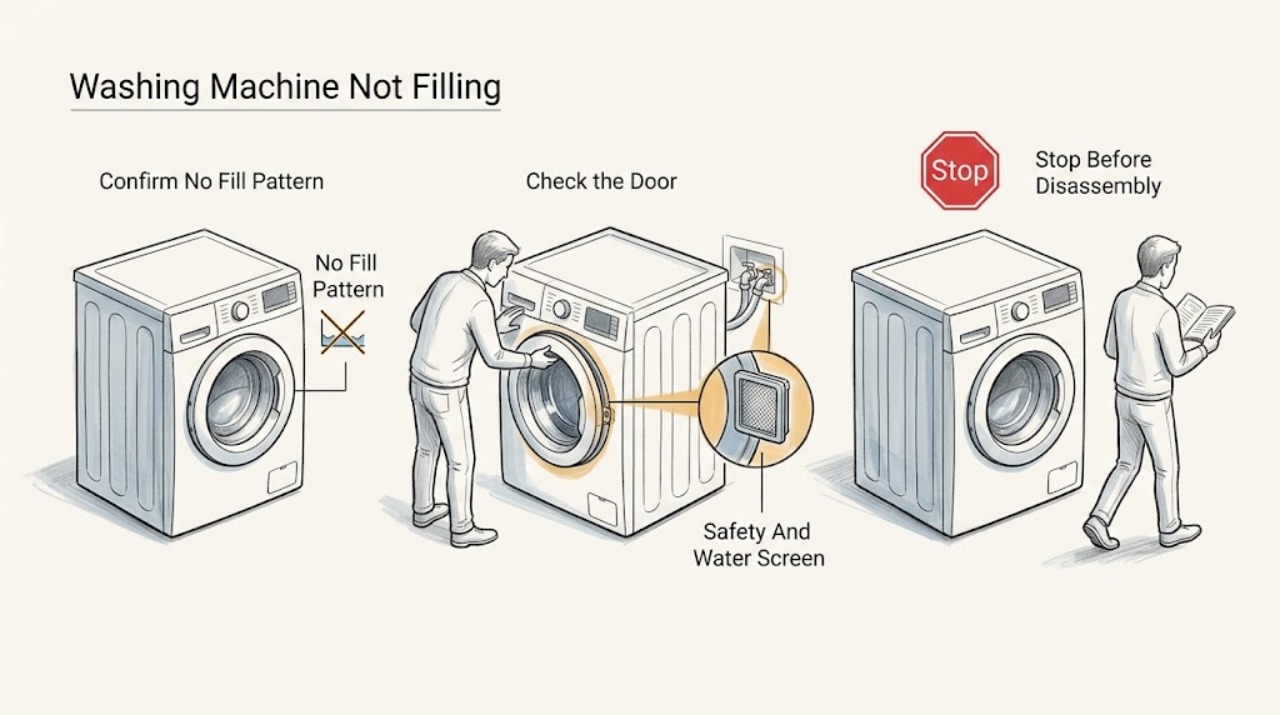
If a Zanussi washing machine does not fill, first keep the drum and floor safe, then check whether the programme is waiting for a closed door, water supply, or an error state. From a dry, safe position confirm that the household water supply is on, the inlet hose is not visibly kinked, and the tap or hose connection is not leaking. Zanussi identifies E10 or similar codes as water-supply warnings and says a blocked valve filter can restrict incoming water. A filter should be inspected or cleaned only when the exact model manual permits safe access, with water and electrical precautions followed. Stop immediately for uncontrolled inflow, an active leak, water near electrics, hot water, smoke, burning odor, arcing, or a repeated trip; do not open the cabinet or replace the inlet valve yourself.
Work through in order
Diagnostic checks
Use only checks that match the exact appliance or system and its official guide.
-
Check 1
Stop the programme and look from a dry, safe position at the floor, plug, cord, visible cabinet, inlet hose, tap, and control display without touching wet equipment.
Expected result: Record an active leak, water near the plug or outlet, a damaged hose, hot water, smoke, burning odor, sparks, unusual heat, severe movement, or a tripped electrical protection device.
Next step: If a hazard is present, keep clear, close the water tap only if it is safely reachable, and isolate electrical power only from a dry safe position; arrange qualified appliance, plumbing, or electrical service.
Stop if: Do not touch wet electrical parts, move or tilt the machine, restore power, or run another programme after a safety symptom.
Why this matters
Why: These signs change a no-fill problem into a water, shock, burn, fire, or mechanical hazard that should not be tested by another cycle.
-
Check 2
With the machine stopped, note whether no water enters, water enters slowly, water enters and immediately drains, or the programme never reaches its fill stage.
Expected result: No sound or water suggests a supply, door, programme, control, or inlet-valve path; a faint slow flow suggests restriction; immediate draining points away from a simple closed tap; a delayed start may be a lock or programme prerequisite.
Next step: Record the selected programme, delay or pause indicator, door-lock indicator, error code, beeps or flashes, and water level before making any change.
Stop if: Do not deliberately repeat a cycle if water is escaping, the machine is unstable, or any odor, heat, smoke, spark, or electrical trip is present.
Why this matters
Why: The exact fill behavior determines which safe branch to follow and prevents treating a drain or door issue as an inlet fault.
-
Check 3
Check from the front that the door is fully closed without forcing it, the programme is selected, and no visible padlock, delay, pause, or child-lock state is preventing a start.
Expected result: A door that is not latched, a padlock symbol, a delayed start, or an incomplete programme selection can prevent the fill command; a closed door with a persistent lock or code needs model-specific help.
Next step: Use only the exact model's documented control or child-lock action once, then observe the display. If the lock, code, or no-fill condition remains, arrange service.
Stop if: Do not pry the door, bypass the interlock, insert tools, or reach into a locked or water-filled drum.
Why this matters
Why: The machine may be waiting for a safe interlock or user command rather than failing to supply water.
-
Check 4
From a dry position, confirm that the washing-machine water tap is open, the household supply has not been shut off, and the visible inlet hose is not sharply kinked, crushed, or visibly damaged.
Expected result: A closed tap, shared supply interruption, kink, cracked section, or damaged connector can prevent or restrict filling; normal tap position and an undamaged visible hose move the decision toward the inlet connection, filter, valve, or appliance control.
Next step: If the hose is damaged or the connection is leaking, close the tap if safely reachable, leave the machine off, and arrange replacement or qualified service. Otherwise continue only with dry, stable surroundings.
Stop if: Do not disconnect a pressurized hose, use pliers on a connection, pull the appliance out, or continue with a damaged hose.
Why this matters
Why: Water must reach the machine before its inlet valve can admit water; a damaged hose is also a leak risk.
-
Check 5
Inspect only the visible tap-side and appliance-side inlet connections for a drip, looseness, mineral trace, or hose deformation; do not reach behind a confined machine.
Expected result: A drip or wet trace at either connection supports an inlet-hose or tap problem; a dry connection with no fill keeps a supply restriction, valve, control, or model-specific fault possible.
Next step: For any leak, keep the water supply closed and obtain qualified service. If the connections are dry and safely accessible, record that result and proceed to the code and filter guidance.
Stop if: Do not tighten with tools, detach the hose, expose the rear panel, or power the machine while water is present.
Why this matters
Why: Zanussi says water can drip from inlet connections or around the appliance and that a damaged hose should not be used.
-
Check 6
Record the exact display code, letters, numbers, symbols, beeps or flashes, selected programme, and stage at which the machine stopped.
Expected result: Zanussi identifies E10 or similar as a possible water-supply problem; E20, E30, E40, EF0 and other codes may point to different drain, pressure, door, leakage, foam, load, or power paths.
Next step: Look up the code in the manual or Zanussi support for the exact model. If the code returns after the permitted external checks, arrange qualified service.
Stop if: Do not guess across models, enter hidden diagnostic modes, or repeatedly reset a code while water, heat, odor, smoke, or electrical trouble is present.
Why this matters
Why: The exact code narrows the next safe check, but a code meaning is model-dependent and is not a part number.
-
Check 7
Only if the exact model manual permits user access, the machine is upright, dry, stopped, and isolated from water and electricity, check the accessible tap-side or valve filter for visible blockage.
Expected result: A visible blockage can restrict water entering the appliance; a clean filter or an inaccessible filter leaves household pressure, hose routing, inlet valve, sensor, or control causes possible.
Next step: Follow only the manual's safe cleaning method, then stop and arrange service if the filter cannot be accessed safely, the seal is damaged, or the no-fill condition remains.
Stop if: Do not remove a filter under pressure, put hands into a wet connection, open the cabinet, use force, or perform electrical or valve work.
Why this matters
Why: Zanussi states that a blocked valve filter restricts water entry, but its repair guidance also requires water and electrical precautions and model-appropriate know-how.
-
Check 8
Note whether other fixtures share the supply and whether the no-fill condition changes when household water is being used elsewhere, without dismantling plumbing or measuring live equipment.
Expected result: A broader interruption or weak shared flow suggests a household supply or tap issue; normal household flow with a persistent machine no-fill points toward the appliance path.
Next step: Resolve household water service through a qualified plumber when indicated; otherwise give the supply observation and exact machine code to appliance service.
Stop if: Do not alter building plumbing, open a pressurized connection, or continue operating during an active leak.
Why this matters
Why: The washer cannot fill reliably when the household supply is unavailable, and a machine-side restriction needs model-specific diagnosis.
-
Check 9
If the machine, floor, cord, and hose are dry and no warning sign is present, use only the one-time restart or reset described for the exact model manual.
Expected result: A normal fill after the documented reset suggests a transient control state; the same no-fill condition, a returning code, or a protection trip indicates an unresolved fault.
Next step: Stop after one documented attempt and arrange service if the problem returns or the machine remains unable to fill.
Stop if: Do not repeatedly reset, bypass a door lock, or restart after a leak, smoke, odor, hot water, spark, or electrical trip.
Why this matters
Why: A reset can clear a temporary state but cannot prove that an inlet valve, sensor, hose, or control is healthy.
-
Check 10
Prepare a service record with the complete Zanussi model number, installation position, fill behavior, tap and hose observations, door state, programme, exact code, water level, and safety symptoms.
Expected result: A precise record distinguishes a supply interruption, inlet restriction, door or programme prerequisite, leakage condition, and internal appliance fault without requiring unsafe testing.
Next step: Keep the machine out of service when the cause is unresolved, a leak occurred, or a code returns, and arrange authorized or qualified repair.
Stop if: Do not select or install an inlet valve, sensor, control, or hose solely from the no-fill symptom.
Why this matters
Why: A qualified technician can use the evidence to choose a model-specific inlet, sensor, control, or safety diagnosis.
Use your observations
Decision map
Find the observation that best matches what you see, then follow the next safe action.
-
PATH 01Safety boundary
What you see
Water is near the plug, outlet, cord, controls, or another electrical item, or an active leak is spreading.
Do this next
Keep clear, close the water tap only if safely reachable, isolate power only from a dry safe position, and arrange qualified appliance, plumbing, or electrical service.
Why this path and its safety boundary
Why it matters: The machine presents a water and electrical hazard, so filling tests are no longer appropriate.
Safety stop: Do not touch wet equipment, move the machine, or restore power to run another programme.
-
PATH 02Safety boundary
What you see
The visible inlet hose is cracked, split, deformed, or leaking at a connection.
Do this next
Close the water supply if safely accessible, stop using the machine, and arrange an exact-model hose replacement or qualified service.
Why this path and its safety boundary
Why it matters: The water path is unsafe or unable to deliver water reliably.
Safety stop: Do not run a cycle, detach a pressurized hose, or use tools to force a connection.
-
PATH 03Safety boundary
What you see
The washing-machine tap is closed or other fixtures show that the household supply is interrupted or weak.
Do this next
Restore household water service safely or arrange plumbing help, then use the exact model guidance if the no-fill condition remains.
Why this path and its safety boundary
Why it matters: The appliance cannot fill until water reaches the inlet path.
Safety stop: Do not open a pressurized connection or continue while a supply leak is present.
-
PATH 04Safety boundary
What you see
The tap is open but the visible hose is kinked, or an authorized accessible filter is visibly blocked.
Do this next
Correct only a safely visible hose position and follow the exact manual for any permitted filter cleaning; arrange service if access or the blockage is uncertain.
Why this path and its safety boundary
Why it matters: Restricted flow can cause a no-fill symptom; Zanussi specifically says a blocked valve filter restricts water entry.
Safety stop: Do not remove a filter under pressure, open the cabinet, or use force on hose or filter connections.
-
PATH 05Safety boundary
What you see
The door is not latched, a padlock or delay state is shown, or a programme has not been fully selected or started.
Do this next
Close the door without force and use the exact manual's control or child-lock action once; service is needed for a persistent lock or no-fill state.
Why this path and its safety boundary
Why it matters: The machine may intentionally withhold the fill command until the interlock or programme condition is satisfied.
Safety stop: Do not pry, bypass, or reach through the door lock.
-
PATH 06Safety boundary
What you see
The machine shows E10 or a similar code, or flashes and beeps at the fill stage.
Do this next
Record the code and use the exact model guide for tap, hose, filter, and service decisions; arrange repair if it returns.
Why this path and its safety boundary
Why it matters: Zanussi describes E10 or similar as a possible water-supply problem, but exact codes and recovery steps depend on model.
Safety stop: Do not treat the code as proof of a failed valve or repeatedly reset it during a safety symptom.
-
PATH 07Safety boundary
What you see
The code points to draining, pressure sensing, door lock, leakage, foam or load, power, or another family rather than water supply.
Do this next
Use the model-specific code guide and arrange service for a returning code; do not substitute an inlet repair.
Why this path and its safety boundary
Why it matters: The machine may be unable to fill because a different prerequisite or detected fault has stopped the programme.
Safety stop: Stop for residual water, a leak, hot water, smoke, odor, arcing, or an electrical trip.
-
PATH 08Safety boundary
What you see
The tap is open, hose and accessible connections appear sound, the door and programme are correct, and the machine still does not fill.
Do this next
Keep the machine off and arrange qualified Zanussi or appliance service with the recorded model, code, and observations.
Why this path and its safety boundary
Why it matters: An inlet valve, sensor, wiring, control, or model-specific internal fault remains possible and cannot be distinguished safely from outside.
Safety stop: Do not open panels, probe wiring, test live components, or replace a valve or control yourself.
-
PATH 09Safety boundary
What you see
Water enters but immediately runs away or the programme behaves as though the drum is empty.
Do this next
Stop the programme, record the timing and hose arrangement without moving the machine, and use the exact model guide or plumbing service.
Why this path and its safety boundary
Why it matters: This is not a simple no-inlet-flow symptom and may involve drain-hose installation or a different detected condition.
Safety stop: Do not pull the machine out, alter plumbing, or continue if water is escaping or the floor is wet.
-
PATH 10Safety boundary
What you see
A dry, hazard-free machine fills normally after one model-authorized reset but the symptom has not yet recurred.
Do this next
Monitor normal use without deliberately repeating the fault; arrange service if no-fill, a code, or a leak returns.
Why this path and its safety boundary
Why it matters: A transient control state is possible, but a reset does not establish that the water path is reliable.
Safety stop: Do not repeat resets or continue use after any water, heat, odor, smoke, spark, or electrical warning.
Helpful context
Understand the symptom
Start with the symptom and safety state
Not filling can mean no water enters at all, a very slow fill, a programme that pauses before filling, or water entering and immediately escaping. Keep the machine stopped while you identify which one is happening. Check only from a dry, standing position: look at the floor, plug, cord, visible hose, tap, door, indicators, and displayed code. A wet electrical area or uncontrolled water flow is a stop condition, not a reason to try another cycle.
Zanussi water-supply checks are model-sensitive
The inlet tap must be open and the hose must be able to deliver water without a visible kink or damaged section. The tap-side filter and the valve filter at the machine connection can restrict flow, but access and cleaning instructions depend on the model. Zanussi's maintenance guidance says to turn off the water supply and disconnect electrical power before maintenance; use the exact manual and do not reach behind a wet or tightly installed machine.
A code is a clue, not a universal repair instruction
Zanussi lists E10 or a similar code as a possible water-supply problem, while E20, E30, E40, EF0 and other families indicate different drain, pressure-sensor, door-lock, leakage, foam, load, or power conditions. Record the exact code, beeps or flashes, selected programme, door state, and whether the drum is empty or has water. Use the model-specific guide instead of applying a code from another Zanussi machine.
Know when the inlet system needs a professional
A cracked, split, or deformed inlet hose should be isolated from the water supply and the machine should not be used. A continuing no-fill after safe external checks can involve the inlet valve, door interlock, pressure sensing, control, or household water supply. Those are service clues, not invitations to remove panels or probe live parts. Give the technician the exact model and the observations that occurred before the programme stopped.
Safety boundary
Stop conditions
- Stop immediately for an active leak, water near a plug, outlet, cord, control, or wet floor; isolate power only from a dry safe position and do not touch wet electrical parts.
- Stop for hot water, smoke, burning odor, sparks, arcing, unusual heat, a damaged hose, severe movement, or a repeated electrical protection trip.
- Do not move, tilt, drag, open, or dismantle the washing machine to find a no-fill fault; do not perform live electrical tests.
- Do not pry or bypass the door or lid interlock, remove a filter under pressure, disconnect a water hose without safe model instructions, or reach into a water-filled drum.
- Do not repeatedly reset the machine, guess an error-code meaning, or replace an inlet valve, sensor, control, or hose from the symptom alone.
Only after diagnosis
Potential parts
- inlet hose
Consider only if the exact model inspection confirms that the hose is cracked, split, deformed, or leaking and a qualified or manual-authorized replacement is appropriate.
Hoses and safety features vary by model; confirm the complete Zanussi model and safe installation requirements before selecting one. - water inlet valve
Consider only after supply, hose, door, programme, and accessible-filter checks leave a qualified diagnosis of an inlet-valve fault.
Valve configuration is model-specific and involves water and electrical connections; do not choose or install it from E10 or no-fill alone. - inlet valve filter or screen
Consider only when the exact model identifies a replaceable damaged screen or a qualified inspection finds restriction after safe water isolation.
Filter access and fit vary by model; do not remove a pressurized screen or substitute a generic part. - door interlock or control component
Consider only when the door closes correctly but the exact model diagnosis shows that an interlock or control is withholding the fill command.
Interlocks and controls are model-specific safety components and require qualified diagnosis; never bypass the interlock.
When checks do not resolve it
Need a professional?
Arrange qualified appliance service when the no-fill condition remains after safe external supply, hose, door, programme, code, and model-authorized filter checks; when a code returns; or when the appliance has an active or recurring leak. Use plumbing service for a household supply or tap problem and electrical service for an outlet, cord, or protection fault.
Common questions
FAQ
Why is my Zanussi washing machine not filling with water?
Check the water tap, shared household supply, visible hose position, door or programme state, and exact display code from a dry safe position. Zanussi identifies E10 or similar as a possible water-supply problem and says a blocked valve filter can restrict entry. A continuing fault needs model-specific service rather than an assumed valve replacement.
What does E10 mean on a Zanussi washing machine?
Zanussi describes E10 or a similar code as a water-supply problem, but the exact display and model guide control the next step. Record the code and check only the safe external supply and hose conditions; do not treat E10 as proof that one particular part has failed.
Can a blocked inlet filter stop a Zanussi washer filling?
Yes. Zanussi says a blocked valve filter restricts water entering the appliance. Inspect or clean a filter only when the exact model manual permits safe access and after the required water and electrical precautions. If access is uncertain or the symptom remains, use qualified service.
Should I replace the Zanussi inlet valve if the machine will not fill?
Not from the symptom alone. A closed supply, kinked or damaged hose, restricted filter, door or programme state, sensor, control, or household water problem can look similar. An inlet valve should be considered only after a qualified, model-specific diagnosis.
What should I do if my Zanussi washing machine is filling very slowly or leaking?
Stop the machine and check only visible, dry-safe areas. A kink, damaged hose, or wet connection requires closing the water supply if safely reachable and keeping the machine off. Water near a plug or outlet, smoke, odor, heat, arcing, or a repeated electrical trip requires immediate safety isolation and qualified help.
Read the exact guide
Official sources
- Washing machine - How to replace the water inlet hose (1)Zanussi · Zanussi washing machines; use the product manual and qualified service for model-specific work
- Valve filter blockedZanussi · Zanussi washing machines with the applicable inlet-valve filter; use the exact model instructions
- Washing Machine Not Working or Not Turning On – Troubleshooting GuideZanussi · Zanussi washing machines and washer dryers; use the exact model manual for controls
- Washing Machine common error codes and troubleshooting tipsZanussi · Zanussi washing machines and washer dryers; exact model controls code meaning and recovery
- Washing Machine Inlet Hose Leaking: Causes and Step-by-Step FixZanussi · Zanussi washing machines; connection and filter access depend on the installed model
Community feedback
Share a repair observation
Share a plain-text repair observation. Accepted observations are published automatically; this page may take a moment to update.