
On this page
Start here
Quick answer
An Amana washer that vibrates or walks is most often reacting to an unbalanced or overloaded load, a single bulky item, an unlevel floor or foot, loose pedestal hardware, or front-load shipping materials that were not removed. Stop the cycle and keep clear of the moving basket, then identify whether movement appears only during spin and whether the machine rocks when stopped. Redistribute a suitable load, confirm all four feet are firmly on a solid floor, and use the exact Amana installation instructions for leveling and shipping-bolt checks. Do not place the washer on a raised wooden platform, defeat a lock, open the cabinet, or keep running it when it strikes the cabinet, leaks, emits smoke or burning odor, sparks, overheats, trips a breaker, or will not stop. Persistent walking after a correct load and safe installation check needs qualified appliance service for possible suspension, bearing, tub, or drive damage.
Before you begin
Safety first
- Do not open the cabinet, defeat a lid or door lock, remove suspension or drive parts, move a heavy machine across a wet floor, or continue using it after severe walking or a safety symptom.
Work through in order
Diagnostic checks
Use only checks that match the exact appliance or system and its official guide.
-
Check 1
Pause or stop the cycle as the Amana model permits and observe from a safe position. Record whether the walking begins during agitation, rinse, or spin, whether the basket is moving normally, whether the cabinet hits nearby objects, and whether smoke, odor, heat, sparks, a leak, or a repeated electrical trip is present.
Expected result: Movement appears only as spin accelerates, occurs at several stages, occurs with an empty basket, or is accompanied by a hazard or uncontrolled motion.
Next step: Keep clear and isolate water or power only from a dry, safe location for smoke, burning odor, sparks, hot electrical parts, a leak near electrics, repeated breaker trips, violent impacts, or motion that will not stop. Otherwise wait until the basket is still before continuing.
Why this matters
Why: Spin-only movement makes load balance and leveling more likely; movement with no load or across several stages makes installation, floor, or internal causes more likely. A hazard is a safety stop rather than a balancing problem.
-
Check 2
When the basket is fully stopped, inspect the load without tightly repacking it. Look for one heavy or bulky item, a load gathered to one side, too many items, or an item that is unsuitable for the selected cycle. Do not reach into a moving basket or add items during motion.
Expected result: The load is tightly packed, a single rug or similarly bulky item is present, clothing is distributed unevenly, or the load is loose and suitable for the cycle.
Next step: Remove excess items and redistribute a bulky load only when the exact cycle and manual permit it; use a few compatible items to balance a single bulky piece. Make one supervised run only if there is no leak or hazard. Stop if walking returns.
Why this matters
Why: Amana links off-balance or oversized loads to excessive vibration, reduced spin speed, longer cycles, and wet clothing. A suitable, balanced load that still produces violent movement shifts suspicion to installation or the washer itself.
-
Check 3
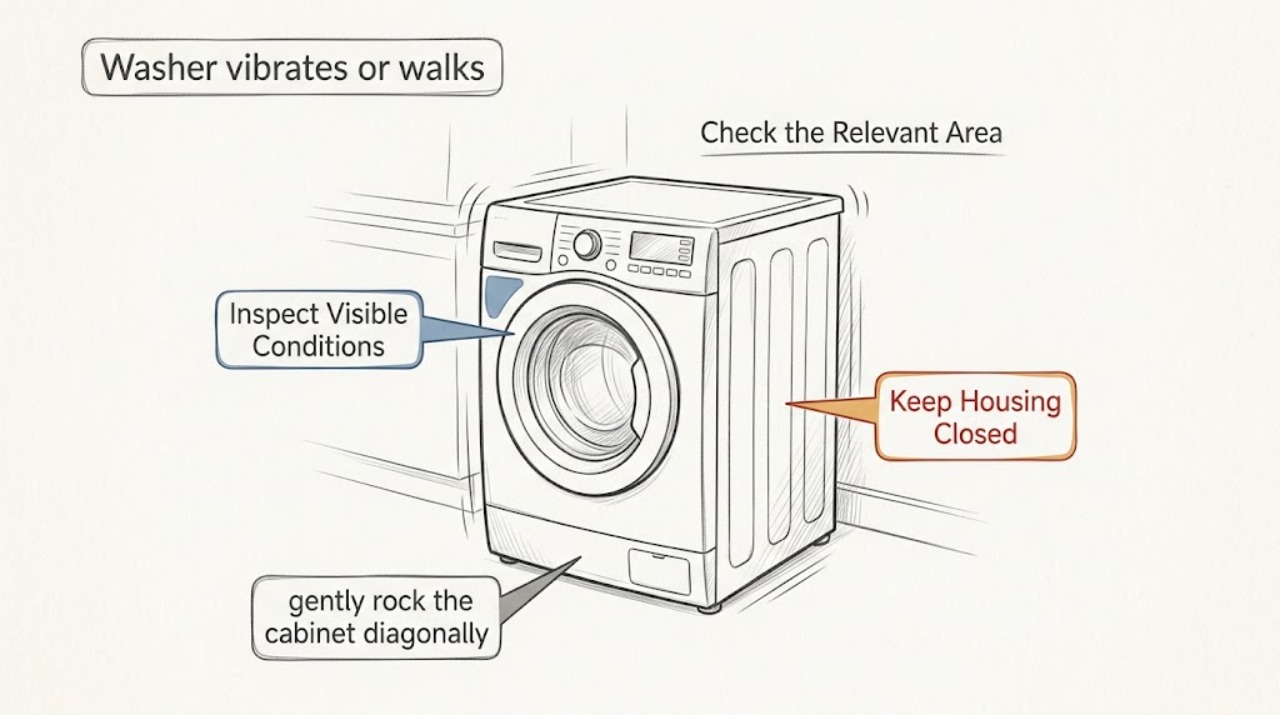
With the washer stopped and the floor dry, gently rock the cabinet diagonally from corner to corner and side to side. Check whether all four feet remain firmly on the floor, whether a foot lock nut is loose, and whether the cabinet is touching a wall or another appliance. Do not crawl under a powered washer or move it across a wet floor.
Expected result: The cabinet rocks, one foot lifts, a lock nut is loose, the washer touches nearby objects, or all four feet are firm and clear.
Next step: If safe and the exact manual permits, adjust the feet until the washer is stable and tighten the lock nuts against the cabinet. Do not use a raised platform; stop and obtain service if the feet cannot be secured or the washer still walks.
Why this matters
Why: Amana says firm four-foot contact and a level cabinet are required; a loose foot or nearby obstruction can transfer vibration into walking. Firm feet with continued movement make load, floor flex, shipping material, pedestal, or internal causes more likely.
-
Check 4
Identify the installation surface and support: note a flexing or sagging floor, a drain pan, a pedestal, or a stacked arrangement. For a pedestal, check only visible mounting or foot conditions described by the exact Amana instructions; do not remove the washer from its pedestal.
Expected result: The floor flexes, the washer sits on a pedestal or pan, pedestal feet or fasteners are loose, or the installation is solid and correctly supported.
Next step: Correct only visible, model-approved pedestal or foot conditions. Have a qualified installer assess a flexing floor or stacked installation rather than adding improvised pads or blocks; stop use if the unit can shift or fall.
Why this matters
Why: Amana says unstable flooring can exacerbate vibration and that pedestal feet, connecting hardware, and washer feet have separate requirements. A stable support with correct load and leveling makes an internal fault more plausible.
-
Check 5
If the washer is a front-load model and the vibration began immediately after installation or relocation, inspect the rear only from a safe, dry position for the shipping-bolt locations shown in the exact installation guide. Do not remove bolts based on a generic image, tip the washer, or operate it with an uncertain transport setup.
Expected result: Shipping bolts or spacers appear to remain, the machine was recently moved, or the rear has no transport hardware and the vibration is new or unexplained.
Next step: Use the exact model installation instructions or a qualified installer for transport-hardware removal and any relocation. Do not run a front-load washer with bolts installed or open its cabinet to access suspension parts.
Why this matters
Why: Amana says front-load shipping materials stabilize the drum during transport and must be removed before use; leaving them in place can cause excessive vibration, noise, or damage. Absence of shipping material does not rule out an internal or load-related issue.
-
Check 6
After a correct load, stable level installation, and model-appropriate shipping check, document whether the basket is empty or loaded, the cycle stage, the speed at which movement starts, any error, and whether the cabinet or hoses are struck. Do not keep running cycles to reproduce severe movement.
Expected result: The washer remains stable after correction, or it still walks with a suitable load and firm four-foot contact; a new scrape, repeated thump, leak, or control error may also be present.
Next step: Keep the washer out of use and arrange qualified appliance service for persistent movement, internal noise, water leakage, a damaged hose, or any control or safety symptom. Provide the model, installation style, cycle stage, and recorded observations.
Why this matters
Why: A resolved load or installation pattern supports an external cause. Persistent movement with those conditions raises concern for suspension, tub, bearing, drive, or structural damage that cannot be identified safely from the outside.
Use your observations
Decision map
Find the observation that best matches what you see, then follow the next safe action.
-
PATH 01Next step
What you see
Do this next
When motion stops, reduce or redistribute the load using the exact cycle guidance; stop if the same load pattern returns or the washer strikes the cabinet.
-
PATH 02Next step
What you see
Do this next
Use the exact Amana leveling instructions to establish firm four-foot contact and secure visible lock nuts or pedestal conditions. Do not improvise a raised base.
-
PATH 03Next step
What you see
Do this next
Stop if the washer can shift or fall and have the floor or installation assessed; do not install it on a raised wooden platform.
-
PATH 04Next step
What you see
Do this next
Do not run it. Use the exact installation guide or qualified installer to confirm and remove transport hardware safely.
-
PATH 05Next step
What you see
Do this next
Leave the washer off and arrange qualified appliance service; do not remove panels or continue test cycles.
-
PATH 06Next step
What you see
Do this next
Keep clear, isolate water and power only from a dry safe location, and obtain qualified appliance or electrical service. Do not restart or defeat a lid or door lock.
Helpful context
Understand the symptom
When the movement happens matters
A basket can move as part of normal operation, but a cabinet that travels across the floor or bangs during spin needs a decision. Note whether the movement starts only as spin speed rises, whether it happens with an empty basket, and whether the washer rocks while stopped. A load-specific event points toward balance; movement with no load or after a recent move points more toward installation or an internal problem.
Top-load and front-load checks are different
Amana's strongest shipping-bolt warning applies to front-load washers. Top-load guidance emphasizes off-balance loads, firm foot contact, leveling, and cycle-appropriate bulky items. Do not remove parts or use a front-load procedure on an unidentified top-load model. Find the exact Amana manual before adjusting feet, checking a pedestal, or inspecting transport hardware.
A firm floor is part of the installation
All four feet must stay in contact with a solid floor. A washer can remain technically powered and still walk if a foot is loose, a lock nut backs off, the pedestal is not secured, or the floor flexes. Do not install the washer on a raised wooden platform. If vibration can be felt across the floor, the floor itself may need qualified evaluation rather than repeated foot adjustments.
Stop before movement becomes damage
Pause the cycle and stay clear of the basket if the cabinet is striking a wall, hoses are being pulled, or the washer is moving violently. Stop completely for a leak near electrical parts, smoke, burning odor, sparks, a hot plug, repeated breaker trips, or a basket that will not stop. Never defeat the lid or door interlock or open the cabinet to inspect suspension or drive parts.
Safety boundary
Stop conditions
- Stop immediately for smoke, burning odor, sparks, a hot or damaged cord or outlet, repeated breaker trips, water near electrical parts, violent cabinet impacts, or a basket that will not stop. Isolate water or power only from a dry, safe location and arrange qualified service.
- Do not reach into a moving basket, defeat a lid or door interlock, force a door, or keep running cycles to reproduce severe walking.
- Do not place the washer on a raised wooden platform or use improvised blocks, pads, or fasteners to compensate for an unstable installation.
- Do not remove a front-load washer from a pedestal, open the cabinet, or remove suspension or drive parts without the exact Amana instructions and safe isolation.
- If a suitable load, firm four-foot contact, correct leveling, solid support, and model-appropriate shipping check do not resolve the movement, stop using the washer and arrange service.
Only after diagnosis
Potential parts
- leveling foot or foot lock hardware
Consider only if the exact model's visible foot or lock hardware is damaged or cannot maintain firm floor contact after the safe leveling check.
Confirm the full Amana model and installation style before ordering; pedestal and non-pedestal foot hardware may differ. - front-load shipping bolt or transport hardware
Consider only for a model-specific relocation or transport setup when the exact installation instructions identify missing or required transport hardware; do not treat it as a cure for routine vibration.
Confirm the exact Amana model and use the installation manual or qualified installer; transport hardware is not a universal operating part. - washer suspension or shock component
Consider only after a qualified diagnosis finds persistent movement with a correct load, level support, and appropriate installation, indicating an internal suspension problem.
Confirm the full model and platform before any part decision; do not infer fit or replace an internal suspension component from walking alone.
When checks do not resolve it
Need a professional?
Arrange qualified Amana appliance service when the washer continues to walk after a suitable load and safe leveling checks, when it moves with an empty basket, when a persistent internal thump or scrape, leak, damaged hose, or error appears, or when shipping material, pedestal, floor, suspension, tub, bearing, or drive issues cannot be confirmed safely. Use urgent service for electrical hazards, uncontrolled movement, or water near electrics.
Safety scope: Do not open the cabinet, defeat a lid or door lock, remove suspension or drive parts, move a heavy machine across a wet floor, or continue using it after severe walking or a safety symptom.
Common questions
FAQ
Why does my Amana washer walk only during spin?
Spin is the first place to check load balance and leveling. A bulky single item, tightly packed load, uneven distribution, or cabinet that rocks can create movement; stop when the basket is still, correct only a model-appropriate load or leveling condition, and stop if walking returns.
How do I know whether my Amana washer is level?
With the washer stopped and the floor dry, gently rock it diagonally and side to side. All four feet should stay firmly on the floor and the cabinet should not teeter. Use the exact Amana installation instructions to adjust feet and secure lock nuts.
Can one bulky item make an Amana washer vibrate?
Yes. Amana warns that a single bulky item can create an off-balance spin load. When motion has stopped, follow the cycle guide and balance the item only with compatible items; do not reach into a moving basket.
Do Amana front-load shipping bolts cause walking?
They can. Amana says front-load shipping materials must be removed before use because leaving them installed can cause excessive vibration, noise, or damage. Confirm the exact rear hardware and removal procedure in the model installation guide rather than guessing.
Should I put a platform under a vibrating Amana washer?
Do not place it on a raised wooden platform. Amana recommends a solid, suitable floor and warns that flexing or sagging support can worsen vibration. Have an unstable floor or pedestal assessed instead of improvising blocks or pads.
When should I stop using an Amana washer that walks?
Stop for violent movement, cabinet impacts, a leak near electrical parts, smoke, burning odor, sparks, a hot connection, repeated breaker trips, a damaged lock, or walking that remains after safe load and installation checks. Leave the washer off and arrange qualified service.
Read the exact guide
Official sources
- Leveling a Front Load WasherAmana Product Help · Front-load guidance; pedestal and non-pedestal procedures differ and require the exact installation instructions.
- Vibration - Washing a Single ItemsAmana Product Help · Top-load-specific guidance; cycle and basket behavior vary by model.
- Front Load Washer Installation ChecklistAmana Product Help · Front-load installation checklist; always compare with the exact model guide.
- Washer is Vibrating, Walking or MovingAmana Product Help · General Amana guidance; it distinguishes load, shipping, and leveling causes, while model procedures remain manual-specific.
- Washer Walking and/or Vibrating - Front Load WasherAmana Product Help · Front-load-specific guidance; use the exact model's installation instructions for access and leveling.
- Use and Care GuideAmana · Manual is model-family specific; use the exact washer manual where instructions differ.
Community feedback
Share a repair observation
Share a plain-text repair observation. Accepted observations are published automatically; this page may take a moment to update.