
On this page
Start here
Quick answer
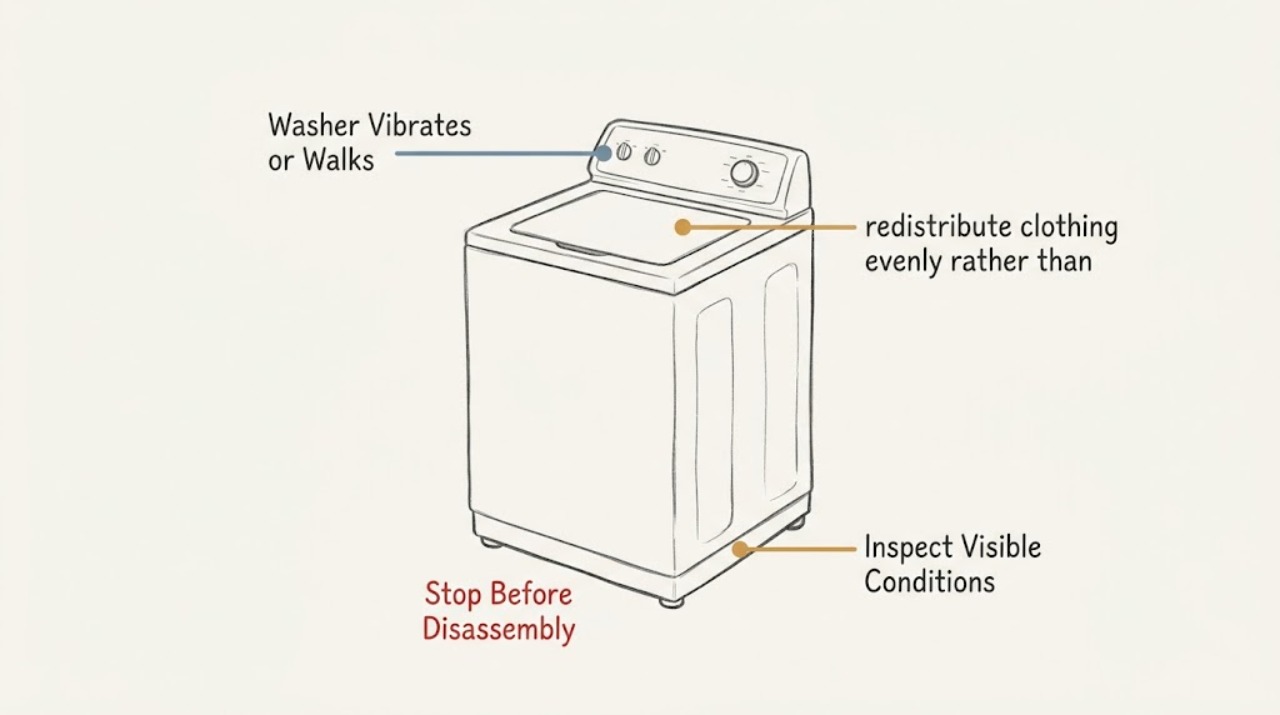
A GE washer that vibrates or walks most often needs its load, level, legs, floor, or installation checked before an internal part is blamed. Stop the cycle, wait for the basket to stop, and redistribute a bunched or single heavy load. With the washer empty and stationary, check that it does not rock and that all leveling feet firmly contact a solid floor; use the exact installation instructions for adjustments. If the problem began after installation or a move, confirm the model-specific shipping material or bolts were handled correctly. On a front-load model, an owner-accessible pump filter may matter only when the exact manual provides that procedure. Stop for severe movement, a leak, damaged cord, burning odor, smoke, sparks, or metal-on-metal noise. If an empty rinse or spin still shakes, or the setup cannot be corrected safely, arrange qualified appliance service.
Work through in order
Diagnostic checks
Use only checks that match the exact appliance or system and its official guide.
-
Check 1
From a safe position, record the exact GE model, top-load or front-load design, and the phase when movement begins. Note whether the tub is full, whether the motion occurs during agitation, drain, or spin, whether the basket bangs or only the cabinet rocks, whether the machine walks, and whether a code, leak, odor, or unusual noise appears. Stop the cycle with the normal control and wait for the basket to stop before opening it.
Expected result: Movement is limited to one heavy or bulky load, occurs during every spin including an empty cycle, began after a move or installation, or is accompanied by water, an odor, a code, or severe noise.
Next step: Follow the load, level, installation, front-load filter, or service branch that matches the observed pattern. Do not run repeated high-speed cycles to reproduce severe movement.
Why this matters
Why: A load-specific event makes imbalance more likely; persistent empty-cycle movement makes leveling, shipping hardware, floor, suspension, or another mechanical condition more likely. A new safety symptom moves the issue out of routine adjustment.
-
Check 2
When the washer is stopped, redistribute clothing evenly rather than leaving one dense bundle or a single heavy item on one side. Keep bulky or water-resistant items within the model's cycle guidance, and do not reach into a moving basket. Run one monitored cycle with a balanced load only after the machine is stable and no danger sign is present.
Expected result: The load was bunched, tightly packed, a single heavy item was present, the movement disappears after redistribution, or the washer walks again with a balanced load.
Next step: Use the model-recommended cycle and monitor one load. If the washer still walks, bangs, or needs repeated interruptions, stop using it and arrange service.
Why this matters
Why: GE says unbalanced loads can increase vibration and recommends stopping and redistributing the load. If the same movement returns with a balanced load, load imbalance is less likely than level, floor, installation, or mechanical causes.
-
Check 3
With the washer empty, powered off, and stationary, check whether the cabinet rocks corner to corner and whether every visible leveling foot firmly contacts the floor. Look for a soft, flexing, wet, oily, or raised surface. Use the exact GE installation instructions for any accessible foot adjustment; do not tip the machine or place hands beneath it to level it.
Expected result: The washer rocks when empty, one foot is not firmly seated, the floor flexes or is slippery, all feet are stable, or the washer cannot be adjusted without lifting or moving it.
Next step: Correct only an accessible adjustment exactly as the installation instructions describe, then verify that the stopped washer no longer rocks. If the floor needs structural work, the washer must be lifted, or movement remains, call qualified service.
Why this matters
Why: GE says the washer should be level on a good, solid floor and that extended or poorly contacting legs can make vibration worse. Stability when empty makes a load-only explanation more likely; instability when empty points to installation or the machine itself.
-
Check 4
If the vibration began after delivery, installation, or a move, compare the visible setup with the exact model's installation instructions. For a top-load machine, confirm the required shipping material was handled at installation; for a front-load machine, confirm the instructions' shipping bolts or braces are addressed. Do not remove or loosen hardware unless the model instructions clearly identify it and the work is safe.
Expected result: The washer is newly installed or moved, the installation paperwork is missing, shipping material or bolts may remain, or the washer has been in place without a recent move.
Next step: Obtain the exact installation instructions and have a qualified installer or appliance technician correct uncertain shipping hardware. Do not improvise by removing structural parts or running the washer to see whether it settles.
Why this matters
Why: GE identifies retained shipping material or bolts and braces as installation-specific causes of noise and vibration. A recent move raises that possibility, but hardware location and removal differ by model.
-
Check 5
For a front-load GE washer only, check the exact owner's manual for an access door and procedure for the drain-pump filter. If the manual explicitly permits owner access, follow it with the washer stopped, power disconnected through the normal accessible method, and residual water controlled; do not remove a panel, reach into the pump, or invent an access point on a model without that door.
Expected result: The model has a documented accessible filter, no filter access is provided, the filter contains debris, water cannot be controlled safely, or vibration remains after the documented check.
Next step: Clean only the documented user-accessible filter as instructed, restore all covers, and monitor one empty or light cycle. If the filter is hidden, water remains, or vibration persists, arrange qualified appliance service.
Why this matters
Why: GE notes that loose items or pet hair can clog a front-load drain pump and contribute to shaking, but access is model-dependent. An inaccessible or unresolved pump condition requires service rather than cabinet disassembly.
-
Check 6
After the load and stationary setup checks, run one model-approved empty rinse-and-spin observation if the washer has no leak, damaged cord, severe movement, or other hazard. Watch from outside for smooth acceleration, repeated balance attempts, cabinet rocking, or movement. Do not stand over an open front door or touch the machine while it spins.
Expected result: The empty cycle is stable, the empty cycle still shakes, movement occurs only after clothing is added, or the washer stops and retries balance repeatedly.
Next step: If the empty cycle is stable, use smaller balanced loads and the model's cycle guidance. If it is not stable, stop operating the washer and schedule qualified service; do not open the cabinet to inspect suspension parts.
Why this matters
Why: GE says a normal empty rinse-and-spin on applicable front-load models makes the original load imbalance more likely. Persistent empty-cycle vibration or repeated balance attempts makes installation, floor, pump, suspension, tub, or drive issues more likely.
-
Check 7
Prepare the service description instead of continuing to test: provide the model, top-load or front-load design, movement phase, load type, empty-cycle result, level and floor observations, recent move or installation, filter result if the manual provided access, codes, leaks, and sounds. Keep the washer out of service for severe or recurring movement.
Expected result: The washer walks with balanced or empty loads, the feet and floor are stable, shipping hardware is uncertain, a pump filter is inaccessible, or there is a leak, odor, smoke, spark, severe banging, or metal contact.
Next step: Arrange qualified appliance repair. Do not tip the washer, remove panels, enter service mode, test live components, or replace suspension, pump, or drive parts based only on the symptom.
Why this matters
Why: A persistent problem after external adjustments may involve suspension, shock or damping components, a pump, tub, drive, cabinet, or another model-specific part. The observed pattern helps a technician choose tests but does not establish a part failure.
Use your observations
Decision map
Find the observation that best matches what you see, then follow the next safe action.
-
PATH 01Next step
What you see
The GE washer is stable when empty and moves only with a bunched, single heavy, bulky, or tightly packed load.
Do this next
Load imbalance is more likely than an internal mechanical fault.
-
PATH 02Next step
What you see
The empty stopped washer rocks, one foot is loose, the floor flexes, or the cabinet is not level.
Do this next
Leveling, floor contact, or installation is more likely than the laundry load.
-
PATH 03Next step
What you see
Severe vibration began after installation or moving and shipping material, bolts, or braces may remain.
Do this next
Installation hardware or an installation-related setup error is more likely.
-
PATH 04Next step
What you see
A front-load GE model has a documented accessible pump filter and movement occurs with drain or spin symptoms, or the filter path is inaccessible.
Do this next
A restricted drain pump may contribute to the symptom, but filter access is model-dependent.
-
PATH 05Next step
What you see
A stable floor and correctly adjusted feet are confirmed, but the empty rinse-and-spin still shakes, walks, or repeatedly retries balance.
Do this next
An installation issue not visible externally or an internal suspension, pump, tub, drive, or control condition is more likely.
-
PATH 06Next step
What you see
The washer moves violently, strikes the cabinet, leaks, smells burned, smokes, sparks, has a damaged cord, or creates an unsafe water or electrical condition.
Do this next
This is beyond routine balancing and may cause injury, flooding, or electrical or mechanical damage.
Helpful context
Understand the symptom
Walking is a symptom, not a diagnosis
A washer can move because a load is concentrated on one side, the cabinet is rocking on a foot, the floor is unsuitable, installation hardware remains in place, or an internal suspension, tub, or drive condition needs repair. The phase matters: movement only with one load points toward balance, while severe movement with an empty basket points toward installation, leveling, or a mechanical issue. Record when it happens before repeatedly running the machine.
Top-load and front-load checks are not identical
GE's top-load guidance emphasizes shipping material, leveling, and redistributing an unbalanced load. Its front-load guidance adds shipping bolts or braces, a model-dependent pump access door, and a no-load rinse-and-spin comparison. Use the model's installation and owner instructions for the washer in front of you; do not tip the cabinet, remove structural hardware, or open a panel because a different GE model used that step.
Make safety the stopping rule
A brief movement during balancing is different from violent shaking, a cabinet that travels across the room, a tub striking the cabinet, a leak, or an electrical or burning odor. Stop the washer for those signs. GE advises disconnecting power before maintenance or cleaning, but a wet area, damaged cord, or unstable machine is not a situation for improvised access; arrange qualified service.
Safety boundary
Stop conditions
- Stop immediately for violent movement, cabinet impact, a leak, water near electrical parts, damaged cord or plug, burning odor, smoke, sparks, or metal-on-metal noise.
- Do not tip or lift the washer, place hands underneath it, remove shipping or structural hardware without the exact model instructions, open panels, enter service diagnostics, or replace suspension, pump, or drive parts from the symptom alone.
- Stop when the washer still vibrates or walks with a balanced or empty load after safe leveling and installation checks, or when a model-specific filter or adjustment cannot be accessed safely; arrange qualified appliance service.
Only after diagnosis
Potential parts
- leveling foot or foot lock
Relevant only when the exact installation instructions or technician confirms a damaged or missing foot prevents stable floor contact after proper adjustment.
Foot design and adjustment hardware vary by GE model; verify the complete model and installation requirements. - drain pump or pump filter
Consider only for a front-load model when the exact manual identifies the access path and a technician confirms a restricted or failed pump contributes to the vibration or drain symptom.
Filter access and pump fit are model-specific; do not open panels or replace a pump from vibration alone. - suspension or damping component
Relevant only when balanced loads, stable floor contact, leveling, and installation hardware are confirmed and qualified diagnosis isolates an internal damping fault.
Top-load and front-load systems differ; confirm the exact model and service documentation before considering any component. - shipping hardware or installation kit
Relevant only when a recent installation or move and the exact model instructions identify missing, retained, or damaged shipping hardware.
Do not choose or remove hardware by appearance; use the model's installation instructions or a qualified installer.
When checks do not resolve it
Need a professional?
Arrange qualified appliance service when a GE washer still vibrates or walks with a balanced or empty load, the level and floor are stable but movement persists, shipping hardware is uncertain, a front-load pump filter is inaccessible, or the washer shows a recurring drain or balance problem. Treat leaks, damaged electrical parts, burning odor, smoke, sparks, severe movement, and cabinet impact as urgent safety conditions.
Common questions
FAQ
Why does my GE washer walk only during spin?
Spin concentrates movement, so a bunched, single heavy, or tightly packed load can make an otherwise stable washer vibrate. Redistribute the load and check stationary foot and floor contact. If it walks with balanced or empty loads, arrange service.
How do I know whether my GE washer is level?
With the washer empty, powered off, and stationary, it should not rock corner to corner and every visible foot should firmly contact a solid floor. Use the exact model installation instructions for adjustments; do not tip or lift the machine as an improvised leveling method.
Could shipping bolts or material make a GE washer vibrate?
Yes, GE identifies shipping material or front-load shipping bolts and braces as installation-specific checks. Hardware differs by model, so use the exact installation instructions or a qualified installer instead of removing unidentified parts.
Should I clean a pump filter when my GE washer vibrates?
Only on a front-load model whose exact manual identifies an accessible pump-filter door and procedure. GE notes that a clogged pump can contribute to shaking, but do not open panels or invent access on a model without that documented path.
When should I stop using a GE washer that is vibrating or walking?
Stop for violent movement, cabinet impact, leaks, water near electrical parts, damaged cord, burning odor, smoke, sparks, or metal-on-metal noise. Also stop when safe load, floor, leveling, and installation checks do not resolve movement with a balanced or empty load; keep it off and arrange qualified appliance service.
Read the exact guide
Official sources
- Washer - Leveling the LegsGE Appliances · GE top-load, front-load, and space-saving washers; procedures vary by age and model
- Top Load Washer - Walking or VibratingGE Appliances · GE top-load washers; use the exact model installation instructions
- Front Load Washer - Walking, Vibrating, Shaking, or MovingGE Appliances · GE front-load washers; filter access and installation hardware are model-dependent
Community feedback
Share a repair observation
Share a plain-text repair observation. Accepted observations are published automatically; this page may take a moment to update.