
On this page
Start here
Quick answer
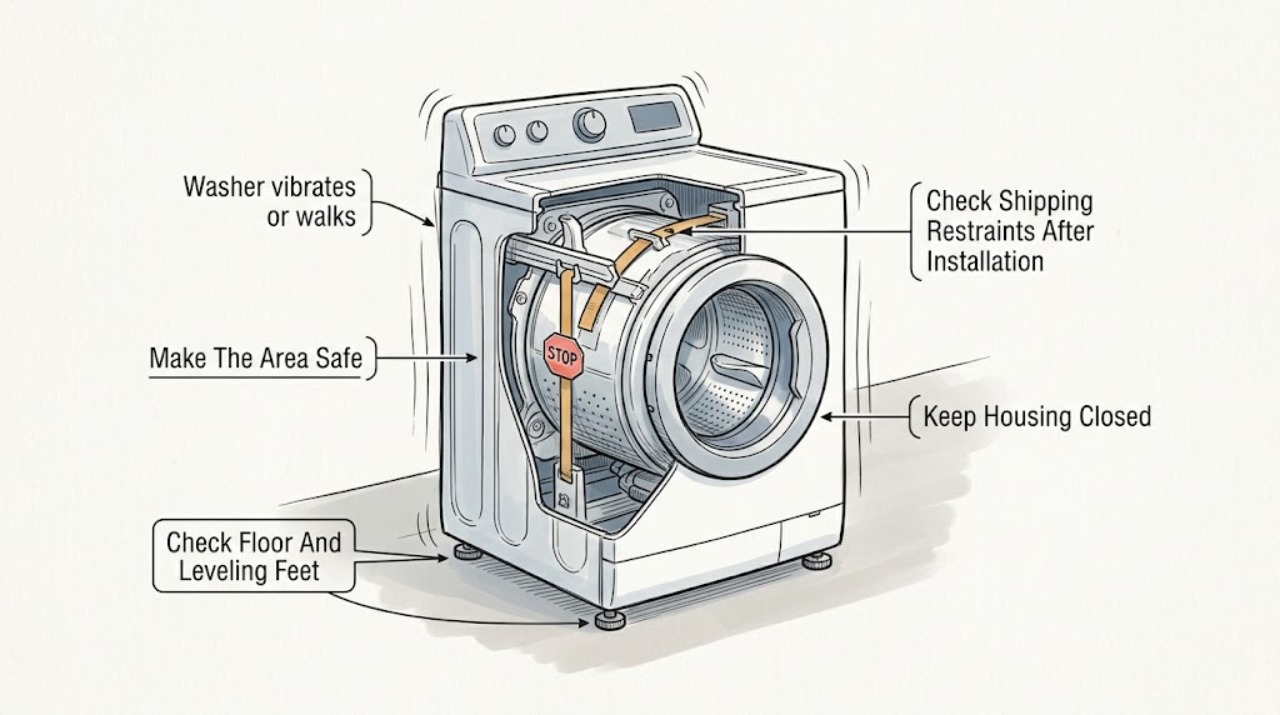
An LG washer that vibrates or walks is most often reacting to an unbalanced load, an unleveled or slippery installation, or shipping restraints left in place after installation. Stop the cycle if the machine is moving violently, and do not reach into a moving drum. With the tub stopped and empty, record whether the washer is front-load or top-load, whether it was recently installed or moved, and whether an LG UE or Ub code appears. For a recent installation, check the exact model's shipping-bolt and packing-material instructions. Then check the floor, all leveling feet, and diagonal rocking, redistribute a suitable load, and run the model-approved rinse-and-spin test. If it still walks with an empty or balanced test load, makes a new grinding or banging sound, or shows damage, arrange qualified LG appliance service instead of opening panels or guessing at suspension or drive parts.
Before you begin
Safety first
- This article supports stopped-machine observation, model-approved external installation checks, safe load redistribution, and a controlled test only. A qualified technician must handle internal panels, suspension or drive diagnosis, energized electrical work, damaged wiring, structural instability, and any lift or tilt that cannot be done safely.
Work through in order
Diagnostic checks
Use only checks that match the exact appliance or system and its official guide.
-
Check 1
Press Pause or otherwise stop the cycle using the normal controls, wait for the drum or basket to stop, and keep people and pets clear. Record the LG model number, front-load or top-load layout, cycle, approximate load, whether the washer was recently installed or moved, and any UE, Ub, or other displayed code.
Expected result: The washer is stable when stopped, or it rocks, leans, has a damaged cord or hose, leaks, shows a damaged cabinet, or has a burning smell, smoke, sparks, or a loud new mechanical sound. Note whether movement occurs during wash, acceleration, or high-speed spin and whether it happens on every load.
Next step: If a hazard is present, keep the washer off and arrange qualified appliance service. Otherwise continue only with the tub stopped and use the recorded model to select LG instructions; do not force a door or lid open.
Stop if: Stop immediately for smoke, sparking, a burning smell, a damaged cord, water near electrical parts, a leaking hose, cabinet damage, a loose structural part, or violent movement that could tip the washer.
Why this matters
Why: Violent movement or a visible electrical, water, or structural hazard is a stop-use condition, not a normal balance adjustment. Movement limited to certain loads or spin acceleration gives a useful comparison for the later load and installation checks.
-
Check 2
If the LG washer is front-load and was recently delivered, installed, or moved, inspect the rear only from a safe, stopped position for the model's shipping bolts and confirm that the packing material or tub-support block was removed as the exact installation guide shows. Open the door and observe whether the tub can move forward and backward as LG describes; do not tilt a heavy washer alone.
Expected result: The tub moves as expected and all model-specified restraints are removed, or the tub is held rigidly, a shipping bolt or packing block remains, the washer was moved without restraints being rechecked, or the material cannot be safely reached.
Next step: Follow the exact LG installation instructions to remove all specified restraints and install the supplied hole caps; use two-person handling or professional service when the washer must be tilted or a bolt cannot be safely removed. Retest only after the washer is stable.
Stop if: Do not reach under or tilt the washer alone, remove panels, cut packing from a moving tub, or use the washer with a known shipping restraint still installed.
Why this matters
Why: LG says retained shipping bolts or packing material can cause severe vibration and noise and can damage the washer. A restraint problem is more likely after a new installation or move than after a long period of stable operation.
-
Check 3
With the tub empty and the washer stopped, inspect the floor for dirt, moisture, softness, or a slippery surface. Press opposing diagonal top corners to check for rocking, look for a tub that leans to one side, and use a level if available. Adjust only the model's leveling feet as instructed, keeping all feet in firm contact with the floor and tightening the lock nuts or height-adjusting screws afterward.
Expected result: The machine rocks diagonally, one foot is not firmly down, the tub is off-center, the floor is wet or unstable, the feet are extended unusually far, or the washer is level and solid with no rocking.
Next step: Clean and dry the accessible floor, level front-to-back and side-to-side according to the model guide, tighten the locking hardware, and use an LG-approved non-skid solution when the floor is slippery. Do not use paper or loose wood as a permanent shim; arrange service if the floor or required adjustment is outside the installation instructions.
Stop if: Do not crawl under a running washer, lift it without suitable help, loosen feet beyond the model's limits, or place loose materials under the feet.
Why this matters
Why: A rocking chassis, off-center tub, loose lock nut, or poor floor contact supports an installation cause. LG says a hard, flat, level surface and firm foot contact reduce vibration; a slippery surface can let a balanced washer move. A stable empty installation makes load distribution or an internal fault more likely.
-
Check 4
After the washer is stopped and any water or door-lock behavior is handled by the model's normal controls, pause and spread the laundry evenly around the tub. Remove an excessive load, add compatible items when a single bulky item is the trigger, and choose a spin intensity suitable for the load; LG commonly illustrates loading around two-thirds of the tub so clothes can move freely.
Expected result: The load is a single heavy or bulky item, very small, tangled, overloaded, or visibly gathered on one side, or the load is evenly distributed and the washer still moves.
Next step: Run the same load only after it is evenly distributed and the washer is stable; compare the result with a light, balanced test load. Stop if the machine begins to walk violently or cannot safely pause and drain under its normal controls.
Stop if: Do not reach into a moving drum, hold the cabinet during spin, overload the washer to counterbalance a load, or use a damaged or waterlogged item that makes the machine unstable.
Why this matters
Why: A load that changes position or size with the symptom supports an imbalance rather than a failed part. LG links unsuitable amounts and uneven distribution to UE/Ub behavior and excessive vibration. Persistent movement with an evenly distributed, suitable load shifts attention back to level, floor, shipping, or service.
-
Check 5
Once shipping restraints, level, floor contact, and load distribution are addressed, run the exact LG model's documented rinse-and-spin or spin-only test with a light, balanced load. Observe from a safe position; do not add force or open the lid or door while the drum is moving.
Expected result: The test reaches spin without walking, rocks only with a particular load, still vibrates with the light balanced load, repeatedly displays UE/Ub, or produces scraping, grinding, banging, or a tub that remains off-center.
Next step: If stable, return to normal use while monitoring load type and floor movement. If the balanced test fails, stop repeated testing and give LG service the model, code, test load, movement timing, installation history, and photos of the feet and floor.
Stop if: Stop the test for violent movement, tipping, smoke, sparking, burning odor, water leakage, a damaged cord, or a new grinding or metal-on-metal sound.
Why this matters
Why: A quiet balanced test supports a load-specific cause. Repeated UE/Ub after level and distribution checks, or vibration on a balanced test, makes an installation limitation or mechanical/suspension issue more likely than ordinary laundry imbalance.
-
Check 6
Compare the before-and-after results and decide whether the symptom is resolved by an external correction or persists after the model-approved checks. Preserve the model number, displayed codes, installation date or move history, load type, floor and leveling observations, test result, and a short safe video or photo taken with the washer stopped if it helps describe the symptom.
Expected result: Movement stops after leveling or load redistribution, or it persists with an empty or balanced test, returns on every cycle, is accompanied by a new abnormal sound, or requires panel access or internal electrical diagnosis.
Next step: Use qualified LG appliance service for persistent or mechanical symptoms and provide the complete observation record. Do not order or install a part until the exact model and failed component are confirmed.
Stop if: Do not remove panels, bypass a lid or door lock, test energized wiring, reach beneath the chassis, or continue operating a washer that is unsafe or damaging the floor.
Why this matters
Why: A repeatable improvement after a load or installation correction supports that branch. Persistent empty-load movement, abnormal noise, or an internal access requirement cannot be safely assigned to a motor, bearing, shock, suspension, control, or other part from the symptom alone.
Use your observations
Decision map
Find the observation that best matches what you see, then follow the next safe action.
-
PATH 01Next step
What you see
The washer is level and stable when empty, movement occurs only with one blanket, jacket, single item, very small load, tangled load, or an overloaded load, and redistribution changes the result.
Do this next
Treat load distribution and spin selection as the leading cause. Use a suitable mixed load, spread items evenly, and monitor whether the washer remains stable; request service if the same problem starts with ordinary balanced loads.
-
PATH 02Next step
What you see
Walking began immediately after delivery, installation, or relocation, and a front-load tub is held unusually rigidly or a shipping bolt, retainer, foam block, or other packing material remains.
Do this next
Stop using the washer until all model-specified shipping restraints are removed by the documented safe method. Use two-person handling or qualified service if access or lifting is required, then re-level and test.
-
PATH 03Next step
What you see
The washer rocks when pressed diagonally, one foot is not firmly contacting the floor, the tub leans, the floor is wet or slippery, or movement improves after leveling and locking the feet.
Do this next
Correct the hard, flat, dry installation using the model's leveling procedure and any approved non-skid solution. If the floor cannot support stable contact or the washer still moves after correction, arrange professional assessment.
-
PATH 04Next step
What you see
The washer is level, shipping material is addressed, the load is suitable and evenly distributed, yet it still walks or vibrates during a light rinse-and-spin test, especially with repeated UE/Ub or an abnormal sound.
Do this next
Stop repeated testing and arrange qualified LG appliance service. The pattern can require diagnosis of suspension, bearings, tub support, drive, or control systems, but the symptom does not identify a replaceable part by itself.
-
PATH 05Next step
What you see
Movement is violent or worsening, the cabinet or floor is being damaged, a cord or hose is compromised, water is near electrical parts, or smoke, sparks, burning odor, tipping, or metal-on-metal noise is present.
Do this next
Keep people away, stop using the washer, and seek qualified appliance service; use the appropriate emergency response for smoke, fire, or an electrical hazard. Do not restart it to collect more evidence.
Helpful context
Understand the symptom
Separate a load problem from an installation problem
Note when the movement occurs. A washer that is stable with ordinary loads but shakes with one blanket, a single heavy item, a very small load, or tangled laundry points first toward load distribution. Movement on most loads, especially immediately after delivery or a move, makes leveling, shipping restraints, the floor, or the installation setup more likely. An LG UE, Ub, or similar balance indication is a clue to compare load, level, and cycle rather than proof that a particular part has failed. The exact front-load or top-load manual controls details that differ by model.
Use a safe test to narrow the cause
Make observations with the washer stopped and the tub empty when checking level or shipping material. LG's vibration guidance uses a light test load and a rinse-and-spin or spin test after the installation checks. A stable test with a normal load but movement only on a particular item supports an imbalance; movement with an empty or balanced test points away from ordinary laundry distribution and toward installation or a mechanical issue. Do not hold the washer, push it during spin, or continue a violent cycle to collect more evidence.
Do not treat walking as permission to repair the suspension
Leveling feet, shipping restraints, floor contact, and load balance are ordinary external checks. A recurring empty-load vibration, a tub that sits off-center after leveling, scraping or grinding, a loose part, or a failure that began without an installation change can require internal diagnosis. LG's support guidance directs service when the vibration remains after the documented checks. Do not remove panels, reach below a running washer, bypass a safety device, or order a suspension, bearing, motor, or control part without the exact model and a confirmed diagnosis.
Safety boundary
Stop conditions
- Stop the cycle and keep clear for violent movement, tipping, worsening walking, cabinet damage, or a floor that is being damaged.
- Stop using the washer for smoke, sparks, burning odor, a damaged power cord, water near electrical parts, or a leaking hose or cabinet.
- Do not reach into a moving drum or basket, hold the washer during spin, open a locked door or lid by force, or bypass a safety lock.
- Do not tilt or lift a washer alone, crawl beneath it, remove panels, test live wiring, or diagnose internal suspension, bearing, motor, or control parts without qualified service.
- Do not leave known shipping restraints installed or use loose paper, wood, or improvised materials as a permanent leveling repair.
Only after diagnosis
Potential parts
- leveling foot or locking hardware
Consider only if a confirmed model-specific foot or locking nut is damaged or missing after the washer has been safely leveled; a loose adjustment alone is not proof that a new part is needed.
Confirm the complete LG model and the exact installation or parts documentation before ordering; do not substitute a loose shim or generic hardware. - shipping-bolt or packing-material replacement set
Relevant only when the exact model requires a missing transport restraint for a future move or a documented restraint component is damaged; shipping bolts left in during operation must be removed, not replaced as a running repair.
Confirm the exact LG model and installation guide; do not operate with transport restraints installed and do not infer fit from appearance. - suspension or tub-support component
Consider only after qualified diagnosis finds persistent vibration with a level installation, removed shipping material, and a suitable balanced test load, or identifies a damaged suspension or tub-support component.
Suspension and tub-support parts vary by model and configuration; verify the exact LG model and technician diagnosis before ordering. - bearing or drive-system component
Consider only if service confirms an abnormal mechanical sound, excessive play, or a drive-related fault; walking by itself does not identify a bearing or motor failure.
Use the exact model and confirmed failed component for fitment; internal repair and electrical diagnosis are professional work.
When checks do not resolve it
Need a professional?
Arrange qualified LG appliance service when the washer still vibrates or walks with a level installation, removed shipping material, and a suitable balanced test load; when UE/Ub repeats after the documented checks; when there is a new grinding, scraping, or banging sound, a tub that remains off-center, floor or cabinet damage, or a symptom that requires panel or electrical access. Provide the exact model, installation or move history, cycle and load pattern, displayed code, level and foot observations, and a safe stopped-machine photo or video.
Safety scope: This article supports stopped-machine observation, model-approved external installation checks, safe load redistribution, and a controlled test only. A qualified technician must handle internal panels, suspension or drive diagnosis, energized electrical work, damaged wiring, structural instability, and any lift or tilt that cannot be done safely.
Common questions
FAQ
Why does my LG washer walk only during spin?
High-speed spin magnifies an unbalanced load, a rocking chassis, poor foot contact, or a slippery floor. With the washer stopped, check level and load distribution, then use the exact model's controlled rinse-and-spin test. Persistent movement with a suitable balanced load needs service.
Can an LG washer vibrate because it is not level?
Yes. LG says a hard, flat, level installation with all feet firmly contacting the floor helps reduce vibration. Check diagonal rocking with the tub empty, adjust only the model's leveling feet, and tighten the locking hardware.
Should I remove shipping bolts from an LG washer?
If a recently installed or moved front-load LG still has its model-specified shipping bolts or packing material, follow the exact installation instructions to remove them before operation. Do not tilt the washer alone or run it with a known restraint installed.
Does a UE or Ub code mean the LG washer is broken?
Not by itself. LG links UE/Ub behavior to load distribution, load amount, and leveling. Redistribute a suitable load and check level first; if the code returns with a balanced, level test, arrange service rather than guessing at a part.
Will non-skid pads stop an LG washer from walking?
LG notes that some floors are too slippery to hold the washer during an unbalanced load and suggests non-skid pads. Correct leveling and load balance first, and use only a compatible installation solution; pads do not repair a damaged floor or internal fault.
When should I stop using a vibrating LG washer?
Stop for violent or worsening movement, tipping, smoke, sparks, burning odor, water near electrical parts, a damaged cord or hose, floor or cabinet damage, or a new grinding or metal-on-metal sound. Keep clear and arrange qualified appliance service.
Read the exact guide
Official sources
- [Installing LG top load washing machine] How can I level the washing machine and adjust the level?LG USA Support · LG USA top-load leveling guidance; the article states it is created for all models and images or content may differ by product.
- LG Washer – Troubleshooting Vibration IssuesLG USA Support · LG USA support guidance for LG washers; images and exact steps can differ by model and installation configuration.
- Front Load Washer – Troubleshooting a UE/Ub Error CodeLG USA Support · LG USA front-load washer UE/Ub guidance; code behavior and controls can vary by exact model.
- LG washer - How to Level an LG Front Load Washing MachineLG USA Support · LG USA front-load leveling guidance; use the exact model's installation instructions where details differ.
Community feedback
Share a repair observation
Share a plain-text repair observation. Accepted observations are published automatically; this page may take a moment to update.