
On this page
Start here
Quick answer
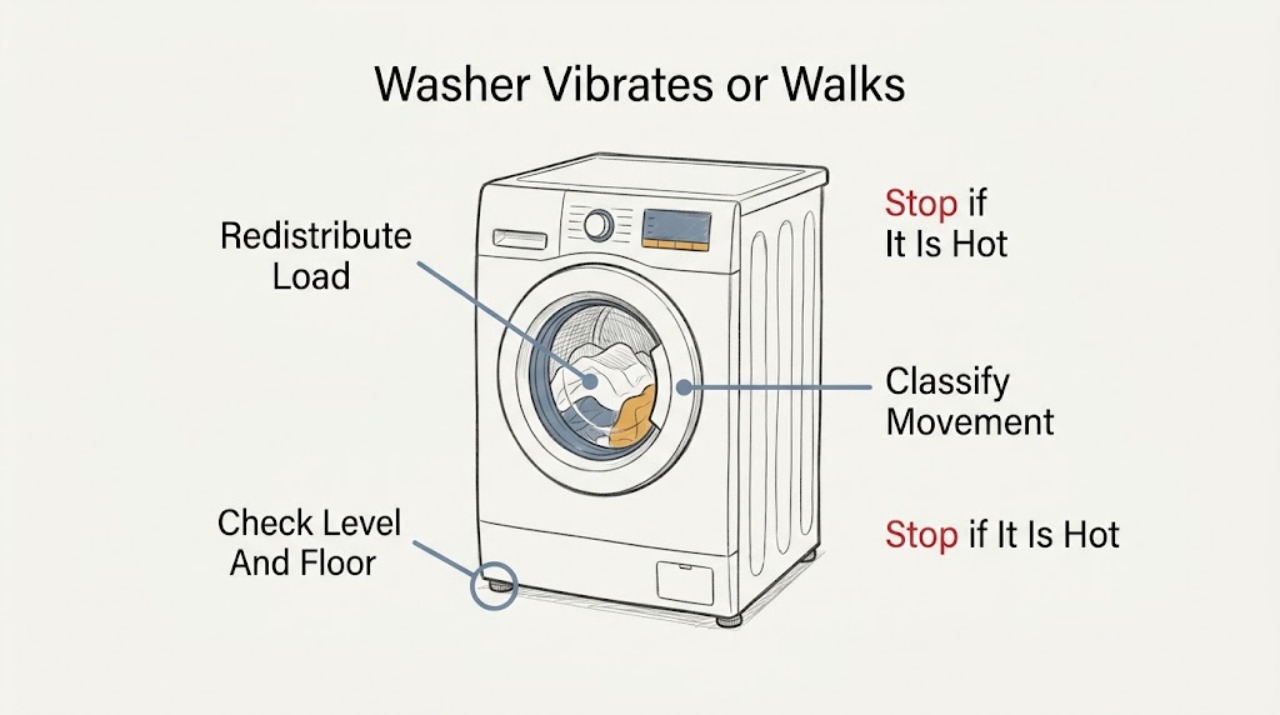
If a Hotpoint washer vibrates or walks, stop the cycle and first note whether the movement occurs during fill, agitation, drain, or spin, and whether the tub is empty or carrying a single, bulky, or tangled load. Redistribute the laundry, check from outside that the washer is level on a solid floor, and look for an object or drain hose striking the cabinet. If the washer was recently installed or moved, confirm the exact model's shipping material was removed according to its installation instructions. Do not tip or drag the appliance to inspect underneath. If it still moves with a balanced load on a stable floor, if the basket bangs violently, the floor flexes, a balance component may be damaged, or the machine leaks or makes a new mechanical sound, stop using it and arrange qualified Hotpoint appliance service.
Work through in order
Diagnostic checks
Use only checks that match the exact appliance or system and its official guide.
-
Check 1
From a safe, dry position, record the Hotpoint model number, load type and size, cycle stage, and whether the washer vibrates, rocks, walks, bangs, or pauses; note whether the tub is empty or loaded when it happens.
Expected result: Movement occurs only during spin, occurs during several stages, started after a move or installation, or comes with a leak, code, scraping, grinding, or burning odor.
Next step: Stop the cycle normally and continue only with external observations that fit the symptom. Keep a short video from a safe distance if it can be recorded without approaching the moving appliance.
Stop if: Stop immediately for smoke, burning odor, arcing, an uncontrolled leak, a damaged cord or outlet, violent impacts, or a washer that is moving toward a wall, edge, or person.
Why this matters
Why: Spin-only movement favors load distribution, level, floor, hose contact, or balance-system checks. A new noise or a condition present with an empty tub is less likely to be a simple laundry imbalance. A safety symptom is not a setup problem to test repeatedly.
-
Check 2
Pause through the normal control, wait for the tub to stop, and spread the laundry evenly. Check for one heavy item, a tightly tangled bundle, a small or single load, or bulky, waterproof, rug-like, or blanket-like items gathered on one side.
Expected result: The laundry is clearly concentrated on one side, the washer settles after redistribution, or the load is even but the movement continues.
Next step: Use the model's appropriate cycle and spin setting for the load and make one supervised observation. Do not hold the tub, add water, or repeatedly restart an unstable cycle.
Stop if: Do not open a locked lid or door, reach into a moving tub, add a loose object as a counterweight, or continue with violent banging or a washer that walks.
Why this matters
Why: An uneven or unsuitable load can make a washer vibrate more and may prevent a stable spin. If an even load still causes walking, the washer's level, floor, installation, hose contact, or internal balance system becomes more important.
-
Check 3
With the tub stopped, check from the outside whether the Hotpoint washer rocks when gently pressed at stable upper corners and whether it sits on a solid, non-flexing floor; do not tip or pull it to inspect underneath.
Expected result: The washer rocks while empty, a leveling foot appears not to contact the floor, the floor flexes during operation, or the cabinet is stable and level.
Next step: If the exact installation instructions assign leveling to the user, adjust only the accessible feet as directed and verify that the washer no longer rocks while stopped. Request service for a flexing floor, pedestal concern, or any need to move the appliance.
Stop if: Do not place hands under the washer, tip it, loosen structural hardware, stack objects under a foot, or continue with a rocking machine or unstable pedestal.
Why this matters
Why: An unstable base can make ordinary spin forces look like a load fault. A stable empty washer makes a recurring movement problem more likely to involve installation, hose contact, suspension or balance components, or another service issue.
-
Check 4
If the vibration began after delivery, installation, or a move, compare the visible installation with the exact Hotpoint model instructions and confirm that any required shipping material was handled as directed before the washer was placed.
Expected result: The washer was recently moved, shipping material may remain, the installation record is unknown, or the washer has been in the same position without a recent change.
Next step: Use the model installation guide or the installer to verify the shipping-material procedure; do not remove hidden material, move the washer, or improvise a lifting method from this article.
Stop if: Do not tip, drag, lift, or open panels to inspect shipping hardware, and stop if the washer is trapped against plumbing, a wall, or another appliance.
Why this matters
Why: Official GE Appliances support says shipping material left in place or mishandled during a move can cause noise and vibration. An unchanged installation shifts attention toward load, level, hose, floor, or internal diagnosis.
-
Check 5
From a safe adjacent position, listen and look for the drain hose or another loose external item striking the cabinet during drain or spin; inspect only what is visible without reaching behind or beneath the washer.
Expected result: The vibration is synchronized with a hose knock, a loose visible item touches the cabinet, or no external contact is visible.
Next step: Secure only an obviously loose hose according to the model installation instructions, then make one supervised observation. Arrange service if the hose cannot be reached safely or the movement remains.
Stop if: Do not pull the appliance, disconnect hoses, reach behind a running washer, or continue after a hose leak, wall-fitting damage, or violent movement.
Why this matters
Why: A hose that is not secured can create banging that sounds like an unbalanced tub. If there is no visible contact, walking may still come from level, load, floor, installation, or an internal fault.
-
Check 6
After the safe external checks, run one supervised cycle or spin observation with a suitable, evenly distributed load as the exact Hotpoint manual directs, watching from outside for movement, noise, and hose contact.
Expected result: The washer remains stable, moves only with a particular load, walks while empty or balanced, makes a new mechanical sound, or the floor or plumbing moves with it.
Next step: Stop after that result and provide the model, load, cycle stage, installation history, leveling result, hose observation, and video or sound description to qualified Hotpoint appliance service.
Stop if: Do not repeat the test for violent movement, a leak, grinding, scraping, burning odor, smoke, arcing, a damaged cord, or an appliance that leaves its safe position.
Why this matters
Why: A problem limited to a specific load supports an imbalance or cycle-load explanation. Movement with a balanced or empty tub, persistent walking after leveling, or a new mechanical sound needs professional diagnosis rather than a guessed balance ring, suspension, motor, or foot replacement.
Use your observations
Decision map
Find the observation that best matches what you see, then follow the next safe action.
-
PATH 01Next step
What you see
The washer moves only during spin with a single, bulky, tangled, or uneven load and settles after the laundry is redistributed.
Do this next
Use the model's suitable cycle and spin setting, then monitor one balanced load. Request service if the same movement returns with ordinary loads or the machine walks.
Why this path and its safety boundary
Why it matters: Load distribution is more likely than a failed internal component.
-
PATH 02Next step
What you see
The washer rocks while stopped, a foot is not firmly seated, or the floor flexes when spin begins even with a balanced load.
Do this next
Follow only the exact model's safe leveling instructions. Do not tip or move the appliance; request service or site assessment for a flexing floor, pedestal, or inaccessible foot.
Why this path and its safety boundary
Why it matters: Leveling, the floor, or an unstable pedestal is more likely than laundry alone.
-
PATH 03Next step
What you see
Walking began after delivery or a move and the shipping-material procedure or installation record is unknown.
Do this next
Have the installer or qualified service provider verify the exact model installation. Do not open the cabinet or improvise a lift to inspect hidden shipping parts.
Why this path and its safety boundary
Why it matters: Installation or shipping material is more likely than a sudden suspension failure.
-
PATH 04Next step
What you see
A repetitive knock occurs during drain or spin and the visible drain hose moves against the cabinet or is unsecured.
Do this next
Secure only the visible hose arrangement allowed by the installation guide, then make one supervised check. Stop for a leak or any need to pull the washer out.
Why this path and its safety boundary
Why it matters: Hose contact can create the reported banging even when the tub load is balanced.
-
PATH 05Next step
What you see
The washer walks with a balanced or empty tub, movement remains after safe leveling and installation checks, or there is violent vibration, a leak, smoke, burning odor, or a new mechanical sound.
Do this next
Keep the washer off, keep people away, and arrange qualified Hotpoint appliance service with the full observation record.
Why this path and its safety boundary
Why it matters: An internal balance, suspension, drive, floor, or electrical problem is possible; the symptom does not identify a part and continued testing can worsen damage or injury risk.
Helpful context
Understand the symptom
Pinpoint when the Hotpoint washer moves
Movement during a fill, agitation, drain, or spin has different clues. A brief click or pause can be part of a model's transition or load sensing, while walking, repeated banging, or a cabinet that shifts across the floor is not something to ignore. Record the exact model, load type, cycle stage, and whether the behavior began after installation or a move.
Balance, level, and floor are separate checks
A load can gather on one side even when the washer itself is level. Conversely, an empty washer can rock because a foot is not set correctly or the floor flexes. Hotpoint models can differ in suspension and control behavior, so redistribute the load first, then assess the stable machine from the outside rather than choosing a suspension part from a symptom.
Recent installation and hose contact deserve their own branch
A washer moved without the required shipping material procedure, or with a drain hose striking the rear cabinet, can vibrate or bang even when the load is ordinary. Use the exact installation instructions for the model. Do not pull the washer out alone, tip it, or reach behind a moving appliance to confirm a suspected problem.
Safety boundary
Stop conditions
- Stop immediately for smoke, burning odor, arcing, a damaged cord or outlet, an uncontrolled leak, violent impacts, or a washer moving toward a person, wall, or edge.
- Stop for a washer that walks with an empty or balanced tub, an unstable floor or pedestal, a trapped object, or a new grinding or scraping sound.
- Do not tip, drag, lift, or place hands under the washer; do not reach behind a running appliance or open panels as a user test.
- Stop after one supervised observation if the washer still vibrates or walks after safe load, level, installation, and hose checks; arrange model-specific service.
When checks do not resolve it
Need a professional?
Arrange qualified Hotpoint appliance service when the washer walks with a balanced or empty tub, rocks after safe leveling, continues to vibrate after load redistribution, or has a suspected installation, suspension, balance, drive, or floor problem. Service is also needed for violent banging, a leak, grinding or scraping, smoke, burning odor, electrical symptoms, or any inspection requiring the appliance to be moved or opened.
Common questions
FAQ
Why does my Hotpoint washer walk only during spin?
Start with load distribution, then check whether the washer rocks while stopped and whether the floor is solid. A single, bulky, or tangled load can become unbalanced, but movement with a balanced load points toward level, installation, hose contact, floor, or service concerns.
Can a Hotpoint washer vibrate because it is not level?
Yes. Official support says a washer should sit level and not rock while stopped. Use only the exact model's leveling instructions; do not tip or move the appliance as a casual test.
Could the drain hose make a Hotpoint washer sound like it is banging?
Yes. An unsecured drain hose can strike the cabinet during drain or spin. Inspect it only from safe access and follow the model installation guide; do not pull the washer out to reach it.
When should I stop using a Hotpoint washer that vibrates or walks?
Stop for violent movement, a washer that leaves its safe position, a leak, grinding or scraping, smoke, burning odor, arcing, a damaged cord, or movement that continues with a balanced or empty tub. Arrange qualified appliance service rather than choosing a part from the symptom.
Read the exact guide
Official sources
- Washer - Leveling the LegsGE Appliances (Hotpoint official support) · Official GE Appliances leveling guidance; procedures differ by washer age, type, and model, so use the exact Hotpoint instructions.
- Washer - Vibration Control TechnologyGE Appliances (Hotpoint official support) · Official GE Appliances explanation of optional vibration-control systems; not every Hotpoint model includes the same technology.
- Top Load Washer - Noises Heard During AgitationGE Appliances (Hotpoint official support) · Official GE Appliances noise guidance with model-specific examples; do not generalize a model-specific sound to every Hotpoint washer.
- Top Load Washer - Walking or VibratingGE Appliances (Hotpoint official support) · Official GE Appliances support page for top-load washer walking or vibration; confirm the exact Hotpoint model installation instructions before acting.
- Washer - Banging Noise During Spin CycleGE Appliances (Hotpoint official support) · Official GE Appliances hose-noise guidance; the installed Hotpoint model's installation instructions control hose routing.
Community feedback
Share a repair observation
Share a plain-text repair observation. Accepted observations are published automatically; this page may take a moment to update.