
On this page
Start here
Quick answer
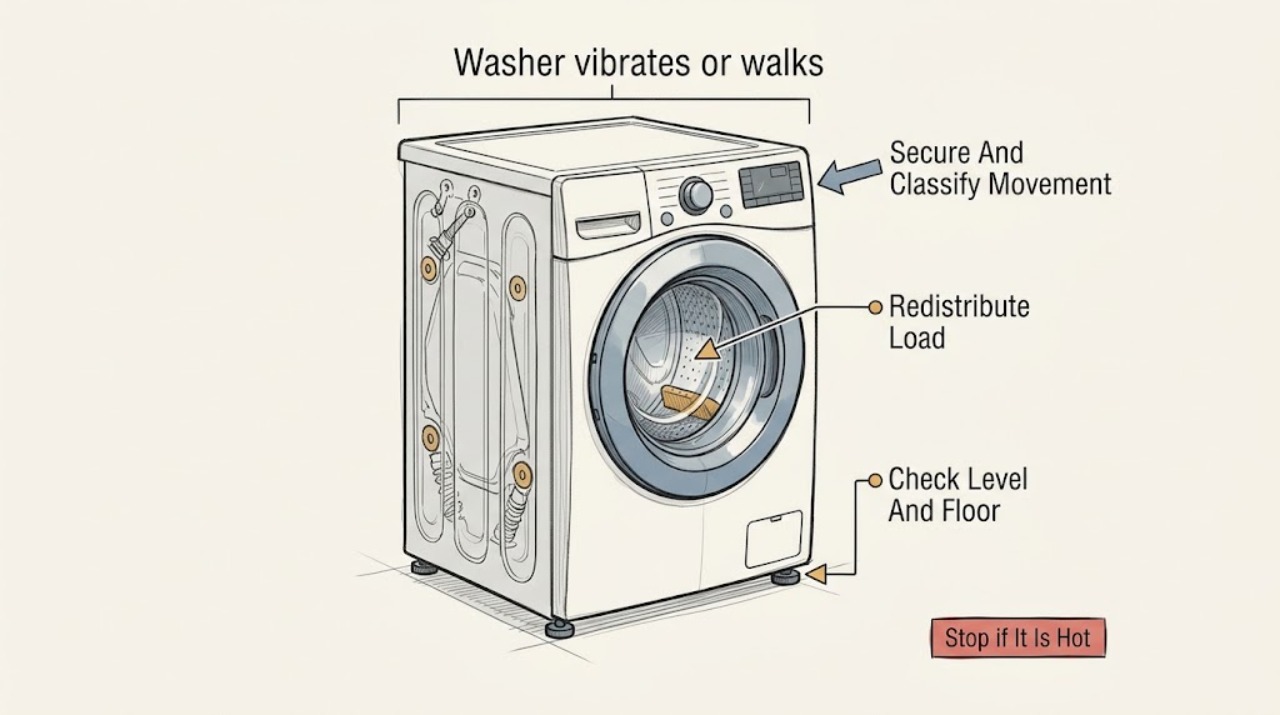
Stop an Electrolux washer that walks toward its hoses, wall, or electrical connections. After all motion stops, first separate an uneven or bulky load from an installation problem: redistribute the load, check that every foot rests firmly on a solid level floor, and for a recently installed front-load machine verify that shipping materials and bolts were removed. A stacked unit also needs the correct kit, feet, and brackets. A drain hose that slaps the cabinet can add knocking but does not explain a washer that moves across the floor. Run only one model-permitted supervised test after a safe correction. If the machine still vibrates or walks when empty or balanced, bangs, scrapes, leaks, or moves into its connections, keep it out of service and arrange qualified appliance service; do not open the cabinet or assume a suspension part is the cause.
Work through in order
Diagnostic checks
Use only checks that match the exact appliance or system and its official guide.
-
Check 1
Pause or turn off the washer and wait until the tub stops completely. From a safe position, record whether the cabinet rocks, slides, or walks, the cycle stage, load type, and whether it is moving toward hoses, the wall, or an electrical connection. Look for leaks, smoke, burning odor, a hot cord, or metal impact.
Expected result: Movement occurs only during spin, follows a bulky or small load, starts after installation or moving, occurs even when empty, or is accompanied by impact or a hazard.
Next step: Keep the washer off for violent movement, impact, smoke, burning odor, a hot or damaged cord, a leak, or movement into a connection. Otherwise continue with the load and installation checks only after all motion stops.
Why this matters
Why: Spin-only movement supports a load-balance or leveling path; a new-installation symptom raises shipping or installation questions. Empty-drum movement or movement into connections is not a normal load adjustment, and a hazard requires stop-use action.
-
Check 2
After the tub is stationary and the door or lid is unlocked, inspect the load for one heavy item, a bulky or waterproof item, a tightly packed drum, or clothes gathered on one side. Redistribute evenly; do not reach into a moving tub or continue with a load that already caused violent movement.
Expected result: The washer settles after redistribution, the noise occurs only with one bulky item, the load is very small or very large, or the washer still moves with an even load.
Next step: Run one suitable, supervised load only if the washer is stable and dry. Stop for repeated walking, cabinet impact, or movement that remains after a balanced load, and arrange service.
Why this matters
Why: Electrolux associates heavier loads and imbalance with thumping and vibration. Improvement after redistribution supports a load cause; persistent movement with an even load shifts attention to level, floor, shipping, stacking, or suspension.
-
Check 3
With the washer empty and stable, check from outside that the floor is solid and that every washer foot contacts it firmly without rocking. Inspect for carpet, loose flooring, a slippery or damaged surface, or a leg that is visibly loose; do not pull the appliance across connected hoses or a power cord.
Expected result: The cabinet rocks at one corner, the floor flexes or is unstable, one foot does not contact the floor, or the washer is firm but still vibrates.
Next step: Use only the exact model's leveling procedure and have assistance for movement. Do not improvise a platform or keep running the washer while a foot is unstable; arrange service if leveling cannot be safely corrected or vibration persists.
Why this matters
Why: A rocking cabinet or unstable floor can amplify spin vibration independently of the laundry. A firm, stable installation with continued movement makes a load-independent mechanical or suspension issue more likely.
-
Check 4
If the washer is newly installed, recently moved, or stacked, check the exact Electrolux installation information for remaining shipping material or bolts, a correctly installed stacking kit, fully seated feet, and tight visible brackets. Do not remove restraints or dismantle a stacked appliance without the model procedure and safe assistance.
Expected result: Shipping material or bolts remain, stacking hardware or brackets are loose, the feet are not seated, or the installation appears correct but walking continues.
Next step: Use the matching Electrolux installation procedure or return the issue to the installer. Keep the washer off if hardware is loose, the unit is unsafe to move, or the symptom remains after a correct installation.
Why this matters
Why: Shipping restraints can prevent the suspended tub from moving as designed, and stacked or loose installation hardware can transfer vibration into the cabinet. Correct installation with persistent walking points beyond these checks.
-
Check 5
With the washer stopped, inspect from outside for a drain hose slapping or rubbing the cabinet, a power cord or water hose pulled tight, or the cabinet contacting a wall or pedestal. Do not stretch, pinch, or disconnect a hose to make room.
Expected result: A hose or cord is visibly striking the cabinet, the washer is contacting a wall or accessory, or no external contact explains the movement.
Next step: Restore safe clearance and secure only accessible hose routing as the installation instructions permit. Stop and arrange service for strained connections, a leak, or movement that continues without external contact.
Why this matters
Why: External contact can create knocking or rattling and may worsen as the cabinet vibrates, but it does not explain a washer that walks with clear space and a balanced load. Tight or strained connections add water or electrical risk.
-
Check 6
Record the complete Electrolux model, washer style, load, cycle stage, floor and foot result, shipping or stacking result, hose-contact result, and whether a single model-permitted supervised test changed the movement. Do not run further tests if the washer bangs, scrapes, leaks, or walks toward a connection.
Expected result: Movement disappears after a safe load or installation correction, returns with an empty or balanced drum, or cannot be evaluated without opening the cabinet.
Next step: Leave the washer out of service for persistent, worsening, or unsafe movement and provide the recorded pattern to qualified appliance service. Do not order suspension rods, shock absorbers, or leveling feet based only on the symptom.
Why this matters
Why: A corrected imbalance or installation issue can explain the symptom. A repeat empty-drum vibration or inaccessible mechanical issue is more likely to involve suspension, leveling hardware, or the drive system, but observation cannot confirm a part.
Use your observations
Decision map
Find the observation that best matches what you see, then follow the next safe action.
-
PATH 01Next step
What you see
Do this next
Use a suitable balanced load and stop if walking, cabinet impact, or repeated imbalance returns. Do not add random weight to a washer that is already unstable.
-
PATH 02Next step
What you see
Do this next
Use only the exact model's leveling instructions and get assistance for movement. Arrange service if the floor or feet cannot be safely corrected or the washer still walks.
-
PATH 03Next step
What you see
Do this next
Keep the washer off and use the model installation procedure or installer to verify the setup. Do not dismantle a stacked unit or move it while connected.
-
PATH 04Next step
What you see
Do this next
Restore clearance and secure only visible hose routing under the installation guidance. Stop for a leak, strained connection, or movement that persists after clearance is restored.
-
PATH 05Next step
What you see
Do this next
Stop immediately, keep clear until motion ends, and isolate power only from a safe dry location. Close water valves when safe and arrange qualified service or emergency help as appropriate; do not restart or open the cabinet.
Helpful context
Understand the symptom
A washer that walks needs a pause before diagnosis
Stop the cycle and wait until the tub is fully stationary. Note whether movement begins only in spin, follows one bulky load, began after installation or moving, or occurs even when the washer is empty. Keep the appliance from pulling on its water hoses, drain hose, or power cord.
Balance and installation are different branches
A load concentrated on one side can create a repeatable spin thump, while an unlevel floor or foot can let the whole cabinet rock. Shipping restraints and loose stacked hardware are especially relevant after installation. Correct only the condition the exact Electrolux instructions describe; do not move a heavy washer with connected services.
Stop for impact, damage, or unsafe movement
Do not continue operating a washer that bangs, scrapes metal, leaks, smells burned, smokes, trips protection, or walks into a wall, hose, cord, or outlet. Keep hands away from moving parts and leave cabinet, motor, and suspension work to qualified service.
Only after diagnosis
Potential parts
- washer suspension rods
Consider this only after qualified diagnosis confirms a suspension fault causing persistent vibration with a balanced load and correctly leveled installation.
Suspension design and fit vary by model. Confirm the complete Electrolux model and manufacturer's fit information before ordering. - washer shock absorbers
Consider this only after service confirms a worn or damaged shock absorber rather than an uneven load, floor, foot, shipping restraint, or stacking condition.
Shock-absorber type and mounting vary by model. Confirm the complete Electrolux model and qualified diagnosis before ordering. - washer leveling feet
Consider this only when a model-specific inspection confirms a damaged or unadjustable foot after the floor and installation have been checked.
Foot threads and locking hardware vary by model. Confirm the complete Electrolux model and installation guidance before ordering.
When checks do not resolve it
Need a professional?
Arrange qualified service for persistent vibration with a balanced or empty drum, repeated walking after safe load and leveling checks, shipping or stacking hardware that cannot be safely corrected, suspected suspension damage, or any issue requiring cabinet access. Treat movement into connections, smoke, burning odor, a hot cord, metal contact, or a leak as immediate stop-use conditions.
Common questions
FAQ
Why is my Electrolux washer walking during spin?
An uneven or bulky load, unlevel feet or floor, shipping restraints, or loose installation can make a washer move. Stop and wait for the tub to stop before redistributing the load or checking leveling.
How do I rebalance an Electrolux washer?
Pause the washer and wait until the tub is fully stationary and unlocked. Redistribute clothing evenly, but stop using it if it already walked violently, hit the cabinet, or continues to move with a balanced load.
Can an unlevel floor make an Electrolux washer vibrate?
Yes. Electrolux says the washer should rest firmly on a solid, level floor with each foot contacting it. Use only the exact model's leveling procedure and do not improvise a platform.
Could shipping bolts cause my new Electrolux washer to shake?
Yes. Electrolux lists shipping materials and bolts as installation checks for a newly installed noisy washer. Verify them with the model installation instructions or installer before running more cycles.
Why does my washer knock even when it is not badly unbalanced?
A drain hose can slap or rub the cabinet, and a cord, wall, pedestal, or stacking hardware can also contact the cabinet. Restore clearance without moving a connected appliance, and arrange service if movement continues.
Should I run an empty Electrolux washer to test vibration?
Only after the tub is stopped and the machine has no leak, metal contact, burning odor, smoke, or violent movement. A safe empty comparison can show whether laundry caused the sound; persistent movement needs service.
Do I need new suspension rods or shock absorbers?
Not based on walking alone. First separate load balance, floor and feet, shipping restraints, stacking hardware, and external contact. Persistent movement with a balanced or empty drum needs qualified diagnosis before choosing a part.
When should I stop using an Electrolux washer that vibrates?
Stop for violent walking, repeated banging, metal scraping, movement into hoses or electrical connections, smoke, burning odor, a hot cord, or a leak. Arrange qualified service for persistent vibration after safe load and installation checks.
Read the exact guide
Official sources
- Is it normal for my washer to make sounds or noises?Electrolux · Electrolux guidance on load-related thumping, foreign objects, and empty-load comparison
- Laundry Washers Noises GuideElectrolux · Electrolux guidance for all laundry washers, including vibration, shaking, load balance, leveling, shipping materials, stacked units, and drain-hose contact
- Laundry front loading washer is leaking water.Electrolux · Electrolux front-load washer water and hose safety when vibration is accompanied by a leak
Community feedback
Share a repair observation
Share a plain-text repair observation. Accepted observations are published automatically; this page may take a moment to update.