
On this page
Start here
Quick answer
When an Amana washer will not start, first confirm that the selected cycle is valid, the Start control is being held as the model requires, and the lid or door is fully closed and latched. Then check the control-lock or delay state, household power, and both water valves. A lid-lock light, control-lock indication, or an exact code changes the next step; do not bypass the interlock or copy another model's button sequence. From a dry, safe location, use only the model-authorized power reset once if no water or electrical hazard is present. If the washer remains unresponsive, the latch will not engage, a code returns, water is flooding or near electrical parts, smoke or burning odor appears, or the breaker trips repeatedly, stop and arrange qualified appliance service.
Before you begin
Safety first
- Keep the washer off for wet electrical areas, flooding, uncontrolled water, smoke, burning or electrical odor, arcing, shock, hot connections, damaged cord, or repeated breaker trips. Do not open the cabinet, bypass an interlock, or repeat start tests.
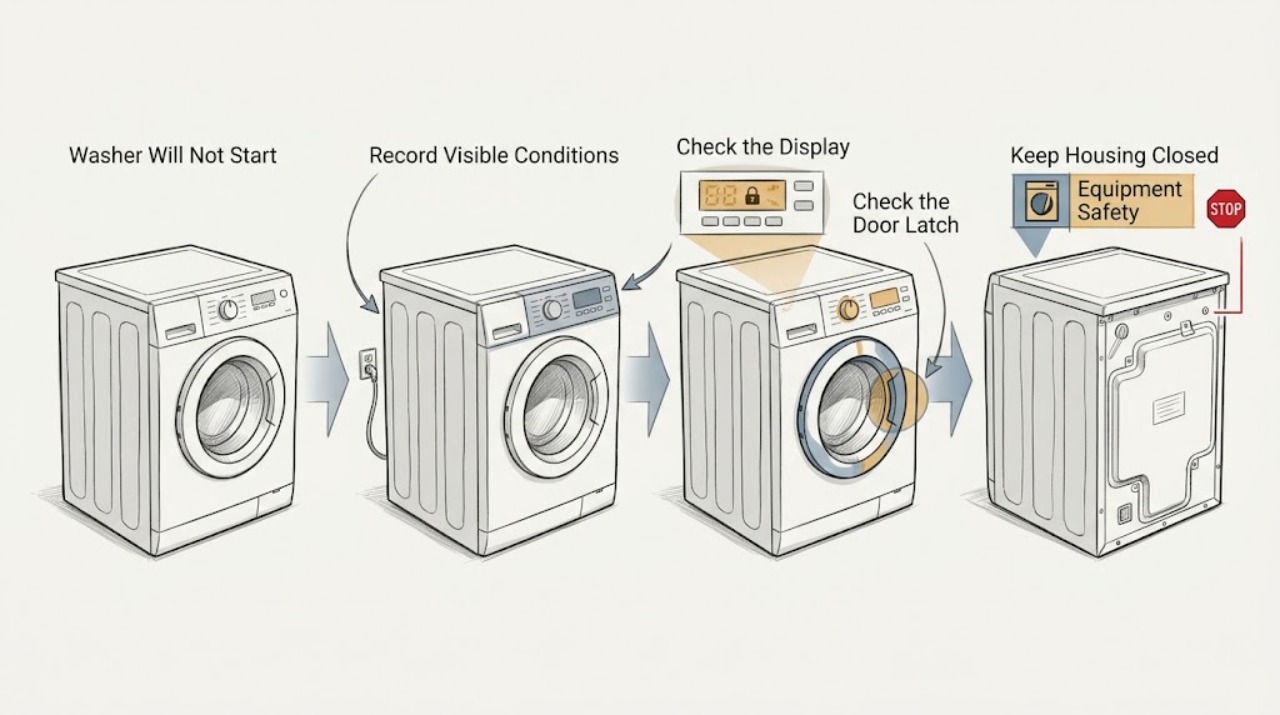
Work through in order
Diagnostic checks
Use only checks that match the exact appliance or system and its official guide.
-
Check 1
Stop pressing controls and inspect from a dry, safe position. Record whether the display or status lights are blank, whether the washer makes any sound, the exact model and washer style, the selected cycle, and whether there is water near the cord, outlet, controls, or floor.
Expected result: The appliance or floor is wet, the cord or outlet is damaged or hot, smoke or burning odor appears, the breaker trips repeatedly, or water enters without stopping.
Next step: Stop immediately, keep clear, and isolate power or water only from a dry, safe location. Arrange qualified appliance or emergency help; do not touch a wet plugged-in appliance or restart it.
Why this matters
Why: This is an electrical, fire, flooding, or water-damage condition, not a routine start-setting problem.
-
Check 2
Use the exact Amana manual to confirm that the selector is aligned with a real cycle, Delay Start is not active, the Start or Push to Start control is being pressed and held as required, and Control Lock is not indicated. Do not copy a control sequence from another model.
Expected result: The selector is between cycles, Start was tapped rather than held, a delay or control lock is active, the controls do not respond, or no setting explains the no-start.
Next step: Clear only the model-documented delay or lock state and start the selected cycle once. If the panel remains unresponsive or the no-start returns, leave the washer off and arrange service.
Why this matters
Why: A control state can prevent a cycle from beginning without a failed motor or water valve. A normal selection with an unresponsive panel points toward power, control, or service.
-
Check 3
From a dry position, check that the lid or front door closes fully and that no clothing, lint, detergent residue, shipping material, or other visible object blocks the latch or striker. Do not force the door/lid, insert an object into the lock, or reach into a moving basket.
Expected result: The lid/door is not fully closed, the lock light flashes, an obstruction is visible, the latch does not click or engage, or the lid/door appears normal but the washer still will not start.
Next step: Remove only a loose visible obstruction and clean the external contact area with the model-approved mild method. Try once as the manual directs; arrange service for a damaged latch, returning indication, or unexplained failure.
Why this matters
Why: A closure or obstruction can prevent the safety interlock from authorizing operation. A clean, correctly closed lid/door with a returning lock indication suggests a latch, sensor, wiring, or control fault.
-
Check 4
Check household power from a dry position: look for normal room power, a tripped breaker or GFCI, and a securely seated washer plug. Do not use an extension cord, open the outlet, increase a fuse rating, or unplug while standing in water.
Expected result: The washer has no power, the breaker or GFCI is tripped, the plug or outlet is loose/hot/damaged, or power appears normal but the washer remains blank.
Next step: Have a qualified person address a recurring breaker, GFCI, hot outlet, or damaged connection. If power is normal but the panel is blank, leave the washer off and arrange appliance or electrical service.
Why this matters
Why: A household supply issue can mimic a failed washer. A normal supply with a blank panel makes the cord, internal control, or wiring more likely and requires service.
-
Check 5
From a dry position, verify that the hot and cold household water valves are open and that the hoses are connected to the correct marked inlets without visible kinks or damage. Do not loosen a pressurized hose or move the washer to reach a wet connection.
Expected result: A valve is closed, a hose is kinked or damaged, the washer was recently installed or moved, the water supply is unavailable, or supply appears normal.
Next step: Open a closed valve or correct only a clearly visible safe hose route. Have installation or plumbing checked for a supply problem; arrange appliance service if the external supply is normal or damaged.
Why this matters
Why: Some Amana models require water available before the cycle can operate correctly. A normal supply with no start shifts attention back to control, latch, power, or internal faults.
-
Check 6
If the exact manual authorizes a power reset and there is no water or electrical hazard, disconnect power once from a dry, safe location for the manual's stated interval, reconnect, and start the correct cycle once. Record any code or light pattern; do not repeat resets or use a live electrical test.
Expected result: The washer starts once, remains blank, shows a lid/control/error indication, or the same no-start condition returns.
Next step: Keep the washer off for a returning fault and give service the model, display, cycle selection, latch behavior, power result, and water-supply observations.
Why this matters
Why: A reset can clear a temporary control state but cannot repair a failed interlock, control, power path, or installation problem. Recurrence is evidence for service.
Use your observations
Decision map
Find the observation that best matches what you see, then follow the next safe action.
-
PATH 01Next step
What you see
The panel is blank, the outlet has no power, or a breaker/GFCI has tripped, with no wet appliance or damaged connection.
Do this next
Have a qualified person restore or diagnose the circuit. Do not increase fuse capacity, open the outlet, or repeatedly reset a tripping breaker; use appliance service when household power is normal but the washer remains blank.
Why this path and its safety boundary
Why it matters: A household power or connection issue is more likely than a washer control fault.
-
PATH 02Next step
What you see
The panel responds, but the selector is not on a valid cycle, Delay Start or Control Lock is active, or Start was not held as the model requires.
Do this next
Clear only the exact model state and start once. If the control does not respond or the condition returns, request service rather than repeating button sequences.
Why this path and its safety boundary
Why it matters: A user-control state is preventing the cycle from beginning.
-
PATH 03Next step
What you see
The lid/door is open or obstructed, the lock light flashes, or the model cannot confirm the latch after a correct closure.
Do this next
Remove only a loose visible obstruction and follow the model manual. Do not bypass or pry the lock; arrange service for a returning lock indication, damaged latch, or failed closure.
Why this path and its safety boundary
Why it matters: The safety interlock is withholding operation or may be failing.
-
PATH 04Next step
What you see
The washer has power and a normal control state, but a supply valve is closed, a hose is restricted, or the unit was recently installed or moved.
Do this next
Correct only a safe visible valve or hose condition and have the installation checked if needed. If both supplies are normal and the washer still will not start, arrange appliance service.
Why this path and its safety boundary
Why it matters: Water availability or installation may be preventing the cycle from operating correctly.
-
PATH 05Next step
What you see
Power, selection, supply, and lid/door state are normal, but the washer remains unresponsive or the same error returns after one model-authorized reset.
Do this next
Keep the washer off and arrange qualified Amana service. Provide the full model, code or light pattern, selected cycle, latch behavior, and reset result; do not open panels or test live parts.
Why this path and its safety boundary
Why it matters: An internal control, wiring, interlock, timer, or other component fault is possible and cannot be confirmed safely from outside.
Helpful context
Understand the symptom
Start by separating a no-start from a no-fill or no-spin
If there are no lights or sounds, begin with power and the control state. If the display responds but the cycle does not begin, check selection, Start-button behavior, Control Lock, Delay Start, and the lid or door. If the washer begins sensing, fills, or pauses, it has started and needs a different diagnosis. Amana publishes separate guidance for top-load and front-load washers, so model identity matters.
The lid or door is an operating interlock
A lid or door can look closed without engaging its latch, and clothing, lint, detergent residue, or packing material can interfere with the striker or lock. Some Amana models perform a brief lock self-test after Start; a click or slight basket movement may be normal. Never pry, hold, or bypass the interlock.
Power and water checks have a safe boundary
Check the breaker, outlet, and supply valves only from a dry position and without opening the washer. A missing water supply can keep some models from operating correctly, while a wet appliance, hot connection, damaged cord, or repeated breaker trip needs service. Internal controls, wiring, latch parts, and power tests are not owner-level checks.
Safety boundary
Stop conditions
- Stop immediately for a wet floor or appliance near electrical parts, a hot or damaged cord/outlet, smoke, burning or electrical odor, arcing, shock, uncontrolled water, or repeated breaker trips.
- Do not touch or unplug a wet plugged-in washer, open the outlet, test live wiring, bypass a lid/door interlock, pry a locked door, or reach into a moving basket.
- Do not move the washer across a wet floor or connected hose, loosen a pressurized connection, or use another Amana model's code, reset, latch, or timer procedure.
- Use only one model-authorized reset from a dry, safe location. If the washer remains blank, the latch fails, a code returns, or the no-start repeats, stop and arrange service.
Only after diagnosis
Potential parts
- lid or door interlock
Consider this only when the lid or door closes correctly but the exact model still cannot confirm the latch or returns a lock indication after the visible obstruction check.
Interlocks vary by Amana washer style and model. Confirm the exact model and service diagnosis before selecting a part. - start control or timer
Consider this professional-repair category only when power, selection, lock, and supply are normal and qualified diagnosis identifies a failed start-control or timer path.
Controls and timers are model-specific and require matching service documentation; do not replace them based on a no-start symptom alone. - water inlet valve or hose
Consider this only when the washer's no-start or no-fill behavior is linked by qualified diagnosis to a damaged hose or inlet valve after household supply is confirmed.
Inlet parts differ across Amana washer styles and models. Confirm exact fitment and the model's installation requirements. - control board or wiring
Consider this professional-repair category only when the panel, power path, latch, and supply checks are normal but qualified testing identifies an internal control or wiring fault.
Electrical parts are model-specific and require qualified diagnosis; do not perform live tests or select by appearance.
When checks do not resolve it
Need a professional?
Arrange qualified Amana or appliance service when the washer remains unresponsive after the exact model's power, selection, control-lock, lid/door, and supply checks; the latch will not engage; an error or light pattern returns; the panel is blank with normal household power; or the issue involves internal wiring, the timer, control, sensor, or interlock. Use electrical service for a household circuit problem and plumbing/installation service for a supply issue. Treat wet electrical parts, flooding, smoke, arcing, shock, or repeated breaker trips as immediate safety issues.
Safety scope: Keep the washer off for wet electrical areas, flooding, uncontrolled water, smoke, burning or electrical odor, arcing, shock, hot connections, damaged cord, or repeated breaker trips. Do not open the cabinet, bypass an interlock, or repeat start tests.
Common questions
FAQ
Why will my Amana washer not start?
Check household power, a valid cycle selection, Start-button behavior, Control Lock or Delay Start, and the lid or door latch. Then confirm water is available. If those states are normal and the panel or cycle remains unresponsive, internal control, wiring, or interlock service is needed.
Does the Amana washer Start button need to be held?
Some Amana models require the Start or Push to Start control to be held for the model's documented interval. Check the exact manual and do not keep pressing a control that remains unresponsive or shows an error.
Why is the lid-lock light flashing on my Amana washer?
The lock may not be engaging because the lid is not fully closed or an item, lint, or detergent buildup is interfering with the striker. Clear only a loose visible obstruction and follow the model manual; never bypass the lock, and arrange service if the indication returns.
Should I reset an Amana washer that will not start?
Use a reset only when the exact Amana manual or support page authorizes it and the appliance is dry and free of electrical or water hazards. A reset can clear a temporary control state, but a blank panel, failed latch, returning error, or repeated no-start needs service.
Read the exact guide
Official sources
- Not Starting or Not Operating - Front Load Washer - Product HelpAmana · Amana front-load support page; code meanings and controls are model-specific.
- What’s Under the LidAmana · Specific Amana top-load owner manual; included to show model-specific lid, sensing, and start behavior, not a universal procedure.
- Lid Locking on a Top Load High Efficiency Washer - Product HelpAmana · Amana top-load high-efficiency guidance; features and operations vary by model.
- 6 THINGS YOU NEED TO KNOW IF YOUR WASHER WON'T STARTAmana · Amana consumer guidance; exact model instructions and safety conditions control.
- Lid Not Latching - Washer - Product HelpAmana · Amana top-load washer support page; latch positions and behavior vary by model.
- Not Starting - Washer - Product HelpAmana · Amana Product Help top-load washer page; exact model manual controls.
Community feedback
Share a repair observation
Share a plain-text repair observation. Accepted observations are published automatically; this page may take a moment to update.