
On this page
Start here
Quick answer
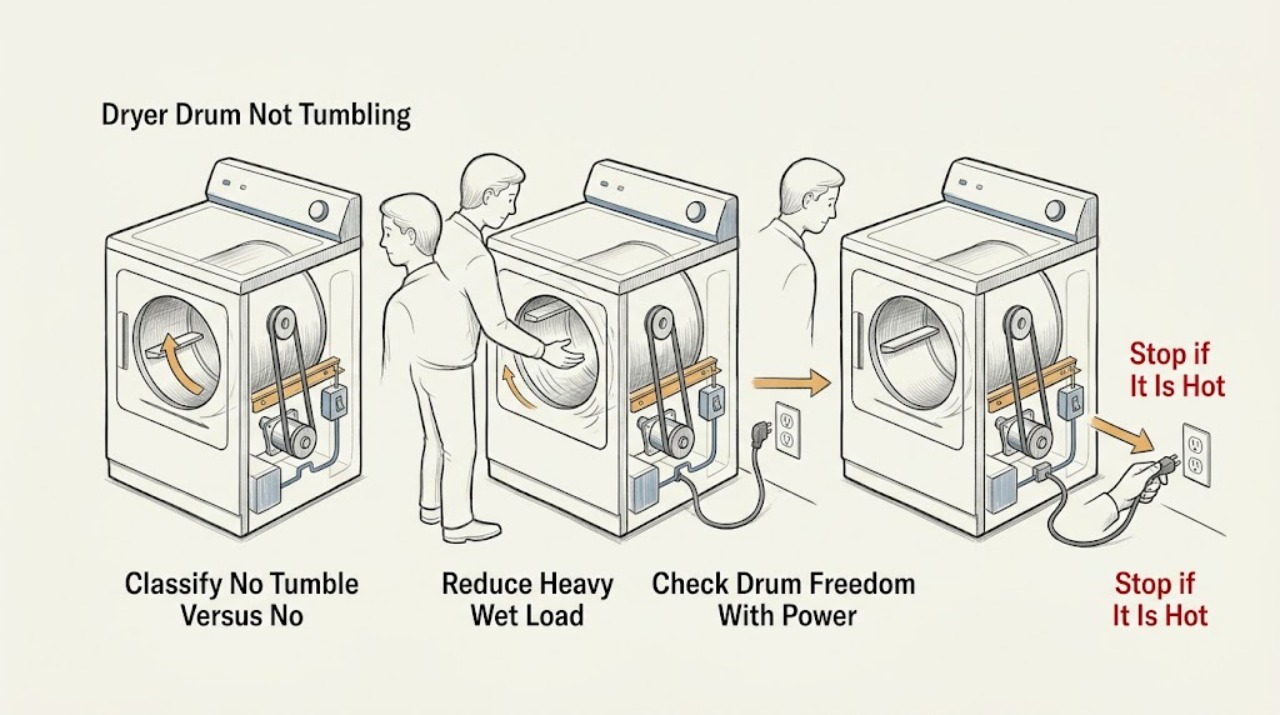
If a GE dryer runs but the drum is not tumbling, stop the cycle and remove part of a heavy, wet load before trying again. GE says an overloaded load can let the drive belt slip; if the drum turns unusually freely when the dryer is off and disconnected from power, the belt may be broken or loose and service is required. If the dryer does not start at all, check the closed door, selected cycle, fully pressed Start control, plug, and household breaker from outside the appliance. Do not open the cabinet, terminal block, motor area, or belt path. Stop using the dryer for a burning smell, smoke, scorched wiring, repeated breaker trips, scraping, a loose drum, or clothing catching at the drum edge. A persistent no-tumble symptom needs qualified GE appliance service to identify the belt, motor, idler, drum support, switch, or control fault.
Work through in order
Diagnostic checks
Use only checks that match the exact appliance or system and its official guide.
-
Check 1
From outside the dryer, note whether the display or controls respond, whether the motor or blower can be heard, whether the drum remains stationary, and whether the cycle stops shortly after starting. Check that the door is fully closed, the desired cycle is selected, and the Start control was pressed as the model manual describes. Do not reach through the door opening while the appliance is energized.
Expected result: The dryer starts and sounds active but the drum does not move, the dryer never starts, the door switch appears damaged, the control is unresponsive, or a breaker trips.
Next step: If the dryer runs without drum motion, stop the cycle and continue with the load and power-disconnected drum checks. If it will not start, check only the external plug, door, cycle, Start control, and household power; arrange qualified service for a damaged switch, wiring, or persistent no-start symptom.
Stop if: Do not keep restarting a dryer with smoke, burning odor, sparking, scorched wiring, a damaged door switch, or a repeated breaker trip.
Why this matters
Why: A running dryer with a stationary drum favors an overloaded or failed drive system. A no-start condition makes the door, cycle, Start control, plug, breaker, or control path more likely. A scorched switch, repeated breaker trip, or unresponsive control is not a routine load adjustment.
-
Check 2
Stop the dryer, open the door only after the drum and clothing have stopped, and remove part of a heavy, wet load. Close the door and select an appropriate cycle for the remaining load according to the GE manual. Do not force the drum or redistribute clothing while it is moving.
Expected result: The dryer tumbles with the smaller load, still starts without drum movement, makes a scraping or grinding sound, or stops again under a normal load.
Next step: Use properly sized loads if tumbling returns. If the drum remains still or the symptom recurs with a normal load, stop cycling and perform only the power-disconnected visual and hand-movement check described next; do not order a drive part from this result alone.
Stop if: Do not operate with a loose drum, scraping, grinding, burning odor, smoke, or clothing caught around the drum edge.
Why this matters
Why: Improvement after reducing a heavy wet load supports belt slip or load-related drive strain. No change with a normal load, abnormal mechanical noise, or repeated stopping makes belt, motor, idler, drum support, or control service more likely.
-
Check 3
Unplug the dryer from its power supply before maintenance, as GE directs. With the dryer empty, cool, and disconnected from power, gently turn the drum by hand only from the normal opening; do not remove a panel or reach into the belt or motor area. Notice whether the drum has ordinary resistance or turns unusually freely, feels loose, rubs, or catches.
Expected result: The empty drum turns unusually freely, feels loose or misaligned, rubs or catches, or has ordinary resistance but the powered dryer still will not tumble.
Next step: Leave the dryer disconnected and arrange qualified GE appliance service for free movement, rubbing, looseness, or persistent no-tumble operation. Give the technician the load condition, sounds, and whether the drum moved by hand.
Stop if: Do not open the cabinet, remove the drum, handle the belt or motor, or reconnect power to test a suspected belt or support failure.
Why this matters
Why: GE says a drum that turns freely may indicate a broken or loose drive belt and requires service. Rubbing, catching, or looseness can also indicate drum support or object interference. Ordinary resistance does not clear the motor, idler, belt, switch, or control because the drive can fail under power.
-
Check 4
For a dryer that does not start or tumble at all, inspect only the external plug and outlet fit, close the door firmly, verify the selected cycle and fabric or temperature setting, and press Start fully as the model manual describes. From outside the appliance, check whether the household breaker or fuse appears tripped; do not remove the power cord cover or terminal-block cover.
Expected result: The plug is loose, the door does not latch, the Start control or display responds only intermittently, a breaker trips, the outlet or cord shows heat or damage, or the external checks are normal.
Next step: Correct only a clearly loose plug or setting from outside the appliance. If the door switch, cord, outlet, breaker, or display remains abnormal, leave the dryer unused and arrange qualified appliance or electrical service. If external checks are normal but the drum remains still, return to the service boundary rather than opening the cabinet.
Stop if: Do not remove covers, touch terminal-block wiring, probe the outlet or dryer circuit, bypass the door switch, or repeatedly reset a tripping breaker.
Why this matters
Why: GE lists the plug, door, cycle setting, Start control, door switch, and household circuit as no-start checks. Heat, charring, loose wiring, intermittent controls, or repeated trips indicate an electrical or switch problem rather than a drum-load issue. Normal external checks shift attention to internal drive or control service.
-
Check 5
With the dryer stopped and disconnected from power, clean the lint filter and make a visual check that the rear vent hose is not kinked, collapsed, crushed, or visibly disconnected. Check the outside wall cap for a visible obstruction without entering the duct. Do not disconnect the vent to run a test on a gas dryer, and do not treat a vent check as permission to operate a dryer whose drum is not turning.
Expected result: Lint is packed on the filter, the hose is visibly restricted, the outside cap is blocked, the dryer is unusually hot, or the vent appears clear while the drum still will not tumble.
Next step: Correct a clearly accessible lint or external vent obstruction according to the GE installation guidance, then have the vent professionally cleaned when the duct is restricted. If the drum remains still, arrange appliance service for the drive system; never run a gas dryer without its approved vent.
Stop if: Do not run a gas dryer with the vent disconnected, operate through overheating or scorching, or open the cabinet to clean hidden lint around the motor or heater.
Why this matters
Why: GE explains that restricted airflow can increase heat and lint buildup and can contribute to poor drying or premature heater problems, but a clear vent does not repair a stationary drum. Overheating, scorching, or poor airflow increases the need to stop use while the drive fault is diagnosed.
-
Check 6
If the drum still does not tumble after a normal load and the external start checks, record the GE model number, whether the motor or blower runs, whether the empty drum turns freely or rubs by hand with power disconnected, any display message, and any scraping, grinding, burning, or stopping symptom. Keep the dryer unused until the drive and safety components are assessed.
Expected result: The dryer tumbles normally after reducing the load, or no-tumble operation persists with normal loading, free or rough drum movement, motor hum, no motor sound, a damaged switch, or an electrical symptom.
Next step: Use the dryer only when tumbling is restored without abnormal noise or heat. Otherwise arrange qualified GE appliance service and provide the model, load, sound, drum-movement, and power observations; do not choose a replacement part solely from the symptom.
Stop if: Do not run repeated cycles, remove panels, handle the belt or motor, or work on live electrical parts while pursuing the diagnosis.
Why this matters
Why: A corrected heavy-load symptom can be load-related, but persistent no-tumble operation requires diagnosis of the belt, motor, idler, drum support, door switch, control, or supply. The observation history helps service distinguish these possibilities without unsafe cabinet access.
Use your observations
Decision map
Find the observation that best matches what you see, then follow the next safe action.
-
PATH 01Next step
What you see
The dryer starts, a heavy wet load is present, and tumbling returns after part of the load is removed.
Do this next
Use appropriately sized loads and monitor for recurrence. If the drum stops again with ordinary loads, or scraping, burning, or loose movement appears, stop and arrange service for the drive system.
Why this path and its safety boundary
Why it matters: The improvement favors load-related drive strain or belt slip rather than a completely failed control path.
-
PATH 02Next step
What you see
With the dryer empty and unplugged, the drum turns unusually freely, feels loose, rubs, catches, or the clothing catches at the drum edge.
Do this next
Leave the dryer disconnected and arrange qualified appliance service. Do not remove the drum or attempt a belt or support replacement from a hand-movement check.
Why this path and its safety boundary
Why it matters: GE associates free drum movement with a loose or broken belt; looseness, rubbing, or catching can also involve drum supports or another internal mechanical condition.
-
PATH 03Next step
What you see
The controls do not start the dryer, the door does not latch, the Start control is intermittent, the plug or cord is damaged, or a breaker trips.
Do this next
Keep the dryer unused when damage or repeated trips are present and arrange qualified appliance or electrical service. Limit user checks to the external plug, door, cycle, Start control, and visible breaker status.
Why this path and its safety boundary
Why it matters: The pattern favors the door switch, control setting, plug, supply circuit, cord, or terminal connection rather than a drum-load problem.
-
PATH 04Next step
What you see
The motor or blower sounds active but the drum stays still with a normal load, or the dryer starts and stops with the drum stationary.
Do this next
Stop using the dryer and arrange qualified GE appliance service. Provide the load, sound, empty-drum movement, and any heat or odor observations without opening the cabinet.
Why this path and its safety boundary
Why it matters: The result makes the belt, idler, drum support, or another drive-path failure more likely than a simple cycle-selection issue, but sound alone cannot identify the failed component.
-
PATH 05Next step
What you see
The vent hose or wall cap is visibly restricted, lint is packed, the dryer is unusually hot, or scorching appears along with the no-tumble symptom.
Do this next
Stop the dryer, correct only an accessible lint or external obstruction, and arrange qualified vent or appliance service. Do not operate a gas dryer without its vent or continue through scorching.
Why this path and its safety boundary
Why it matters: Restricted airflow can increase heat and lint accumulation and may compound a mechanical failure; scorching or overheating changes the safety decision.
-
PATH 06Next step
What you see
There is smoke, a burning odor, sparking, scorched wiring, a repeated breaker trip, a loose drum, or clothing caught at the drum edge.
Do this next
Stop using the dryer and keep people away from it. Use local emergency guidance for smoke or fire and arrange qualified appliance or electrical service; do not restore power or restart it as a test.
Why this path and its safety boundary
Why it matters: This is an immediate appliance or electrical safety boundary, not a routine no-tumble adjustment.
Helpful context
Understand the symptom
Separate a no-tumble symptom from a no-start symptom
Listen and observe from a safe position: does the control panel start and the motor sound run while the drum stays still, or does the dryer never begin? A heavy wet load can overload the drive system, while a drum that turns unusually freely points more toward a loose or broken belt. A dark display, door-switch issue, control setting, or household power problem is a different path. The exact GE model manual controls cycle names and any model-specific display behavior.
Do not turn a belt check into a cabinet repair
GE's user-level guidance supports reducing the load, checking the door and controls, and observing how the drum behaves only after power is safely disconnected. Belt, motor, idler, drum support, terminal-block, and control work requires appliance service. Do not remove panels, reach around the drum, reconnect burned wiring, or run a gas dryer without its approved vent.
Only after diagnosis
Potential parts
- GE dryer drive belt
Consider this only after a qualified diagnosis confirms that the drum's free movement or persistent no-tumble symptom is caused by a loose or broken belt.
Drive-belt length and routing vary by GE model. Confirm the exact model and diagnosis before selecting a part or attempting installation. - GE dryer drum support or idler assembly
Consider this only when service inspection finds rubbing, catching, looseness, or a failed support or idler in the drum drive path.
Support and idler designs differ by model and require cabinet access. Have a qualified technician confirm the failed component and fit. - GE dryer door switch, motor, or control component
Consider this only after service diagnosis identifies a no-start, motor, switch, or control fault that remains after external plug, door, cycle, Start, and breaker checks.
Electrical and drive components are model-specific and require safe power isolation and testing. Do not infer the component from a no-tumble symptom alone.
When checks do not resolve it
Need a professional?
Arrange qualified GE appliance service when a normal load still will not tumble, the empty unplugged drum turns unusually freely or rubs, the motor runs without drum movement, the dryer starts and stops, the door switch or controls are damaged, or the problem persists after external plug, cycle, Start, and breaker checks. Arrange qualified vent service for a restricted duct or wall cap. Stop immediately for smoke, burning odor, sparking, scorched wiring, a repeated breaker trip, a loose drum, or clothing caught at the drum edge; use local emergency guidance for fire or immediate electrical danger. Do not remove panels, handle a belt or motor, open the terminal block, bypass the door switch, probe wiring, or run a gas dryer without its approved vent.
Common questions
FAQ
Why is my GE dryer running but the drum is not turning?
Stop the dryer and remove part of a heavy, wet load, then try an appropriate cycle. If the drum remains still with a normal load, unplug the cool, empty dryer and check whether the drum turns unusually freely or rubs. GE says free movement may indicate a loose or broken belt; persistent no-tumble operation needs qualified service.
What does it mean if the GE dryer drum turns freely by hand?
With the dryer cool, empty, and unplugged, unusually free drum movement can indicate a loose or broken drive belt. It can also accompany another internal mechanical problem. Do not remove the cabinet or belt; leave the dryer disconnected and arrange service.
Can an overloaded GE dryer stop the drum from tumbling?
Yes. GE notes that a heavy, wet load can cause the drive belt to slip. Remove part of the load and try again with an appropriate cycle. If the drum still does not move, or the problem returns with ordinary loads, the drive system needs diagnosis.
What should I check if my GE dryer will not start or tumble?
Check the external plug, closed door, selected cycle, fully pressed Start control, and household breaker as GE describes. Do not remove the cord cover, terminal-block cover, or cabinet. A damaged door switch, cord, outlet, intermittent control, or repeated breaker trip requires qualified service.
When should I call for GE dryer service for a no-tumble problem?
Arrange service when a normal load still will not tumble, the empty unplugged drum turns freely or rubs, the motor runs while the drum stays still, the door switch or controls are damaged, or the symptom returns. Stop immediately for smoke, burning odor, sparking, scorched wiring, repeated breaker trips, a loose drum, or clothing caught at the drum edge.
Read the exact guide
Official sources
- Dryer - Taking Too Long To Dry Clothes or Not Drying at AllGE Appliances · GE dryer load size, leveling, lint filter, venting, operating conditions, and power-isolation guidance
- Electric Dryer - Has No PowerGE Appliances · GE electric dryer household breaker and supply checks and service boundary
- Dryer - Clothes Catching Around Filter, Sensor or DrumGE Appliances · GE dryer clothing caught around the drum, filter, or sensor and service guidance
- Dryer - Will Not Run or StartGE Appliances · GE dryer no-start checks for plug, door, cycle, Start control, door switch, household circuit, and service boundary
- Dryer - Things To Check For A Venting IssueGE Appliances · GE dryer exhaust-hose, wall-cap, airflow, overheating, installation, and gas-dryer vent safety guidance
- Dryer - Drum Does Not TurnGE Appliances · GE dryer drum-not-turning diagnosis, overloaded loads, freely turning drum, belt implication, power isolation, and service guidance
Community feedback
Share a repair observation
Share a plain-text repair observation. Accepted observations are published automatically; this page may take a moment to update.