
On this page
Start here
Quick answer
Treat a burning smell from a GE dryer as a safety symptom first. Stop the cycle, remove the load only after the drum has stopped, and disconnect power when it is safe; do not run the dryer again while smoke, a strong or worsening smell, unusual heat, sparks, a damaged cord, or a gas odor is present. If the dryer is brand new and there is only a brief oily or dusty smell with no smoke or overheating, GE says initial oils or dust can cause it and describes a short empty run, but follow the exact model manual and stop if the smell persists. For an installed dryer, inspect and clean the lint filter and check the outside wall cap and accessible exhaust path for blockage without opening the cabinet. A yellow gas flame, a smell that returns, or a smell with scraping, a stalled drum, or electrical symptoms needs qualified appliance or electrical service; never operate a gas dryer with its vent disconnected.
Before you begin
Safety first
- This article supports only stopping the cycle, safe external observation, user-accessible lint-filter care, and visible external exhaust checks. Internal lint, heater, burner, drive, motor, blower, wiring, control, and gas-system work requires a qualified appliance, electrical, or gas professional with power and fuel isolated.
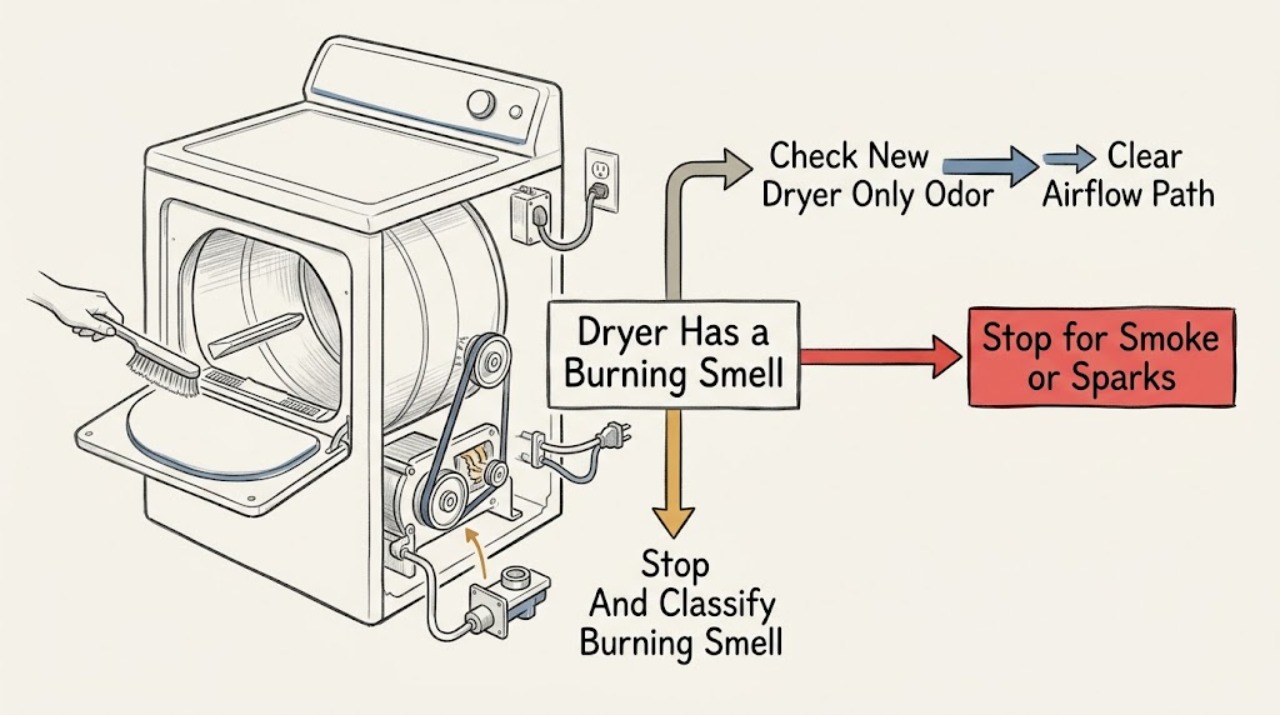
Work through in order
Diagnostic checks
Use only checks that match the exact appliance or system and its official guide.
-
Check 1
Stop the cycle and wait for the drum to stop before opening the door or removing clothes. From a safe position, note whether there is smoke, a strong or worsening odor, hot plastic or rubber smell, sparks, a hot plug or cord, unusual cabinet heat, visible lint, or a gas-like odor. Do not restart the dryer to reproduce the smell.
Expected result: The smell is brief and limited to first use, returns during every cycle, appears only when heat starts, follows drum motion, comes from the rear or cord, or is accompanied by smoke, heat, sparks, or gas odor.
Next step: Keep the dryer off and use only the safe filter and external vent checks below when no hazard sign is present. For any hazard sign, isolate the appliance if safe and arrange qualified service or emergency help as appropriate.
Stop if: Stop immediately for smoke, flames, sparking, a burning electrical odor, a hot or damaged plug or cord, a gas odor, or heat that is worsening; leave the area and contact appropriate emergency or gas help if there is an active fire or strong gas release.
Why this matters
Why: A brief first-use oily or dusty odor may fit GE's limited new-dryer explanation. A recurring smell, a location-specific smell, or an odor with heat or mechanical symptoms makes lint or airflow, drive friction, heater or burner, gas ignition, or electrical trouble more likely. Smoke, sparks, gas odor, or severe heat is an immediate stop condition.
-
Check 2
If the GE dryer is brand new or has just been installed, and there is no smoke, gas odor, unusual heat, electrical symptom, or visible lint, compare the smell with GE's description of a brief oily or dusty initial-use odor. Follow the exact model manual and use only the manufacturer's permitted empty-cycle guidance; do not place clothes in the test.
Expected result: The odor fades during the first permitted empty run, remains noticeable after initial use, returns on later cycles, or is stronger than a mild oily or dusty smell.
Next step: Stop using the dryer and arrange qualified appliance service if the odor persists or returns. Do not run an empty cycle at all when a hazard sign is present, and do not use this step to mask a lint, vent, gas, or electrical fault.
Stop if: Do not continue operating a new dryer that smokes, overheats, sparks, smells strongly of gas, or produces a burning electrical or plastic odor.
Why this matters
Why: A fading odor limited to initial operation can fit residue from assembly or dust. Persistence, recurrence, smoke, heat, or a rubber, plastic, electrical, or gas-like character is not established as normal by the new-appliance explanation.
-
Check 3
With the dryer off and power isolated when safe, clean the lint filter and inspect the accessible exhaust path and outside wall cap for lint, debris, crushed ducting, a blocked flap, or another visible obstruction. Keep clothing and other combustible material away from the dryer. Do not open the cabinet or dismantle the internal exhaust connection.
Expected result: The filter is packed with lint, the wall cap or accessible duct is blocked, the dryer case was hot or sweating, airflow is weak, or the accessible path is clear.
Next step: Clean the user-accessible filter and have a qualified person clean the interior and exhaust connection when lint accumulation is suspected. If the smell persists, stop use and arrange service rather than repeatedly running cycles.
Stop if: Do not operate without the lint filter, vacuum or clean inside the cabinet as an ordinary user task, use unapproved ducting, or keep running the dryer with restricted airflow or overheating.
Why this matters
Why: Lint or restricted exhaust can impair airflow, raise dryer heat, lengthen drying, and contribute to a burning or musty smell. A clear external path does not rule out lint inside the cabinet, a heater or burner problem, or a mechanical or electrical fault.
-
Check 4
For a gas GE dryer, identify whether the odor is gas-like rather than lint, rubber, or hot dust. From outside the appliance, note any abnormal flame indication only if it is already visible through the model's intended observation area; do not remove a panel, light a burner, adjust gas hardware, or disconnect the vent.
Expected result: There is a gas odor, the flame is yellow rather than the expected blue appearance with only a slight yellow tip described by GE, the vent is disconnected or damaged, or there is no gas-specific symptom.
Next step: Stop the dryer and obtain qualified gas or appliance service for a gas odor, abnormal flame, damaged vent, or recurring smell. Keep the vent connected on a gas dryer and do not attempt burner or ignition repair.
Stop if: If you smell gas strongly, do not operate electrical switches or create flames nearby; leave the area and contact the gas utility or emergency services according to local safety guidance.
Why this matters
Why: A gas odor, abnormal flame, or disconnected vent shifts the problem to a combustion, gas-supply, or exhaust-safety boundary. The absence of a gas symptom does not make a persistent burning smell safe; lint, airflow, mechanical, heater, and electrical causes remain possible.
-
Check 5
With the dryer unplugged and empty, note whether the drum turns smoothly by hand only when the model manual and access make that safe. From outside, record scraping, squealing, thumping, a stalled or slow drum, a motor hum, a hot rear connection, a tripped breaker, or an odor that follows drum movement or heat; do not remove panels.
Expected result: The drum is hard or rough to turn, the smell follows drum motion, the motor hums or stalls, the odor is concentrated at the rear or cord, or the dryer repeatedly trips a protective device.
Next step: Leave the dryer unplugged and arrange qualified appliance or electrical service. Provide the sound, odor location, drum-resistance result, cycle phase, and protective-device history.
Stop if: Do not touch wiring, probe live power, remove the cabinet, run with a panel removed, or force a drum that is hard to turn.
Why this matters
Why: A hard or noisy drum can make drive friction or a support, roller, belt, or motor issue more likely. A rear or cord odor or repeated trip raises an electrical connection or supply concern. These observations narrow the service diagnosis but do not identify a safe user replacement.
-
Check 6
If the smell persists after the safe filter and external checks, record the exact GE model and serial information from an ordinary-access label without moving or opening the dryer. Note whether it is gas or electric, the load and cycle, where the smell is strongest, and whether it occurs during startup, tumbling, heating, or cooldown.
Expected result: The odor returns, the dryer becomes unusually hot, the drum stops or makes noise, drying takes longer, a code or breaker trip appears, or the smell remains with an empty permitted test.
Next step: Keep the dryer off and arrange qualified appliance service; use a qualified electrician or gas professional when the evidence points to the supply, cord, outlet, gas odor, or flame. Do not resume normal laundry cycles while the smell is unexplained.
Stop if: Do not continue testing a persistent smell, and do not use the appliance if it is damaged, partially disassembled, missing parts, or has a damaged cord or plug.
Why this matters
Why: A recurring burning smell after accessible lint and airflow checks needs model-specific diagnosis. Possible categories include internal lint, restricted exhaust, drive friction, heater or burner, gas ignition, terminal or control connection, or another component; the odor alone cannot select a part.
Use your observations
Decision map
Find the observation that best matches what you see, then follow the next safe action.
-
PATH 01Safety boundary
What you see
Do this next
Follow the exact model manual and monitor the next normal use from outside. Stop and arrange service if the smell persists, returns, changes character, or is joined by heat or smoke.
Why this path and its safety boundary
Why it matters: This pattern is consistent with GE's limited explanation for residue or dust during initial operation, but it should not be used to explain a recurring or stronger odor.
Safety stop: Do not continue an initial-use test when smoke, flame, gas odor, strong burning plastic or electrical smell, or abnormal heat appears.
-
PATH 02Safety boundary
What you see
Do this next
Clean the accessible filter and have a qualified person inspect and clean the interior and exhaust connection. Keep the dryer off if the smell is strong or returns after the path is clear.
Why this path and its safety boundary
Why it matters: Restricted airflow or lint accumulation is more likely and can raise heat enough to create a burning or musty odor, but accessible cleaning does not rule out lint inside the cabinet.
Safety stop: Do not run with a missing filter, blocked vent, excessive heat, or unexplained burning odor, and do not disconnect a gas-dryer vent.
-
PATH 03Safety boundary
What you see
Do this next
Stop using the dryer, avoid flames and electrical switching if gas is strongly present, leave the area as needed, and contact the gas utility or emergency service for an active gas hazard; arrange qualified appliance service for the dryer.
Why this path and its safety boundary
Why it matters: A gas-supply, burner, ignition, combustion, or exhaust-safety issue is more likely than ordinary lint odor and requires professional handling.
Safety stop: Never light a burner, adjust gas components, operate a gas dryer without its vent, or keep testing a gas odor.
-
PATH 04Safety boundary
What you see
Do this next
Keep the dryer unplugged and arrange qualified appliance service. Do not open the cabinet or run the dryer to identify the rotating component.
Why this path and its safety boundary
Why it matters: Drive friction or a support, roller, belt, motor, or related mechanical issue is more likely than a new-appliance residue odor.
Safety stop: Stop immediately for worsening odor, smoke, heat, sparks, or a stalled drum, and do not attempt an internal belt or motor repair from the symptom alone.
-
PATH 05Safety boundary
What you see
Do this next
Leave the dryer disconnected and obtain qualified electrical or appliance service as indicated by the location. Provide the model, dryer type, smell timing and location, load, airflow observations, and any protective-device trip.
Why this path and its safety boundary
Why it matters: An electrical connection, supply, internal heater, control, lint, or another model-specific fault remains possible. A clear filter and vent do not make a persistent burning smell safe.
Safety stop: Do not reset a repeatedly tripping breaker, open electrical panels, touch wiring, or resume use while the smell is unexplained.
Helpful context
Understand the symptom
A burning smell is not automatically a harmless new-appliance odor
GE says a new gas or electric dryer can briefly smell oily or burning as assembly oils or dust burn off during initial operation. That narrow situation differs from a smell that is strong, recurring, accompanied by smoke or hot plastic, or first appears on an older appliance. Treat the latter as a possible lint, airflow, mechanical, gas, or electrical problem and keep the dryer off until the cause is checked.
Airflow and lint are safety checks, not a license to keep testing
A clogged lint filter, exhaust duct, or outside wall cap can restrict heat and air movement. Clean only the user-accessible filter and inspect accessible external vent areas without opening the cabinet. GE advises that the inside of the machine and the exhaust connection inside the dryer be cleaned by a qualified individual. Do not disconnect the vent on a gas dryer to experiment; combustion gases could enter the room.
The smell's location and timing guide the service handoff
A smell at the rear plug or cord, a smell that follows drum motion, and a smell that appears when heat starts are different clues. They can point toward a power connection, drive or support friction, airflow or lint, or the heater or burner, but an external smell report cannot identify a failed component. Give the technician the model, dryer type, location, timing, load, and observations rather than ordering a part from the odor alone.
Safety boundary
Stop conditions
- Stop the dryer immediately for smoke, flames, sparking, a strong gas odor, burning electrical or plastic smell, severe heat, a hot or damaged plug or cord, or an active fire; leave the area and contact appropriate emergency, gas, or electrical help.
- Do not keep running a dryer with an unexplained or recurring burning smell, even if the lint filter or visible vent appears clear; leave it disconnected until it is checked.
- Do not operate a gas dryer with the vent disconnected, light a burner, adjust gas hardware, bypass a safety device, or test live wiring.
- Do not open the cabinet, reach near the heater, burner, belt, motor, blower, or control, vacuum internal lint as an ordinary user task, or run with a panel removed.
- Do not operate without the lint filter or dry clothing contaminated with flammable liquids, solvents, oils, gasoline, or other combustible substances.
- Arrange qualified appliance service for a persistent odor, unusual heat, mechanical noise or stalled drum, internal lint concern, suspected heater or burner fault, or any odor that returns after the safe external checks.
Only after diagnosis
Potential parts
- dryer lint filter or exhaust component
Consider this category only if the exact model and service inspection confirm a damaged filter, defective accessible exhaust component, or model-specific airflow part after a blockage is identified.
Filter and exhaust designs vary by exact GE model; confirm the model and manufacturer's fit information before ordering. - dryer drum support, belt, idler, or motor
Consider this category only when a qualified technician confirms mechanical friction, a hard-to-turn drum, stalled tumbling, or a drive component fault rather than a lint or load condition.
Drive parts and repair procedures are model-specific; a burning smell alone cannot establish the failed component or fit. - dryer heater, burner, or electrical connection
Consider this category only after qualified appliance, electrical, or gas diagnosis identifies a heater, burner, terminal, control, wiring, or ignition fault associated with the odor.
Gas, electric, control, and connection assemblies require exact model matching and professional safety procedures; do not order or replace one from odor alone.
When checks do not resolve it
Need a professional?
Arrange qualified GE appliance service when a burning smell persists or returns, when the dryer is unusually hot, when the drum scrapes, stalls, or turns roughly, when lint may be inside the cabinet, or when filter and accessible vent checks do not resolve the odor. Use a qualified electrician for a hot or damaged plug, cord, outlet, breaker, repeated trip, or electrical smell; use gas-utility or emergency help for a strong gas odor, flame concern, smoke, or fire. Provide the exact model and serial information if safely visible, gas or electric type, cycle and load, smell character and location, timing, filter and vent observations, drum behavior, and any heat, spark, code, or protective-device history.
Safety scope: This article supports only stopping the cycle, safe external observation, user-accessible lint-filter care, and visible external exhaust checks. Internal lint, heater, burner, drive, motor, blower, wiring, control, and gas-system work requires a qualified appliance, electrical, or gas professional with power and fuel isolated.
Common questions
FAQ
Is a burning smell from a new GE dryer normal?
GE says a new gas or electric dryer may briefly smell oily or burning while assembly oils or dust burn off. That explanation does not cover smoke, severe heat, sparks, gas odor, a strong plastic or electrical smell, or an odor that persists or returns. Stop and arrange service when those symptoms occur.
Can lint cause a GE dryer to smell like it is burning?
Yes. GE says lint buildup can emit a burning or musty smell, and restricted exhaust can impair airflow and increase heat. Clean the user-accessible lint filter and inspect external vent areas, but have a qualified person clean suspected lint inside the machine or exhaust connection. Keep the dryer off if the smell persists or the case is unusually hot.
Should I disconnect the vent to test a GE dryer burning smell?
Do not disconnect the vent on a gas dryer; GE warns that combustion gases could enter the room. For an electric dryer, any model-approved vent test should be performed only when there is no odor, smoke, or overheating and only according to the exact manual. A burning smell is a reason to stop and arrange diagnosis, not to keep testing.
What if the burning smell is accompanied by a scraping or stalled drum?
Stop using the dryer and leave it unplugged when safe. A smell that follows drum motion, scraping, rough rotation, or a stall can make drive friction, a support, belt, motor, or another internal component more likely, but the odor alone cannot identify the part. Arrange qualified appliance service rather than opening the cabinet.
When is a GE dryer burning smell an emergency?
Treat smoke, flames, sparks, a strong gas odor, a hot or damaged plug or cord, severe heat, or an active fire as an immediate hazard. Stop the dryer, leave the area as needed, avoid flames and electrical switching around a strong gas odor, and contact appropriate emergency, gas, or electrical help. Do not restart the dryer.
Read the exact guide
Official sources
- Dryer - Hot to the Touch or SweatsGE Appliances · Manufacturer support article for GE dryers that become hot or sweat; used for accessible exhaust and wall-cap checks, airflow and heat interpretation, and the gas vent boundary.
- Important Safety InformationGE Appliances · GE dryer safety manual used for lint and combustible-material precautions, qualified internal cleaning, no-reach and no-panel work, gas ignition cautions, and power isolation before maintenance.
- Dryer - OdorGE Appliances · Manufacturer support article for GE dryer odors; used for the new-dryer versus persistent-odor distinction, lint-related odor, and gas-flame boundary.
Community feedback
Share a repair observation
Share a plain-text repair observation. Accepted observations are published automatically; this page may take a moment to update.