
On this page
Start here
Quick answer
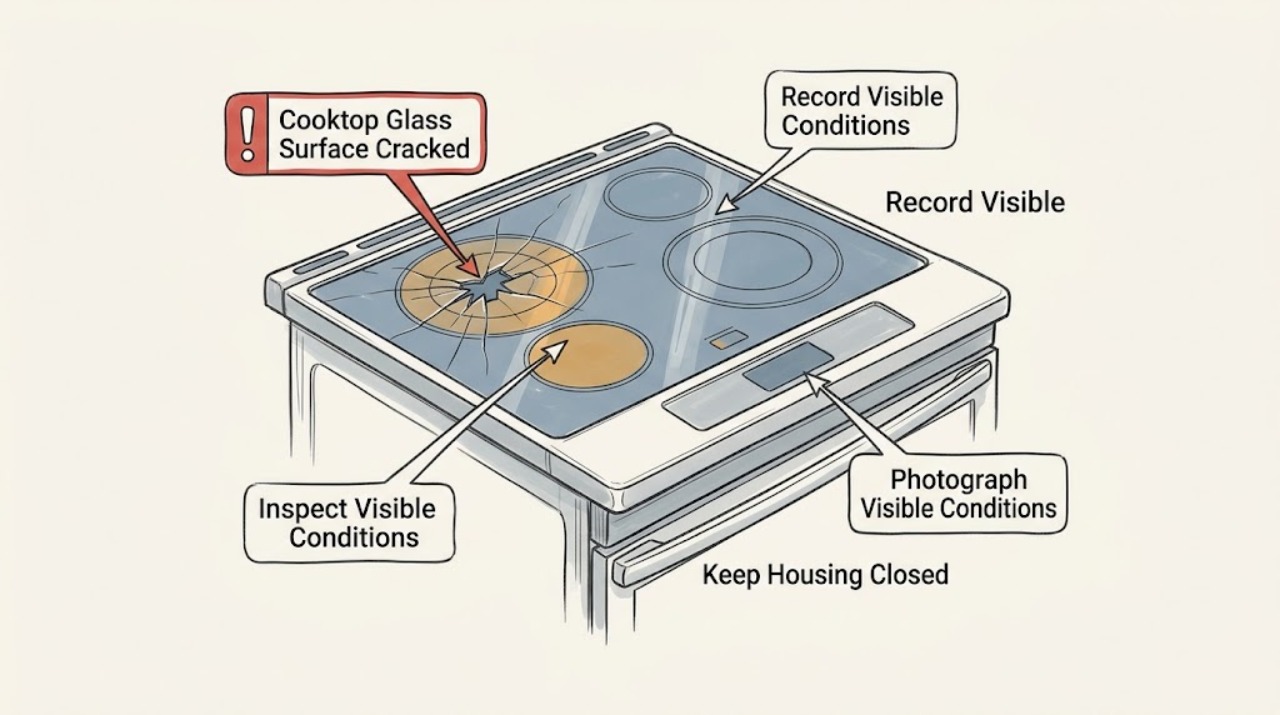
Treat a visible crack in an LG ceramic-glass cooktop as a stop-and-service condition, not a cosmetic repair. Turn all controls off, keep cookware and liquids away, and do not cook on, clean, scrape, glue, or tape over the cracked surface. A hairline mark may be a scratch or stain, but do not probe it or heat the area to find out. Photograph the crack from a safe distance, note whether a zone, display, or breaker behaved abnormally, and identify the exact LG model. Keep the cooktop out of use until a qualified technician evaluates it and determines whether the glass assembly or another component needs replacement. Do not remove the glass, open the electrical enclosure, or attempt a glass-only repair. If the crack is spreading, the surface is hot or sparking, liquid has entered it, smoke or burning odor is present, or the breaker trips, isolate power only from a safe dry location and obtain qualified or emergency help.
Before you begin
Safety first
- Keep the cooktop off for any crack. For liquid entry, smoke, burning odor, arcing, uncontrolled heating, a hot connection, or a spreading or loose break, keep clear and isolate power only from a safe dry location if possible. Do not remove the glass or open the electrical enclosure.
Work through in order
Diagnostic checks
Use only checks that match the exact appliance or system and its official guide.
-
Check 1
Turn every cooktop control off and observe from a safe distance. Do not touch the glass. Record whether the surface is still hot, a zone remains on, the display or hot-surface indicator disagrees with actual heat, smoke or burning odor is present, liquid entered the crack, or the breaker tripped.
Expected result: The glass is hot, a zone remains energized, liquid is inside or near the break, smoke, odor, arcing, heat damage, or a breaker trip is present, or the appliance is off and cool.
Next step: For a safety symptom, keep clear and isolate power only from a safe dry location if possible; arrange qualified or emergency help. Otherwise keep the cooktop out of use and continue only with visual documentation.
Why this matters
Why: A crack combined with heat, liquid entry, electrical symptoms, or uncontrolled operation increases shock, burn, and fire risk. A cool, de-energized surface is safer to document but is still not safe to operate or clean.
-
Check 2
From a safe position with the surface cool and dry, photograph and describe the mark without scraping, pressing, wetting, gluing, or heating it. Note whether it is a single fine line, a branching impact, a chip, a raised edge, a loose fragment, or only a superficial mark that does not interrupt the surface.
Expected result: The line has a chip or branch, catches light or a fingertip visually without touching, crosses a zone or control area, has loose glass, or appears to be a removable surface mark.
Next step: Keep the unit off and give the photo and description to qualified service. Do not use a scraper or cleaner to prove that a mark is harmless; let service distinguish a scratch, pitting, or crack.
Why this matters
Why: A chip, branch, loose edge, or zone-crossing line is consistent with structural glass damage and cannot be safely treated as cosmetic. A superficial mark may be residue or transfer, but cleaning is not appropriate while a crack remains possible.
-
Check 3
Identify the exact LG model and cooktop type from the rating label or owner documentation, and record whether it is radiant electric, induction, or gas-on-glass. Do not remove trim or lift the cooktop to find the label.
Expected result: The model and type are clear, the label is inaccessible, or the appliance type is uncertain.
Next step: Use the model information to obtain the matching LG manual and arrange service. If the label cannot be reached safely, give the technician the visible product details instead of moving the appliance or opening panels.
Why this matters
Why: Glass assemblies, electrical connections, heating zones, and service procedures differ by model and cooktop type. Uncertain identity prevents a safe parts or repair decision.
-
Check 4
Review the exact LG manual's safety and service instructions without powering the cooktop. Confirm that no user procedure authorizes operation or cleaning with damaged glass; do not apply an instruction for another LG series or an unrelated range.
Expected result: The manual warns against broken glass, identifies a model-specific glass assembly, or does not clearly address the visible damage.
Next step: Keep the cooktop off and request qualified LG appliance service. Do not use generic glass repair, adhesive, sealant, or a replacement panel selected by appearance.
Why this matters
Why: A manual warning or missing model-specific procedure supports a service-only boundary. Similar-looking glass does not establish fit, electrical insulation, or safe clearances.
-
Check 5
Record the event that may have caused the damage—impact, a hard object, a hot lid, a boil-dry event, a spill, or a cleaning attempt—and check only for related visible damage around the frame, controls, and counter cutout. Do not recreate the event or place cookware on the surface.
Expected result: The frame is bent, the glass is shifted, the crack followed impact or thermal stress, the controls are damaged, or no related damage is visible.
Next step: Keep the cooktop unused and provide the event history and photographs to the technician. Do not straighten the frame, clamp the glass, or remove adjacent components.
Why this matters
Why: The event history helps service assess glass support and hidden damage, but it does not prove that only the top needs replacement. A shifted frame or damaged control area raises the repair boundary.
-
Check 6
After documenting the crack, secure the area from accidental contact without touching the glass and keep children, pets, cookware, and liquids away. Do not cover the surface with tape, a mat, or a cloth that could hide fragments or be heated accidentally.
Expected result: The crack is stable and isolated, fragments are loose, the crack is spreading, or the surface cannot be kept clear and unused.
Next step: Keep the room or appliance access controlled and arrange qualified service. If fragments, smoke, heat, or electrical symptoms are present, do not touch them; isolate power only from a safe dry location and obtain help.
Why this matters
Why: A stable crack still needs repair; loose or spreading glass creates a cut and contamination hazard. An area that cannot be kept clear needs immediate service or emergency assistance.
Use your observations
Decision map
Find the observation that best matches what you see, then follow the next safe action.
-
PATH 01Next step
What you see
The glass has a visible crack, chip, branch, loose edge, or opening, regardless of whether the cooktop still heats.
Do this next
Keep the cooktop off and arrange qualified service for the exact LG model. Do not clean, heat, tape, glue, or use the surface until repaired.
Why this path and its safety boundary
Why it matters: The damage is a structural glass concern and should not be treated as a cosmetic scratch or tested by cooking.
-
PATH 02Next step
What you see
The mark is superficial, does not interrupt the glass, and resembles residue or metal transfer, but no one has confirmed that it is not a crack.
Do this next
Keep the surface cool and unused until the exact manual or a qualified technician confirms it is only a mark. If confirmed superficial, use the model-approved non-abrasive cleaning method.
Why this path and its safety boundary
Why it matters: LG cleaning guidance recognizes that deposits and marks can resemble surface damage, but a user should not use abrasion or heat to distinguish a suspected crack.
-
PATH 03Next step
What you see
The crack followed a dropped object, a hot lid, a boil-dry event, or another thermal or impact event, and the frame or controls may also be shifted.
Do this next
Keep the cooktop off and provide service with the event history and photos. Do not straighten the frame, lift the glass, or assume a glass-only replacement is safe.
Why this path and its safety boundary
Why it matters: Related support, control, or heating damage is possible even if only the top surface appears damaged.
-
PATH 04Next step
What you see
The crack is near a control or heating zone, liquid entered it, a zone remains on, or the display and surface temperature disagree.
Do this next
Stop immediately, keep clear, and isolate power only from a safe dry location if possible. Arrange qualified or emergency help; do not touch the surface or attempt a reset.
Why this path and its safety boundary
Why it matters: Electrical insulation, control, or uncontrolled-heating risk is higher than for an isolated superficial mark.
-
PATH 05Next step
What you see
A firm visual description is unavailable, the exact LG model cannot be identified safely, or the damage cannot be kept isolated from people and liquids.
Do this next
Keep the appliance off and request qualified service. Do not move the cooktop, remove trim, or use a generic replacement panel to continue cooking.
Why this path and its safety boundary
Why it matters: The user cannot establish safe operation or compatible repair from external checks.
Helpful context
Understand the symptom
Assume a crack is real until service says otherwise
A straight line, star-shaped impact mark, lifted edge, or branch that reaches a cooking-zone opening can be more than a stain. LG's cleaning guidance explains that residue and foreign objects can damage glass or interfere with touch buttons, while its ceramic-glass manual warns that hard or sharp objects can damage the surface. Because cleaning and heating can change the condition, do not test a suspected crack with a pan, scraper, water, or a cooking cycle.
What you can safely document
From a safe distance, note the location and length of the visible line, whether it crosses a heating zone or control area, and whether the glass is raised, sharp, loose, or shedding fragments. Photograph it only when the surface is cool and the area is dry. Record whether a pan was dropped, a spill occurred, a hot lid was left on the surface, or the issue appeared after cleaning, but do not try to reproduce the event.
Why a patch is not a repair
Cooktop glass is part of a heated appliance and may sit over electrical or induction components. Adhesive, tape, sealant, a replacement pane from another model, or a tightened trim piece cannot restore the designed insulation, support, clearances, or temperature behavior. A qualified technician needs the exact model and damage pattern to identify the correct assembly and inspect for related damage.
Prevent a second failure after repair
Once service confirms the appliance is safe, follow the exact LG manual for cookware and cleaning. Avoid sliding pans, rough or damaged pan bases, hard impacts, empty hot cookware, and abrupt thermal stress. Use only the recommended ceramic-glass cleaner and a non-abrasive method on a cool surface; never use the cooktop as a work surface or cutting board.
Safety boundary
Stop conditions
- Do not operate or clean a cooktop with broken or cracked glass. Spillovers and cleaning liquid can penetrate the break and create a risk of electric shock.
- Stop immediately for a hot or spreading crack, loose glass, liquid entry, smoke, burning odor, arcing, a zone that remains on, a hot connection, or a repeated breaker trip. Keep clear and obtain qualified or emergency help.
- Do not scrape, press, drill, glue, tape, seal, clamp, lift, or replace the glass yourself; do not test the crack with cookware, water, or a heating cycle.
- Do not open the electrical enclosure, remove the cooktop from the counter, or select a replacement glass assembly by appearance. Use the exact LG model and qualified service boundary.
Only after diagnosis
Potential parts
- ceramic-glass cooktop assembly
Consider this category only after qualified inspection confirms that the glass assembly is the correct repair and related frame, heater, control, and wiring checks pass.
Glass assemblies differ by LG model, cooktop type, size, and electrical configuration. Confirm exact model and service diagnosis before any part decision. - cooktop frame or mounting hardware
Consider this category only when impact or shifting has damaged the support frame or mounting hardware in addition to the glass.
Frame and mounting geometry are model-specific and affect safe glass support. Do not straighten or substitute hardware without qualified guidance. - surface-heating or control component
Consider this category only if qualified testing finds related heating, sensor, relay, or control damage after a glass break or impact.
Electrical components require exact model and voltage confirmation and qualified installation; a cracked surface alone does not identify a failed component.
When checks do not resolve it
Need a professional?
Arrange qualified LG appliance service immediately for any visible crack, chip, loose edge, or opening in the cooktop glass. Keep the surface out of use until repaired. Treat a spreading crack, liquid entry, smoke, burning odor, arcing, uncontrolled heating, a hot electrical connection, or a repeated breaker trip as an immediate safety issue and isolate power only from a safe dry location if possible.
Safety scope: Keep the cooktop off for any crack. For liquid entry, smoke, burning odor, arcing, uncontrolled heating, a hot connection, or a spreading or loose break, keep clear and isolate power only from a safe dry location if possible. Do not remove the glass or open the electrical enclosure.
Common questions
FAQ
Can I still use my LG cooktop if the glass is cracked?
No. Keep a cracked cooktop out of use until qualified service evaluates and repairs it. Liquids and spillovers can penetrate the break, and heating can worsen the hazard.
How can I tell whether a line is a crack or just a scratch?
Do not scrape, press, wet, or heat the mark to find out. Photograph it from a safe distance while the surface is cool and have the exact LG model and damage evaluated by qualified service.
Can I clean a cracked glass cooktop before service?
No. Keep cleaners and spillovers away from the break and do not operate or clean the cooktop while cracked. If something has already entered the crack, keep the appliance off and tell the technician.
What causes an LG ceramic-glass cooktop to crack?
Possible contributors include a hard or sharp impact, rough or sliding cookware, a hot lid or thermal stress, a boil-dry event, or an underlying support issue. The cause cannot be confirmed from the crack alone, so document the event without reproducing it.
Can I repair an LG cooktop crack with glue or glass sealant?
No. A patch cannot restore the cooktop's designed electrical insulation, heat support, or clearances. Do not glue, tape, clamp, drill, or substitute a glass panel; use qualified model-specific service.
When is a cracked cooktop an emergency?
Treat liquid entry, a spreading or loose break, smoke, burning odor, arcing, uncontrolled heating, a hot connection, or a repeated breaker trip as an immediate safety issue. Keep clear, isolate power only from a safe dry location if possible, and obtain qualified or emergency help.
Read the exact guide
Official sources
- Cooktop - Glass CrackedGE Appliances · Manufacturer safety guidance for ceramic-glass cooktops, used as a general crack-safety principle and not as an LG model-specific parts claim.
- MFL41494801 Cooktop LCE30845 Owner's ManualLG Electronics · Official LG induction ceramic-glass cooktop manual example; use the exact LG model manual for any different cooktop.
- LG Range - How to Clean My Glass CooktopLG Electronics · LG manufacturer cleaning guidance for glass cooktops; exact model instructions control and suspected cracks must not be cleaned or tested.
- Maintenance of Ceramic GlassWhirlpool Corporation · Manufacturer ceramic-glass maintenance guidance used for general damage mechanisms; LG model instructions control the affected appliance.
Community feedback
Share a repair observation
Share a plain-text repair observation. Accepted observations are published automatically; this page may take a moment to update.