
On this page
Start here
Quick answer
Excess frost in an LG freezer is often moisture that entered with humid air, hot or uncovered food, a door that did not seal, an overfilled compartment, or a recent power interruption. First note where the frost is concentrated and whether it returns. Check the door gasket, drawers, shelves, visible air paths, food packaging, and recent operating history without removing panels. If frost is thick or has formed at the bottom, move food, disconnect power only when you can safely keep the doors open, and let the ice thaw naturally with towels in place; never chip it with a knife or ice pick or apply direct heat. Frost that returns after a complete thaw, water that pools or refreezes, an F dH or r dH display, weak cooling, or any electrical or burning warning sign needs qualified appliance service.
Before you begin
Safety first
- Do not remove panels, probe a drain, test live wiring, touch a heater, fuse, sensor, fan, or control, handle refrigerant, or apply direct heat. Keep the unit off for electrical or thermal warning signs and follow the model manual or qualified technician's instructions.
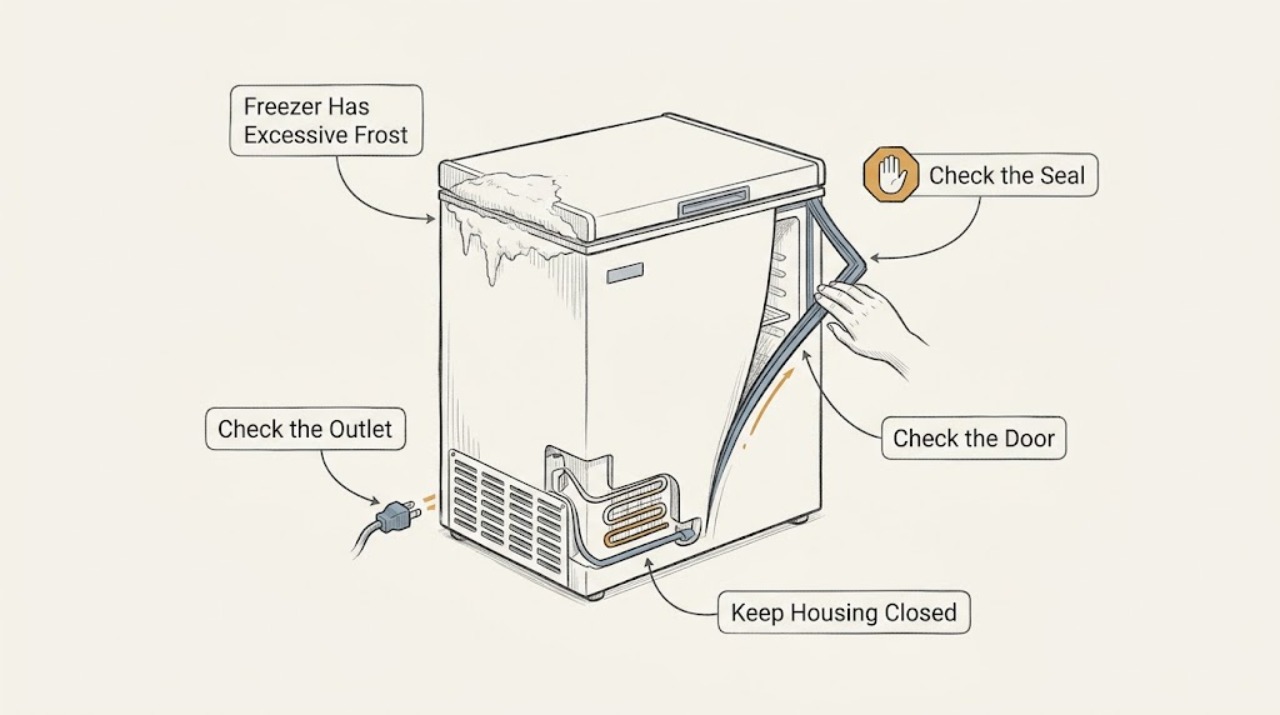
Work through in order
Diagnostic checks
Use only checks that match the exact appliance or system and its official guide.
-
Check 1
With the freezer door open and the appliance otherwise untouched, map where the frost is heaviest: the door perimeter, upper wall, shelves or food, bottom surface, rear wall, or around a visible air outlet. Note whether it is loose crystals, a hard sheet, icicles, or accompanied by water.
Expected result: Frost may be localized at the door edge, upper surfaces, or stored food, or it may form as a sheet at the bottom or a thick layer on the rear wall; water may be absent or may return after melting.
Next step: Use the observed location to choose the door-and-load checks, the safe natural-thaw path, or professional defrost diagnosis below. Do not scrape or puncture the frost.
Why this matters
Why: Door-edge or upper-surface frost makes outside moisture and sealing more likely, while a bottom sheet or returning water makes a blocked drain more likely. A thick rear-wall layer with poor airflow raises a defrost or airflow concern.
-
Check 2
Inspect the closed door from the outside for a drawer, shelf, bag, container, or food package protruding into the gasket path. Check that removable drawers and shelves are seated correctly, and wipe visible residue from the gasket with a clean damp cloth before drying it.
Expected result: The door may close evenly with full gasket contact, or it may stop short, sit loosely, show a visible gap, or have a gasket section that is dirty or pulled out of its groove.
Next step: Reposition only accessible food, shelves, and drawers; remove the obstruction and close the door gently. If a gasket remains damaged or the gap persists, keep the door closed as much as practical and arrange service rather than forcing or replacing parts by guesswork.
Why this matters
Why: Overpacking, misplaced storage parts, obstructions, or a dirty or displaced gasket can let humid room air enter and freeze. A torn, hardened, or persistently separated gasket is not confirmed by cleaning alone.
-
Check 3
Review what happened before the buildup: hot food placed in the freezer, uncovered or wet food, long door openings, a humid location, or a recent outage or power restoration. Check food containers and bags without rearranging the cooling system.
Expected result: There may be a clear recent moisture event, or the frost may have appeared during ordinary use with sealed food, short door openings, and no outage.
Next step: Allow hot food to cool before freezing it, seal high-moisture food, minimize unnecessary door openings, and monitor the pattern. If the buildup continues without a clear moisture cause, proceed to the thaw and service decision.
Why this matters
Why: Steam and unsealed moisture can condense and freeze, and LG says frost after restored power can dissipate as operation stabilizes. Frost during ordinary, well-sealed use is less consistent with a one-time moisture event and deserves recurrence tracking.
-
Check 4
Look at the visible air outlets and the space around stored food without removing covers. Make sure bags or containers are not pressed against an outlet and that the compartment is not packed so tightly that the door cannot close.
Expected result: Visible airflow paths may be clear, partly blocked by packaging, or difficult to assess because ice covers the outlet or rear area.
Next step: Move only accessible packaging away from visible outlets and restore a gentle door closure. If ice blocks the outlet or rear panel, do not remove a cover; use the natural-thaw step or request service.
Why this matters
Why: A loose package can interfere with air movement or door closure, but an ice-covered outlet or rear panel may be a consequence of a defrost problem rather than something the user can clear safely.
-
Check 5
For a substantial buildup, move food to suitable cold storage, place towels to contain meltwater, and follow the model's instructions for disconnecting power and leaving the freezer doors open for a natural thaw. Keep the appliance closed off from children and pets during the thaw.
Expected result: After the frost melts completely, water may run normally to the drain tray, or it may pool, return to the freezer bottom, or fail to drain; the frost may be gone or may remain behind a panel.
Next step: Dry the compartment and restore power only as the model guidance allows. Do not probe the drain, remove panels, chip ice, or apply direct heat. Request service for recurring bottom ice, poor drainage, or concealed frost.
Why this matters
Why: LG links bottom ice that returns to a drain path blocked by ice or foreign material. If water does not drain after a complete natural thaw, or ice remains concealed, the drain or defrost system needs professional diagnosis.
-
Check 6
After a complete natural thaw and safe restart under the owner's instructions, read the user-facing display and observe whether cooling, airflow, door closure, and frost behavior return to normal. Record any F dH or r dH message and whether the same frost pattern returns.
Expected result: The freezer may stabilize without a code, show an F dH or r dH code, cool poorly, or begin rebuilding frost in the same place after the door and moisture checks were corrected.
Next step: Arrange qualified appliance service for a repeated code, recurring frost, poor cooling, or water return. Stop use and seek urgent help for smoke, burning odor, sparks, abnormal heat, a damaged cord, or water near electrical parts.
Why this matters
Why: A repeated code is a defrost-related service clue; recurring frost after a full thaw makes a persistent seal, drain, defrost, fan, or control fault more likely than a single humidity event.
Use your observations
Decision map
Find the observation that best matches what you see, then follow the next safe action.
-
PATH 01Next step
What you see
Frost is concentrated around the door edge and the door has a visible gap, an obstruction, or a gasket that stays dirty or displaced.
Do this next
Correct the accessible load, shelf, drawer, or gasket-cleaning issue and confirm that the door closes evenly. If the gap or frost remains, request service for the seal and door alignment rather than forcing the door.
-
PATH 02Next step
What you see
Frost is on the upper wall, shelves, or food after hot or unsealed food, humid air, long openings, or recent power restoration, with no persistent door gap.
Do this next
Treat outside moisture as the leading explanation: cool food before storage, seal moist food, close the door promptly, and monitor after operation stabilizes. Escalate if the pattern grows or returns without another moisture event.
-
PATH 03Next step
What you see
A hard ice sheet forms at the freezer bottom, or water returns to the bottom after the ice has melted.
Do this next
Use the safe natural-thaw procedure and observe drainage without probing it. If water still pools or the bottom refreezes, request service for a blocked drain or related defrost problem.
-
PATH 04Next step
What you see
The rear wall or visible air outlet is heavily iced, airflow is weak, cooling is poor, or F dH/r dH appears.
Do this next
Do not remove the interior panel or attempt to reach the heater, sensor, fuse, fan, or control. A complete natural thaw may be a model-approved first step, but a repeated code or recurrence requires qualified appliance diagnosis.
-
PATH 05Next step
What you see
Frost appeared after a power interruption, the door seals, food is covered, cooling is normal, and the buildup is not returning rapidly.
Do this next
Monitor after the freezer stabilizes; LG says moisture from restored power can freeze temporarily and may dissipate naturally. Request service if the frost persists, spreads, or is joined by water, poor cooling, or a code.
-
PATH 06Next step
What you see
Frost returns after a complete natural thaw and the door, food, and visible-air-path checks are sound, or the same defrost code repeats.
Do this next
Stop treating the buildup as a one-time moisture event and arrange qualified appliance service. The technician should confirm whether the seal, drain, defrost heater, temperature protection, sensor, fan, or control is involved.
Helpful context
Understand the symptom
Start with the frost pattern rather than assuming a failed part. Frost on an upper wall, shelf, or food after a power interruption or a humid period may be moisture that entered during normal use. Frost around the door perimeter points more toward a sealing or obstruction problem. A hard sheet at the bottom, standing water, or frost that returns after a full thaw makes drainage or defrost trouble more likely. LG notes that its general guidance can differ from the details for a particular model, so use the owner's manual for model-specific controls and thawing instructions.
A freezer door can look closed while a shelf, drawer, bag, or overpacked load keeps the gasket from contacting the cabinet. Clean residue from the gasket, make sure drawers and shelves are seated, and leave room for the door to close without force. Let hot food cool before freezing it and keep high-moisture food sealed. These changes reduce the moisture entering the compartment but do not repair a torn gasket or a recurring internal ice blockage.
For a heavy buildup, protect the floor, move food to suitable storage, disconnect power if the model's instructions permit it, and leave the doors open for a natural thaw. Keep towels ready and allow the ice to melt rather than probing it. Do not use a knife, ice pick, hair dryer, space heater, open flame, or hot water around the freezer. Do not remove an interior panel or force a drain clear.
If the frost returns after the compartment has fully thawed and the door and food checks are sound, arrange appliance service. A technician may need to distinguish a blocked drain from a defrost heater, temperature fuse, sensor, control, fan, or gasket issue. An F dH or r dH code, repeated water return, poor cooling, exposed wiring, smoke, burning odor, or water near electrical parts changes the decision from monitoring to prompt or urgent service.
Safety boundary
Stop conditions
- Do not use a knife, ice pick, awl, screwdriver, or other sharp object to remove frost or ice.
- Do not apply direct heat with a hair dryer, space heater, open flame, or hot water, and do not remove an interior panel or force a drain clear.
- Stop and obtain urgent help for smoke, burning odor, sparks, abnormal heat, a damaged power cord, or water near electrical parts.
- Keep the appliance disconnected and arrange qualified service if frost blocks a fan or outlet, cooling is poor, water repeatedly returns, or an F dH or r DH code repeats.
- Do not test live wiring, touch electrical components, handle refrigerant, or select a replacement part from frost location alone.
Only after diagnosis
Potential parts
- freezer door gasket
Consider this only if a persistent visible gap, damaged gasket, or confirmed sealing problem remains after cleaning and correcting door obstructions.
Confirm the complete LG model and manufacturer fit information; gasket shape and attachment vary by model. - freezer defrost drain component
Consider this only after a technician confirms that bottom ice or returning water is caused by a blocked or damaged drain path rather than a door or defrost-control issue.
Use the complete model and the service diagnosis to confirm the correct drain component and installation method. - freezer defrost heater, sensor, or temperature protection
Consider these only after qualified service confirms a recurring defrost fault or F dH/r dH condition and identifies the failed component.
These are model-specific electrical parts; verify the complete model and approved fitment before any replacement.
When checks do not resolve it
Need a professional?
Arrange qualified LG appliance service when frost returns after a complete natural thaw, the freezer has a recurring bottom ice or water problem, the door gasket remains damaged or will not seal, cooling or airflow is poor, or F dH or r DH repeats. Stop the appliance from a safe control and seek urgent help for smoke, burning odor, sparks, abnormal heat, a damaged cord, or water near electrical parts.
Safety scope: Do not remove panels, probe a drain, test live wiring, touch a heater, fuse, sensor, fan, or control, handle refrigerant, or apply direct heat. Keep the unit off for electrical or thermal warning signs and follow the model manual or qualified technician's instructions.
Have this ready
- Provide the complete LG model, frost location and pattern, photographs taken without opening panels, door-seal and obstruction observations, recent outage or moisture history, whether the freezer cools normally, water behavior after thawing, and any F dH or r DH message.
Common questions
FAQ
Why does my LG freezer have excessive frost?
Common causes are humid air, hot food, uncovered high-moisture food, long door openings, an overfilled or obstructed door, a dirty or displaced gasket, and frost after power is restored. A bottom ice sheet, returning water, repeated buildup, poor cooling, or a defrost code points to a service issue rather than a one-time moisture event.
What does the location of the frost tell me?
Frost at the door edge suggests outside air entering through an obstruction or seal gap. Frost on an upper wall, shelf, or food after a moisture event can be temporary. A hard bottom sheet or water that returns after thawing makes a blocked drain more likely, while a heavily iced rear wall or defrost code needs professional diagnosis.
Can I remove freezer frost with a knife or hair dryer?
No. LG specifically warns against sharp objects. Do not use a hair dryer, space heater, open flame, or hot water either. Move food, disconnect power only under the model's instructions, leave the doors open, use towels, and let the ice thaw naturally.
Is frost after a power outage normal?
It can be temporary. When the freezer warms during an outage and cools again after power is restored, moisture can condense and freeze. Keep the door sealing and food covered, then monitor. If frost spreads, returns repeatedly, affects cooling, or appears with a code or water problem, arrange service.
Why does ice or water come back at the bottom after thawing?
LG explains that a blocked freezer drain can keep melted frost from reaching the drain tray, allowing water to return and freeze at the bottom. Do not probe the drain or remove panels; if the problem returns after a complete natural thaw, request qualified service.
When should I call for LG freezer frost service?
Call when frost returns after a full natural thaw and safe door or food corrections, water repeatedly pools or refreezes, the gasket will not seal, cooling or airflow is poor, or F dH or r DH repeats. Seek urgent help for smoke, burning odor, sparks, abnormal heat, a damaged cord, or water near electrical parts.
Read the exact guide
Official sources
- LG Refrigerator - Troubleshooting Ice Buildup in an LG RefrigeratorLG USA Support · General LG refrigerator/freezer ice-buildup guidance; exact thaw instructions vary by model
- [LG Refrigerator] Refrigerator Door Seal IssuesLG USA Support · General LG refrigerator door-seal guidance applicable to freezer-door closure checks
- LG Refrigerator - Troubleshooting Frost or Moisture Buildup In Your LG RefrigeratorLG USA Support · General LG refrigerator guidance that includes freezer-related moisture mechanisms
- [LG refrigerator frost build-up] There is frost build-up and icicles in the freezer compartmentLG USA Support · General LG refrigerator/freezer guidance; model-specific details can differ
- LG Refrigerator - Troubleshooting an F dH or r DH Error CodeLG USA Support · LG refrigerator/freezer display-code guidance; exact display behavior varies by model
Community feedback
Share a repair observation
Share a plain-text repair observation. Accepted observations are published automatically; this page may take a moment to update.