
On this page
Start here
Quick answer
First locate where and when the LG freezer leaks. Water or ice at the bottom of the freezing compartment after frost points to a blocked or frozen defrost drain; a dispenser, ice-maker, filter, or rear water-line drip is a different path. LG advises disconnecting power and allowing frost to melt naturally when a blocked drain is suspected, with towels and food protection in place. Check the door seal, closure, vents, drain tray, and visible water connections without removing hidden panels. Do not use a hair dryer, boiling water, knife, wire, compressed air, or pressure to clear ice, and do not work near energized parts. If water remains after complete melt, returns, the drain is hidden, food is warming, or water reaches wiring, stop and arrange qualified appliance service.
Before you begin
Safety first
- This article covers ordinary-access leak mapping, gasket and closure observation, model lookup, visible water-path inspection, and only the exact model's natural-melt procedure. A technician must handle hidden drains, panels, pressurized water lines, defrost parts, electrical testing, and sealed-system work.
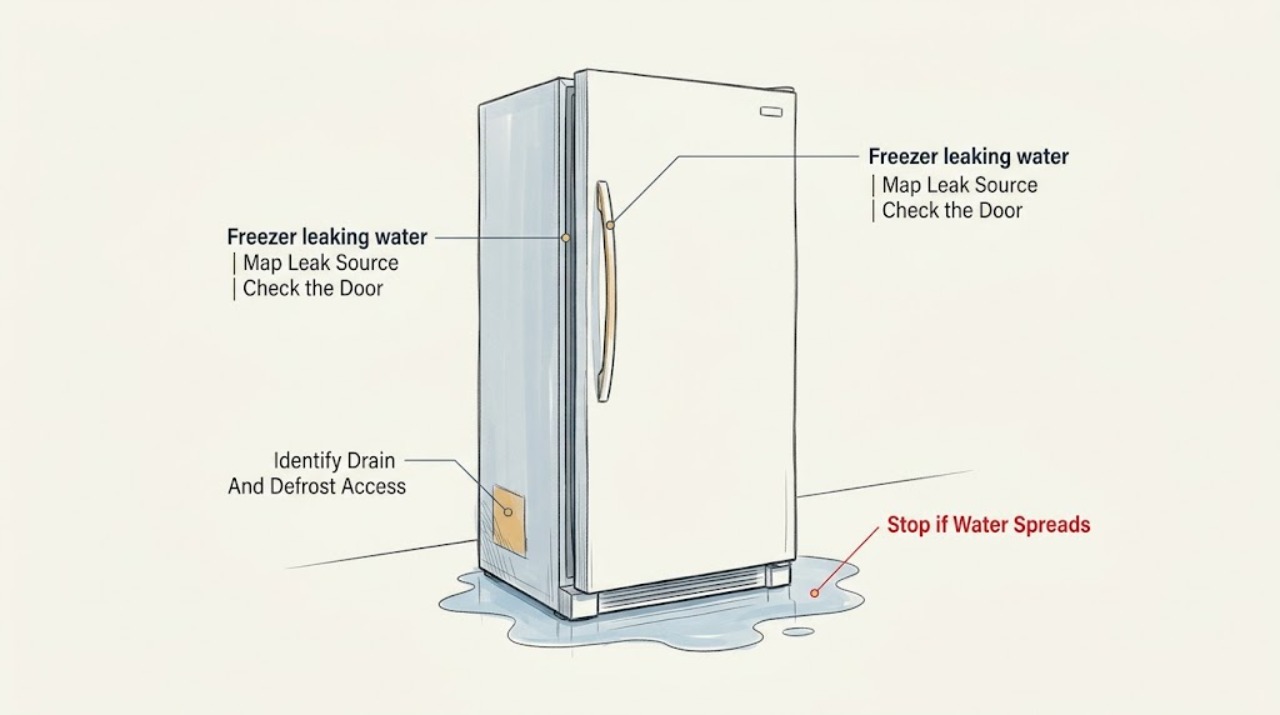
Work through in order
Diagnostic checks
Use only checks that match the exact appliance or system and its official guide.
-
Check 1
Dry the visible water and observe from a dry, stable position. Record whether the first water appears on the freezer floor, from a rear drain area or tray, below the door, near the ice maker or dispenser, or at a water-line or filter connection.
Expected result: Water or ice is tied to frost or a defrost event, is steady from a supply path, appears near the ice maker or dispenser, or cannot be traced without moving or opening the appliance.
Next step: Photograph the first wet point and continue only with the matching model guidance. Stop and arrange service for active water near wiring, flooding, or a source that cannot be isolated safely.
Stop if: Stop for water near electrical parts, smoke, burning odor, a damaged cord, a tripped breaker, or a freezer that is warming.
Why this matters
Why: A defrost-timed floor leak supports a drain or frost branch. A steady water-line or ice-maker leak is a different path; an unknown source needs service rather than repeated drying.
-
Check 2
Inspect the freezer door or drawer, ice-maker door, gasket, frame, and accessible vents for a gap, dirt, frost, or a package preventing closure. Clean the gasket only with the model-approved method and close the door normally.
Expected result: The gasket contacts evenly and frost is absent, or a gap, dirty seal, ice ridge, open ice-maker door, or blocked vent is visible.
Next step: Remove only a loose obstruction and monitor the leak after closure. If the gasket is damaged, the gap remains, or frost is thick, arrange model-specific service.
Stop if: Do not force the door, stretch or heat the gasket, chip frost, remove a door or drawer, or block vents.
Why this matters
Why: LG links an unclosed or poorly sealed door with warm-air entry, melting ice, condensation, frost, and unstable cooling. A good seal shifts attention to the drain, tray, or water system.
-
Check 3
Use the exact LG model number and owner's guide to identify the drain tray, drain opening, freezer type, and defrost access. Look only at the visible area named by the guide; do not remove an evaporator cover or poke a hidden tube.
Expected result: LG's model guidance provides a natural-melt procedure, the drain is visibly accessible, or the path is hidden and requires a panel, fan, heater, or service access.
Next step: Follow only the exact model's ordinary-access steps. If the path is hidden, the guide is unclear, or the leak is from a built-in tray or drain system, arrange service.
Stop if: Do not use a generic diagram, remove hidden panels, or open a sealed cooling area.
Why this matters
Why: LG drain and defrost layouts vary by refrigerator-freezer design. A hidden drain can remain blocked after surface ice melts and is not a user-accessible opening by default.
-
Check 4
Only when LG's exact model procedure permits it, move food to a safe cold location, disconnect power, open the affected doors, place dry towels around the base, and let frost melt naturally. Keep the floor and the area around the appliance dry as water accumulates.
Expected result: Ice melts and water reaches the drain tray, water remains trapped in the freezer, water overflows, or the model guidance does not permit this user procedure.
Next step: Dry the interior and restore power only as LG directs. If water does not drain or the source is hidden, stop and arrange qualified service.
Stop if: Never use a hair dryer, heat gun, flame, boiling water, knife, ice pick, wire, or electrical device inside or near a wet freezer.
Why this matters
Why: A complete natural melt that restores drainage supports an ice blockage. Trapped or overflowing water, absent model guidance, or a leak that continues after melt indicates a deeper drain, tray, defrost, or water-source problem.
-
Check 5
If the freezer has an ice maker, dispenser, filter, or supply line, inspect only visible dry-access areas for a wet fitting, cracked filter housing, ice-maker tray overflow, open ice-maker door, or water running from the dispenser. Do not disconnect a pressurized or hidden line.
Expected result: The ice maker is off or open, the tray or chute has ice, the filter or fitting is wet or cracked, water drips from the dispenser, or the water path is dry while the freezer floor still leaks.
Next step: Close or reinstall only an accessible ice bin or door as the manual directs. For a cracked filter, wet fitting, recurring dispenser leak, or hidden line, stop and request service.
Stop if: Do not tighten cracked fittings, remove a water filter by force, disconnect a hidden line, alter water pressure by guesswork, or run a leaking ice maker.
Why this matters
Why: LG identifies an off or open ice-maker compartment, trapped line air, pressure, filter damage, and ice or frost in the chute as separate leak causes. A dry visible water path makes defrost drainage more likely.
-
Check 6
After one safe model-directed check, keep the freezer doors closed and monitor the next cooling and defrost period. Record whether the floor stays dry, frost returns, water appears without a defrost event, the freezer remains cold, or food is warming.
Expected result: The leak stops and cooling is stable, or water returns, frost rapidly builds, an alarm or defrost code appears, or the freezer warms.
Next step: Arrange qualified LG appliance service for recurrence, hidden access, a defrost code, poor cooling, or a leak that cannot be contained. Provide the model, timing, location, and photos.
Stop if: Stop use when food is warming, water reaches electrical parts, smoke or burning odor appears, the cord is damaged, or protection trips.
Why this matters
Why: A stable result supports a temporary melt, closure, or visible ice-maker issue. Recurrence or warming suggests a hidden drain, gasket, airflow, defrost, tray, water-line, or cooling fault.
Use your observations
Decision map
Find the observation that best matches what you see, then follow the next safe action.
-
PATH 01Safety boundary
What you see
Water or ice is on the freezer floor after frost or defrost, and LG's guidance identifies a blocked drain or drainage hole.
Do this next
Use the exact model's natural-melt and water-collection procedure once, then arrange service if water remains, backs up, or returns.
Why this path and its safety boundary
Why it matters: Ice or debris in the defrost path is plausible, but the blockage may be deeper than the visible opening.
Safety stop: Do not probe the drain, force water, chip ice, or remove a hidden cover.
-
PATH 02Safety boundary
What you see
The freezer or ice-maker door was open, the gasket has a gap or frost, or water and frost are concentrated near the door.
Do this next
Clear the closing path, clean and check the gasket, close the door fully, and monitor. Arrange service for a persistent gap or rapid frost return.
Why this path and its safety boundary
Why it matters: Warm-air entry and closure are more likely, with melting ice or frost overflow causing the water.
Safety stop: Do not heat, stretch, glue, cut, or force the gasket or door.
-
PATH 03Safety boundary
What you see
Water is steady or tied to dispensing or ice making, and a visible filter, tray, chute, fitting, or line is wet, cracked, open, or mis-seated.
Do this next
Use only an identified safe shutoff, keep the floor dry, and arrange service for a cracked, pressurized, hidden, or recurring water path.
Why this path and its safety boundary
Why it matters: A water-supply, filter, dispenser, or ice-maker cause is more likely than a defrost drain clog.
Safety stop: Do not disconnect hidden tubing, change pressure by guesswork, or run the appliance with active leakage.
-
PATH 04Safety boundary
What you see
A complete natural melt stops the first leak, but water or ice returns, frost rapidly builds, a defrost code appears, or cooling is poor.
Do this next
Stop DIY access and arrange qualified LG service with the model, code if any, leak timing, frost pattern, and temperature result.
Why this path and its safety boundary
Why it matters: A hidden drain restriction, defrost heater or sensor, control, airflow, gasket, or another cooling fault may remain.
Safety stop: Do not remove panels, bypass a defrost component, test live parts, or keep operating while food warms.
-
PATH 05Safety boundary
What you see
The leak follows one frost or defrost event, the model-directed melt restores drainage, the doors seal, and the freezer returns to stable temperature.
Do this next
Keep doors closed, keep vents and food paths clear, and monitor the next normal defrost event.
Why this path and its safety boundary
Why it matters: A temporary ice blockage or opening is more likely than a continuing component fault, but recurrence should be watched.
Safety stop: Stop if water returns, frost rapidly rebuilds, the door loses its seal, or cooling becomes unstable.
Helpful context
Understand the symptom
Map the water before assuming a drain clog
A leak in an LG refrigerator-freezer can begin on the freezer floor, inside a drain tray, at the ice maker, at the dispenser, or along a rear water line. LG's support guidance treats these as separate branches. Wipe the area dry, note the first place that becomes wet, and check whether the event follows a defrost or ice-making cycle. Do not pull a connected appliance out of a tight space just to inspect a hidden line.
Door sealing and drainage affect each other
A freezer door or ice-maker door left ajar lets warm air in, which can melt ice, create condensation, or add frost. Frost can then block cold-air vents or the drain and turn a small moisture issue into a floor leak. Check closure, the gasket, food placement, and frost together. A water leak with a stable, sealed door and no frost shifts attention to the drain tray, water path, or another component.
Use a natural melt and keep hidden access professional
LG's drain guidance recommends removing food, disconnecting power, opening the doors, protecting the floor, and allowing ice to melt naturally when a frozen drain is suspected. It warns that hot air or boiling water can damage plastic. If the drain remains blocked after a complete melt or requires an interior cover to reach, stop rather than probing deeper or bypassing the defrost system.
Safety boundary
Stop conditions
- Stop for flooding, water near electrical parts, smoke, burning odor, a damaged cord, a tripped breaker, a freezer that is warming, or food whose safe temperature is uncertain.
- Do not remove evaporator or interior service panels, bypass defrost controls, test live wiring, or work on heaters, sensors, fans, valves, or sealed cooling parts.
- Never use a knife, ice pick, screwdriver, wire, compressed air, heat gun, flame, boiling water, or pressure to clear ice or a drain.
- Do not disconnect a hidden or pressurized water line, tighten a cracked fitting, force a filter or ice bin, or run a leaking ice maker.
- Do not force the freezer door, drawer, gasket, drain tray, or water fitting, and do not move a loaded appliance alone.
- Stop after one exact-model natural-melt or visible-path check when water returns, the source is hidden, frost recurs, or cooling does not recover; arrange qualified appliance service.
Only after diagnosis
Potential parts
- defrost drain or drain tray
Consider this category only when service confirms that the exact model's drain, tube, or tray is blocked, cracked, displaced, or unable to carry defrost water after safe melting.
Confirm the exact LG model, drain routing, tray design, dimensions, and manufacturer's fit information before ordering. - freezer door gasket
Consider this category only when the exact model's gasket is damaged or fails the perimeter contact test after cleaning and closure obstructions are removed.
Confirm the exact model, freezer type, seal profile, mounting method, and manufacturer's fit information before ordering. - defrost system component
Consider this category only after a qualified technician confirms recurring frost or a defrost code is caused by a failed heater, sensor, or control rather than a seal or airflow issue.
Confirm the exact model, defrost design, electrical rating, connectors, and manufacturer's fit information; do not bypass or live-test the component.
When checks do not resolve it
Need a professional?
Arrange qualified LG appliance service when water remains after a complete model-directed natural melt, the drain or tray is hidden or blocked, water returns, frost rapidly rebuilds, a defrost code appears, the door or gasket does not seal, the ice maker or water line leaks, or the freezer warms or runs continuously. Panel removal, pressurized line work, defrost-component testing, electrical work, and sealed-system diagnosis require a technician.
Safety scope: This article covers ordinary-access leak mapping, gasket and closure observation, model lookup, visible water-path inspection, and only the exact model's natural-melt procedure. A technician must handle hidden drains, panels, pressurized water lines, defrost parts, electrical testing, and sealed-system work.
Common questions
FAQ
Why is my LG freezer leaking water onto the floor?
The source may be a blocked or frozen defrost drain, frost from a weak door seal, a drain tray, an ice maker, dispenser, filter, or water line. First note where the first water appears and whether it follows frost or defrost; a steady supply drip is a different branch.
How do I clear a frozen LG freezer drain?
Use only the exact model's LG guidance. If natural defrost is permitted, protect the food and floor, disconnect power, open the doors, and let the ice melt completely. Do not use a hair dryer, boiling water, flame, knife, wire, or pressure, and stop if water remains or the drain is hidden.
Can a bad LG freezer door seal cause a water leak?
Yes. A door or ice-maker door left ajar lets warm air in, which can create frost, condensation, melting ice, and an overflow. Check closure and the gasket around the full perimeter; arrange service if a gap remains or frost returns rapidly.
Why does my LG freezer leak again after the ice melts?
The drain may still be blocked deeper inside, or a gasket, defrost heater or sensor, control, airflow, drain tray, ice maker, or water line may be involved. If water or frost returns after one complete model-directed melt, stop repeating it and arrange service.
When should I stop using a leaking LG freezer?
Stop for water near electrical parts, flooding, smoke, burning odor, a damaged cord, a tripped breaker, warming food, or a leak that cannot be contained. Keep the doors closed and arrange qualified LG appliance service with the model and leak observations.
Read the exact guide
Official sources
- LG Refrigerator – How to Connect the Water LineLG USA Support · Official LG water-line source used only for visible supply-path and service boundaries; it is not a repair procedure for hidden leaks.
- How to Troubleshoot Water Leaking from the Ceiling or Pooling on the Floor in Your LG Top Freezer RefrigeratorLG USA Support · Direct LG freezer leak guidance used for drain branches; exact model procedure controls.
- LG Refrigerator - Troubleshooting an F dH or r DH Error CodeLG USA Support · Official LG technical support used for defrost-related water and code branches; it is not a claim that every model displays this code.
- [LG refrigerator - leak] There is lots of ice in the bottom of the freezing compartment.LG USA Support · Direct LG guidance for water or ice in the freezer bottom; model images and access can differ.
- LG Refrigerator – Why is Water Leaking from the DispenserLG USA Support · Official LG water-path guidance used for dispenser-related leaks in refrigerator-freezer products.
- LG Refrigerator – Troubleshooting Leaking Inside My LG RefrigeratorLG USA Support · Official LG leak source used to distinguish filter, ice-maker, and door causes from freezer drainage.
- [LG refrigerator leakage] There is water dripping near the ice maker. Water is dripping near the ice maker.LG USA Support · Official LG support used for ice-maker and freezer-door water branches; model features differ.
Community feedback
Share a repair observation
Share a plain-text repair observation. Accepted observations are published automatically; this page may take a moment to update.