
On this page
Start here
Quick answer
Excessive frost in a Midea freezer is usually moisture from frequent or prolonged door opening, a door gasket that does not seal, food or ice blocking the air path, or a setting or defrost condition that does not match the model. First confirm the freezer is in freezer mode and the setting is appropriate, then check the gasket and door closure with the Midea paper or dollar-bill test, clear packages from the door and vents, and avoid loading hot or uncovered food. If it is a manual-defrost chest or upright model, remove the food, turn the control off or unplug it, use the provided drain path if present, and let the frost melt according to the manual. Use only an approved plastic scraper for softened accessible frost; never use a sharp or metallic tool, boiling water, or an improvised heat source. A frost-free Midea unit that becomes heavily frosted again, remains warm, has blocked airflow, or needs an internal defrost, fan, sensor, or control diagnosis should be serviced.
Before you begin
Safety first
- This article covers ordinary-access observation, food protection, power isolation, gasket and food placement checks, and a model-approved manual defrost only. Do not open electrical or sealed-system covers, touch live parts, use sharp tools or direct heat, puncture refrigerant tubing, bypass controls, or continue through a water, electrical, cooling, or food-safety hazard.
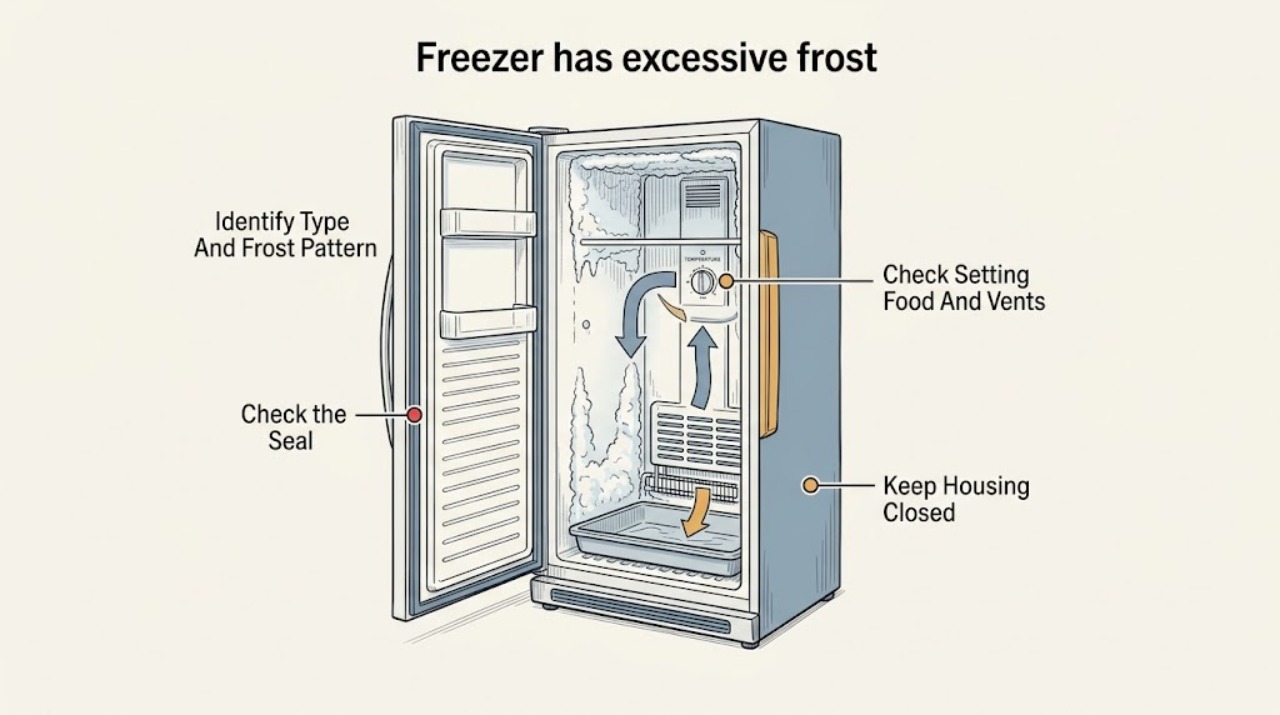
Work through in order
Diagnostic checks
Use only checks that match the exact appliance or system and its official guide.
-
Check 1
Read the Midea model label and Owner's Manual to identify whether the freezer is chest or upright and manual-defrost, frost-free, or convertible; then map the frost to the door edge, food, drawers, vents, rear wall, or entire compartment.
Expected result: Record whether frost is light and localized, a thick layer across surfaces, concentrated around the door or rear wall, blocking vents, or returning on a model advertised as frost-free.
Next step: Follow the exact manual for the identified type. Do not apply a chest-freezer drain or manual-defrost procedure to a frost-free unit without model guidance.
Stop if: Stop and protect food if the freezer is warm, ice blocks the door or vents, water reaches electrical parts, or the model type cannot be confirmed.
Why this matters
Why: Midea says chest freezers require manual defrost, while its upright range includes both frost-free and manual-defrost models. Frost location and the model's defrost type determine whether routine defrosting or fault diagnosis is appropriate.
-
Check 2
Close the freezer door or lid fully and inspect the gasket around the whole perimeter for dirt, tears, gaps, distortion, or packages preventing closure; perform Midea's paper or dollar-bill check and observe the unit's level and hinge alignment.
Expected result: Note whether air can be felt around the seal, a bill or paper pulls out easily, light is visible at the edge, the door rebounds open, or the cabinet is out of level or a hinge is loose.
Next step: Clean the gasket with a mild method, remove closure obstructions, and correct only ordinary leveling or hinge issues described by the manual; request service for a torn or persistently leaking seal.
Stop if: Do not force the door, heat or reshape the gasket, remove hinges, tip a loaded freezer, or keep food in a unit that cannot seal.
Why this matters
Why: Midea links excessive frost to a door seal that does not close, and says an easy-to-pull bill may indicate leveling or hinge problems. A leak lets humid room air enter and freeze inside.
-
Check 3
Confirm the correct freezer mode and temperature setting, then move packages away from vents, the rear wall, and the door path; avoid loading hot or uncovered food and reduce unnecessary door opening.
Expected result: Record whether the unit was in a refrigerator conversion mode, the setting was unusually cold, vents were blocked, food held a door or drawer open, or frost began after warm food or humid conditions.
Next step: Restore the manual's setting and ordinary clearances, keep food covered and cooled before loading, and continue with safe defrosting if existing frost still blocks operation.
Stop if: Do not block vents, overpack the cabinet, force drawers, or scrape around hidden fans or evaporator components.
Why this matters
Why: Midea says settings must be correct, some models can convert between refrigerator and freezer modes, frequent opening adds humidity, and poor loading can restrict airflow or closure. These conditions can create or worsen frost without proving a hardware failure.
-
Check 4
For a manual-defrost Midea freezer, remove and protect all food, turn the control off or unplug, open the door, place a container under the model's drain or outflow hole if provided, let the frost melt naturally, wipe moisture, and restore the drain parts and power as directed.
Expected result: Confirm frost has fully melted, water is contained without overflow, the drain or outflow plug is restored, the cabinet is dry, and no liner or refrigerant tubing was damaged.
Next step: Return food only after the freezer is operating normally and monitor for recurrence. If the unit is frost-free, the drain is hidden, or the frost does not resolve, use service instead of extending the DIY procedure.
Stop if: Never use a knife, ice pick, screwdriver, metal scraper, boiling water, open flame, hair dryer, or other unapproved heat or mechanical device.
Why this matters
Why: Midea's manual and FAQ use power isolation, food removal, natural thawing, and a drain where fitted. Midea warns against mechanical or unapproved defrost methods and sharp or metallic instruments.
-
Check 5
After the approved defrost or seal and loading correction, observe the temperature trend, airflow, door seal, fan and compressor sounds, frost location, and water behavior through the next normal operating period.
Expected result: Classify the result as gradual normal frost on a manual model, no new frost, rapid refreezing, heavy rear-wall or vent ice, weak cooling, an error code, abnormal noise, or water-pan overflow.
Next step: Arrange qualified Midea appliance service for recurring heavy frost, poor cooling, abnormal noise, a persistent alert, inaccessible internal ice, or water that cannot be safely drained.
Stop if: Do not repeatedly thaw, bypass a control or sensor, open electrical or sealed covers, or continue if food is warming or water creates an electrical or slip hazard.
Why this matters
Why: A manual freezer can require periodic defrosting, but rapid recurrence or heavy frost on a frost-free model points toward a persistent sealing, airflow, defrost, sensor, control, or other fault. Midea also lists defrost and sensor alerts in its support FAQ.
Use your observations
Decision map
Find the observation that best matches what you see, then follow the next safe action.
-
PATH 01Safety boundary
What you see
The freezer is a manual-defrost chest or upright and frost has gradually become thick without a sealing, cooling, or electrical warning.
Do this next
Remove food, unplug or turn the control off, use the model drain path if provided, allow a complete thaw, wipe dry, and restore power and food as the manual directs.
Why this path and its safety boundary
Why it matters: Midea says manual-defrost models require periodic defrosting; the frost is a maintenance condition until it causes restricted storage or cooling.
Safety stop: Do not use sharp or metallic tools, unapproved mechanical devices, direct heat, or an improvised drain procedure.
-
PATH 02Safety boundary
What you see
Frost is concentrated near the door or drawers and the gasket leaks, is dirty or damaged, the door is blocked, or the unit is out of level.
Do this next
Clean the seal, remove obstructions, perform the paper or bill check, and correct ordinary leveling or hinge conditions as the manual allows; service a damaged gasket or persistent gap.
Why this path and its safety boundary
Why it matters: Humid air can enter through the imperfect closure and freeze; Midea identifies door seals, level, and hinges as important checks.
Safety stop: Do not force, heat, reshape, or replace a gasket without model-specific guidance, and do not store food if the door cannot seal.
-
PATH 03Safety boundary
What you see
Frost appeared after frequent or prolonged openings, hot or uncovered food, high humidity, overloading, or packages against the rear wall or vents.
Do this next
Cool and cover food before loading, clear vents and the rear wall, reduce door opening, restore the correct mode and setting, and safely remove existing frost according to the manual.
Why this path and its safety boundary
Why it matters: Midea links moist air, food placement, and blocked airflow or closure to frost formation and over-freezing.
Safety stop: Do not block vents, overpack, force drawers, or keep operating if frost blocks circulation or the freezer is warming.
-
PATH 04Safety boundary
What you see
A convertible unit is in refrigerator mode, the setting is not the model's recommended freezer setting, or frost changes after a setting correction.
Do this next
Use the exact model manual to return to freezer mode and the intended setting, then allow the cabinet to stabilize after existing frost is safely removed.
Why this path and its safety boundary
Why it matters: Midea says some units have refrigerator conversion mode and that settings should be checked; a control setting can change the apparent frost and cooling behavior.
Safety stop: Do not keep selecting colder extremes to compensate for a leaking door, blocked airflow, or a recurring frost-free failure.
-
PATH 05Safety boundary
What you see
A frost-free Midea freezer develops heavy frost again after basic door, food, vent, and setting checks, or the rear wall or vents become iced and cooling declines.
Do this next
Protect food, avoid repeated scraping or hidden-panel removal, and arrange qualified Midea service with the model, frost pattern, temperature trend, and recurrence timing.
Why this path and its safety boundary
Why it matters: Recurring heavy frost on a frost-free unit is not routine manual defrosting; a door seal, airflow, defrost system, fan, sensor, or control fault is more likely.
Safety stop: Do not bypass defrost components, open electrical or sealed covers, or use direct heat to keep the unit running.
-
PATH 06Safety boundary
What you see
Meltwater overflows, the drain or pan is inaccessible or blocked, food is thawing, water reaches electrical parts, a cord is hot or damaged, or smoke, sparks, or repeated breaker trips occur.
Do this next
If safe, disconnect power at the plug or breaker, contain water without touching wet electrical parts, protect food, and arrange qualified appliance or electrical service; use local emergency procedures for smoke or fire.
Why this path and its safety boundary
Why it matters: This exceeds ordinary frost maintenance and may involve property, electrical, equipment, or food-safety risk.
Safety stop: Do not restart repeatedly, touch wet live parts, remove covers, puncture the liner or refrigerant circuit, or keep food in an unsafe freezer.
Helpful context
Understand the symptom
Separate routine manual frost from a frost-free fault
Midea sells both frost-free and manual-defrost upright freezers, and its support FAQ states that chest freezers require manual defrost. A gradual thick layer on a manual model is a maintenance condition; heavy frost that returns on a frost-free model is a symptom. Frost only on food or near the front can follow humid air and door use, while frost covering vents, drawers, or a rear evaporator can restrict cooling and needs closer attention.
Check the seal, loading, and temperature setting
Midea says frequent door opening adds humid air and recommends checking the gasket for leakage. A dollar-bill test that pulls out easily can indicate poor level or loose hinges, while packages can hold the door open or block vents. Confirm the unit is in freezer mode and not set colder than necessary. Correct these ordinary conditions before deciding that a defrost heater, sensor, or sealed system has failed.
Defrost only with the model-approved procedure
For a manual-defrost Midea unit, the official sequence is to remove food, unplug, open the door, use the outflow or drain hole when the model provides one, let frost melt naturally, wipe the water, and restore the appliance as the manual directs. Midea's manual warns not to use mechanical devices or other means not recommended by the manufacturer and not to damage the refrigerant circuit. Do not remove hidden covers from a frost-free unit as a shortcut.
Recurrence determines the service boundary
After the approved defrost or seal and loading correction, monitor the temperature, airflow, door closure, and frost pattern. If the frost returns quickly, a frost-free unit remains iced, the freezer is warm, an error alert appears, or the fan and compressor sound abnormal, a hidden airflow, defrost, door, control, or refrigerant issue is possible. Do not repeatedly thaw the cabinet or order a part from the symptom alone; provide the model and observations to a qualified technician.
Safety boundary
Stop conditions
- For manual defrosting, remove food and turn the control off or unplug before draining or cleaning; contain meltwater and protect food.
- Never use a sharp or metallic tool, ice pick, knife, screwdriver, boiling water, open flame, hair dryer, or unapproved mechanical or heating device to remove frost.
- Do not damage the refrigerant circuit, open electrical or sealed covers, or repeatedly dismantle a frost-free freezer; follow the exact model manual.
- Stop for a damaged or leaking gasket, stuck drain, uncontrolled overflow, food thawing, weak cooling, water near electrical parts, smoke, burning odor, sparks, a hot cord, or repeated breaker trips.
- Do not bypass a thermostat, defrost heater, sensor, fan, or control, and do not keep restarting the freezer when heavy frost returns.
Only after diagnosis
Potential parts
- freezer door gasket, hinge, or closure assembly
Consider this category only when the paper or bill test and inspection confirm a damaged, misaligned, or persistently leaking seal or closure condition.
Match the complete Midea model and gasket or hinge design; do not force or reshape the seal without model-specific instructions. - defrost heater, thermostat, sensor, or electronic control
Consider this category only when recurring frost or an applicable sensor or defrost alert leads a qualified technician to identify a failed component.
Confirm the exact model, measured fault, wiring, and service procedure before ordering; do not bypass a safety or defrost control. - evaporator or condenser fan assembly
Consider this category only when airflow remains weak or a technician confirms a failed, obstructed, or noisy fan after safe thawing.
Fan assemblies, connectors, and ratings are model-specific; do not reach into a fan or remove an internal cover as a first check. - drain plug, drain tube, pan, or defrost-water component
Consider this category only when the manual identifies the component and inspection confirms damage, displacement, blockage, or overflow after qualified diagnosis.
Manual-defrost drain hardware and frost-free drain components differ by model; match the exact unit and do not order from frost symptoms alone.
When checks do not resolve it
Need a professional?
Arrange qualified Midea appliance service when a frost-free freezer develops heavy or recurring frost, the evaporator or rear wall is encased, cooling or airflow is weak, the gasket is damaged, the drain or pan is inaccessible or overflowing, an error alert persists, or a fan, defrost component, sensor, or control needs diagnosis. Disconnect power if safe for water or electrical hazards and follow local emergency procedures for smoke or fire.
Safety scope: This article covers ordinary-access observation, food protection, power isolation, gasket and food placement checks, and a model-approved manual defrost only. Do not open electrical or sealed-system covers, touch live parts, use sharp tools or direct heat, puncture refrigerant tubing, bypass controls, or continue through a water, electrical, cooling, or food-safety hazard.
Common questions
FAQ
Why does my Midea freezer have excessive frost?
Midea links frost to humid air from frequent or prolonged door opening, a dirty or leaking gasket, food or packages blocking the door or vents, incorrect settings or refrigerator mode, and the need for manual defrosting on applicable models.
How do I know whether my Midea freezer needs manual defrosting?
Check the model manual. Midea says chest freezers require manual defrost, while its upright range includes both frost-free and manual-defrost models. Do not manually scrape a frost-free cabinet repeatedly when heavy frost returns.
Can I use a knife or metal scraper to remove Midea freezer frost?
No. Midea warns against sharp or metallic instruments because they can damage cooling coils or the refrigerant circuit. Use the model-approved natural thaw and only an approved plastic scraper for softened, accessible frost if the manual permits it.
Can a bad Midea freezer gasket cause frost?
Yes. A dirty, damaged, or poorly sealing gasket admits humid air and can keep frost forming. Clean the seal, remove door obstructions, and perform the Midea paper or dollar-bill check; a persistent gap or damaged gasket needs service.
When should a Midea freezer with excessive frost be serviced?
Arrange service when a frost-free freezer refreezes quickly, the rear wall or vents are encased, cooling or airflow is weak, the gasket or drain is damaged, an error alert persists, water overflows, or a defrost, fan, sensor, or control component needs diagnosis.
Read the exact guide
Official sources
- Midea WHS-109F MRU03M2ABB User ManualMidea · Official Midea manual for the linked compact upright model family; use the installed unit's manual for exact defrost steps.
- MRC10M5CWW User ManualMidea · Official Midea manual for a specific manual-defrost freezer model family; use the installed unit's manual for exact hardware.
- Shop Midea Upright FreezersMidea US · Midea product-category guidance; individual product specifications and manuals control a particular unit.
- Midea 7 cu. ft. Convertible Chest Freezer with Removable Storage BasketMidea US · Midea support content for the linked freezer product; other models may differ and require their own manual.
- All RefrigeratorsMidea US · Midea US refrigerator FAQ with freezer-related guidance; exact appliance configuration varies.
- All FreezersMidea US · Midea US FAQ for multiple freezer formats; the installed model manual controls exact settings and defrost procedures.
Community feedback
Share a repair observation
Share a plain-text repair observation. Accepted observations are published automatically; this page may take a moment to update.