
On this page
Start here
Quick answer
A gas smell with an oven burner igniter is a safety decision before it is a repair diagnosis. If you smell unburned gas or a rotten-egg odor now, hear hissing, feel dizzy, or cannot tell whether gas is escaping, do not light the oven, touch electrical switches, use a phone inside, or move the range. Leave immediately and contact the gas supplier or emergency services from outside or another safe location. If the odor was only a brief, faint smell as a correctly operating oven first ignited and it disappeared, that can be a normal combustion odor according to some manufacturer guidance; it is not a reason to test a suspected igniter repeatedly. A delayed ignition, no flame, boom or pop, odor that persists after startup, or gas smell while the oven is off requires the appliance to remain off and a qualified gas or appliance professional to inspect the igniter, safety valve, burner, controls, and gas connections. Never remove a panel or attempt to replace an igniter while gas may be present.
Before you begin
Safety first
- This article permits only safe observation from outside the hazard area and non-invasive record gathering after the area is declared safe. It does not authorize ignition tests, manual lighting, range movement, panel removal, gas-fitting work, pressure measurement, or igniter replacement.
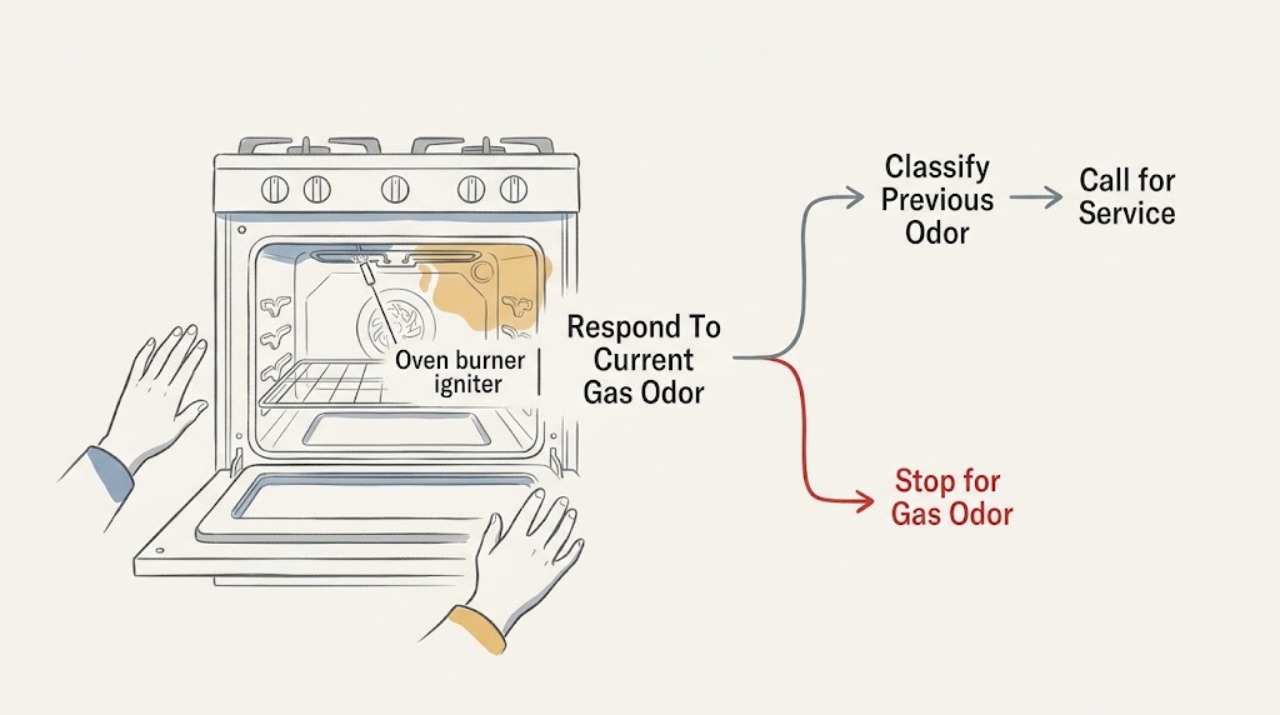
Work through in order
Diagnostic checks
Use only checks that match the exact appliance or system and its official guide.
-
Check 1
If a gas or rotten-egg odor is present now, stop troubleshooting, do not ignite the oven or another burner, do not touch switches or electrical equipment, and leave the building by the safest available route without moving the appliance.
Expected result: From outside or another safe location, note whether the odor was strong or persistent, whether anyone has dizziness or headache, whether hissing was heard, and whether the odor was present with the oven off; do not return indoors to gather more evidence.
Next step: Contact the gas supplier or emergency services from outside or another safe location and follow their instructions. Do not re-enter or restore appliance use until the appropriate authority or qualified professional says it is safe.
Stop if: Do not use a phone inside, operate a switch, light a flame, smoke, start the oven, or move the range to find the source.
Why this matters
Why: A current or uncertain unburned-gas odor is a possible gas leak, regardless of whether the igniter may also be faulty. Symptoms, hissing, or odor while off increase the need for immediate emergency and gas-supplier response rather than appliance diagnosis.
-
Check 2
Only after the area has been declared safe and no gas odor remains, reconstruct the last event from memory or notes without operating the oven again: record whether the smell was brief and faint during initial ignition, lasted beyond startup, occurred after the oven was off, or followed a failed ignition attempt.
Expected result: Record any delay before the flame appeared, failure to heat, boom or popping sound, flame abnormality, repeated ignition attempts, or need to turn the control off; do not infer a safe condition from the absence of an odor later.
Next step: Keep the oven off and give the event sequence to a qualified appliance or gas professional; include whether the cooktop burners or other gas appliances had any odor without testing them.
Stop if: Do not repeat an ignition attempt to measure the delay, manually light the oven, remove the oven bottom, or watch an exposed burner while gas is available.
Why this matters
Why: A brief, faint startup odor can be described by some manufacturers as combustion during ignition, while persistent odor, odor while off, delayed ignition, no heat, or a boom is an abnormal pattern requiring service. The pattern cannot identify the failed part by itself.
-
Check 3
With no odor present and without turning on a burner or moving the appliance, visually confirm from the normal operating position that the oven and cooktop controls are fully off and record the oven model and fuel type from an accessible label or manual.
Expected result: Note a control that is not fully off, a knob that is hard to turn, a control display or indicator that behaves unexpectedly, a missing manual, or an unknown fuel conversion; do not reach behind the range or open a panel.
Next step: If any control is abnormal or the fuel type is uncertain, leave the appliance off and report it. Otherwise preserve the model information and proceed only to service scheduling, not another ignition test.
Stop if: Do not turn a control on to see whether gas flows, pull the range out, inspect the rear connector, or enter a service mode.
Why this matters
Why: A control not fully off can account for gas flow at a burner, but a normal-looking control does not rule out a valve, igniter, connector, or control fault. Model and fuel information is needed for a safe professional diagnosis and does not authorize user disassembly.
-
Check 4
Without opening the oven or repeating the fault, gather the exact symptoms that accompanied the suspected burner-igniter problem: whether the oven heated, whether ignition was delayed, whether a flame was seen during the prior event, and whether the odor stopped when the control was turned off.
Expected result: Classify the history as no ignition or no heat, delayed ignition, repeated clicking or cycling, a normal quick ignition with only a brief odor, odor after shutoff, or an unknown sequence.
Next step: Keep the oven out of service and provide the symptom classification and model to a qualified appliance or gas professional; ask them to verify the complete ignition and gas-safety sequence.
Stop if: Do not test igniter glow, measure gas pressure, bypass a safety valve, manually light the oven, or replace a burner igniter yourself.
Why this matters
Why: No heat or delayed ignition can involve the igniter, burner, safety valve, controls, or gas supply. A normal quick ignition with no continuing odor is less suggestive of a current leak, but a history of odor after shutoff or an unknown sequence cannot be cleared by visual inspection.
-
Check 5
Leave the oven and suspected appliance unused while arranging qualified service; if a gas professional or emergency responder has identified a safe appliance shutoff procedure, follow only that instruction and do not move the range or disturb the connector.
Expected result: Before service, note whether any odor returns while the appliance remains off, whether the accessible area stays free of odor, and whether the gas supplier or responder has isolated the appliance or building supply; do not reopen a closed supply yourself.
Next step: Give the professional the odor timing, ignition history, model, fuel type, and any official instructions already received. Resume use only after the qualified person confirms the appliance and gas system are safe.
Stop if: Stop and leave again for any returning gas odor, hissing, symptoms, or uncertainty about whether gas has been isolated.
Why this matters
Why: Returning odor while the appliance is off points away from a simple igniter-only symptom and may involve the appliance gas path, connector, supply, or another source. A no-odor period does not prove that the ignition system is safe to operate.
Use your observations
Decision map
Find the observation that best matches what you see, then follow the next safe action.
-
PATH 01Safety boundary
What you see
The odor is present now, is described as rotten egg or unburned gas, persists after the oven is off, or its source cannot be ruled out; hissing or symptoms may be present.
Do this next
Leave immediately, avoid flames, switches, phones, and electrical equipment inside, and contact the gas supplier or emergency services from outside or another safe location.
Why this path and its safety boundary
Why it matters: Treat this as a possible gas leak, not an igniter troubleshooting opportunity. The igniter may be one failed component, but the source could also be a valve, connector, supply, or another appliance.
Safety stop: Do not re-enter to inspect the igniter, close an inaccessible valve, move the range, or repeat ignition attempts.
-
PATH 02Safety boundary
What you see
The area is safe, the prior odor was brief and faint only at startup, the oven ignited promptly and heated, and no odor returned with the appliance off.
Do this next
Do not repeat a test solely to confirm the smell. Record the model and event, follow the owner's operating guidance, and arrange service if the odor becomes stronger, lasts longer, returns when off, or ignition behavior changes.
Why this path and its safety boundary
Why it matters: Some manufacturer guidance describes a short initial combustion odor as a normal startup characteristic, but this history does not prove the igniter or gas system is fault-free.
Safety stop: Stop use and apply the gas-odor emergency response for any persistent or uncertain unburned-gas smell, delayed ignition, boom, or abnormal flame.
-
PATH 03Safety boundary
What you see
The oven failed to heat, ignition was delayed, the oven made a boom or forceful pop, or gas odor remained after a start attempt.
Do this next
Keep the appliance off and arrange qualified appliance or gas service; provide the exact delay or sound, whether a flame appeared, and whether odor remained after shutoff.
Why this path and its safety boundary
Why it matters: The ignition sequence is abnormal. A failed or weak igniter is possible, but the burner, safety valve, controls, airflow, or gas supply also require evaluation.
Safety stop: Do not start the oven again, manually ignite it, watch an exposed burner, bypass the safety valve, or replace the igniter as a guess.
-
PATH 04Safety boundary
What you see
The oven was off but a gas odor appeared, a control was not fully off, or another appliance may have been operating; the igniter event is not established.
Do this next
If any odor remains or returns, leave and contact the gas supplier or emergency services from safety. If no odor remains, keep the suspect appliance off and have a professional identify the source before use.
Why this path and its safety boundary
Why it matters: The odor cannot be assigned to the burner igniter. A control, connector, supply, cooktop burner, or another gas appliance may be involved.
Safety stop: Do not turn other gas appliances on to compare them, move the range, or search behind it for a connector leak.
-
PATH 05Safety boundary
What you see
The range would need to be pulled out, a wall oven panel would need removal, the connector is behind the appliance, or the gas shutoff is unknown or inaccessible.
Do this next
Leave the appliance in place and arrange qualified gas or appliance service, giving the model, installation type, odor history, and any accessible signs of damage without disturbing them.
Why this path and its safety boundary
Why it matters: The suspected gas path is outside safe ordinary-user access. Moving or opening the appliance can create a leak or ignition hazard.
Safety stop: Do not move the appliance, remove panels, loosen gas fittings, or inspect the connector yourself.
-
PATH 06Safety boundary
What you see
The odor has stopped, but the ignition sequence, duration, fuel type, or source is unknown and no safe official model procedure is available.
Do this next
Keep the oven off and give a qualified professional all known facts, including when the odor occurred and whether anyone felt symptoms. Do not create a new test event.
Why this path and its safety boundary
Why it matters: The absence of current odor is not enough evidence to clear the appliance; an igniter fault and a gas leak have not been separated.
Safety stop: Stop for any returning odor, hissing, symptoms, or request to open or manually ignite the appliance.
Helpful context
Understand the symptom
Treat the odor as gas until the immediate risk is excluded
A burner igniter is part of the ignition sequence, but the smell does not identify whether the igniter, safety valve, burner, control, connector, or another gas appliance is involved. A brief combustion odor during a normal startup is different from the distinctive odor of unburned gas. Do not stay inside to compare smells, listen for the leak, or open the range to look for the igniter.
A delayed ignition is a service symptom, not a DIY test
If the oven takes noticeably longer to ignite, fails to light, makes a boom or door-blowing event, or leaves a gas smell after an attempted start, the burner may be receiving gas before ignition is established. Manufacturer guidance treats delayed ignition and persistent unburned-gas odor as service conditions. Keep the oven off and report exactly what happened rather than repeating the start cycle.
Do not move a range to inspect the connector
The gas connector behind a range can be damaged by movement, and the Consumer Product Safety Commission warns that only a qualified professional should inspect or replace it. A wall oven or built-in unit may have no user-accessible appliance shutoff. Leave the appliance in place and give the professional the model and odor history.
Safety boundary
Stop conditions
- If gas or rotten-egg odor is present or uncertain, leave immediately and contact the gas supplier or emergency services from outside or another safe location.
- Do not light the oven or another burner, manually ignite gas, touch electrical switches, use a phone inside, smoke, or create a spark while gas may be present.
- Do not move the range to inspect the connector, remove oven panels, loosen gas fittings, measure gas pressure, or bypass a safety valve.
- Do not repeat a delayed ignition or no-heat event to see whether the igniter works; keep the appliance off until qualified service clears it.
- Do not replace an igniter from the symptom alone; the burner, safety valve, controls, connector, supply, and other gas appliances may require assessment.
Only after diagnosis
Potential parts
- oven burner igniter
Consider this category only when a qualified diagnosis confirms a failed or weak igniter as the cause of delayed ignition or no heat and rules out an active gas leak and other ignition components.
Confirm the exact oven model, fuel type, igniter design, wiring, mounting, and manufacturer's fit information; do not order or install from the odor symptom alone. - oven safety valve or ignition-control component
Consider this category only if qualified testing identifies a valve or control fault after gas safety has been established and the igniter and burner path are evaluated.
Use the exact model and fuel configuration confirmed by a qualified professional; gas-safety components require professional installation and verification. - gas appliance connector
Consider this category only when a qualified professional identifies connector damage, corrosion, or an outdated connector as the confirmed source or required safety repair.
Do not move the range or inspect or replace the connector yourself; the professional must confirm the connector type, installation, and applicable requirements.
When checks do not resolve it
Need a professional?
Use the gas-leak emergency response immediately for a current, persistent, rotten-egg, or uncertain gas odor, hissing, symptoms, or odor while the oven is off. Arrange qualified appliance or gas service for delayed ignition, no heat, a boom or forceful pop, repeated odor after startup, an unknown ignition sequence, an inaccessible connector or shutoff, or any need to open, move, or disassemble the appliance.
Safety scope: This article permits only safe observation from outside the hazard area and non-invasive record gathering after the area is declared safe. It does not authorize ignition tests, manual lighting, range movement, panel removal, gas-fitting work, pressure measurement, or igniter replacement.
Common questions
FAQ
Is it normal for a gas oven to smell like gas when it starts?
Some manufacturer guidance describes a brief, faint odor during initial ignition as a normal combustion characteristic. A persistent or strong odor, odor while the oven is off, delayed ignition, no heat, a boom, or uncertainty about the smell is not a safe normal condition: leave if gas may be present and arrange qualified service.
Can a bad oven igniter cause a gas smell?
A weak or failed igniter can delay ignition or leave the oven unable to heat, so an igniter is one possible cause. It is not the only possibility; a valve, burner, control, connector, supply, or another appliance can also be involved. Do not test or replace it while gas may be present.
What should I do if I smell gas from the oven when it is off?
Do not investigate the igniter. Leave immediately, avoid flames, electrical switches, and phones inside, and contact the gas supplier or emergency services from outside or another safe location. Do not return or use the oven until the appropriate professional clears it.
Can I manually light a gas oven if the igniter is bad?
Do not manually light the oven. A gas oven's ignition and safety-valve sequence is model-specific, and manual lighting can expose you to unburned gas or flame. Keep the oven off and use qualified appliance or gas service.
Should I pull the range out to inspect the gas connector?
No. The CPSC warns that moving a range can damage an older connector and says connector inspection or replacement is for a qualified professional. Leave the appliance in place and report the odor and model information.
When should an oven burner igniter gas smell get professional attention?
Use the emergency gas response for a current, persistent, rotten-egg, or uncertain odor, hissing, symptoms, or odor while the oven is off. Arrange qualified service for delayed ignition, no heat, a boom or forceful pop, repeated odor after startup, an inaccessible connector, or any repair requiring panels or gas fittings.
Read the exact guide
Official sources
- Range SafetyWhirlpool · Whirlpool range safety manual; the installed appliance manual and local gas requirements control a specific model.
- Certain Older Gas Connectors May Be DangerousU.S. Consumer Product Safety Commission · CPSC consumer safety bulletin for gas appliances and connectors; emergency instructions apply when a gas leak is suspected, while connector details are model and installation dependent.
- Gas Range - What is Normal Operation vs What Requires ServiceGE Appliances · GE gas-range support guidance; operating behavior and service steps vary by model and fuel configuration.
- Why does my oven smell like gas?Whirlpool · Whirlpool consumer guidance; brief ignition odor and troubleshooting examples do not clear another brand or model from a gas-safety concern.
- Gas Range & Wall Oven - Oven Will Not Come OnGE Appliances · GE gas range and wall-oven support page; it is not permission to inspect or repair an oven when gas odor is present.
Community feedback
Share a repair observation
Share a plain-text repair observation. Accepted observations are published automatically; this page may take a moment to update.