
On this page
Start here
Quick answer
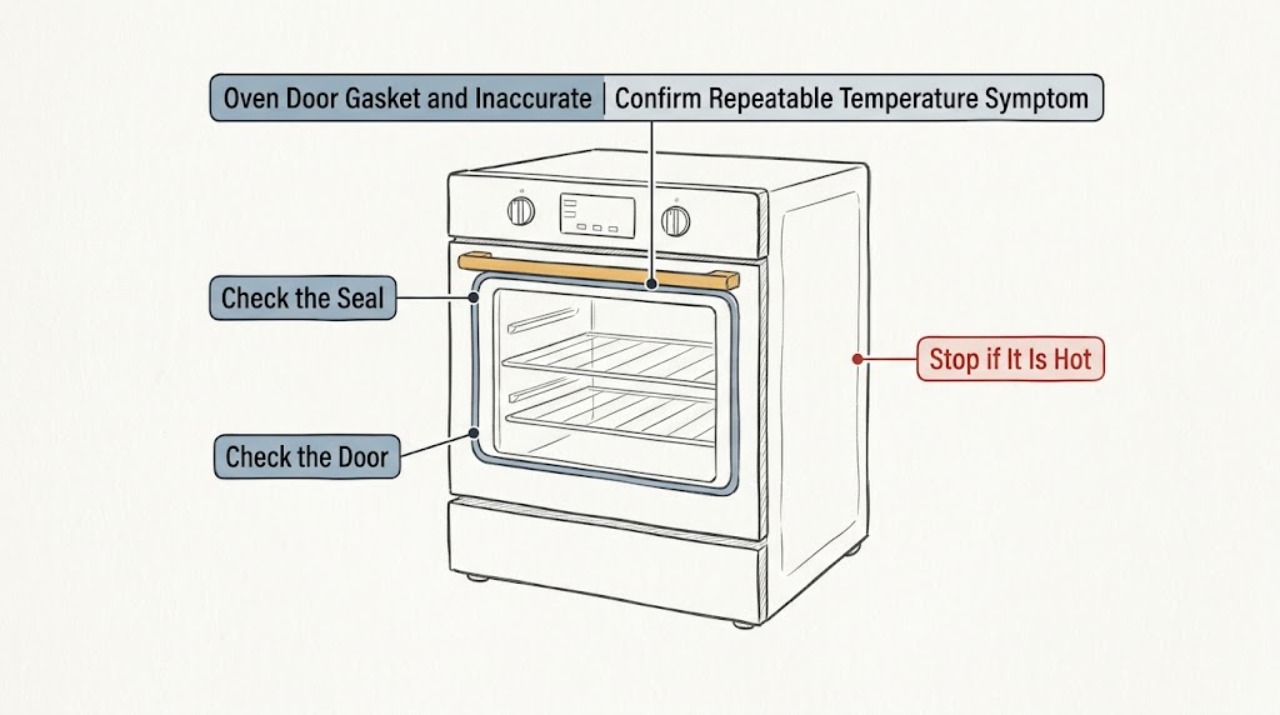
A damaged or displaced oven door gasket can let heat escape and make an oven struggle to reach or hold temperature, but a temperature that seems inaccurate is not automatically a gasket failure. Ovens normally cycle above and below the set temperature, and readings change with rack position, pan placement, door openings, preheat time, and thermometer location. With the oven cold, inspect the gasket and door closure for a tear, gap, displacement, or hinge misalignment without rubbing or pulling the gasket. If the gasket is intact, use the manufacturer's controlled bake or thermometer check and follow the exact model's calibration instructions; gas ovens with analog controls may need a technician. Stop using the oven for smoke, scorching, a door that will not close, exposed insulation, or electrical or gas symptoms, and have a qualified appliance technician replace or diagnose parts. Do not calibrate around a major heat leak or order a universal gasket by appearance.
Before you begin
Safety first
- The technician should determine whether the inaccurate result comes from the door gasket or hinge, sensor, heating element, burner, control, insulation, airflow, power, or calibration before selecting a part.
Work through in order
Diagnostic checks
Use only checks that match the exact appliance or system and its official guide.
-
Check 1
Use the oven's normal preheat and cooking procedure with the recommended rack and pan placement, keeping the door closed as much as possible; record whether the same food is consistently underdone, overdone, uneven, or only different on one occasion.
Expected result: The result repeats across controlled attempts, changes with rack or pan position, occurs after frequent door openings, or cannot be reproduced.
Next step: Record the recipe, rack, pan, preheat, and result, then inspect the cold gasket and door before considering calibration or service.
Stop if: Do not keep cooking through smoke, scorching, a gas odor, unusual flame, a damaged door, or an oven that cannot close safely.
Why this matters
Why: A repeatable result supports a temperature, sealing, airflow, sensor, element, burner, or calibration issue. A position- or door-opening-dependent result may reflect heat circulation or measurement rather than the gasket, while an unreproducible result is not enough to select a part.
-
Check 2
With the oven completely cool, visually inspect the door gasket around its full accessible path for a tear, fray, detachment, flattening, gap, or section outside its channel; do not rub, pull, wet, or stretch it.
Expected result: The gasket is torn, frayed, detached, flattened, displaced, visibly gapped, or appears intact.
Next step: Photograph the defect and model label and arrange model-specific service; if the gasket appears intact, continue with door-closure and controlled-temperature checks.
Stop if: Do not remove or clean a woven gasket, force it into place, use adhesive, or operate the oven with a loose gasket, exposed insulation, smoke, or scorching.
Why this matters
Why: A compromised gasket can allow heat loss and contribute to poor temperature retention, but an intact gasket makes sensor, heating, burner, control, hinge, airflow, or calibration issues more likely. A visual defect does not establish the exact replacement part.
-
Check 3
With the oven cold and empty, close the door normally and check from the front whether it sits evenly; verify that racks, pans, or a displaced door are not preventing the seal from meeting the cavity, without removing the door or forcing hinges.
Expected result: The door closes evenly, a rack or pan blocks closure, the door is crooked or loose, the gasket gap is uneven, or the hinge or door cannot be checked safely.
Next step: Remove only an obvious rack or pan obstruction when the oven is cold; otherwise document the alignment and arrange appliance service before further temperature testing.
Stop if: Do not lift or remove the door, bend hinges, force the latch, or continue heating with an uneven, loose, or damaged door.
Why this matters
Why: A blocked or misaligned door can leak heat even when the gasket itself is not torn. A crooked door, hinge problem, or unsafe access can require service and may make calibration misleading.
-
Check 4
If the door and gasket are intact and the oven has no safety symptom, follow the exact manufacturer temperature-check procedure, placing any approved thermometer or test food as directed and avoiding door openings that would change the reading.
Expected result: The controlled test is consistent with the manual, the result is repeatedly high or low, the result varies by rack or pan, or the test cannot be completed as directed.
Next step: Record the model, test method, rack, pan, and result. Use calibration only if the manual permits it and the door seals correctly; arrange service for persistent error or an unsafe test.
Stop if: Do not place a thermometer against a heating element, leave the door open to compare readings, or calibrate an oven with smoke, scorching, gas or electrical symptoms, or a major heat leak.
Why this matters
Why: A repeatable high or low result after a sound seal supports calibration or a heating, sensor, burner, element, or control diagnosis. Rack or pan variation points toward circulation or placement, while an incomplete test cannot establish a gasket fault.
-
Check 5
Identify whether the oven uses digital or analog temperature control and read the model's use and care manual for calibration options; do not turn an analog control screw or change a gas-oven setting unless the manual and a qualified technician authorize it.
Expected result: The manual provides calibration, calibration is unavailable, the oven has analog gas controls, or the model instructions are missing or unclear.
Next step: Use only the documented user calibration feature when permitted; otherwise provide the model and test record to a qualified appliance technician.
Stop if: Do not disassemble controls, adjust gas or burner settings, remove a sensor, or calibrate around a damaged gasket, hinge, element, burner, or insulation problem.
Why this matters
Why: Calibration is model- and control-dependent and can adjust user preference only when the oven is otherwise operating correctly. An analog gas control or unclear instruction raises the risk of changing combustion or temperature behavior incorrectly.
-
Check 6
Photograph the model label, cold gasket and door alignment, control type, test setup, cooking result, and any smoke, scorching, unusual flame, odor, or error indication for the appliance technician.
Expected result: The gasket is damaged, the door is misaligned, temperature remains inaccurate after a sound-seal check, calibration is unavailable or ineffective, or any safety symptom is present.
Next step: Keep the oven unused when a safety symptom or major sealing defect is present and arrange qualified appliance service; give the technician the complete record rather than ordering a generic part.
Stop if: Do not replace the gasket, sensor, element, burner, or control by appearance alone and do not keep operating an oven that smokes, scorches, leaks gas, or cannot close safely.
Why this matters
Why: A persistent error can involve the gasket, hinge, sensor, heating element, burner, control, insulation, airflow, or calibration rather than one confirmed part. Safety symptoms require the oven to remain out of service.
Use your observations
Decision map
Find the observation that best matches what you see, then follow the next safe action.
-
PATH 01Next step
What you see
The cold gasket is torn, frayed, detached, displaced, flattened, or leaves a clear uneven gap and cooking is consistently slow or cool.
Do this next
Keep the oven out of service if the gap is major or there is scorching or smoke, photograph the model, and arrange model-specific service for the gasket and temperature check.
Why this path and its safety boundary
Why it matters: Heat loss through the door seal is more likely, but the gasket defect does not rule out a sensor, heating, burner, hinge, or control problem.
-
PATH 02Next step
What you see
The gasket and door close evenly, but a controlled test repeatedly shows the oven hotter or cooler than expected.
Do this next
Use only the model's documented calibration option if available; arrange appliance service if the error persists or the control type is gas analog or unclear.
Why this path and its safety boundary
Why it matters: Calibration, sensor, heating element, burner, control, airflow, or power issues are more likely than a door-gasket repair.
-
PATH 03Next step
What you see
A rack or pan blocks closure, the door is crooked or loose, the gasket gap is uneven, or a hinge was disturbed.
Do this next
Remove only an obvious cold rack or pan obstruction; leave a misaligned or loose door unused and arrange service before further testing.
Why this path and its safety boundary
Why it matters: Door alignment, hinge, or interference is more likely than a temperature calibration issue and can cause heat loss even when the gasket is not torn.
-
PATH 04Next step
What you see
The gasket and door are sound, the result changes with rack, pan, or door opening, and a repeatable controlled test does not show a consistent error.
Do this next
Follow the cooking guide for preheat, rack, pan, and convection settings and monitor for a repeatable change; request service if the symptom becomes consistent or unsafe.
Why this path and its safety boundary
Why it matters: Normal cycling, heat circulation, pan placement, preheat, or thermometer location is more likely than a failed door gasket.
-
PATH 05Next step
What you see
Smoke, scorching, exposed insulation, gas odor, unusual flame, electrical smell, a door that will not close, or another unsafe condition is present.
Do this next
Stop using the oven and arrange urgent qualified appliance service; for gas odor, leave the area and contact emergency services or the gas utility from a safe location.
Why this path and its safety boundary
Why it matters: The oven may have a combustion, electrical, structural, insulation, or major sealing hazard that cannot be corrected by calibration or a gasket guess.
Helpful context
Understand the symptom
Confirm a real temperature problem before blaming the gasket
An oven's heating system cycles to maintain an average temperature, so a single thermometer reading or one pan can be misleading. Preheat fully, use the recommended rack and pan position, keep space for air circulation, and avoid opening the door while judging the result. Compare a repeatable cooking result with the manufacturer's test or manual before adjusting calibration.
Inspect the cold gasket and door closure without damaging them
When the oven is cold, look around the door gasket for tears, fraying, detachment, flattening, or a section outside its channel. Check that the door closes evenly and that a rack or pan is not preventing closure. Some heat movement around a door can be normal; scorching, smoke stains, a major gap, or an uneven door calls for service. Do not scrub, pull, or stretch the gasket.
Calibration comes after sealing and measurement checks
If the gasket and door are sound and a repeatable test still shows a preference for hotter or cooler results, use the model's calibration feature only as described in its manual. Digital and analog controls differ, and an analog gas oven may require certified service. Calibration cannot correct a burner, element, sensor, control, hinge, insulation, or major door-sealing fault.
Safety boundary
Stop conditions
- Stop using the oven for smoke, scorching, exposed insulation, gas odor, unusual flame, electrical smell, a door that will not close, or any unsafe condition.
- Do not rub, wet, pull, stretch, glue, or force the door gasket, and do not bend hinges or remove the oven door as an ordinary temperature check.
- Do not open control panels, adjust gas or burner settings, remove sensors or heating parts, or perform live electrical work.
- Do not calibrate around a major heat leak or order a universal gasket, sensor, burner, element, or control by appearance alone; confirm the exact model and diagnosis.
- Arrange qualified appliance service for a damaged gasket, misaligned door, persistent inaccurate temperature, ineffective calibration, analog gas controls, or any condition that cannot be checked safely.
Only after diagnosis
Potential parts
- oven door gasket
Consider this part only when a qualified technician confirms that the exact model's gasket is torn, displaced, hardened, or unable to seal and that the temperature complaint is not caused by another component.
Confirm the exact oven model, gasket style and channel, fuel type, and manufacturer fit information; oven gaskets are not universal.
When checks do not resolve it
Need a professional?
Use prompt service for a torn or displaced gasket, uneven door, persistent temperature error, calibration trouble, or suspected sensor, heating, burner, control, insulation, or hinge issue. Treat smoke, scorching, gas odor, abnormal flame, electrical smell, exposed insulation, or unsafe closure as urgent.
Safety scope: The technician should determine whether the inaccurate result comes from the door gasket or hinge, sensor, heating element, burner, control, insulation, airflow, power, or calibration before selecting a part.
Have this ready
- The oven model, fuel type, control type, and photos of the model label, door, gasket, and hinge area
- The recipe, rack and pan position, preheat procedure, cooking result, and whether the result repeats
- The controlled temperature-check method, thermometer or test-food placement, and observed result without repeated door opening
- Whether the gasket is torn, displaced, flattened, gapped, or intact and whether the door closes evenly
- Any calibration setting used according to the manual and any smoke, scorching, gas odor, unusual flame, electrical smell, or error indication
Common questions
FAQ
Can a damaged oven door gasket make the temperature inaccurate?
Yes. A torn, detached, displaced, or flattened gasket can let heat escape and affect temperature retention, but a gasket symptom does not rule out a sensor, heating, burner, control, hinge, airflow, or calibration issue.
Is some heat around the oven door normal?
Some heat movement around an oven door can be normal because ovens need controlled airflow. A major gap, uneven closure, scorching, smoke stains, exposed insulation, or consistently poor heating needs appliance service.
How can I check an oven gasket safely?
With the oven completely cold, look for tears, fraying, detachment, flattening, displacement, or a visible gap without rubbing, pulling, wetting, or stretching the gasket. Photograph any defect and arrange model-specific service rather than forcing it into place.
Why does my oven thermometer disagree with the set temperature?
Ovens cycle above and below the set temperature, and readings change with thermometer position, rack, pan, preheat, room conditions, and door openings. Use the manufacturer's controlled test before concluding that the gasket or thermostat has failed.
Should I calibrate the oven if the door gasket is damaged?
No. Correct the sealing problem through model-specific service first; calibration cannot fix a major heat leak and may hide a gasket, hinge, sensor, burner, element, or control fault.
When should I call an appliance technician?
Call for a damaged or displaced gasket, uneven door, repeatable inaccurate temperature, ineffective calibration, analog gas controls, smoke, scorching, gas odor, unusual flame, electrical smell, exposed insulation, or an oven door that will not close safely.
Read the exact guide
Official sources
- How to Calibrate Your Oven TemperatureMaytag · The opened Maytag manufacturer guide describes controlled temperature checks, advises keeping the door closed during testing, and notes that gas ovens with analog controls may require certified service.
- Range & Wall Oven - Oven Gasket Not Sealing ProperlyGE Appliances · The opened GE support article covers gasket sealing, normal airflow around an oven door, major heat leaks, scorching, smoke stains, hinges, and service.
- Oven - Is Not Hot EnoughFrigidaire · The opened Frigidaire support article connects poor heating with a damaged gasket or power issue, advises not pulling the gasket, and refers users to the model manual for calibration.
- Range & Wall Oven - Oven Temperature Is Not CorrectGE Appliances · The opened GE support article explains normal temperature cycling, measurement variation, preheat and rack effects, heat loss, and gasket inspection.
Community feedback
Share a repair observation
Share a plain-text repair observation. Accepted observations are published automatically; this page may take a moment to update.