
On this page
Start here
Quick answer
A gas smell at an oven door seal is not proof that the seal is the gas leak, because odor can travel from the burner, igniter, gas connection, vent, or another appliance. If you smell unburned gas now, do not troubleshoot or relight the oven: leave the building, avoid switches, flames, phones, and vehicles in the area, and call 911 or your gas utility from a safe location. Some manufacturers note that a brief, faint odor when a gas oven first ignites can fade as it heats, but unburned-gas odor in the home is not normal. Only after the area has been cleared by the gas utility or a qualified professional should you document whether the prior odor occurred during ignition, while heating, or with the oven off and have the appliance inspected. Do not remove the door, replace the gasket, test a valve, or operate the oven to reproduce the smell.
Before you begin
Safety first
- The gas utility or qualified technician should establish whether the source is the supply, connector, valve, igniter, burner, combustion or vent path, control, door seal, or another appliance before selecting a repair.
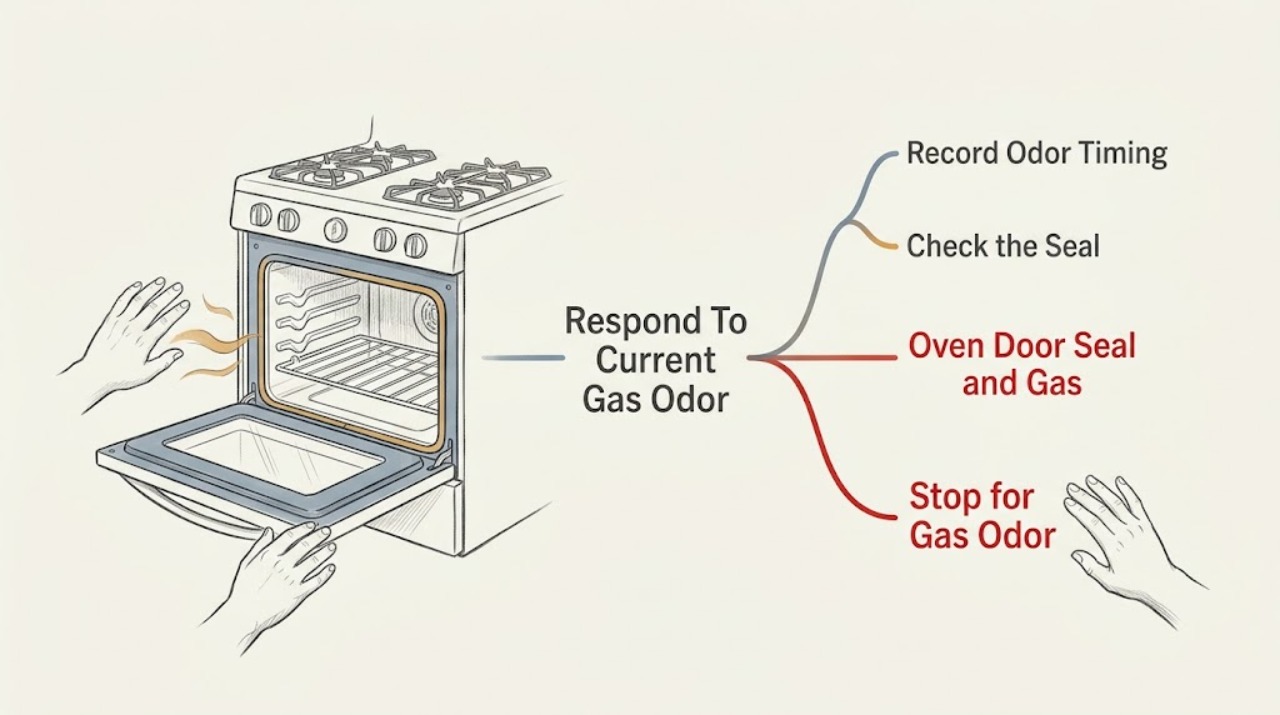
Work through in order
Diagnostic checks
Use only checks that match the exact appliance or system and its official guide.
-
Check 1
If gas odor is present now, stop using the oven and leave the building with all occupants; avoid switches, flames, phones, vehicles, and anything else that could create an ignition source while leaving.
Expected result: The odor is strong or persistent, anyone feels unwell, a hissing sound or visible flame is present, or the odor has cleared before everyone exits.
Next step: From a safe location, call 911 or the gas utility and follow responder instructions. Do not return, relight the oven, or troubleshoot the door seal until the area is declared safe.
Stop if: Do not use a phone, light switch, appliance control, match, flashlight, or vehicle in the odor area, and do not search for the leak yourself.
Why this matters
Why: Any current gas odor may indicate unburned gas, and smell strength or disappearance cannot safely prove that the appliance or home is clear. Illness, hissing, or flame raises the urgency further.
-
Check 2
After the gas utility or emergency responder has cleared the area, write down when the prior odor was noticed: during first ignition, while heating, after the oven was turned off, with the oven unused, or after another appliance operated; do not turn the oven on to recreate it.
Expected result: The odor was brief at initial ignition, continued while heating, appeared with the oven off, returned between uses, or the timing is unknown.
Next step: Keep the oven out of service and give the timing, location, and any responder findings to a qualified gas-appliance technician; treat a recurring or off-cycle odor as urgent.
Stop if: Do not perform another ignition, sniff inside the cavity, use a flame, apply leak-detection liquid, or remove panels to compare odors.
Why this matters
Why: A brief ignition-time odor can have a different explanation from an odor that continues, occurs while off, or returns between uses. Timing narrows the service diagnosis but cannot rule out a leak or prove that the door seal is the source.
-
Check 3
Only after a professional has declared the appliance safe to inspect and it is cool, photograph the door gasket in place without removing it; look for a visible tear, displacement, hardening, flattened section, or gap in the channel.
Expected result: The gasket is visibly damaged or out of its channel, the gasket appears intact, the door does not close evenly, or inspection cannot be made without disassembly.
Next step: Leave the gasket and door assembled, record the model, and have the technician decide whether the gasket needs replacement and whether a separate gas-safety repair is required.
Stop if: Do not remove the door or gasket, reach around the burner, open the appliance cabinet, or operate the oven to compare the seal.
Why this matters
Why: A visible gasket defect may explain heat or odor escape but does not prove a gas leak or identify the failed gas component. An intact gasket shifts attention toward ignition, burner, vent, control, or gas-path diagnosis.
-
Check 4
From outside the appliance and only when the area is declared safe, record whether the odor was also noticed near the cooktop, gas connection area, another gas appliance, or the room ventilation path; do not move the range or touch a gas fitting.
Expected result: The odor is limited to the oven area, present near another appliance or connection, associated with a vent or combustion concern, or the source cannot be localized safely.
Next step: Keep all suspect gas appliances off and provide the observation to the gas utility or qualified technician. Let responders determine whether the supply, appliance, vent, or seal is involved.
Stop if: Do not move the appliance, close an unfamiliar gas valve, disconnect a connector, block a vent, or use a flame or detector as a substitute for professional clearance.
Why this matters
Why: Odor outside the door area makes a broader gas-line, neighboring-appliance, ventilation, or combustion issue possible; odor location alone cannot identify a door-seal failure.
-
Check 5
Photograph the appliance model label, door and gasket, control panel, burner or ignition symptoms already observed without retesting, and any responder notes for the qualified gas-appliance technician.
Expected result: The exact model is known, only the brand or style is known, the odor recurs, the oven fails to ignite normally, or the appliance has not been professionally cleared.
Next step: Leave the oven unused and arrange prompt service by a qualified gas-appliance technician or gas supplier. Do not order a gasket or gas component as a substitute for leak diagnosis.
Stop if: Do not reconnect, relight, disassemble, or continue using the oven while a gas odor, ignition fault, or unresolved service finding remains.
Why this matters
Why: The model determines the correct service instructions and gasket or burner parts, while recurrence, ignition trouble, and lack of clearance keep the gas-safety risk unresolved.
Use your observations
Decision map
Find the observation that best matches what you see, then follow the next safe action.
-
PATH 01Next step
What you see
Gas odor is present now, persists, returns while the oven is off, or is accompanied by hissing, illness, or an unusual flame.
Do this next
Leave immediately, avoid ignition sources, and call 911 or the gas utility from outside. Do not return until responders clear the area.
Why this path and its safety boundary
Why it matters: A gas leak or combustion problem cannot be excluded, and the door gasket is not a safe diagnosis or repair boundary.
-
PATH 02Next step
What you see
A qualified responder has cleared the area and the prior odor was a brief, faint event at first ignition that did not continue or recur.
Do this next
Follow the exact owner manual and have recurring odor, delayed ignition, abnormal flame, or any uncertainty assessed before normal use.
Why this path and its safety boundary
Why it matters: A short ignition-time odor can be consistent with the manufacturer's described startup odor, but this pattern still does not prove the seal or gas system is sound.
-
PATH 03Next step
What you see
After professional safety clearance, the cool door gasket is visibly torn, displaced, hardened, flattened, or unable to sit in its channel.
Do this next
Give the model and photographs to the qualified technician and replace the gasket only through the model-specific service procedure.
Why this path and its safety boundary
Why it matters: A door-seal repair may be warranted for heat retention or odor escape, but the defect does not identify or eliminate a separate gas leak, ignition, burner, or vent problem.
-
PATH 04Next step
What you see
The gasket appears intact after clearance, or odor was noticed near the cooktop, another appliance, a connection area, or a vent rather than only at the door.
Do this next
Keep the suspect appliance off and have the gas utility or qualified technician locate and test the source; do not move or open the appliance.
Why this path and its safety boundary
Why it matters: A door-seal replacement is less supported; a gas path, ignition, burner, ventilation, neighboring appliance, or broader supply issue remains possible.
-
PATH 05Next step
What you see
The smell pattern is unknown, the model is unavailable, the oven has not been cleared by a gas professional, or the odor returns after service.
Do this next
Keep the oven out of service, report any current odor from a safe location, and arrange qualified gas-appliance service before further operation.
Why this path and its safety boundary
Why it matters: The source and risk remain unresolved; a door seal cannot be used as a proxy for a gas-leak inspection.
Helpful context
Understand the symptom
Treat the odor as a gas-safety event first
A smell near the door may be where odor exits the oven, not where gas is leaking. If the odor is present now, do not open the oven to look, turn controls, use a light switch, light a flame, or call from inside. Leave with everyone else and contact the gas utility or emergency services from outside. Do not return to test the seal until the responsible utility or responder says the area is safe.
A brief ignition odor is different from unburned gas, but timing is not a home leak test
Manufacturer guidance acknowledges that a brief odor can occur when a gas oven first starts and may fade as the burner heats. That does not make a continuing, strong, rotten-egg-like, or off-cycle odor safe to investigate. Record the timing only from the safe location and never relight the oven to reproduce it.
The seal is a conditional repair, not a diagnosis
After a gas professional has cleared the appliance for inspection, a technician can examine whether the door gasket is torn, displaced, hardened, or unable to sit in its channel. A visible gasket defect can affect heat retention or allow odor to escape, but it does not identify the gas source. The technician should also assess ignition, burner operation, venting, controls, and gas connections using the exact model instructions.
Safety boundary
Stop conditions
- If gas odor is present now or returns, leave immediately, avoid switches, flames, phones, and vehicles in the area, and call 911 or the gas utility from outside.
- Do not relight the oven, turn controls, sniff inside the cavity, use a flame, move the range, or search for a gas leak yourself.
- Do not remove the door, gasket, burner cover, panels, gas connector, valve, igniter, or vent parts as an ordinary-user troubleshooting step.
- Do not order or install a door gasket or gas component as a substitute for leak, ignition, combustion, or ventilation diagnosis; model-specific service is required.
- Arrange qualified gas-appliance or utility service before operation for recurring, off-cycle, strong, or unexplained odor, delayed ignition, abnormal flame, hissing, illness, or any unsafe condition.
Only after diagnosis
Potential parts
- oven door gasket
Consider this part only after a qualified technician confirms that the exact model's gasket is damaged or displaced and separately rules out a gas leak, ignition, burner, vent, or supply problem.
Confirm the exact oven model, gasket channel and installation procedure through the manufacturer; a door gasket is not a universal gas-leak repair.
When checks do not resolve it
Need a professional?
Use emergency gas-safety response for current or strong odor, hissing, illness, flame, or suspected leak. Use prompt qualified appliance service after the area is cleared for recurring odor, delayed ignition, abnormal flame, a damaged door gasket, or any unresolved model-specific gas-path concern.
Safety scope: The gas utility or qualified technician should establish whether the source is the supply, connector, valve, igniter, burner, combustion or vent path, control, door seal, or another appliance before selecting a repair.
Have this ready
- The appliance model and fuel type, photographed from a safe location without moving or opening the range
- When the odor was noticed, whether the oven was igniting, heating, off, or unused, and whether it recurred
- Whether the odor was also noticed near the cooktop, another gas appliance, a connection area, or a vent
- Any responder or gas-utility findings, and whether the appliance was cleared before inspection
- Photos of the cool door gasket and door alignment only after professional safety clearance, plus any prior service record
Common questions
FAQ
Can a worn oven door seal cause a gas smell?
A damaged seal may let odor escape near the door, but the location does not prove that the gasket is the gas source. A burner, igniter, gas connection, vent, control, or another appliance may be involved, so a gas professional must assess the appliance before a gasket is replaced.
What should I do if I smell gas from the oven right now?
Do not troubleshoot or relight it. Leave the building, avoid switches, flames, phones, and vehicles in the odor area, and call 911 or your gas utility from a safe location. Do not return until responders or the utility say it is safe.
Is a brief gas smell when a gas oven starts normal?
GE and Whirlpool describe a possible brief odor during initial ignition or preheating that should fade, but unburned-gas odor in the home, a continuing smell, an off-cycle smell, or a recurring smell is not a home test to dismiss. Leave and report any current or concerning odor.
Should I replace the oven gasket first?
No. Do not replace the gasket as a guess or operate the oven to compare the seal. After the area is professionally cleared, have a qualified technician inspect the gasket and the separate ignition, burner, vent, control, and gas paths using the exact model information.
Why does the gas smell seem strongest at the oven door?
Odor can move through the oven cavity or vent and become noticeable at the door even when the source is elsewhere. The door location narrows where the odor is noticed, not which component has failed. A gas utility or qualified technician must locate the source.
When should I call for oven gas-smell service?
For any current or strong smell, leave and call 911 or the gas utility from outside. Arrange qualified gas-appliance service before further use for recurring or off-cycle odor, delayed ignition, abnormal flame, a damaged gasket, hissing, illness, or an unresolved source.
Read the exact guide
Official sources
- Why does my oven smell like gas?Whirlpool · The opened Whirlpool manufacturer article distinguishes brief preheating odor from suspected leaks and says not to investigate or resolve a suspected leak on one's own.
- If You Smell Gas in Your HomeGE Appliances · The opened GE safety page covers what to do when gas is smelled in the home, including avoiding switches, appliances, and phones inside.
- Whirlpool Range Owner's ManualWhirlpool Corporation · The opened Whirlpool owner manual states that gas leaks cannot always be detected by smell and assigns installation and service to qualified installers, agencies, or the gas supplier.
- Using Natural Gas SafelyAmerican Gas Association · The opened American Gas Association safety page explains the odorant used for natural gas and gives evacuation, ignition-source avoidance, and outside-call guidance.
- Gas Range - Gas OdorsGE Appliances · The opened GE support article distinguishes a possible brief startup odor from unburned-gas odor and gives immediate safety instructions.
Community feedback
Share a repair observation
Share a plain-text repair observation. Accepted observations are published automatically; this page may take a moment to update.