
On this page
Start here
Quick answer
Treat a gas smell from an oven with no flame, a flame that repeatedly goes out, or an abnormal flame as a safety issue until a qualified professional clears it. Do not relight the oven, use a match, touch electrical switches, use a phone inside, or keep testing; leave the building and call the gas supplier or emergency services from outside or a neighbor's location. A brief, faint odor during first ignition can occur on some gas ovens, and an orange glow can be an igniter rather than a burner flame, but unburned-gas or rotten-egg odor, a persistent smell, hissing, delayed ignition, a boom, yellow or sooty flame, dizziness, or a flame that is absent when gas is being released is not a user troubleshooting condition. After the area is declared safe, provide the oven model, fuel type, timing, and flame observations to a qualified appliance or gas professional.
Before you begin
Safety first
- This article is limited to evacuation, emergency reporting, and recording observations from a safe or professionally cleared location. A qualified gas professional must perform leak checks, connector inspection, burner and igniter work, regulator or air adjustment, pilot work, combustion testing, and any repair.
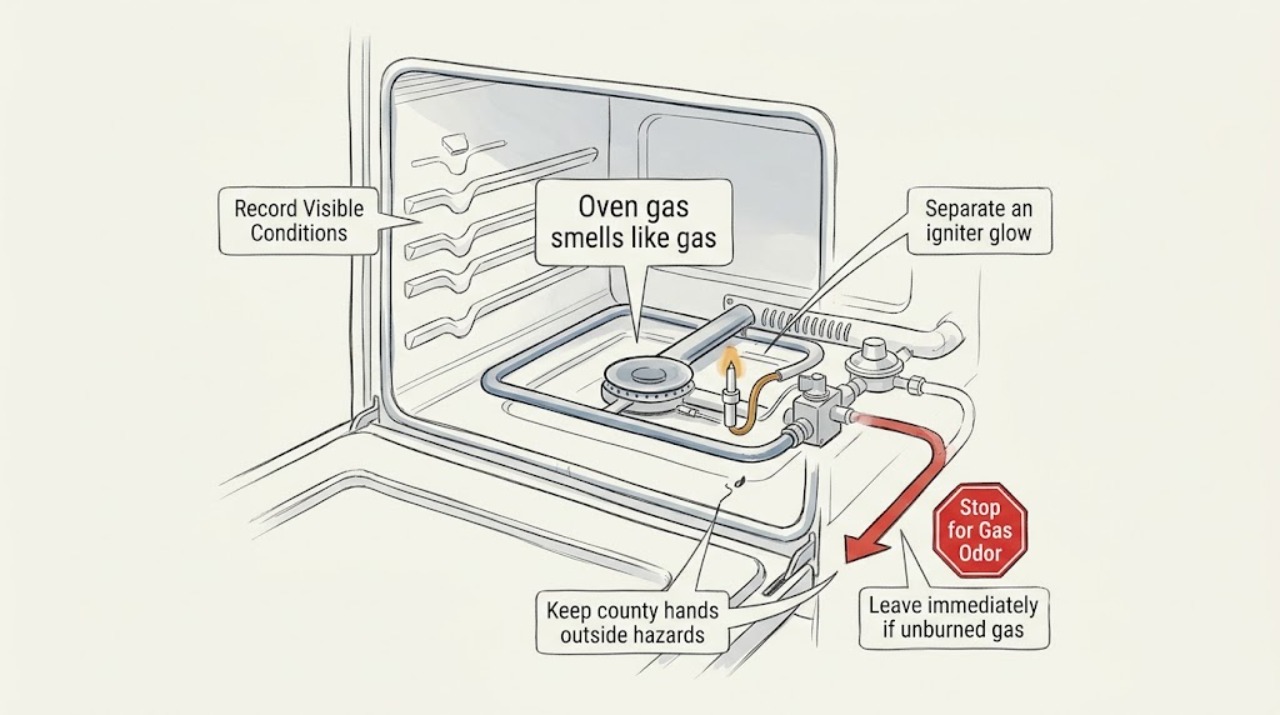
Work through in order
Diagnostic checks
Use only checks that match the exact appliance or system and its official guide.
-
Leave immediately if unburned gas is suspected
If you smell gas or a rotten-egg-like odor, hear hissing, feel ill, or see an absent or abnormal flame while the gas oven is on, do not relight it or operate any control. Warn others as you leave, avoid matches, switches, lights, phones, and other ignition sources, and call the gas supplier or emergency services from outside or a neighbor's location.
Expected result: The odor is strong, persistent, or present while the oven is off; there is hissing, smoke, fire, a gas alarm, dizziness, headache, nausea, or any uncertainty about whether gas is leaking.
Next step: Stay out until the gas supplier, fire department, or other qualified authority says it is safe. Do not re-enter to shut off the appliance or retrieve items if doing so exposes you to the odor or ignition risk.
Stop if: Do not touch switches, thermostats, circuit breakers, appliance controls, phones, or electrical equipment inside the affected area.
Why this matters
Why: These are possible gas-leak or combustion-safety indicators. They require evacuation and professional assessment, not a flame or control test.
-
Record when the odor occurred without returning to test
From outside the affected area or after authorities have cleared re-entry, record whether the smell was only a brief odor at first ignition, continued while the oven was heating, appeared when the oven was off, followed an attempted ignition with no flame, or returned after the burner cycled.
Expected result: The odor was brief and disappeared during normal ignition, or it persisted, returned, occurred with no flame, or was present while the oven was off.
Next step: Give the timeline to the gas supplier and appliance technician. Do not repeat the ignition attempt to see whether the smell goes away.
Stop if: Do not re-enter or restart the oven while an odor remains, and do not use a fan, light, or window control if that requires electrical operation in the affected area.
Why this matters
Why: GE describes a brief initial ignition odor as a possible normal operating characteristic, but persistent or unburned-gas odor is not normal and needs gas or appliance service. An odor after failed ignition makes further ignition attempts unsafe.
-
Separate an igniter glow from an abnormal burner flame
Only after the gas supplier or qualified professional has cleared the area, review the model manual and record what was previously visible through the normal oven viewing path: an orange igniter glow with no odor, a stable blue burner flame, a flame that was yellow or sooty, a flame that lifted or went out, or no ignition after gas was released.
Expected result: The orange glow was present but there was no odor and the oven otherwise heated normally, or the burner was absent, delayed, unstable, yellow, orange, or sooty.
Next step: Keep the oven out of service and provide the flame description and model to a gas-qualified appliance technician. Do not repeat the test if any gas odor, delayed ignition, boom, or flame rollout occurred.
Stop if: Do not light the burner manually, use a match or lighter, reach into the burner area, or adjust an air shutter, regulator, gas valve, or safety device.
Why this matters
Why: GE explains that an orange igniter glow can be mistaken for the burner flame. A persistently abnormal or absent burner flame can involve ignition, airflow, fuel, regulator, burner, or safety-valve service and cannot be corrected by a user flame adjustment.
-
Give the professional the fuel and installation history
After the area is cleared, record whether the oven uses natural gas or LP, whether it was recently installed, moved, converted, serviced, or connected after a supply interruption, and whether the symptom affects the oven only or other burners too. Do not move the appliance to inspect the connector.
Expected result: The appliance was recently converted or moved, other burners are also abnormal, the oven is a standing-pilot model, or the fuel type and installation history are unknown.
Next step: Provide the model, fuel type, installation history, and any official service records to the gas supplier or technician. Keep the oven and affected burners off until cleared.
Stop if: Do not move the range, remove a connector, change fuel settings, or open gas-line fittings to identify the cause.
Why this matters
Why: Fuel conversion, connector movement, pilot behavior, and a whole-appliance flame issue change the service scope. A qualified gas professional must confirm the installation, regulator, burner air path, ignition, and safety shutoff.
-
Treat a carbon-monoxide alarm or illness as an emergency
If a carbon-monoxide alarm sounds or anyone has headache, dizziness, nausea, fatigue, shortness of breath, confusion, or loss of coordination while the gas oven has an abnormal flame or odor, leave for fresh air immediately and call emergency services from a safe location.
Expected result: Symptoms or an alarm improve outside, persist, or occur without a clear gas odor.
Next step: Do not re-enter until emergency personnel or qualified authorities say it is safe, and do not use the oven until a qualified technician inspects it.
Stop if: Do not silence the alarm, ventilate by operating electrical equipment in the affected area, or use the gas oven for heat.
Why this matters
Why: Carbon monoxide cannot be seen or smelled, and fuel-burning appliances can produce it when combustion or venting is unsafe. An improving symptom outside still requires professional evaluation of people and the appliance.
Use your observations
Decision map
Find the observation that best matches what you see, then follow the next safe action.
-
PATH 01Safety boundary
What you see
Gas odor persists, is present while the oven is off, follows a failed ignition, or is accompanied by hissing, an alarm, or illness.
Do this next
Leave immediately, avoid all ignition and electrical sources, and call the gas supplier or emergency services from outside or a neighbor's location. Wait for clearance before re-entry.
Why this path and its safety boundary
Why it matters: Unburned gas or unsafe combustion cannot be ruled out, so appliance troubleshooting is suspended.
Safety stop: Do not relight, operate controls, move the appliance, inspect fittings, or use a phone inside.
-
PATH 02Safety boundary
What you see
After professional safety clearance, the odor was only brief at initial ignition, disappeared as the oven heated, and no abnormal flame, smoke, delayed ignition, or repeat odor occurred.
Do this next
Follow the exact model manual and monitor future starts without leaning into the oven or repeating ignition tests. Arrange service if the odor lasts, returns, or changes.
Why this path and its safety boundary
Why it matters: A short combustion or gas-line odor can be a normal operating characteristic on some gas ovens, but the conclusion depends on the absence of persistent odor and abnormal flame symptoms.
Safety stop: Stop use for any rotten-egg-like or persistent odor, delayed ignition, boom, smoke, or flame abnormality.
-
PATH 03Safety boundary
What you see
The oven shows an orange igniter glow but no stable burner flame, or gas is released without a normal ignition.
Do this next
Keep the oven off and request gas-qualified appliance service. Do not manually light the burner or repeat the ignition attempt.
Why this path and its safety boundary
Why it matters: The glow is not proof of burner ignition; ignition, safety-valve, burner, fuel, or airflow service may be required.
Safety stop: Do not use a match, lighter, improvised sensor, or tool in the burner area.
-
PATH 04Safety boundary
What you see
The burner flame is yellow, orange, sooty, unstable, delayed, goes out, or is accompanied by a pop, boom, or door movement.
Do this next
Stop using the oven and have a qualified appliance technician or gas professional inspect it. Provide the fuel type and flame description; do not adjust combustion hardware.
Why this path and its safety boundary
Why it matters: The flame or ignition is outside the normal condition described by the manufacturer and may involve fuel, conversion, airflow, burner, ignition, or safety components.
Safety stop: Do not continue heating, adjust the regulator or air shutter, or relight after flame failure.
-
PATH 05Safety boundary
What you see
A carbon-monoxide alarm sounds or people develop headache, dizziness, nausea, shortness of breath, confusion, or loss of coordination near the oven.
Do this next
Leave for fresh air and call emergency services from a safe location. Keep the oven off and arrange qualified inspection after authorities clear the building.
Why this path and its safety boundary
Why it matters: Carbon monoxide is odorless and a combustion or venting fault may be present even if the gas odor has faded.
Safety stop: Do not return to silence an alarm or operate the oven for heat.
Helpful context
Understand the symptom
Gas odor and flame interpretation come after immediate safety
A gas oven can produce a short odor at ignition, but that possibility must not be used to explain away a persistent or rotten-egg-like smell. With no flame, gas may be released without being consumed. A flame that is yellow, orange, sooty, unstable, or delayed can indicate an air, fuel, burner, ignition, or conversion problem. Do not diagnose those causes while the smell is present; leave and call from a safe location.
An orange glow is not always the burner flame
On some gas ovens, the igniter or Glo-Bar glows orange while the burner flame is elsewhere or cycles off as the oven reaches temperature. GE describes this as a normal source of confusion, but the distinction is useful only when there is no gas odor and the appliance is operating normally. Never open a hot oven or use a light, match, or other ignition source to look for a flame.
Do not move the range to inspect its gas connector
The CPSC warns that moving an appliance can damage an older or weakened gas connector and cause a leak. Connector inspection and replacement belong to a qualified professional. A gas smell is not a reason to pull out the range, remove panels, check fittings with a flame, or attempt a regulator or burner adjustment.
Safety boundary
Stop conditions
- If gas or rotten-egg odor, hissing, smoke, fire, a gas alarm, or illness is present, leave immediately and call the gas supplier or emergency services from outside or a neighbor's location.
- Do not light a match or burner, operate oven or cooktop controls, touch electrical switches, use a phone inside, or reset electrical equipment while gas may be present.
- Do not repeat an ignition attempt when no flame appears, do not manually relight a burner, and do not adjust a gas valve, regulator, air shutter, pilot, igniter, or safety device.
- Do not move the range or inspect, bend, disconnect, or replace its gas connector; the CPSC says connector work belongs to a qualified professional.
- Keep the oven out of service for persistent odor, delayed ignition, a yellow or sooty flame, flame rollout or loss, major popping or boom, cracked parts, or any carbon-monoxide alarm or symptoms.
Only after diagnosis
Potential parts
- oven igniter or pilot assembly
Consider this category only after a gas-qualified technician confirms that ignition failure or a model-specific pilot or igniter fault is causing the absent flame.
Confirm the exact oven model, fuel type, ignition design, and manufacturer fit information; do not manually light or bypass the ignition system. - oven burner or burner orifice
Consider this category only when professional combustion diagnosis identifies a blocked, damaged, or fuel-incompatible burner or orifice after the area is safe.
Fuel type and model determine the correct component; a burner or orifice must not be selected by appearance or adjusted by a household user. - oven gas safety valve
Consider this category only when a qualified technician confirms that the safety valve is not opening or closing correctly after ignition and gas-supply checks.
Gas-valve replacement requires exact model and fuel confirmation and qualified installation; never bypass a safety valve. - gas appliance connector
Consider this category only when a qualified gas professional identifies a connector that is damaged, corroded, or unsuitable; do not move the range to inspect it.
Connector selection and installation depend on the appliance, fuel, local code, and professional inspection; never replace it as a self-test.
When checks do not resolve it
Need a professional?
Call the gas supplier or emergency services immediately from a safe location for a suspected gas leak, persistent gas odor, hissing, fire, or illness. After the area is cleared, arrange a qualified gas-appliance technician for an absent, delayed, yellow, orange, sooty, unstable, or repeatedly extinguished oven flame; a failed ignition; a fuel conversion or installation concern; or any odor that persists beyond a brief initial ignition period. Do not use the oven until it is professionally cleared.
Safety scope: This article is limited to evacuation, emergency reporting, and recording observations from a safe or professionally cleared location. A qualified gas professional must perform leak checks, connector inspection, burner and igniter work, regulator or air adjustment, pilot work, combustion testing, and any repair.
Common questions
FAQ
What should I do if my gas oven smells like gas and there is no flame?
Do not relight it or operate any switch. Leave immediately, avoid matches and electrical equipment, and call the gas supplier or emergency services from outside or a neighbor's location. Do not return until qualified authorities clear the area.
Can a brief gas smell when an oven starts be normal?
Some manufacturer guidance describes a brief odor during first ignition as possible, but persistent or rotten-egg-like odor is not normal. If the flame is absent, delayed, unstable, yellow, sooty, or the smell returns, stop use and obtain gas-qualified service.
Is an orange glow inside a gas oven the burner flame?
Not always. On some models the igniter glows orange and can be mistaken for the burner flame. This distinction should only be considered after the area is safe and there is no gas odor; never use a match or repeat an ignition attempt to investigate.
Should I move my gas range to check for a leak?
No. The CPSC warns that moving a gas appliance can damage a weakened connector. Leave the area for suspected gas and have a qualified gas professional inspect the connector and appliance.
What does a yellow or sooty oven flame mean?
It can indicate a fuel-conversion, airflow, burner, regulator, or other combustion problem. Stop using the oven and arrange qualified appliance or gas service; do not adjust the air shutter, regulator, gas valve, or safety device yourself.
Read the exact guide
Official sources
- Certain Older Gas Connectors May Be DangerousU.S. Consumer Product Safety Commission · Government safety guidance used for evacuation, ignition-source avoidance, and the prohibition on moving an appliance to inspect its connector.
- Protect Your Family from Carbon Monoxide PoisoningU.S. Consumer Product Safety Commission · Government guidance used for carbon-monoxide emergency escalation related to abnormal fuel combustion; it does not replace gas-leak or appliance service.
- Odors or SmellsWhirlpool Product Help · Official Whirlpool guidance used as cross-manufacturer gas-appliance safety support; it does not define another brand's oven adjustment procedure.
- Gas Range Air in Gas LineGE Appliances · Official GE guidance used only to explain a model-specific first-use possibility; it does not authorize repeated ignition attempts for an active gas odor.
- Gas Range - What is Normal Operation vs What Requires ServiceGE Appliances · Official GE guidance used for general gas-oven safety interpretation; exact combustion behavior and service steps remain model-specific.
- Gas Range - Gas OdorsGE Appliances · Official GE guidance used to distinguish a brief ignition odor from an unburned-gas smell and establish the no-switch, no-flame, outside-call boundary.
Community feedback
Share a repair observation
Share a plain-text repair observation. Accepted observations are published automatically; this page may take a moment to update.