
On this page
Start here
Quick answer
A gas smell before the oven burner ignites is not a routine troubleshooting symptom. Stop trying to ignite the oven, do not operate lights, switches, controls, or other electrical equipment near the odor, and leave the home or affected area immediately. From a safe location outside, contact the local gas supplier or emergency services according to local guidance. GE distinguishes a brief odor from gas combustion when a gas oven starts from the odor of unburned gas, which it says is not normal in the home; the U.S. Consumer Product Safety Commission likewise says to leave immediately and not use a phone, match, light, or electrical switch in a suspected gas leak. Do not move the range, inspect the connector, relight a pilot, test the burner, or order a gas part. Return only after the responsible utility or qualified appliance professional has made the appliance safe and the odor source has been corrected.
Before you begin
Safety first
- This article supports leaving, reporting the odor from a safe location, recording the timeline without re-entry, and providing information to qualified responders. It does not authorize relighting, gas testing, appliance movement, connector work, burner adjustment, panel removal, or safety-control bypass.
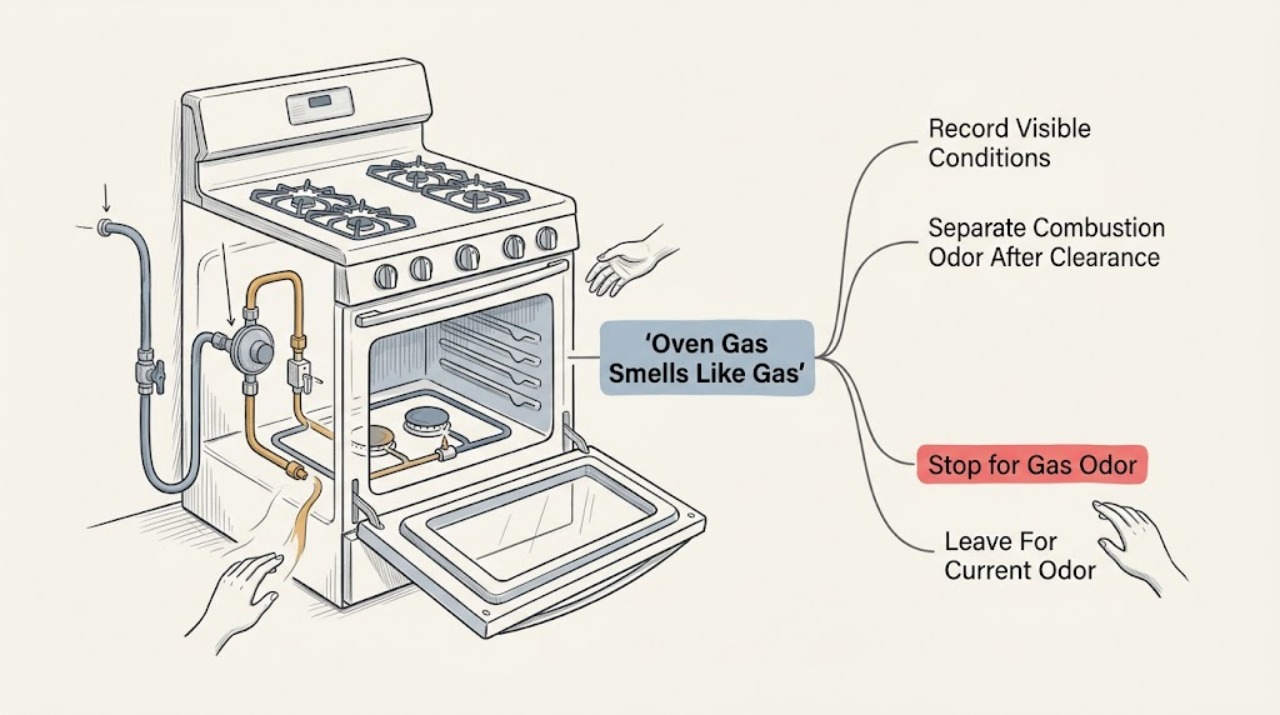
Work through in order
Diagnostic checks
Use only checks that match the exact appliance or system and its official guide.
-
Check 1
If gas odor is present now or the oven failed to ignite and gas is suspected, stop the ignition attempt, leave the home or affected area immediately, and do not operate lights, switches, oven controls, phones, matches, or other electrical equipment while leaving.
Expected result: From a safe location, record whether the odor was present before ignition, after a failed ignition, while the oven was off, or throughout the area; do not return indoors to make the observation more precise.
Next step: From outside or another safe location, contact the local gas supplier or emergency services according to local instructions and do not re-enter until the responsible authority says it is safe.
Stop if: Do not use a phone inside, create a spark, light a flame, operate an electrical switch, or attempt to shut or reopen an appliance gas control while the odor is present.
Why this matters
Why: Any current or unexplained gas odor is a suspected gas-leak emergency, not a normal oven adjustment. The timing can help the utility or emergency responder, but it does not make it safe to remain inside or attempt a test.
-
Check 2
After the gas emergency has been reported and only from a safe location, write down the oven model if already known, the selected mode, whether ignition was attempted, whether the oven was hot or cold, and where the odor was first noticed; do not return to inspect the appliance.
Expected result: Record whether the smell occurred before any flame, after a failed start, while the oven was off, after a recent move or installation, or near another gas appliance; include any reported hissing, alarm, smoke, or illness without approaching the source.
Next step: Give the timeline and model information to the gas supplier, emergency responder, or qualified appliance professional when they request it; keep the oven out of service.
Stop if: Do not move the range, pull it away from the wall, remove a burner or panel, inspect a connector, or search for the leak yourself.
Why this matters
Why: The context helps the utility or technician distinguish an ignition event from a possible connector, supply, or separate gas-device concern, but no context makes user relighting or inspection appropriate.
-
Check 3
Only after the gas supplier or qualified professional has declared the area and appliance safe, describe whether any brief odor occurs only during normal combustion or whether odor returns before ignition or while the oven is off; do not recreate a failed ignition to obtain this comparison.
Expected result: The professional may establish that there is no unburned-gas odor and that any remaining startup smell is a combustion-related condition, or may find that odor persists, ignition is delayed, or the burner fails to light.
Next step: Follow the professional's return-to-use instruction only when the gas source and appliance have been cleared; report any recurrence immediately and stop using the oven again.
Stop if: Do not relight a pilot, cycle the oven repeatedly, adjust a regulator or burner, or treat a disappearing smell as proof that the appliance is repaired.
Why this matters
Why: GE distinguishes combustion odor at startup from unburned gas. A persistent or pre-ignition odor, delayed ignition, or failed ignition remains a service condition even if a later attempt seems to work.
-
Check 4
Have the qualified gas utility or appliance professional inspect the complete gas installation and oven without the homeowner moving the appliance or opening panels; provide the odor timeline and any recent installation or movement history.
Expected result: The professional should determine whether the source is the supply, connector, shutoff, regulator, burner, ignition or pilot system, safety control, combustion path, or another appliance, and should document the safe disposition of the oven.
Next step: Keep the oven disconnected from use until the professional corrects the source and explicitly states the conditions for return to service; use no workaround cooking mode on the suspect appliance.
Stop if: Do not perform gas work, live electrical testing, burner adjustment, pilot relighting, connector replacement, or interlock bypass as a homeowner.
Why this matters
Why: A gas smell before ignition cannot identify one failed part. A connector or gas-control concern can be dangerous even when no odor is present at the time of inspection, and a failed ignition can release unburned gas without proving which component needs replacement.
-
Check 5
If any gas odor returns after a clearance, stop using the oven and leave again rather than repeating an ignition attempt or relying on a prior inspection.
Expected result: Record whether the recurrence happens before ignition, after an unsuccessful start, while the oven is off, or near another gas appliance, from the safe location where it was noticed.
Next step: Report the recurrence from outside to the gas supplier, emergency services, or the responsible qualified professional and wait for a new safety determination.
Stop if: Do not remain indoors to monitor the odor, ventilate by operating switches, or restart the oven to compare cycles.
Why this matters
Why: Recurrence means the condition is not resolved or the source may be elsewhere in the gas system. The earlier clearance does not authorize continued use when the odor returns.
Use your observations
Decision map
Find the observation that best matches what you see, then follow the next safe action.
-
PATH 01Safety boundary
What you see
Gas odor is present now, the oven failed to ignite, or the source is unknown while anyone is near the appliance.
Do this next
Leave immediately without operating switches or equipment and contact the local gas supplier or emergency services from a safe location; do not re-enter until cleared.
Why this path and its safety boundary
Why it matters: Treat this as a suspected gas leak or unburned-gas release. A normal combustion explanation cannot be established while the odor is active.
Safety stop: Do not light, relight, inspect, move, ventilate with electrical equipment, or keep testing the oven.
-
PATH 02Safety boundary
What you see
A qualified professional has cleared the appliance and establishes that any brief odor occurs only with normal combustion after ignition, with no unburned-gas odor before ignition or while off.
Do this next
Use the oven only under the clearance and manufacturer instructions; stop and report it again if odor occurs before ignition, after a failed start, or while the oven is off.
Why this path and its safety boundary
Why it matters: This pattern is different from the assigned pre-ignition gas-odor problem, but it remains model- and installation-specific and should follow the owner's manual and professional guidance.
Safety stop: Do not recreate a failed start or keep using the oven when the odor pattern changes.
-
PATH 03Safety boundary
What you see
The smell returns, appears before ignition, follows a failed ignition, occurs while the oven is off, or the burner lights late or not at all.
Do this next
Stop using the oven, leave if odor is present, and request a new gas-safety and qualified-appliance assessment with the complete timeline.
Why this path and its safety boundary
Why it matters: The appliance remains unsafe or unresolved. Possible causes include gas delivery, ignition, pilot, safety control, connector, or another gas-device condition; the symptom cannot select a repair part.
Safety stop: Do not repeatedly ignite, adjust gas controls, move the range, or bypass a safety system.
-
PATH 04Safety boundary
What you see
The oven is not operating, but gas odor is detected near another appliance, after a recent appliance move, or throughout the home rather than only during a cleared oven start.
Do this next
Leave and report the broader odor pattern from a safe location; let the utility or qualified professional isolate the source before any appliance is used.
Why this path and its safety boundary
Why it matters: The oven may not be the source. A connector, supply, or another gas appliance can create the same emergency symptom, and moving the oven to investigate can worsen a connector failure.
Safety stop: Do not narrow the source by sniffing around, moving appliances, or turning gas appliances on and off.
Helpful context
Understand the symptom
Treat the timing of the odor as a safety signal, not a test invitation
A slight odor associated with combustion after a gas oven starts is not the same as an odor of unburned gas before ignition. The important user decision is whether gas is being smelled before the burner lights, while the oven fails to light, after a failed attempt, or while the oven is off. If the odor is present now, do not stay to identify the exact timing or look behind the range: leave first and report the pattern from a safe location.
Why moving or relighting the appliance is unsafe
A gas odor can come from an unburned-gas release, a failed ignition sequence, a pilot or safety-control condition, a connector, or another part of the gas installation. The user cannot safely identify that cause by watching a burner or pulling the range forward. CPSC specifically warns that moving an appliance to inspect an older connector can cause it to fail and says connector inspection or replacement belongs to a qualified professional.
The appliance stays out of service until cleared
Do not use a power cycle, repeated ignition attempts, ventilation experiment, or a different cooking mode to see whether the smell disappears. If the odor clears after people leave, that does not prove the oven is safe. A utility or qualified appliance professional needs to determine whether the source is the appliance, connector, supply, ignition, or another gas device and confirm the conditions for safe return to service.
Safety boundary
Stop conditions
- If gas odor is present, stop immediately, leave the home or affected area, and contact the local gas supplier or emergency services from a safe location according to local guidance.
- Do not operate lights, switches, oven controls, phones, matches, or other electrical equipment near a suspected gas leak; do not create a spark or flame.
- Do not move the range, inspect or replace the connector, relight a pilot, test a burner, adjust gas controls, open panels, or bypass a safety system.
- Keep the oven out of service until the responsible utility or qualified appliance professional has corrected the source and explicitly cleared the appliance for use; if odor returns, leave and report it again.
When checks do not resolve it
Need a professional?
Treat a current gas odor or a failed ignition with suspected unburned gas as an immediate gas-safety event: leave and contact the local gas supplier or emergency services from a safe location. Arrange qualified appliance service after the area is safe whenever odor occurred before ignition, the burner failed or ignited late, the smell recurs, the oven was moved or installed recently, or the source is uncertain. Provide the model, timing, selected mode, ignition result, odor location, and any recent work without moving the appliance.
Safety scope: This article supports leaving, reporting the odor from a safe location, recording the timeline without re-entry, and providing information to qualified responders. It does not authorize relighting, gas testing, appliance movement, connector work, burner adjustment, panel removal, or safety-control bypass.
Common questions
FAQ
Is it normal for a gas oven to smell like gas before ignition?
No. GE distinguishes a brief combustion odor after a gas oven starts from the odor of unburned gas and says unburned gas odor in the home is not normal. Stop ignition, leave, and report the odor from a safe location.
What should I do if my oven smells like gas but the burner did not light?
Do not try again. Leave immediately without operating switches or electrical equipment, then contact the local gas supplier or emergency services from outside or another safe location. Do not re-enter until cleared.
Can I open a window or move the oven to find the gas leak?
Do not stay to ventilate, operate switches, or move the range to inspect it. CPSC warns that moving an appliance can cause an older weakened connector to fail; leave and let the utility or qualified professional isolate the source.
Can I relight the pilot or adjust the burner after smelling gas?
No. Relighting, repeated ignition, burner adjustment, and gas-control work can create ignition or leak hazards. Keep the oven out of service and let the qualified utility or appliance professional determine the cause and safe return conditions.
When can I use the oven again after a gas odor?
Only after the responsible gas utility or qualified appliance professional has corrected or ruled out the source and explicitly cleared the appliance. If any gas odor returns, leave again and report it rather than testing another cycle.
Read the exact guide
Official sources
- Gas Range - Gas OdorsGE Appliances · GE manufacturer guidance for gas ranges; the installed appliance manual and local gas-safety instructions control.
- Certain Older Gas Connectors May Be DangerousU.S. Consumer Product Safety Commission · CPSC consumer safety guidance for gas appliances; local emergency and utility instructions control during an active odor event.
- Gas Range - Oven Safety Concerns When a Standing Pilot Light Goes OutGE Appliances · GE guidance for freestanding gas ranges with standing oven pilots; other ignition designs and models differ.
Community feedback
Share a repair observation
Share a plain-text repair observation. Accepted observations are published automatically; this page may take a moment to update.