
On this page
Start here
Quick answer
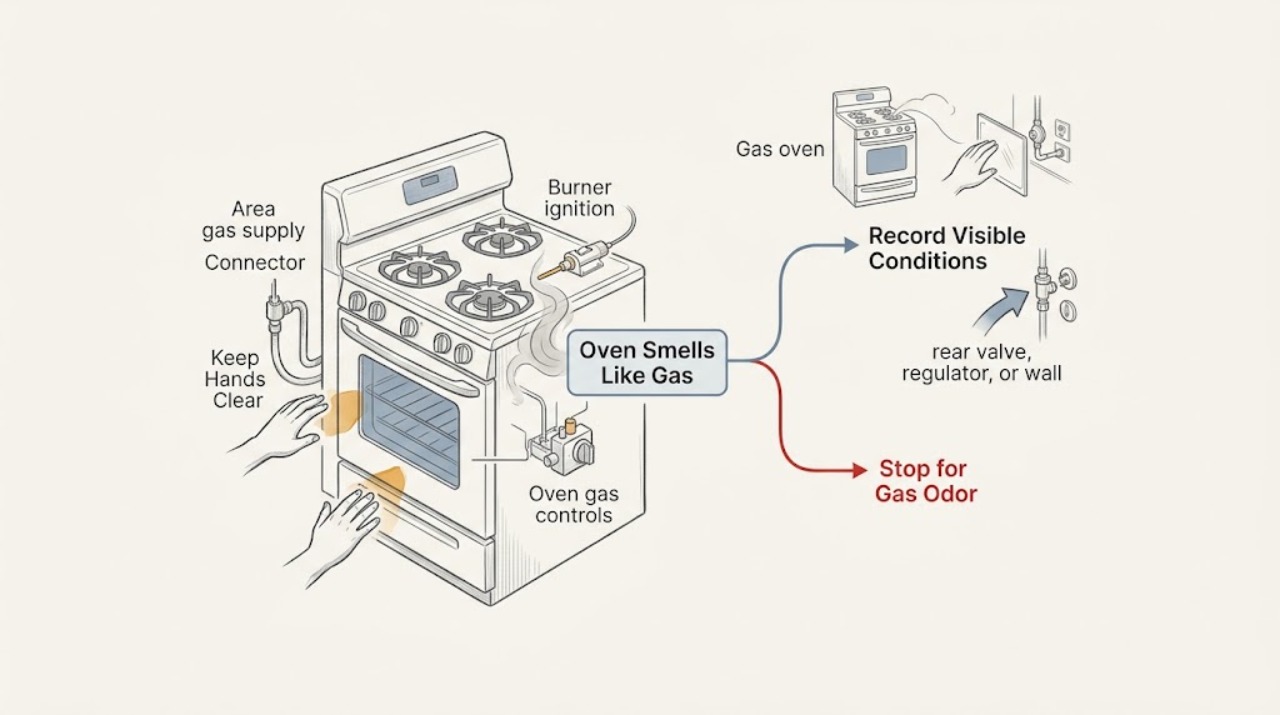
If a gas smell remains after the oven and burners are turned off, treat it as a possible gas leak, not as an oven-cleaning problem. Leave the building immediately, do not light anything, touch electrical switches, operate appliances, or use a device inside, and contact the gas supplier or emergency services from a safe location. Do not move the range, inspect its connector, relight a burner, test for bubbles, or try to repair a valve or igniter. A brief odor during ignition can occur on some gas ovens, but an odor that persists after shutoff is outside that normal-use pattern. Re-enter, restore gas, or use the oven only after the gas utility or a qualified professional has declared it safe and completed the needed checks.
Work through in order
Diagnostic checks
Use only checks that match the exact appliance or system and its official guide.
-
Check 1
If you smell gas now or the odor persists after the oven and burners are off, leave the building immediately using the nearest safe exit. Do not light a match, touch a switch, start a fan, operate an appliance, or use a device while inside.
Expected result: The odor is present, there is hissing, anyone feels unwell, or the source cannot be ruled out before leaving.
Next step: From a safe location away from the building, contact the gas supplier or emergency services and follow their instructions. Do not return to check the oven or retrieve items until responders say it is safe.
Why this matters
Why: These are possible fuel-leak conditions. The absence of visible flame or a strong sound does not make it safe to remain inside, and an odor that persists after shutoff is not a normal cooking-use signal to investigate indoors.
-
Check 2
Once outside and safe, record what was happening when the odor began without returning inside: oven on or off, burner use, recent installation or movement, outage or service, hissing, and whether the smell continued after the controls were shut off.
Expected result: The odor began during ignition and faded quickly; it began while all controls were off and persisted; or the timing is unknown.
Next step: Give the timing and any symptoms to the gas utility or responding professional from the safe location. Do not return inside to repeat the ignition or perform a visual comparison.
Why this matters
Why: Some manufacturer guidance describes a brief odor during gas ignition as a possible operating pattern, but a smell with the oven off or one that persists after shutoff keeps a leak in the appliance, connector, or gas line in the leading branch. Unknown timing does not lower the safety response.
-
Check 3
Do not move the oven or range to inspect the flexible connector, rear valve, regulator, or wall connection. Tell the responder whether the appliance has recently been installed, disconnected, cleaned behind, or moved, and whether the smell seems concentrated near the appliance only after the area has been declared safe.
Expected result: The range was recently moved or installed; the connector is old, corroded, kinked, or unknown; or no movement or connector history is available.
Next step: Keep the appliance out of service and have a qualified professional inspect or replace the connector and verify the gas connection. Do not pull the range forward, apply leak solution, tighten fittings, or restore gas yourself.
Why this matters
Why: A connector or gas connection can be damaged or leak even when the oven controls are off. Movement can worsen a weakened connector, so the history is useful to a professional while self-inspection is unsafe.
-
Check 4
After the gas utility or emergency responders have cleared the building for re-entry, keep the oven off and provide the technician with the model, fuel type if known, odor timing, control positions, recent service or movement, and any visible damage reported from a safe position. Do not relight or test the appliance before the professional check.
Expected result: The utility isolated the supply, the appliance was cleared but the smell returns, a professional found an appliance fault, or the cause remains unresolved.
Next step: If the odor returns, leave again and contact the gas supplier or emergency services from outside. If the cause is unresolved, leave the appliance off and schedule qualified gas-appliance service; do not rely on a temporary disappearance of odor.
Why this matters
Why: Isolation confirms that fuel control is needed; a returning odor after clearance requires renewed emergency contact. An igniter, burner valve, regulator, connector, or control fault cannot be identified safely from smell alone.
-
Check 5
After qualified service, verify only that the professional has documented the repair or clearance and that all appliance controls are off before the next authorized use. Do not conduct a personal flame, connector, or leak test in place of the required professional check.
Expected result: The technician identifies and corrects a leak; no leak is found but the odor persists; or the appliance is not cleared for use.
Next step: Keep the oven off and contact the gas supplier or qualified service provider again for persistent odor or an incomplete clearance. Do not use the oven until the responsible professional confirms safe operation.
Why this matters
Why: A completed repair with documented safe return is different from a smell that merely fades. Persistent odor or an uncleared appliance means the fuel or appliance issue remains unresolved.
-
Check 6
If no current odor is present after an authorized clearance, review the exact model manual for ordinary ignition behavior and maintenance limits before using the oven. Do not assume a previous persistent odor was food residue, paint, or a new-appliance smell without the gas professional's assessment.
Expected result: The manual describes a brief ignition odor that fades; the odor returns while the oven is off; or the manual does not cover the observed condition.
Next step: Stop use and contact the gas supplier or qualified appliance service for any recurring or unexplained odor. Do not use cleaning, ventilation, or repeated burner tests to decide that gas is not involved.
Why this matters
Why: A brief documented ignition odor is a different branch from an odor that remains after shutoff. Recurrence while off or an uncovered condition requires service and keeps a fuel leak or faulty gas component possible.
Use your observations
Decision map
Find the observation that best matches what you see, then follow the next safe action.
-
PATH 01Next step
What you see
Gas odor is present now, remains after shutoff, is accompanied by hissing, or the source cannot be ruled out.
Do this next
Leave immediately, avoid ignition sources and electrical controls, and contact the gas supplier or emergency services from outside. Do not return to inspect or test the oven.
-
PATH 02Next step
What you see
The smell occurred only for a brief period during ignition and fully disappeared with all controls off, with no recurrence or other warning sign.
Do this next
Do not generalize this result to the assigned persistent-odor condition. Use the exact model manual for normal ignition guidance, and arrange service if the smell becomes strong, lasts beyond ignition, recurs while off, or is accompanied by sound or symptoms.
-
PATH 03Next step
What you see
The appliance was recently moved, installed, disconnected, or cleaned behind, or the connector history is unknown.
Do this next
Do not move it again or inspect the connector. Keep the appliance out of service and have the gas utility or qualified professional inspect the connector, valve, regulator, and installation.
-
PATH 04Next step
What you see
The gas supply was isolated, but the odor returns after re-entry or after a professional says the appliance is not yet cleared.
Do this next
Leave again and contact the gas supplier or emergency services from a safe location. Keep the oven off; a fading smell is not a safe substitute for locating and correcting the leak.
-
PATH 05Next step
What you see
A person has headache, dizziness, nausea, breathing difficulty, or other symptoms while a gas odor or combustion concern is present.
Do this next
Leave immediately for fresh air and request emergency assistance from outside. Do not re-enter to troubleshoot or wait for symptoms to pass inside the building.
Helpful context
Understand the symptom
Do not spend time narrowing the smell by opening the oven, checking the connector, or trying another ignition. Odorant can warn of escaping fuel before a flame or visible damage is present, and the safe response is the same whether the source is the range, a connection, or nearby gas piping.
A short, faint odor while a gas burner is igniting can have a different explanation from a smell that remains when the appliance is off. The condition in this article is the latter: persistence after shutoff means the appliance stays out of service until the fuel system and appliance are checked.
The connector behind a range is not an occupant inspection point. Moving a range, even slightly, can damage an older or weakened connector. Let the gas utility, fire service, or qualified gas-appliance professional control isolation, testing, repair, and safe return to use.
Safety boundary
Stop conditions
- Leave immediately for any current or persistent gas odor, hissing, suspected leak, or illness; do not operate switches, appliances, flames, or devices inside.
- Do not move the range, pull it forward, inspect or replace its connector, test fittings with a flame or liquid, relight burners, or repair a valve or igniter yourself.
- Do not re-enter, restore gas, or use the oven because the odor faded. Wait for the gas utility, emergency responders, or qualified professional to declare the area and appliance safe.
- Keep the oven off and obtain renewed emergency or qualified service for an odor that returns, a leak that was not located, a damaged installation, or any appliance that is not cleared for use.
Only after diagnosis
Potential parts
- gas appliance flexible connector
Consider only when a qualified professional confirms connector damage, corrosion, age, or an installation-related leak after the gas supply is safely isolated.
Connector type, length, fittings, coating, fuel, and local installation requirements must be selected and installed by a qualified professional; do not move the range to inspect it. - oven igniter
Consider only when professional testing finds delayed or failed ignition as the cause of an odor during operation, after an active leak has been ruled out.
Igniter type, electrical characteristics, mounting, and gas-valve pairing are model-specific and require professional confirmation. - oven gas valve or regulator
Consider only when a qualified technician isolates the valve or regulator as the source of fuel flow or pressure trouble.
Fuel type, pressure specification, connection, and safety-control compatibility must be verified by a qualified gas-appliance professional. - burner control or ignition component
Consider only when professional diagnosis identifies a burner control, ignition module, or related component after the fuel system is made safe.
Component fit and safe installation depend on the exact model and gas-control design; a smell does not identify this part.
When checks do not resolve it
Need a professional?
For a current or persistent gas odor, leave immediately and contact the gas supplier or emergency services from outside. After the immediate response, use qualified gas-appliance service for connector, valve, regulator, igniter, burner, control, or installation diagnosis; do not attempt those repairs yourself.
Common questions
FAQ
What should I do if my oven still smells like gas after I turn it off?
Leave the building immediately. Do not operate electrical switches, flames, appliances, or devices inside. From a safe location, contact the gas supplier or emergency services and follow their instructions; do not return to inspect the oven.
Is a brief gas smell when an oven starts always dangerous?
Some manufacturer guidance says a brief, faint odor during ignition can occur, but it should not be used to explain an odor that continues after shutoff. A strong, persistent, recurring, or unexplained odor requires the emergency response and professional assessment.
Can I check the gas connector behind the range?
No. Do not move the range to inspect its connector. The CPSC warns that moving an appliance can cause a weakened connector to fail; a qualified professional should inspect or replace it.
Should I open windows or turn on the exhaust fan when I smell gas?
Do not operate switches, fans, or appliances inside while a leak is suspected. Leave immediately and contact the gas supplier or emergency services from outside; follow their re-entry and ventilation instructions.
What if the smell disappears before help arrives?
Do not assume the oven is safe. Keep away until the gas utility or qualified professional gives instructions, and provide the timing, control positions, recent installation or movement, and any hissing or symptoms. A temporary disappearance does not locate or repair a leak.
Read the exact guide
Official sources
- Odors or SmellsWhirlpool Product Help · Supports the distinction between an odor during use and an odor when controls are off, with emergency escalation for an unexplained smell.
- How to Install a Gas or Electric StoveWhirlpool · Supports the post-isolation service branch and the requirement to use model instructions and professional help for gas connections; it is not a DIY instruction for an active odor.
- gasU.S. Consumer Product Safety Commission · Directly supports the emergency response to a persistent gas odor and the prohibition on moving a range to inspect its connector.
- Why does my oven smell like gas?Whirlpool · Supports distinguishing a brief ignition odor from an odor that persists while the oven is off and the boundary against self-repair.
Community feedback
Share a repair observation
Share a plain-text repair observation. Accepted observations are published automatically; this page may take a moment to update.