
On this page
Start here
Quick answer
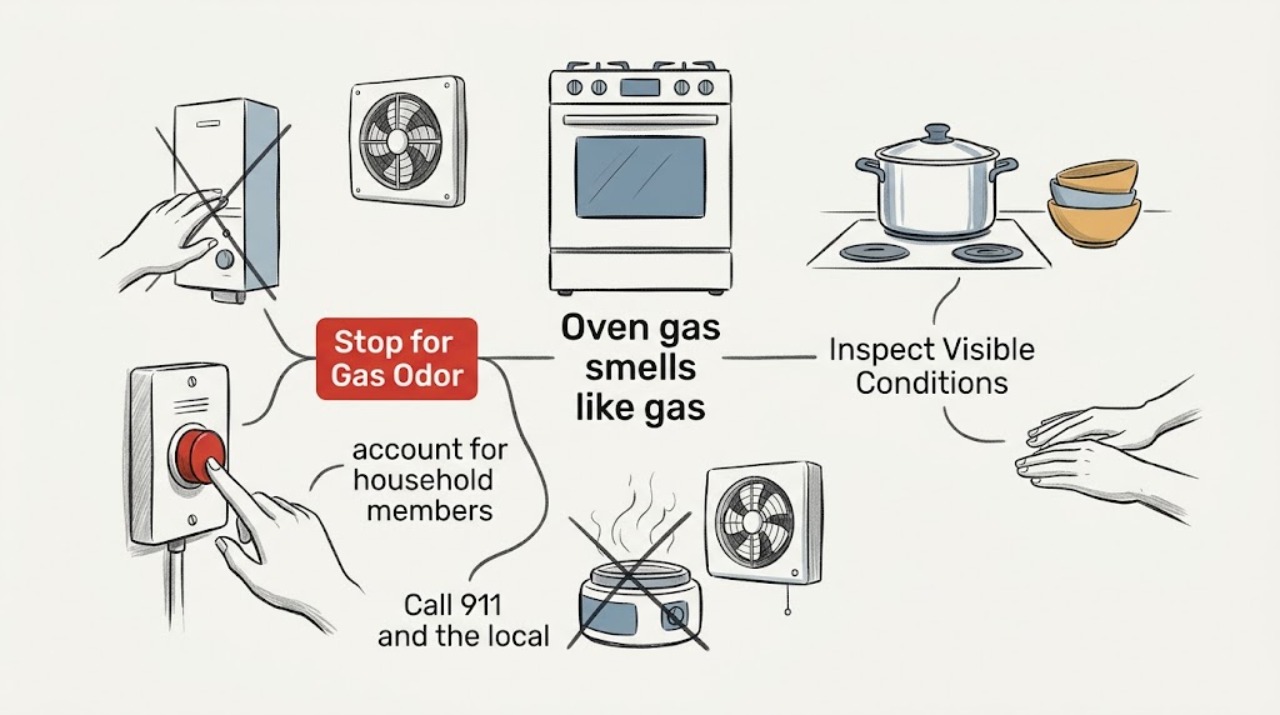
Treat any unexpected gas odor from an oven or range as a possible gas leak. Do not keep using the oven, relight a burner, open the appliance, search for the source, operate switches, use a phone inside, or attempt a gas-part repair. Leave the home or building on foot, keeping others away, and call 911 and the local gas utility or emergency gas authority from a safe location outside. If the local official emergency procedure specifically directs you to close an immediately accessible gas shutoff and it can be done without entering the odor area or creating another hazard, follow that procedure; do not approach the oven or operate an unfamiliar valve. Do not re-enter or use the appliance until emergency personnel and a qualified gas-appliance professional say it is safe.
Work through in order
Diagnostic checks
Use only checks that match the exact appliance or system and its official guide.
-
Check 1
At the first unexpected gas odor, stop the oven and all cooking activity without touching appliance controls, switches, plugs, valves, or other electrical equipment; observe only what is already apparent while moving toward an exit.
Expected result: Notice whether there is a rotten-egg or unusual gas odor, hissing, a gas alarm, visible flame, smoke, or symptoms such as dizziness or nausea, but do not stay to locate the source or test whether the odor changes.
Next step: Leave immediately on foot, direct occupants and pets away from the area if it can be done without delay, and continue to a safe location outside or well away from the odor.
Stop if: Do not investigate the oven, relight a burner, use a match or flashlight, open windows, operate a light or fan, use a phone inside, or return for belongings.
Why this matters
Why: Any unexpected odor or hissing is enough to treat the situation as a possible gas release. The combination of odor, sound, alarm, flame, or symptoms increases urgency but does not change the required evacuation response.
-
Check 2
From a safe location outside or well away from the odor, account for household members and pets without re-entering the building.
Expected result: Report whether everyone is out, whether anyone has breathing difficulty, dizziness, headache, nausea, or other symptoms, and whether anyone may still be inside or unable to leave.
Next step: Tell 911 the location and occupant or health situation from the safe area; request medical help for symptoms and follow the emergency operator's instructions.
Stop if: Do not re-enter for a person, pet, phone, keys, or appliance information; tell emergency responders who may remain inside.
Why this matters
Why: Missing occupants, symptoms, or a person unable to evacuate turns the event into an emergency response matter. Do not send someone back inside to check or rescue an appliance.
-
Check 3
Call 911 and the local gas utility or emergency gas authority from a safe location using a device that is away from the odor area.
Expected result: Provide the property location, that an oven or range gas odor was detected, whether anyone is symptomatic, whether the odor or hissing continues as far as can be known without returning, and whether there is visible fire or smoke.
Next step: Stay at the safe location, keep people away, and wait for the gas utility, fire department, or emergency responders to give re-entry instructions.
Stop if: Do not call from inside, use a vehicle or electrical device near the odor, operate a gas meter or valve unless emergency personnel explicitly direct a safe action, or cancel the response because the odor fades.
Why this matters
Why: Emergency responders and the gas utility can isolate and test the gas system with appropriate equipment. A consumer cannot make the appliance safe by changing a setting or replacing a part.
-
Check 4
After emergency personnel or the gas utility has declared the area safe, document the event for the qualified gas-appliance technician without operating the oven or opening any gas component.
Expected result: Record when the odor was noticed, whether the oven was on or off, whether it occurred during ignition or after a burner went out, any alarm or hissing report, and any emergency findings or instructions.
Next step: Give the notes and appliance identity to a licensed or otherwise qualified gas-appliance professional and keep the oven out of service until that professional authorizes use.
Stop if: Stop documentation if it requires turning the oven on, relighting a burner, removing a panel, testing gas pressure, or approaching an area that has not been cleared.
Why this matters
Why: Timing and official findings can help the technician distinguish an appliance-service request from a building gas-line or ventilation issue, but they do not establish a failed igniter, valve, or gasket.
-
Check 5
Before any later appliance appointment, confirm from the outside or through official instructions that the gas utility or emergency responders have cleared re-entry and that the appliance remains unused.
Expected result: Note whether an official tag, instruction, isolation notice, damaged connector, fire damage, or unresolved odor remains, without touching or removing it.
Next step: Follow the utility or emergency authority's instructions and schedule qualified service; do not order a part or attempt a test ignition based only on the original symptom.
Stop if: If any gas odor returns, leave again immediately and restart the gas-emergency response rather than troubleshooting.
Why this matters
Why: An unresolved notice, damage, or returning odor means the gas system or appliance is not ready for consumer operation and may require utility, fire, or specialized gas service before an appliance technician can proceed.
Use your observations
Decision map
Find the observation that best matches what you see, then follow the next safe action.
-
PATH 01Safety boundary
What you see
Gas odor, hissing, a gas alarm, or suspected gas release is present now.
Do this next
Leave immediately on foot, keep others away, and call 911 and the local gas utility or emergency gas authority from a safe location.
Why this path and its safety boundary
Safety stop: Do not use switches, phones, appliances, flames, vehicles, or tools near the odor, and do not search for the source.
-
PATH 02Safety boundary
What you see
There is visible fire, smoke, an explosion, or a person has symptoms or cannot evacuate.
Do this next
Move to safety and tell 911 exactly what is happening; follow emergency responders' instructions.
Why this path and its safety boundary
Safety stop: Do not re-enter, attempt to extinguish a gas fire, rescue an appliance, or operate a gas or electrical control.
-
PATH 03Safety boundary
What you see
The odor has faded after the oven was turned off, but no gas utility or emergency professional has cleared the location.
Do this next
Treat the event as unresolved, remain out or keep the area isolated as directed, and request official gas-safety assessment.
Why this path and its safety boundary
Safety stop: Do not relight the oven, run a burner to reproduce the symptom, ventilate by operating fans, or assume the appliance is safe.
-
PATH 04Safety boundary
What you see
The gas utility or emergency responders have cleared re-entry and a qualified technician is evaluating the oven.
Do this next
Provide the timing, odor context, appliance identity, and official findings; let the technician determine whether the appliance or building gas system needs repair.
Why this path and its safety boundary
Safety stop: Do not open panels, test pressure, replace an igniter or valve, adjust a burner, or continue using the oven without professional clearance.
Helpful context
Understand the symptom
Why this is an emergency, not an oven diagnosis
A brief odor associated with a normal ignition event can be different from an odor that persists, appears when the oven is off, or is accompanied by hissing. A person at home cannot safely distinguish a burner issue, connector or valve leak, ventilation problem, or another gas release by taking the oven apart. PHMSA says an unusual gaseous odor or hissing can accompany a suspected leak and directs people to leave immediately rather than locate the source.
Use the official gas-emergency path
CPSC advises that anyone who smells or hears gas leaking should leave immediately and contact local gas authorities from outside, without operating electronics before leaving. The immediate objective is to remove people from the possible ignition and exposure hazard. Appliance diagnosis and any replacement decision come only after the gas utility or emergency responders have made the location safe.
Only after diagnosis
Potential parts
- oven igniter
Consider this category only if a qualified gas-appliance technician confirms an igniter fault after the gas emergency has been cleared; a gas odor alone does not identify the igniter.
Match the exact oven model and approved gas-appliance part, and have the qualified technician handle diagnosis and installation. - oven gas valve
Consider this only when a qualified technician identifies the gas valve as the failed component after testing under safe professional conditions.
Confirm model, fuel type, certification, and manufacturer fit; do not handle, adjust, or replace a gas valve yourself. - oven door gasket
Consider this only for a separately diagnosed door-seal problem after the gas system and burner operation are confirmed safe; a door gasket is not a gas-leak repair.
Match the exact oven model and approved temperature-rated seal, and do not use it to mask a gas odor or continued-use restriction.
When checks do not resolve it
Need a professional?
Treat any oven gas odor as an emergency: leave, call 911 and the local gas utility or emergency gas authority from outside, and wait for clearance. After the location is declared safe, arrange a qualified gas-appliance technician before any oven use or part decision.
Have this ready
- From a safe location, provide the property location, symptom timing, whether the oven was on or off, odor or hissing observations, alarm or health information, appliance brand/model if already known, and the gas utility or emergency responders' findings.
Common questions
FAQ
Can a gas oven smell briefly during ignition?
Do not try to decide that while the odor is present. Treat any unexpected or persistent gas odor, hissing, or alarm as a possible leak: leave and contact the local gas authority from outside. A qualified professional can assess normal operation only after the area is safe.
Should I turn off the oven or gas valve before leaving?
Do not approach the oven or an unfamiliar valve to troubleshoot. Follow the local gas utility or emergency authority's official procedure; only perform an immediately accessible shutoff if they direct it and it can be done without entering the odor area or creating another hazard.
Can I open windows or use a fan to clear the smell?
No. Do not operate fans, switches, phones, or other devices near the odor. Leave immediately and let emergency professionals determine when the area can be ventilated and re-entered.
Can I replace the igniter or gas valve after the smell stops?
No. A faded odor does not establish that the location is safe or identify a failed part. Wait for gas-utility or emergency clearance, then have a qualified gas-appliance technician diagnose and repair the oven.
Read the exact guide
Official sources
- Pipeline Leak Recognition and What to DoU.S. Department of Transportation Pipeline and Hazardous Materials Safety Administration · Supporting the instruction not to locate a suspected gas leak and to call from a safe location
- CPSC Urges Flood Victims to Take Steps to Prevent CO Poisoning, Electrocution, Explosion and FiresU.S. Consumer Product Safety Commission · Immediate response to gas odor or suspected gas leak from an oven or range
Community feedback
Share a repair observation
Share a plain-text repair observation. Accepted observations are published automatically; this page may take a moment to update.